
Mondex’s Long Game: A Finnish Heater Maker’s Patient Bet on the US

By Arlene Scott
Senior Wellness Correspondent & Hospitality Consultant
- Published
- Reading time
- 9 min
SaunaNews is published by SaunaShare, Inc., which also runs SaunaShare.com and SaunaMarketplace.com, where we sell many of the products we write about. Assume that experience shapes what we cover and what we don't. Who owns SaunaNews · The ownership announcement
A heritage Finnish heater brand, an unusual industrial parent, and a patient push toward America, just as US certification rules have started to favor European designs.
In this story4 sections
Ask Teppo Petäjistö what pulled him into sauna heaters and he does not reach first for heritage or löyly. He talks about engineering. A sauna heater may look simple, but when you go deeper into the device’s construction, thermal distribution, air dynamics, durability and reliability, and safety aspects, you see how complex the product is,
he says. Treating the humble kiuas as a hard engineering problem is the throughline of Mondex Oy today, and a useful lens on a company at an interesting moment.
Petäjistö became Mondex’s chief executive in July 2025. He was born in 1992 in Kokkola, the same year and the same city the company was founded, a coincidence he says has been mentioned a few times.
He joined in 2017 as a product-development engineer and worked up through production and commercial roles. He now runs a brand that has made Finnish heaters for more than three decades and is, for the first time, seriously preparing to sell them in the United States.
That preparation is deliberate and unhurried, and it is shaped almost entirely by one decision the company made long ago and has never walked back: it builds everything at home, in Ylivieska, in northern Finland.
The company inside the company
Mondex is not an independent in the way HUUM is, and it is not a public company answerable to a share price the way Harvia and Tulikivi are. It is a subsidiary of Darekon, a contract manufacturer whose broader work spans electronics and assemblies for medical devices, clean technology, and aerospace and defense. Heritage löyly, in other words, sits inside an industrial group whose other customers want circuit boards.
Petäjistö describes the arrangement as a deliberate balance.
We benefit from its industrial backbone and significant production capacity and capabilities, and at the same time are able to operate with a high level of autonomy when it comes to strategy, product roadmap, and market focus.
It is an unusual structure and a useful one. It explains how a company that Petäjistö says currently builds about 5,000 heaters a year can credibly talk about scaling for export. The capacity is not a second Mondex factory waiting in reserve; it is Darekon’s subcontracting network and Mondex’s own warehousing in Ylivieska, which the company says lets it ramp volume quickly when it needs to. Where an independent of Mondex’s size would have to raise money or find a partner to grow, Mondex has a parent built to manufacture.
The structure bought the company something subtler, too: time. When Petäjistö describes the US plan, the phrase that recurs is done properly.
Mondex is in discussions with potential distributors, he says, but these processes take time when done properly.
Patience is easy to promise and hard to afford, and patient capital is exactly what industrial ownership can provide: no founder running short on runway, no quarter to hit.
Seen that way, the return to the Mondex Oy name last July, after a stretch operating under the parent name Premec Oy, reads less like a rebrand than like housekeeping. It was primarily a structural change,
Petäjistö says, one in which Mondex was separated and strengthened as its own dedicated sauna heater business within the group.
The business ID never changed and customers saw nothing. What changed was clarity: a cleaner line drawn around the heater business inside a bigger industrial machine.
Starting with Rakka
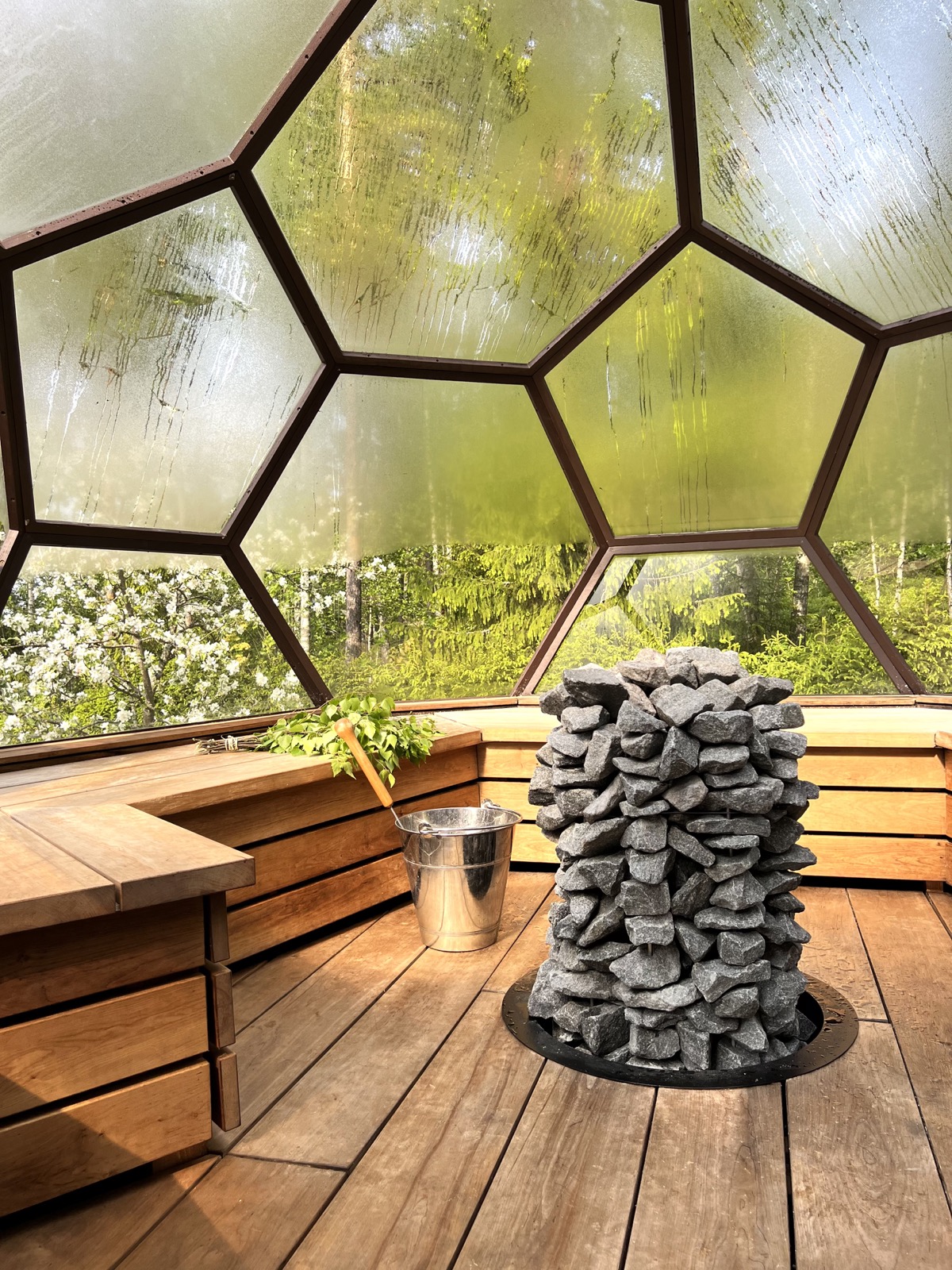
Whatever Mondex eventually ships to America, the company would like the conversation to begin with Rakka. It is the heater Petäjistö calls the brand’s most innovative and visually distinctive, and the inspiration is old. The inspiration comes from traditional smoke sauna heaters, which were already in use thousands of years ago,
he says. Rakka is a floor-standing, netless, all-stone heater: a large mass of stone you can throw water across anywhere, producing the long, soft, enveloping steam of a wood-fired smoke sauna in an electric unit. It is the clearest expression of the company’s pitch, an old idea in modern execution, and it has a following among sauna professionals abroad.
Around it sit the workhorses. Teno 2.0, the wall-mounted heater Petäjistö says reflects Mondex’s core engineering philosophy: reliability, ease of installation, and consistent performance,
is the volume seller, part of the same line whose 2026 refresh SaunaNews previewed this spring. Kalla 2.0 is the newer, modular design aimed at smaller rooms, and the claim for it is specific and characteristically practical: it provides a moisturizing steam that is as good as from a pillar sauna heater, but has a smaller safety distance clearance.
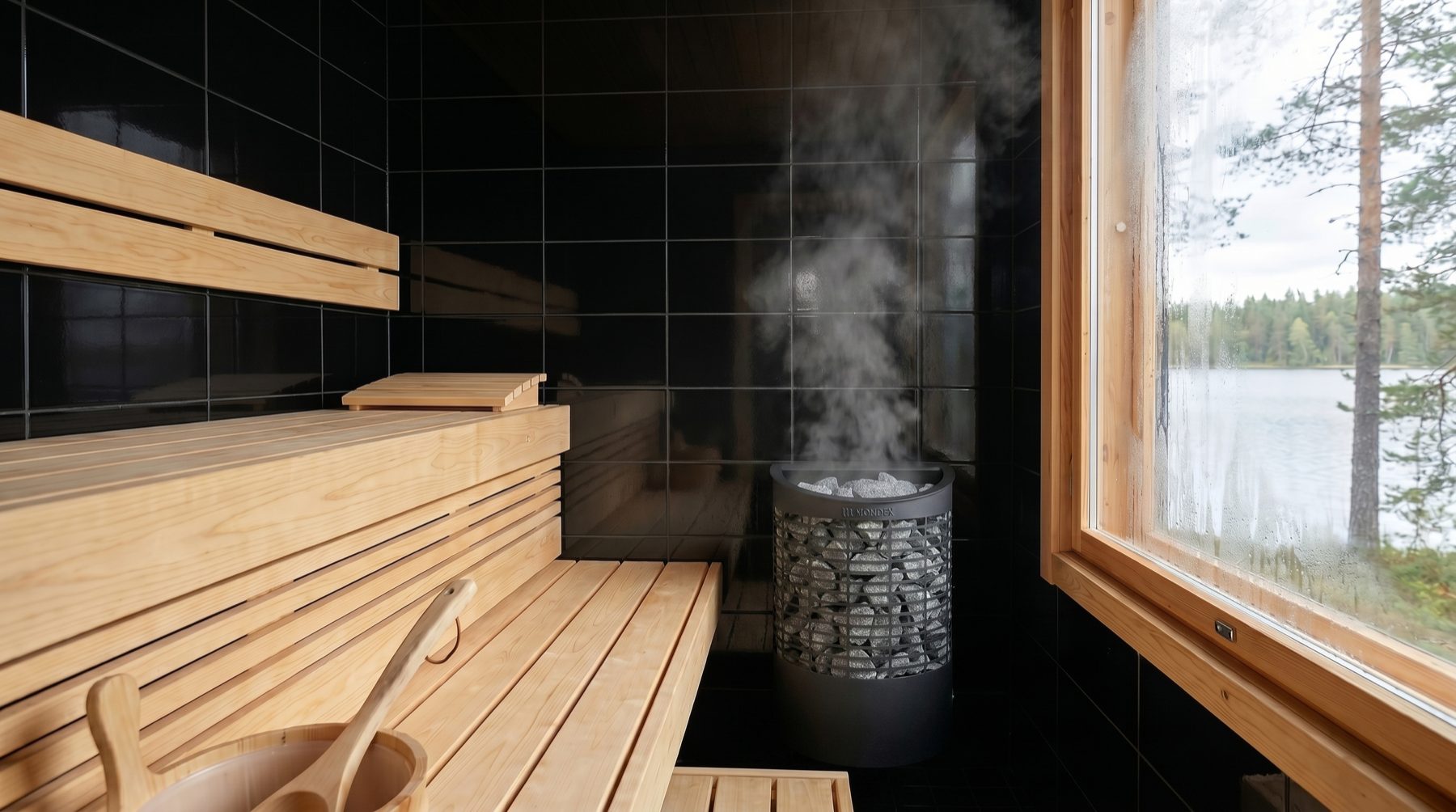
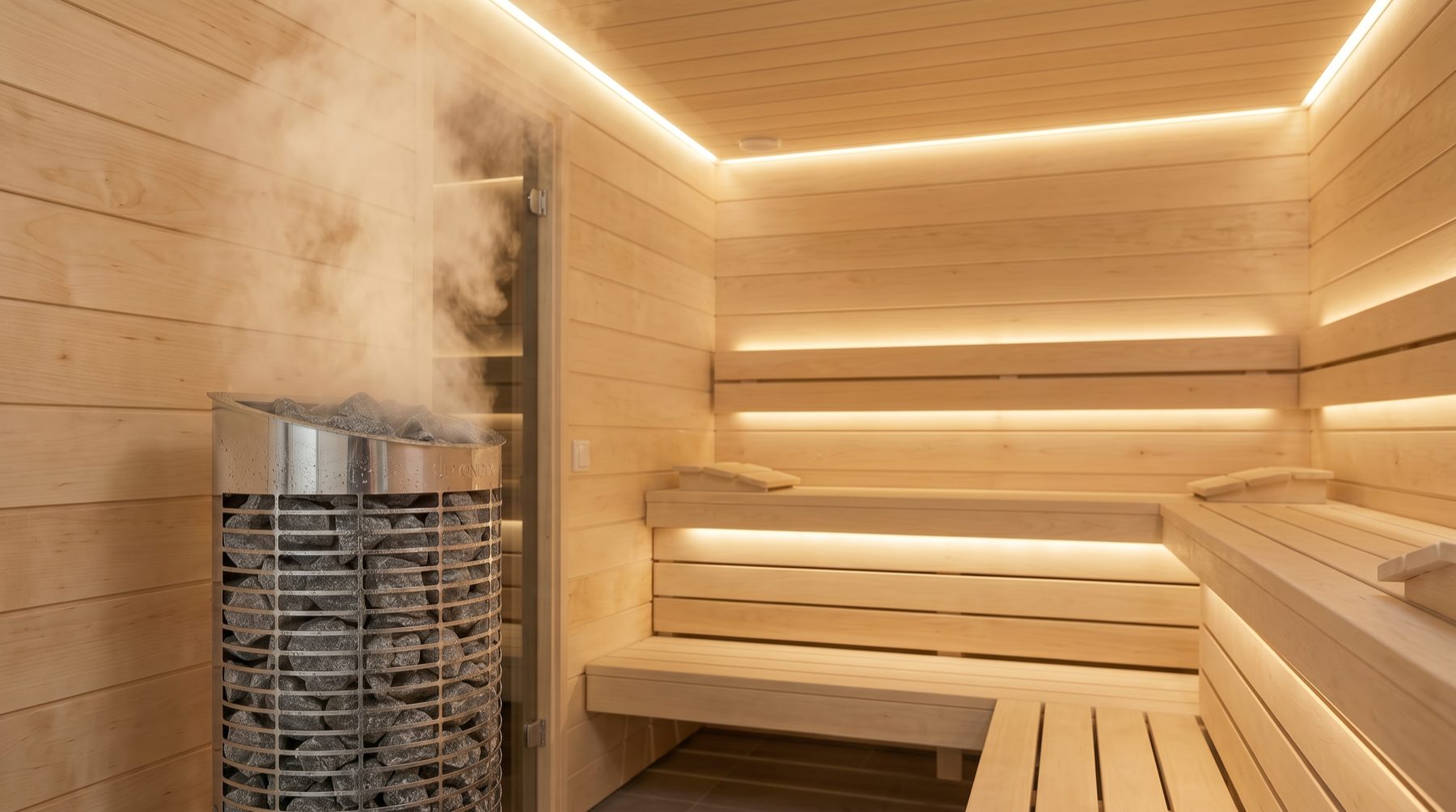
For the US specifically, Mondex is starting narrow. The plan, Petäjistö says, is to certify first the models that match American demand, beginning with pillar-style heaters, the large-stone-mass format premium US buyers increasingly want. It is a sensible beachhead, if not an empty one. Pillar heaters are precisely where HUUM and Harvia have already planted their most design-forward products.
The market it’s walking into
The timing, on one reading, is fortunate. In June 2025 UL adopted a new sauna-heater standard, ANSI/UL 60335-2-53, aligning the American rulebook with the international IEC standard that European heaters are already built to, a change some in the trade have called the most consequential in North American sauna history. The older UL 875 standard, with its lower temperature ceiling and stricter sensor and shut-off rules, is still being phased out model by model. But the door for European designs is wider than it has been in years.
Mondex intends to walk through it the conventional way. UL is the most recognized standard in the US, so it is a natural direction for us as we move forward,
Petäjistö says. That is the same credibility path Harvia and HUUM already travel, though through different testing and certification routes. It is also, today, an intention rather than a listing. Mondex has no US certification and no announced distributor yet, and it is behind the European brands already active in the US. Harvia, HUUM, Saunum and Tylö are all either established in the US or visibly working on it. Saunum’s heater lineup now includes the Air Perfect, launched in the US earlier this year.
What makes the moment genuinely interesting is the backdrop at home, where Mondex’s all-Finnish model cuts both ways.
Authenticity is the brand and the bill
Finland has been grinding through a weak economic stretch, with high unemployment and only a fragile recovery path. For a company whose home market is small, mature, and under pressure, the logic of looking outward is not complicated. America is not easy, but it is one of the few markets where premium sauna demand is still expanding fast enough to justify a patient export push.
Currency can help at the margin. A softer euro against the dollar makes US revenue more attractive for a Finnish cost base; a stronger euro does the reverse. But exchange rates are a tailwind only when they hold, not a strategy. The harder structural issue is everything that comes with building all of your product in a high-wage country and shipping every unit across an ocean.
Harvia, the compatriot Mondex is implicitly measured against, has spent years engineering exactly that exposure away: it builds heaters in West Virginia, Romania, China, and Finland, and North America is now its single largest region. Harvia builds more than 150,000 heaters a year at its main Finnish plant alone; Mondex builds about 5,000. This is not a contest between equals, and Mondex is not pretending otherwise. It is a specialist, not a scale player.
Which is the paradox at the center of Mondex’s story, and it is not really a flaw. It is a choice. The thing that makes a Mondex heater authentically Finnish, built in one northern town, carrying the Avainlippu mark, is also the thing that most exposes it to currency, labor costs, and tariffs. Authenticity is the brand and the bill at once.
Petäjistö frames the all-Finnish model as a discipline rather than a constraint. We are not trying to compete purely on price or chase the latest trends at the expense of usability and functionality,
he says. Instead, our position is based on reliable and steady performance, practical innovations and long lifecycle.
The bet is that a particular kind of buyer, the operator or designer who wants the real Finnish thing and will pay for it, is worth more than the volume the company gives up by refusing to chase the bottom of the market.
Whether the all-Finnish bet eventually needs a hedge is the question the company has not had to answer yet. Darekon’s manufacturing footprint reaches beyond Finland, into Poland and Sweden, and a parent like that gives a brand options for where things get built. For now, Mondex’s answer is to stay home and grow from there.
There is a quiet irony in the timing. One of the livelier corners of Finnish manufacturing is defense, and Darekon, Mondex’s parent, sits squarely in defense electronics. The industrial group rides a resilient strategic sector while its sauna arm looks abroad for the growth the home market cannot provide.
What Mondex is attempting is harder than a press release makes it sound and more interesting than its size suggests: to take a specialist’s product, an unusual owner’s patience, and a stubbornly Finnish supply chain, and turn them into an international brand, starting with the toughest and best-defended market in the business. Petäjistö’s goal for the next three years is modest in wording and large in ambition: building Mondex’s brand presence outside Finland in a sustainable way.
He has, at least, chosen the right word. Sustainable is the only way a company built the way Mondex is built could possibly do it.