Harvia North America +38.6%; Cabins Surge as Steam Slips
Harvia's North American surge came with a warning label: cabins grew 44%, steam fell 13.8%, and a three-week factory shutdown pushed about EUR 4 million of high-margin heater deliveries into the back half. The investor call made clear which parts are timing, which are mix, and where Harvia wants to buy next.

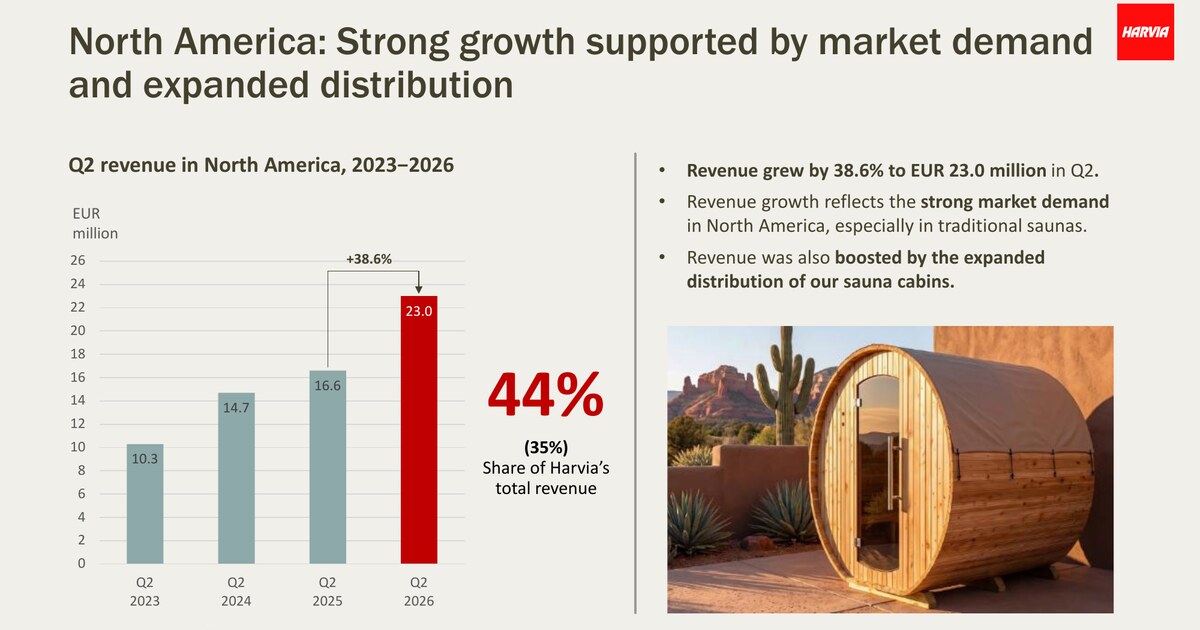
North America supplied all of Harvia's regional revenue growth in Q2 2026, adding EUR 6.4 million as the other three regions declined. Source: Harvia Plc Q2 2026 investor presentation.
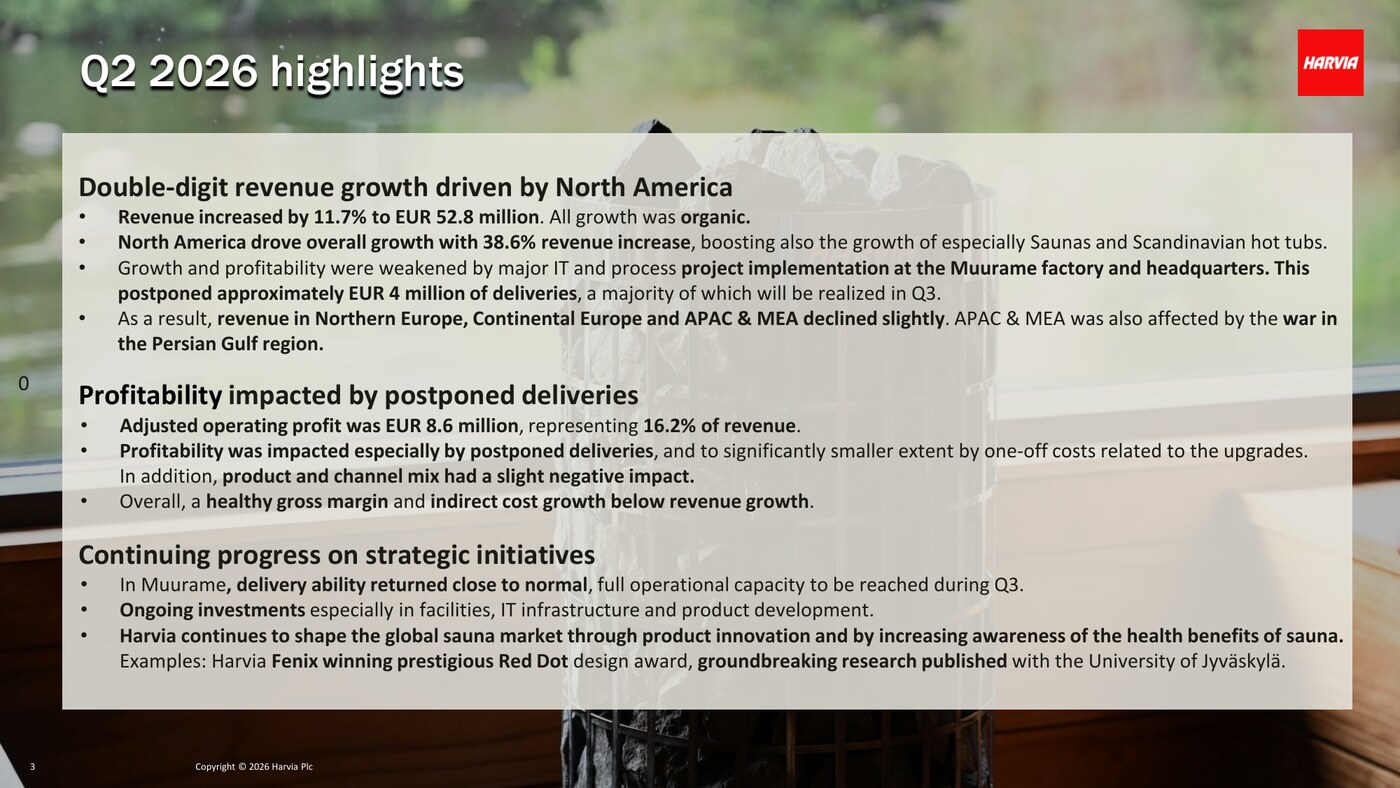
Harvia's North American business grew 38.6% in the second quarter, lifting company revenue 11.7% to EUR 52.8 million (about USD 60 million). Every euro of growth came organically. Every other reporting region declined.
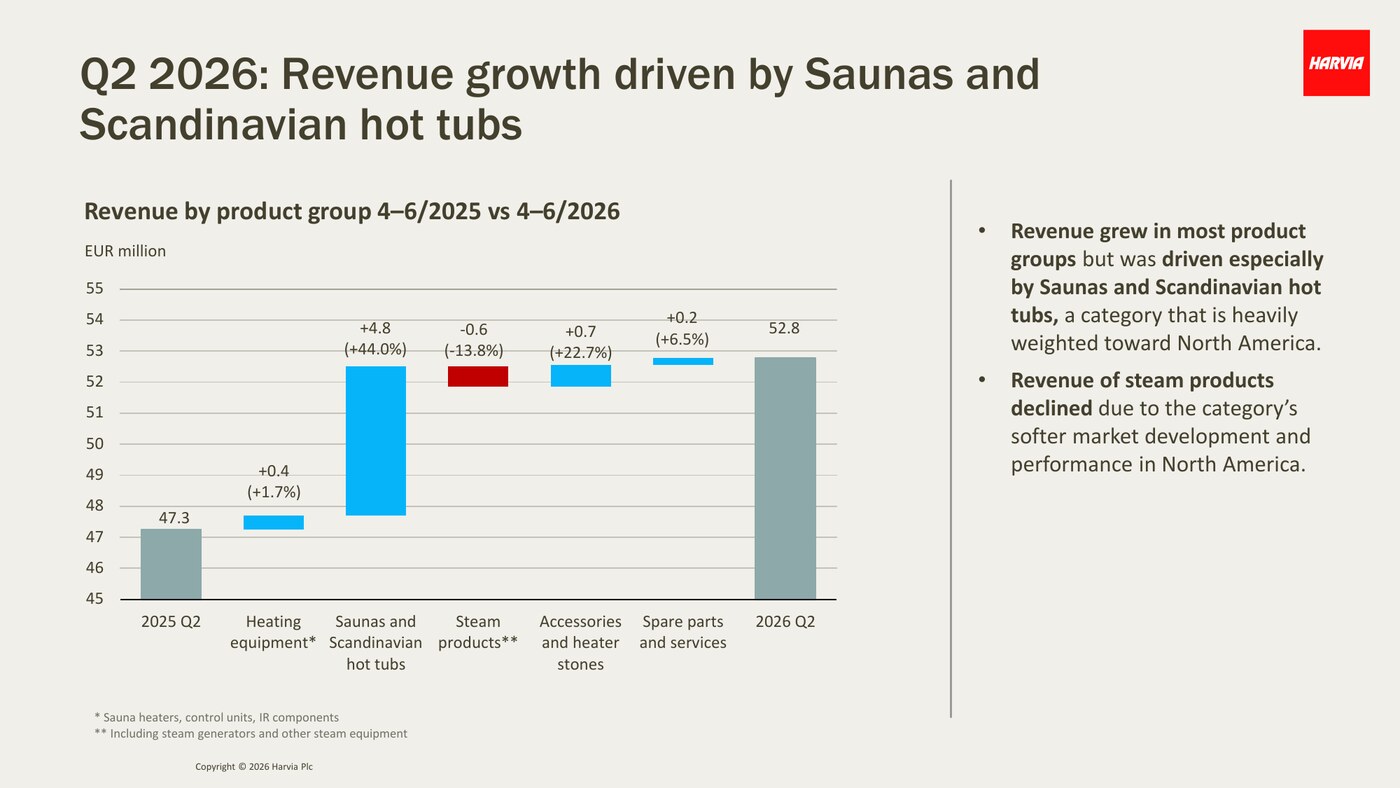
That is the clean headline from Harvia's January to June financial review. The useful story sits one layer down. Full sauna cabins and Scandinavian hot tubs grew 44%, while steam products fell 13.8%. A planned shutdown at Harvia's Muurame heater factory deferred about EUR 4 million (USD 4.6 million) of deliveries, pulling high-margin equipment out of the quarter just as lower-margin cabins took off.
On the August 6 investor call, CEO Matias Järnefelt and CFO Ari Vesterinen put sharper edges on all three moves. Most of the North American growth came through channels Harvia already had. Management is not satisfied with the pace of ThermaSol's steam growth. And the next acquisition target Harvia described most clearly is not another steam company. It is an infrared platform in North America.
USD conversions use the European Central Bank's July 29 reference rate of USD 1.1380 per euro and are rounded.
Harvia Q2 2026 at a glance
- Revenue: EUR 52.8M, up 11.7% reported and 12.9% at comparable exchange rates
- North America: EUR 23.0M, up 38.6% reported and roughly 42% in local currency
- Saunas and Scandinavian hot tubs: EUR 15.8M, up 44.0%
- Steam products: EUR 4.0M, down 13.8%
- Adjusted operating profit: EUR 8.6M, up 4.8%
- Adjusted operating margin: 16.2%, down from 17.3%
- Operating free cash flow: EUR 3.1M, down 17.1%
- Deferred Muurame deliveries: about EUR 4M, with most expected in Q3
- Employees: 806, up 64 year over year, including 59 additions in the US
North America is now 44% of Harvia's business
Harvia sold EUR 23.0 million in the United States and Canada during Q2, up from EUR 16.6 million a year earlier. North America supplied 44% of group revenue, compared with 35% in Q2 2025. Add Asia-Pacific, the Middle East and Africa, and 55% of Harvia's quarterly revenue came from outside Europe.
The growth did not come primarily from signing a giant new retailer. Järnefelt said the majority came through existing channels. Harvia's direct-to-consumer store grew strongly, existing mass-market retail partners expanded their business, and new accounts added a smaller contribution.
Harvia's North American channel order is now unusually clear. Big-box retail is largest, its own direct-to-consumer business is second, specialty sauna, pool, spa and wellness dealers are third, and other sauna-cabin manufacturers buying Harvia heaters are fourth.
The product driving that machine is the cabin, especially easy-to-buy barrels and entry-level indoor rooms made in Lewisburg, West Virginia. Järnefelt credited improved digital merchandising, including configurable 3D models that show options and price changes, along with short delivery times and a product range spanning entry to higher price points.
The margin miss was mostly heaters that did not ship
Adjusted operating profit rose 4.8% to EUR 8.6 million, but adjusted margin fell 1.1 percentage points to 16.2%. That is below Harvia's long-term target of more than 20%, and below the level investors are used to seeing from the company.
The biggest cause was planned disruption in Muurame, Finland. Harvia stopped production and shipping for about three weeks while it moved its main heater factory and headquarters onto new IT infrastructure and business processes. Management estimates the shutdown postponed about EUR 4 million of deliveries and their related gross margin.
The mix made the effect worse. Cabins use more material and carry slightly lower gross margins than technical equipment such as heaters and control panels. Q2 therefore paired unusually strong cabin sales with unusually weak availability of some of Harvia's highest-margin products.
That distinction matters. Harvia did not report that the heater orders vanished. Management said the factory had returned close to normal by quarter end, expects full operating capacity during Q3, and stocked several million euros of additional material and work in progress to catch up. Järnefelt said he was highly confident that most of the delayed deliveries would ship in Q3, while stopping short of guaranteeing that none would slip into Q4.
The cutover also creates a cleaner test for the second half. If those heaters ship as promised, revenue, gross margin and cash conversion should all improve together. If the delivery backlog lingers, the issue has moved from planned timing to execution.
Lewisburg is expanding because winter is getting bigger
Harvia is making the opposite move at its US cabin plant: adding space before demand reaches the walls.
The company bought about 20 acres around the Lewisburg site roughly 18 months ago and developed a plan for producing several times the factory's current unit volume. The expansion due for completion in September adds warehousing and truck-loading capacity, the first bottlenecks Harvia expects to hit as it builds more finished cabins for the Q4 and Q1 selling season. A later phase would expand the production floor.
Järnefelt said North American revenue grew from EUR 3 million in 2018 to roughly USD 90 million in 2025, and that, absent a major disruption, it should pass USD 100 million in 2026. That would make the site plan less a moonshot than a queue of practical construction projects.
Harvia added 59 US employees over the past year across production and sales support. The company is also deliberately building finished-goods inventory ahead of winter, which helps explain Q2's 29.2% cash conversion and elevated working capital. Vesterinen expects working capital to release in the normal Q4 pattern but did not quantify it.
ThermaSol's steam problem is not just the Middle East
Steam products were the only declining product group, down 13.8% to EUR 4.0 million. Harvia has two main steam markets, and both had problems.
In the Persian Gulf, commercial projects were postponed or became harder to deliver during the war with Iran. The Gulf was about 2% of Harvia's 2025 revenue, roughly EUR 4 million. Management estimates as much as half of that annual business is at risk in 2026, or about a one-percentage-point drag on group growth.
North America is the harder admission. An investor asked directly whether the 2024 ThermaSol acquisition had disappointed. Järnefelt said Harvia is "not fully satisfied" with the pace of scaling steam in North America and wants a positive trend change in the second half through account management, channel work and portfolio development.
He did not blame the whole decline on Harvia's own execution. Traditional and infrared sauna receive much more search and social-media attention than steam, he said. Steam also tends to require a bathroom renovation or new construction, with a generator, valves, piping and other systems behind the walls. Infrared can be installed with no plumbing and less electrical load than a traditional heater.
But management also acknowledged competitive pressure in steam. That makes this more than a category-cycle excuse. Harvia bought ThermaSol partly to secure a position in a steam segment that had consolidated early. It also acquired wet-environment digital controls and a premium US channel that can sell other Harvia products. Those additional synergies are real, but they do not erase a 13.8% decline in the category ThermaSol was bought to strengthen.
The M&A clue was infrared
Harvia ended June with net leverage of 1.2 times adjusted EBITDA, less than half its 2.5-times target ceiling. Vesterinen called that "firepower for acquisitions." Järnefelt then described where it could go.
Infrared is the largest sauna category in North America by unit volume and likely by revenue, according to management. Harvia has infrared products but no meaningful North American position. Building that business from near zero under the Harvia brand would take too long, Järnefelt said. The company needs a "growth platform," not necessarily the market leader, but a meaningful player with market presence, a portfolio and an established sales operation.
That sales operation is part of the attraction. Infrared companies have pushed furthest into wellness-style selling, including free online consultations followed by calls from dedicated salespeople. Harvia sees value not only in buying products and distribution, but in buying that commercial machine.
Management said multiple acquisition discussions are underway but gave no timetable. High-growth US category leaders command higher multiples than smaller traditional European sauna companies. Harvia's rule remains to buy below its own public-market multiple.
Replacement demand is still ahead
The other long-term lever barely contributes yet. Harvia estimates a privately used sauna heater lasts roughly seven to ten years, while a cabin can run longer than ten. Its North American base was only EUR 3 million in 2018 and expanded materially with the Almost Heaven acquisition in 2019. That means the first large replacement and upgrade wave is still forming.
When it arrives, Harvia expects some owners who entered with a basic room to trade up. Management also sees recurring digital services eventually contributing meaningful revenue and profit, an important comment given Harvia's move to put some Fenix remote-control functions behind a paid MyHarvia Control upgrade.
What this quarter says about the sauna market
Harvia's Q2 is not evidence that every sauna category is booming. It is evidence that North American cabins are booming, traditional and infrared sauna have more demand energy than steam, and a company with US manufacturing is using distribution and digital merchandising to turn that interest into volume.
For dealers and operators, the immediate watch is heater availability from Muurame. For manufacturers, it is Harvia's scale in big-box and direct-to-consumer cabins. For investors, it is whether the company buys an infrared platform before replacement demand begins adding a second engine to the North American business.
The quarter's 11.7% growth rate is the least interesting number in the report. The mix underneath it is Harvia's next strategy.
Arlene Scott
Senior Wellness Correspondent & Hospitality Consultant
Arlene Scott brings over fifteen years of reporting and consulting experience across energy infrastructure, sustainable design, and thermotherapy-focused hospitality.
Full byline
Arlene Scott is a Senior Wellness Correspondent for SaunaNews.com, bringing over fifteen years of experience at the intersection of energy infrastructure, sustainable design, and thermotherapy. Her work focuses on the physiological benefits of passive heat therapies and the sustainable integration of sauna culture into modern wellness routines.
Arlene's background is rooted in the clean energy transition. She was a founding writer at MicrogridMedia.com, where she covered the technical and economic viability of desalination projects, microgrid deployments, and distributed renewable energy systems. During the mid-2010s, she was a regular contributor to Greentech Media (GTM) during its independent era — prior to the Wood Mackenzie acquisition in 2016 — reporting on the early integration of thermal energy storage and sustainable infrastructure.
Transitioning her focus from macro-energy systems to human-scale wellness, Arlene now applies her technical background to the hospitality sector. She operates as an independent consultant, advising boutique hotels and eco-resorts on the design, energy efficiency, and historical authenticity of commercial sauna and thermal spa installations. Her consulting work ensures that high-end wellness facilities balance traditional Nordic bathing principles with modern sustainable engineering.
Arlene holds a specialized certification in Applied Thermic Wellness from the Nordic Institute of Passive Heat Studies (NIPHS) and is a recognized associate member of the International Sauna Association (ISA). When she isn't reviewing the latest innovations in infrared technology or consulting on a new resort project, Arlene can be found tending to her own traditional wood-fired sauna in the Pacific Northwest. You can read her complete archive of essays on energy, wellness, and sustainable living at www.arlenescott.com.