Can Sauna Prepare You for a Heatwave? Yes, Just Not During One

By Arlene Scott
Correspondent, Research and Industry
- Published
- Updated
- Reading time
- 8 min
SaunaNews is published by SaunaShare, Inc., which also runs SaunaShare.com and SaunaMarketplace.com, where we sell many of the products we write about. That experience may change what we write about and what we don't. Who owns SaunaNews
Some sauna venues advertised themselves as heatwave relief this summer. The researchers whose work that pitch rests on say heat adaptation takes 40 to 60 minutes a day for four to six days, fades in about a week, and is not the same thing as protection during a heat advisory.
In this story8 sections
Some sauna venues spent this summer advertising the heat as relief from the heat. The scientists whose research that pitch rests on have now said, on the record, that it does not work that way.
The Guardian reported on July 29 that with parts of the UK in their fourth heatwave of the year and the UK Health Security Agency issuing heat health alerts across much of England, a growing number of studies are asking whether heat training can prepare people for extreme heat. The piece also noted that some saunas are already advertising themselves as an unexpected solution to heatwaves. The two researchers quoted drew a line straight through the middle of that: repeated heat exposure does adapt a body, and adaptation is not protection.
For a US operator who has spent this summer running a business through heat advisories, the specifics matter. Heat acclimation has a dose, a decay curve, and a short list of people it is contraindicated for. All three are inconvenient for the product most saunas sell in August. If you are still treating the summer booking dip as a seasonality problem, the Finnish market says otherwise.
What the adaptation is
Prof. Jari Laukkanen, the University of Eastern Finland cardiologist behind much of the Finnish cohort work on sauna and health, put the mechanism in terms borrowed from sport rather than wellness.
“This is well established in sports physiology, where athletes deliberately use repeated heat exposure to improve heat tolerance before competing in hot environments. Indeed, quite similar physiological adaptations may also occur with passive heat exposure, such as sauna bathing and hot water immersion.”
(Prof. Jari Laukkanen, University of Eastern Finland, to The Guardian)
The adaptations he lists are the standard four: earlier and more efficient sweating, improved skin blood flow, expansion of plasma volume, and reduced cardiovascular strain on subsequent heat exposure. Those are measurable and well established in exercise physiology.
Dr. Jessica Mee of the University of Worcester, who is recruiting for a study on whether regular hot water immersion changes how the body responds to heat, added that regular heat exposure changes behavior as well as physiology. “People who are accustomed to heat pace themselves more sensibly, hydrate more consistently and recognise their own warning signs earlier,” she said.
The caveat came from Dr. Heather Massey at the University of Portsmouth, who studies human physiology in extreme environments: “The adaptations rely heavily on the body’s ability to increase sweating and skin blood flow.” Anyone whose sweat response or skin blood flow is already limited, whether by age, medication, or a cardiovascular condition, gets less out of the same protocol. The operational read is that a mixed-age customer base will not adapt uniformly, and nothing in the booking flow tells you who is in which group.
The dose takes a series of sessions
Heat training takes 40 to 60 minutes of heat exposure per day, for at least four to six days, and the benefit lasts about a week. Longer training produces longer-lasting adaptation.
Run that against a booking calendar. Forty to sixty minutes of actual heat exposure is not a 45-minute reservation, because the cooldowns, the plunge, and the changing room are not heat exposure. It is closer to a 90-minute slot, six days running, and then it decays unless the customer keeps coming. That is a series pass or a membership, not the single walk-in session that “prepare for the heatwave” copy implies.
That is a reason to price it as a series, not to skip it. A six-session block sold in April to a customer with a July trip to Phoenix, a summer race, or an outdoor job is a coherent offer with a defensible mechanism behind it. The same block sold on the third day of a heat advisory is not.
The performance evidence is thinner than the marketing
Most of the “sauna heat training” copy in circulation traces back to one paper. Scoon and colleagues, publishing in the Journal of Science and Medicine in Sport in 2007, put six male distance runners through three weeks of post-training sauna at roughly 194°F, about 31 minutes per session, around 12.7 sessions each. Run time to exhaustion rose 32% against control, plasma volume rose 7.1%, and the performance change correlated tightly with the plasma volume change.
Six runners carry most of that marketing.
The pooled evidence is weaker. Solomon and Laye published a systematic review and meta-analysis in BMC Sports Science, Medicine and Rehabilitation on January 6, 2025, pooling 10 studies and 199 participants (156 male, 43 female, ages 20 to 32) on post-exercise heat exposure by sauna or hot water immersion. The effect on performance in hot conditions, tested between 91°F and 104°F, was trivial: a ratio of means of 1.04, with a 95% confidence interval of 0.94 to 1.15 that comfortably straddles no effect at all. Effects on thermoneutral performance and lactate threshold speed were also trivial. Core temperature, heart rate, sweat rate, and VO2max showed small effects, thermal sensation a moderate one. The authors graded certainty across every outcome as low to very low, citing small samples, high risk of bias, publication bias, and low statistical power, and concluded that the practice is “uncertain.”
Together, the two studies support a narrow position. The thermoregulatory adaptations are well measured. Whether they convert into meaningful performance, or into meaningful protection on a hot day, is a separate claim carrying much weaker evidence. Sell the first. Do not sell the second.
The claim that gets a venue in trouble
Mee summarized it this way:
“Heat acclimation is a preparation strategy for the mild months, not a coping strategy for the hottest day of the year.”
(Dr. Jessica Mee, University of Worcester, to The Guardian)
Her reasoning is physiological. On a hot day there is no meaningful recovery between exposures.
“You are stacking one thermal challenge on top of another, on a body that in all likelihood is already dealing with several consecutive nights of poor sleep, some degree of dehydration and cumulative cardiovascular strain. That is precisely the profile in which heat-related illness develops.”
(Dr. Jessica Mee)
Mee also flagged the transfer problem. The studies were run in supervised laboratory or controlled settings, with monitored temperature, controlled exposure time, and a person present throughout. “We do not yet know how safely or effectively this transfers to people doing [hot baths] unsupervised at home,” she said, naming fainting as the most immediate risk. A barrel sauna in a backyard, or an unattended cabin at the end of a self-serve booking, sits a lot closer to the unsupervised end of that spectrum than to the lab.
Laukkanen said adaptation is not the same as protection. “There is currently limited evidence that going to a sauna during a heatwave itself protects people from heat-related illness or other conditions,” he said. His guidance for an active heat event is the boring public health list: hydration, avoiding strenuous activity during the hottest part of the day, and checking on vulnerable people. “Those remain the most important measures.”
Screening is the cheap part
Laukkanen named four conditions that should keep someone out of a hot room until they have been medically assessed or treated: acute illness or fever, unstable angina, a recent heart attack, and uncontrolled low blood pressure.
Put those four on the intake form as explicit checkboxes rather than burying them in a waiver paragraph nobody reads. It costs nothing, and the first three are exactly the profile that shows up more often during a heat event, when people are already running hot, tired, and underhydrated. A 2001 review of sauna safety in the American Journal of Medicine adds a fifth: severe aortic stenosis.
Add a line about alcohol while you’re at it. About half of Finnish sauna deaths in a forensic review involved alcohol, and in a small crossover trial of 10 young men, sauna after heavy drinking dropped systolic blood pressure from 136 to 113, while sauna alone did not. That fall is the fainting profile Mee describes, on a hot day or any other.
Do not sell this as OSHA compliance
Heat acclimatization is a live workplace safety requirement in the US, which makes “we can acclimate your crew” sound like a sellable service to a contractor, a warehouse, or a utility. It is not one, and the regulatory text says so.
OSHA’s proposed Heat Injury and Illness Prevention standard defines acclimatization as graduated exposure to the job itself, and points to the NIOSH approach of 20% of a normal workload on day one, adding 20% per day through day five, for new workers and workers returning after seven or more days away. Passive heat exposure in a sauna is not in that text and does not discharge an employer’s duty. The standard also has not been finalized. What is live is enforcement: OSHA issued an updated National Emphasis Program on heat hazards on April 10, 2026, effective immediately and scheduled to run five years, replacing the version that expired April 8. It targets 55 high-hazard industries, 22 of them newly added.
An employer under that program needs a written plan and on-the-job acclimatization, not a spa contract. Pitching one as the other creates exposure for the buyer and for you.
Contrast bathing still sells in a heatwave
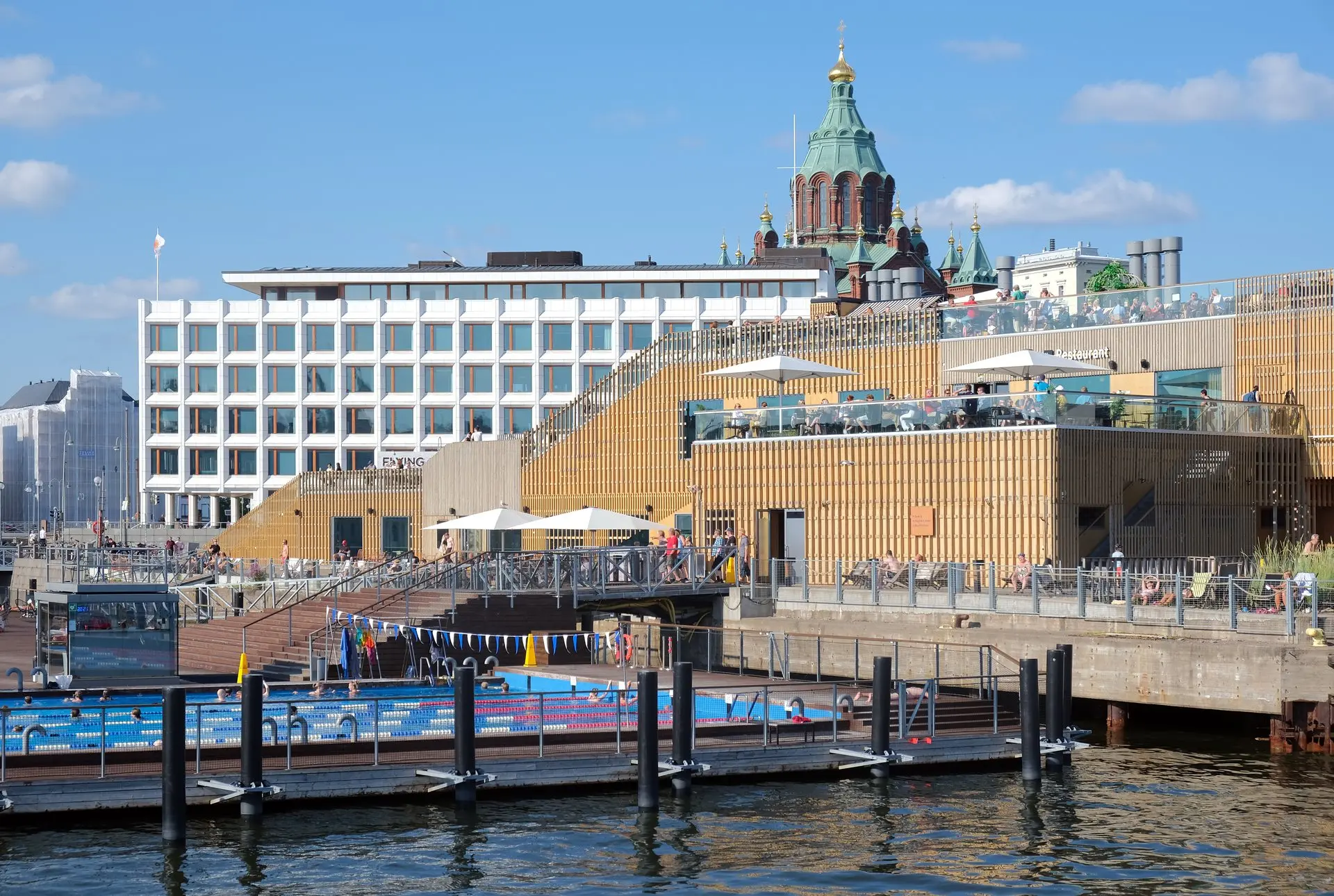
Nicola Pegues, head of operations at the not-for-profit Community Sauna Baths, said bookings initially fell as temperatures rose, then recovered. All of their sites are outdoors with saunas and cold plunges, letting people cycle between the two. “You get real relief out of it actually,” she said.
That is contrast bathing, with the relief coming from the cold end, not a health claim about surviving a heatwave. Operators with outdoor sites and a real plunge have a summer product; operators with an indoor cabin and a cold shower have a harder sell, which is one more argument for the capital case behind plunge as a demand driver rather than an accessory and for the outdoor build format that has been absorbing North American demand.
Four things to do this quarter
Before next summer:
Strip protective language from summer copy now. Anything that reads as “beat the heat,” “heatwave relief,” or “protect yourself from extreme heat” is a claim the cited researchers explicitly declined to make. Describe the contrast experience instead. Recovery and sleep claims rest on small or self-reported studies, so attribute them if you use them.
Build the acclimation product as a six-session block and sell it in spring. The dose is 40 to 60 minutes a day for four to six days, and it fades in about a week. That is a series and a maintenance cadence, and it should be priced and scheduled as one.
Put the contraindications on the intake form as checkboxes. Acute illness or fever, unstable angina, recent heart attack, uncontrolled low blood pressure, severe aortic stenosis, and alcohol in the last few hours.
Put the question to your insurer and your attorney in writing before next summer. Ask specifically whether heat resilience or heat preparation language on your site, your booking flow, or your signage changes your coverage or your duty of care, and get the answer on paper while nothing has gone wrong.
Update, November 8, 2026: Adds severe aortic stenosis and alcohol to the screening list, with the studies behind them.