Sauna After Workouts Lowered LDL Particles More Than Exercise Alone in a 47-Person Finnish Trial

Research, standards and the sauna industry
- Published
- Reading time
- 5 min
SaunaNews is published by SaunaShare, Inc., which also runs SaunaShare.com and SaunaMarketplace.com, where we sell many of the products we write about. That experience may change what we write about and what we don't. Who owns SaunaNews
The eight-week trial, published in Mayo Clinic Proceedings, added 15 minutes of sauna to three workouts a week. It had no sauna-only group, and the abstract gives the direction of each change, not its size.

In this story5 sections
Fifteen minutes in a sauna after each workout lowered LDL cholesterol particles more than the workouts alone in an eight-week Finnish trial of 47 sedentary adults. The sauna group also had larger drops in VLDL particles and an increase in HDL particle size, according to a paper published November 12 in Mayo Clinic Proceedings by researchers in Finland and Canada. The paper’s abstract gives the direction of each change and not its size, and the trial had no group that used the sauna without exercising.
The study comes from the group around Jari Laukkanen at the University of Eastern Finland, with co-authors at the universities of Jyväskylä, Turku and Helsinki, the Montreal Heart Institute and the University of Manitoba. It measured blood with nuclear magnetic resonance, a lab method that counts and sizes the particles that carry cholesterol and fat instead of reporting one total. Two sets of volunteers took part: the 47 in the trial, and 63 regular sauna users who gave blood around a single 30-minute session.
The sauna dose was 15 minutes, three times a week
The abstract describes the same design and headcount as the trial this group ran in Jyväskylä and first reported in 2022, in an American Journal of Physiology paper that gives the protocol in detail. Volunteers were 30 to 64 years old, worked desk jobs, exercised less than 30 minutes a week and used a sauna no more than once a week. Each had at least one heart-disease risk factor, such as obesity, high blood pressure or high cholesterol, and none took cardiovascular medication. Forty-one of the 47 were women.
Two groups of 16 trained three times a week for eight weeks: a 10-minute warm-up, 20 minutes of resistance exercises and 30 minutes on an exercise bike. One of those groups then sat in a sauna for 15 minutes. A third group of 15 did neither. The sauna started at 149°F and went up 9°F every two weeks, reaching 176°F for the last two, at 10% to 20% relative humidity. No one left the sauna early in any session.
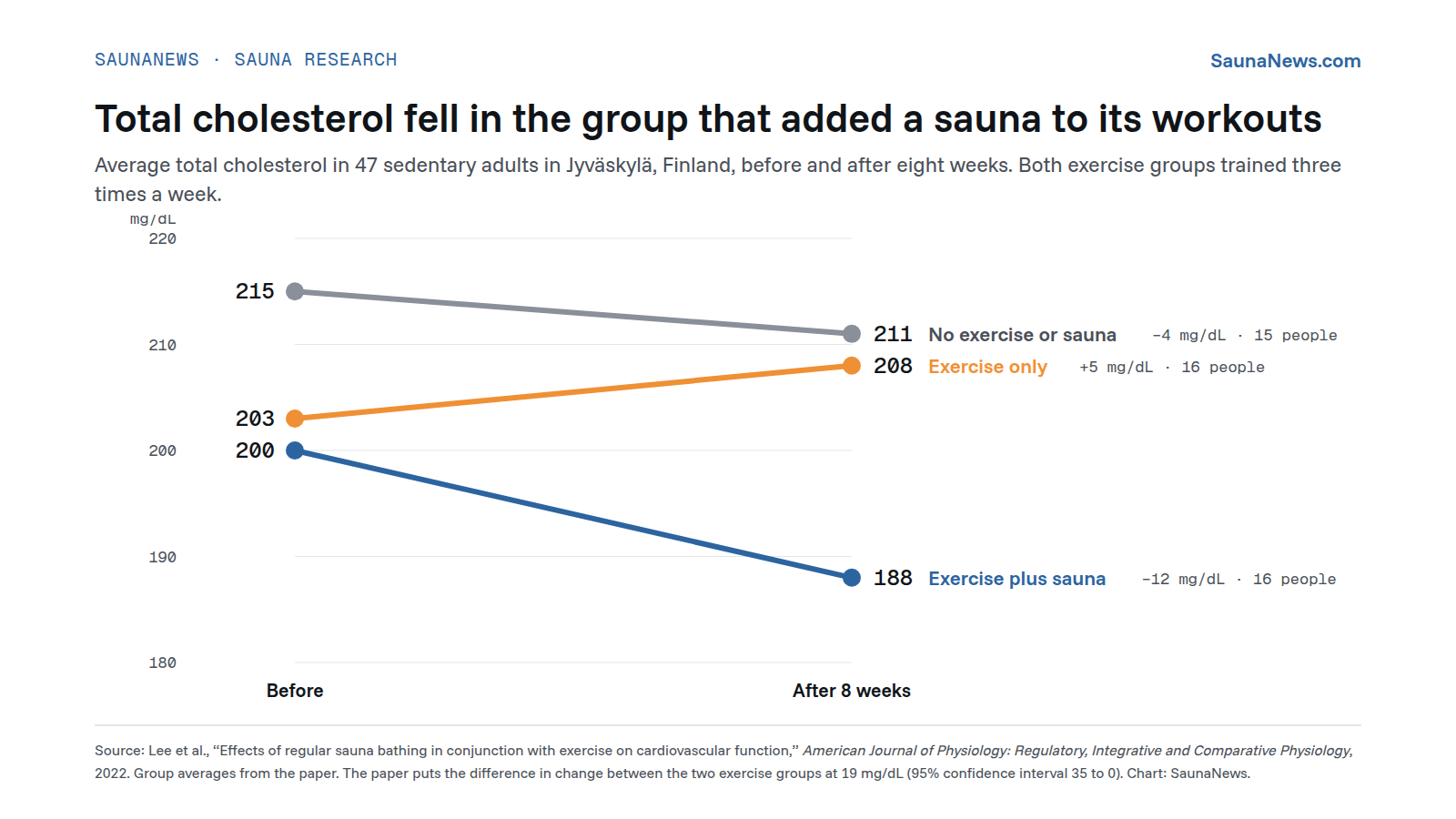
That 2022 paper reported standard blood tests. Total cholesterol fell from an average of 200 to 188 mg/dL in the sauna group and rose from 203 to 208 in the exercise-only group. The authors put the difference at 19 mg/dL, with a range of uncertainty that ran from 35 down to zero. Systolic blood pressure fell 8 points more in the sauna group than in the exercise-only group.
The new paper counts the particles behind that total
The new analysis looks inside the cholesterol number. Compared with exercise alone, exercise plus sauna brought “reductions in LDL particle number and concentration, greater decreases in VLDL subclasses, and increases in HDL particle size,” the abstract says. LDL is the cholesterol carrier doctors try to lower, VLDL carries triglycerides, and HDL carries cholesterol back to the liver.
The authors conclude that heat, “when combined with regular exercise, augments longer-term improvements in lipoprotein profiles.” The abstract doesn’t say how many particles, or what share of them, the sauna group lost.
One 30-minute session lowered triglycerides too
The second part of the paper tested a single session. Sixty-three habitual sauna users, each with at least one heart-disease risk factor, spent 30 minutes in a Finnish sauna and gave blood at several points. Triglycerides and VLDL particles fell, as did two families of amino acids, and ketone bodies rose. Ketone bodies are a fuel the liver makes from fat, and they also rise during fasting and long exercise. The authors call the result “a metabolic pattern compatible with enhanced lipid utilization and a transient metabolic stress response.”
The same researchers reported in March that one session raises white blood cell counts by 8% to 10%, with most cell types back to baseline 30 minutes later, in a study of 51 volunteers. The new abstract doesn’t say how long the fat and amino acid changes lasted. It also doesn’t say whether the figures were corrected for plasma lost as sweat, as the white cell counts were.
The trial didn’t test sauna without the workout
The study at a glance
- Paper Laukkanen et al., “Effects of Sauna Bathing on NMR-Based Metabolomic Profiles,” Mayo Clinic Proceedings, published online November 12, 2026, DOI 10.1016/j.mayocp.2026.11.006
- Trial Forty-seven sedentary adults in Jyväskylä, Finland, randomly assigned to exercise plus sauna, exercise only, or neither, for eight weeks
- Sauna Fifteen minutes after each of three weekly workouts. The 2022 paper gives 149°F rising to 176°F at 10% to 20% relative humidity
- Result Lower LDL particle number and concentration, larger VLDL decreases and larger HDL particles than exercise alone, with no sizes given in the abstract
- Single session Sixty-three regular sauna users, 30 minutes, with triglycerides, VLDL particles and branched-chain and aromatic amino acids down and ketone bodies up
- Not tested Sauna without exercise, sauna before a workout, infrared saunas, and heart attacks or strokes
- Funding listed by the journal Research Council of Finland, Novo Nordisk Foundation and Finnish Cultural Foundation
Every volunteer who used the sauna also exercised, so the results describe sauna added to training and never sauna in place of it. The 2022 paper names the missing sauna-only group as a limitation and says the volunteers’ diets weren’t controlled. The sauna always came straight after the workout. The trial didn’t test a sauna before training, on rest days or for longer than 15 minutes, and it measured blood markers over eight weeks. It didn’t count heart attacks or strokes.
Sauna from Finland, the Finnish industry association, made the same point in its own summary of the paper on November 16: “Changes in metabolic biomarkers do not on their own prove that sauna bathing prevents disease or improves long-term health.”
The long-term case still rests on studies of habits. A 2015 paper in JAMA Internal Medicine followed 2,315 Finnish men for about 20 years and found that those who used a sauna four to seven times a week had a 40% lower risk of death from any cause than those who went once a week. That is an association among men who chose their own habits, and most of the long-term sauna evidence comes from men, while this trial was mostly women.
For a gym or bathhouse, the supported claim is narrow
The dose is one a gym sauna can deliver: 15 minutes at 149 to 176°F, straight after training, three times a week. The result arrives while gyms from Crunch to the Y charge $15 to $169 a month for recovery tiers.
The paper supports one sentence on a menu or a membership page: in an eight-week Finnish trial, sedentary adults who added a 15-minute sauna to three weekly workouts lowered their LDL particle counts more than those who only exercised. It doesn’t support “sauna lowers cholesterol” on its own, any claim about infrared cabins, or anything about heart disease. The Federal Trade Commission’s guidance on health claims generally expects randomized, controlled trials in people behind a health benefit claim. This is one, with 47 people in it.