One Sauna Session Sends Immune Cells Into the Blood. Thirty Minutes Later, Most Are Back to Baseline

Research, standards and the sauna industry
- Published
- Reading time
- 6 min
SaunaNews is published by SaunaShare, Inc., which also runs SaunaShare.com and SaunaMarketplace.com, where we sell many of the products we write about. That experience may change what we write about and what we don't. Who owns SaunaNews
Blood drawn from 51 adults in Finland showed white cell counts up 8% to 10% right after a 30-minute sauna. Half an hour later, neutrophils and lymphocytes were back where they started. The study didn’t test whether anyone got sick less.
In this story5 sections
One 30-minute Finnish sauna raised the number of white blood cells circulating in 51 middle-aged adults by 8% to 10%. Thirty minutes after they came out, the two largest groups of those cells, neutrophils and lymphocytes, were back to their starting counts. The study tracked blood for half an hour after a single session. It didn’t test whether anyone got sick less often.
Researchers led by the universities of Turku and Eastern Finland published the results on March 31 in the open-access journal Temperature, and the paper is making the rounds again under headlines such as “Just one sauna session can quickly change your immune system” (Knowridge, November 1). The University of Eastern Finland’s own April release ran as “Sauna bathing may boost immune responses.” The volunteers were 27 women and 24 men from Jyväskylä in Central Finland, average age 50, each with at least one heart-disease risk factor such as high blood pressure or a smoking history, and none with heart disease. SaunaNews covered the study’s cytokine and interferon findings in April.
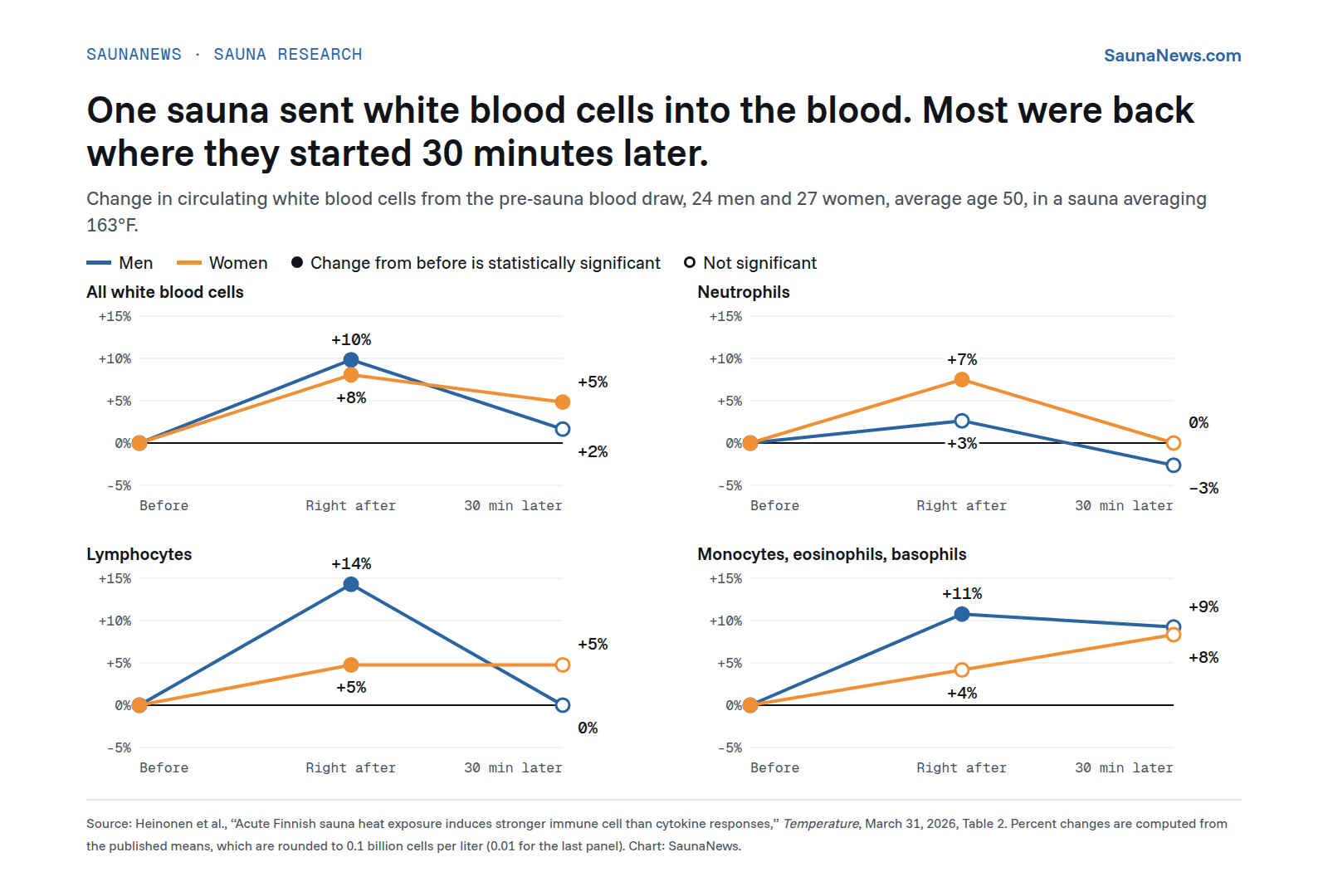
The rise was about 10%, and every cell type moved together
Average counts went from 6.1 to 6.7 billion white cells per liter of blood in men and from 6.2 to 6.7 billion in women. Both sit well inside the normal range of 4.5 billion to 11 billion that labs use. Lymphocytes rose 14% in men. Neutrophils rose 7% in women and didn’t change significantly in men. Each cell type kept the same share of the total before and after, so the sauna raised the count without changing the mix.
Sweat can make blood counts look higher than they are, because losing plasma concentrates what’s left. The team corrected every count for each person’s change in plasma volume. Volunteers drank about 17 ounces of water across the session and the rest that followed, and their plasma volume didn’t change on average. “This may indicate that sauna bathing mobilises additional white blood cells into the bloodstream from tissues,” Ilkka Heinonen of the University of Turku said in the release. The paper says the team doesn’t know which tissues the cells came from or where they went next.

For scale, Heinonen’s group in Turku put 20 young, fit adults on exercise bikes for 30 hard minutes in a study published in 2025, and total white cells rose 52% in the men and 19% in the women. The two groups differ in age and fitness, so the figures don’t line up one to one, but the sauna’s 8% to 10% is the smaller move.
Half an hour later, most of it had settled
The third blood draw came after 30 minutes of rest in a 70°F lounge. Neutrophils and lymphocytes were back to baseline in both men and women. Two numbers hadn’t fully come down. Women’s total count was still about 5% above where it started, a difference the paper rates as significant. The smallest group, monocytes, eosinophils and basophils, which the lab’s analyzer counted together, sat 8% to 9% above baseline in both sexes, though the paper’s table doesn’t flag those 30-minute values as significant.
How hot a bather got didn’t predict how many cells moved. Ear temperature rose from 97.5°F to 101.1°F on average, and the size of each person’s rise had no link to their white cell change. It did line up with changes in 18 cytokines, the chemical messengers immune cells use, mostly right after the session. On average, only two of the 37 cytokines measured changed, sCD30 and pentraxin-3, and both went down.
Habit made no difference either. About a third of the volunteers didn’t use a sauna at home, a third went less than once a week, and a third went two or more times a week. Their responses matched on every measure.

The study had no comparison session and counted no colds
The study at a glance
- Who Fifty-one adults in Jyväskylä, Finland, 27 women and 24 men, average age 50, all with at least one cardiovascular risk factor and none with heart disease
- Session Thirty minutes alone in the sauna between 9 and 11 a.m., with a two-minute shower after 15 minutes, then 30 minutes resting in a 70°F lounge, with about 17 ounces of water to drink across both
- Room set to 176°F and controlled with sensors designed by Harvia; a room thermometer logged an average of 163°F at 10% to 20% relative humidity
- Blood draws about two hours before, right after, and 30 minutes after
- Measured white cell counts by type and 37 cytokines
- Not measured colds or infections, T-cell or natural killer cell subsets, and anything beyond the 30-minute draw
- Paper Heinonen et al., “Acute Finnish sauna heat exposure induces stronger immune cell than cytokine responses,” Temperature, March 31, 2026, open access, DOI 10.1080/23328940.2026.2645467
There was no comparison morning without heat, so the design can’t separate the sauna from anything else that changed between draws. Body temperature came from an ear thermometer, which the authors say doesn’t measure core temperature. The session matched the volunteers’ habits: at home they reported a median of 30 minutes at 158°F. The two-minute shower at the halfway mark means the result describes a typical Finnish round of heat, a rinse and more heat, rather than heat alone. The university’s release calls it a cold shower. The paper doesn’t give its temperature.
The evidence on getting sick is older and comes from regular users
The case that sauna users get sick less often rests on long-running studies of habits, not on blood drawn after one session. In the Kuopio Ischemic Heart Disease study, 2,210 Finnish men aged 42 to 61 reported their sauna habits and were followed for a median of 25.6 years. Men who took two or three sessions a week had a 28% lower risk of a hospital pneumonia diagnosis than men who went once a week or less, after adjusting for income, exercise, diet and inflammation. For four or more sessions the estimate was 37%, though its range of uncertainty reached no effect at all. Those are associations in a men-only cohort, like much of the long-term sauna evidence; the same team has also linked frequent sauna use to lower inflammation markers.
A small trial in Vienna tested colds directly in 1990. Twenty-five volunteers took regular saunas for six months while 25 others didn’t. The sauna group had significantly fewer colds, roughly half as many in the last three months, but their colds lasted as long and were no milder. The authors concluded that regular sauna “probably reduces the incidence of common colds, but further studies are needed to prove this.”
Cold water has its own version. In a 2016 Dutch trial, 3,018 adults were randomly assigned to end their showers with 30 to 90 seconds of cold water or to shower as usual. The cold-shower groups took 29% fewer sick days off work but reported no fewer days of illness. The Finnish authors list heat followed by cold water, the contrast format many bathhouses sell, as untested for the responses they measured.
What one session supports on a menu: a short shift in blood counts
For operators and brands writing menus, class descriptions and product pages, the study supports a narrow sentence: in a 2026 Finnish study, one 30-minute sauna raised circulating white blood cells about 10%, and most cell types were back to baseline within 30 minutes. It doesn’t support “boosts your immune system” or “fewer colds.” The Federal Trade Commission’s staff guidance on health claims, issued in December 2022, says health benefit claims generally need randomized, controlled trials in people, and cautions against applying research on one group to everyone. One of its examples treats an ad saying a supplement “boosts” the immune system to keep noses and throats healthy in winter as a claim to prevent colds. That bar matters to buyers too: in a 2025 survey, wellness consumers rated “clinically proven” the most trustworthy health claim.
Three findings matter on the floor. A hotter session didn’t move more cells, because the rise didn’t track how much a bather heated up. Regulars and first-timers responded the same, so nothing here supports selling memberships as immune training. And the volunteers drank water throughout. Their plasma volume held steady because they did, and the authors say they don’t know how the counts would look if they hadn’t.