
Your Sauna Session Mobilizes Your Immune System. Finnish Researchers Just Mapped How.

By Arlene Scott
Senior Wellness Correspondent & Hospitality Consultant
- Published
- Reading time
- 7 min
SaunaNews is published by SaunaShare, Inc., which also runs SaunaShare.com and SaunaMarketplace.com, where we sell many of the products we write about. Assume that experience shapes what we cover and what we don't. Who owns SaunaNews · The ownership announcement
A peer-reviewed Finnish study tracked 51 adults through a single 30-minute sauna and found significant white blood cell mobilization, plus cytokine responses tied to body temperature rise, including interferon signals associated with antiviral defense.
In this story6 sections
A peer-reviewed study published in the journal Temperature in March offers a granular look at what one Finnish sauna session does to your immune system. The findings are specific, measurable, and harder to dismiss than the usual long-term epidemiological correlations: a single 30-minute session at 163°F raised white blood cell counts significantly in both men and women, with some immune populations staying elevated for at least 30 minutes after participants left the heat.
The research was led by Ilkka Heinonen of the University of Turku, alongside cardiologist and Professor Jari Laukkanen of the University of Eastern Finland, whose longitudinal KIHD cohort studies established that frequent sauna use is associated with a 40% reduction in all-cause mortality for 4-7x weekly users. This new study is different. Rather than asking whether regular sauna use correlates with better long-term health outcomes, it asks what actually happens inside your body during a single session. The answer involves white blood cells, interferons, and a temperature sensor made by Harvia.
What they did
Fifty-one adults from Jyvaskyla, Finland participated. Twenty-seven women, 24 men, average age 50, average BMI just under 27. These were people with at least one cardiovascular risk factor (high blood pressure, smoking history, dyslipidemia, family history of heart disease), but no active heart disease. Roughly a third hadn’t been in a sauna in months. Another third used one weekly or less. The remaining third went 2-3 times per week.
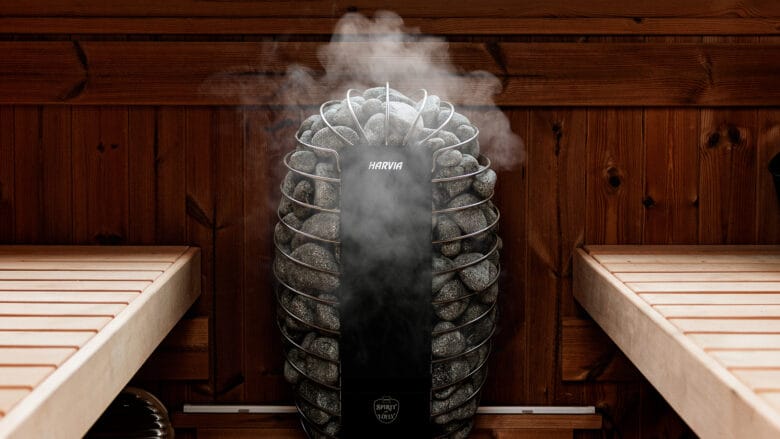
The protocol: one 30-minute Finnish sauna session. The room was set to 176°F and held at a measured average of 163°F with 10-20% relative humidity. Temperature monitoring was continuous using internal sensors designed by Harvia. Participants sat alone in sex-specific sauna rooms wearing swimwear, drank water throughout, and had a brief shower after the first 15 minutes. Blood was drawn immediately before, immediately after, and 30 minutes after the session. The researchers tested for white blood cell counts across all major subtypes, plus 37 cytokines. Body temperature was measured from the ear. It started at around 97.5°F and rose to 101.1°F on average by the end of the session.
The white blood cell surge
Total leukocyte count rose significantly right after the sauna and stayed slightly elevated in women at the 30-minute mark. Neutrophils and lymphocytes both spiked immediately post-sauna, then returned to baseline by the 30-minute blood draw. The MXD group, the combined count of monocytes, eosinophils, and basophils, went up immediately and stayed elevated for the full recovery window in men.
That last point matters. Proportions staying the same while total counts rise tells researchers this is a generalized immune mobilization, not a targeted stress response to a specific threat. Every white blood cell type increased roughly in parallel. The body was summoning its full immune complement, not dispatching a specialized unit.
The researchers also ruled out hemoconcentration, the artifact where blood appears to have more cells simply because sweat loss has reduced plasma volume. All results were corrected for individual plasma volume changes, and on average, plasma volume did not shift significantly because participants drank water throughout. This was a genuine mobilization of immune cells into circulation.
The cytokine story is more complicated (and more interesting)
If the white blood cell findings were the expected result (heat stresses the body, immune system responds), the cytokine data is where things get genuinely interesting.
Of 37 cytokines tested, only two changed significantly. Pentraxin-3 dropped, more notably in women. sCD30 also decreased. One other cytokine, MMP-2, trended upward but didn’t reach statistical significance. For the vast majority of immune signaling proteins measured, the sauna session did nothing detectable in absolute terms.
But here is the finding that deserves more attention: the researchers identified 18 statistically significant correlations between the change in body temperature and changes in specific cytokines, concentrated immediately post-sauna and largely gone 30 minutes later. Put simply: the bigger someone’s body temperature rose during the sauna, the more certain cytokines moved in predictable directions. And among the cytokines most strongly correlated with that temperature rise were interferons.
The interferon signal
This is the part most headlines will skip over, so it is worth slowing down here.
The cytokines most positively correlated with body temperature rise included IFN-alpha2, IFN-beta, and IFN-gamma, three core members of the interferon family. Interferons are the immune system’s primary antiviral signaling proteins. When a cell detects viral invasion, one of its first moves is to secrete interferons that alert neighboring cells to activate their own antiviral defenses. Interferons are also central to cancer immune surveillance and are the basis for multiple cancer and autoimmune therapies.
This study did not show that sauna fights viruses or treats cancer. The design cannot support those conclusions. What it found is that people whose body temperature climbed the most during a sauna session showed the strongest correlations in interferon-type cytokines. Whether that represents meaningful antiviral activation or just a fever-mimicking temperature response remains an open question. The researchers are careful about this distinction, describing these findings as associations that “suggest” a mechanism rather than proving one.
Still, this sits alongside prior population-level research showing that regular Finnish sauna use is associated with significantly lower rates of pneumonia and chronic obstructive pulmonary disease. The plausible immune mechanism behind those associations has never been clearly identified. These cytokine correlations, transient and correlational as they are, point in a direction worth taking seriously.
The observed associations between changes in body temperature and circulating cytokines suggest that sauna-induced heat stress, along with immune activation, may partly mediate the health benefits of Finnish sauna bathing.
What this study does not prove
The honest accounting: 51 people is a modest sample. The participants were middle-aged Finns with cardiovascular risk factors, so the results may not generalize broadly. The tympanic thermometer used to measure body temperature does not capture true core temperature, though the researchers defend it as practical for a study of this scale and design.
The study did not break out T-cell subsets, natural killer cells, or specific B-cell populations. Monocytes, eosinophils, and basophils were measured only as a combined MXD figure. The cytokines were measured in serum, so the researchers cannot say where the cells migrated or what the cytokine signals ultimately triggered in tissue. The 30-minute post-sauna window may also simply be too short to see the full picture of recovery and downstream immune activity.
One finding is worth flagging specifically: there were no differences in immune response based on how often participants used saunas at home. Habitual users (2-3 times per week) showed essentially the same immune response as people who almost never go. If regular sauna were building a stronger or faster immune response through repeated thermal adaptation, you would expect to see some signal here. The study did not find one, at least not in the variables measured.
Why this research matters
The most important contribution of this paper is not any single finding. It is the mechanistic framework it begins to establish.
Researchers have spent years documenting that regular sauna use correlates with better health outcomes across multiple disease categories: cardiovascular, respiratory, neurological, metabolic. The KIHD data is strong. The COPD and pneumonia associations are strong. The dementia and Alzheimer’s data is strong. But the question of why has been only partially answered, mostly through cardiovascular pathways involving blood pressure, arterial stiffness, and cardiac remodeling.
What Heinonen, Laukkanen and their colleagues are trying to do here is open up the immune pathway as a viable mechanistic explanation. If every sauna session mobilizes white blood cells and triggers temperature-correlated cytokine responses, including interferon activity that resembles what the body deploys against pathogens, then the long-term data showing fewer infections and less respiratory disease among frequent sauna users starts to have a plausible biological story behind it.
That story is not proven. But the direction is consistent and the methodology is sound. Laukkanen is expected to speak at the World Sauna Forum in Jyvaskyla this June, where this research is likely to be discussed alongside the broader KIHD findings.
If you are shopping for a traditional Finnish sauna and want one capable of delivering the kind of deep heat used in this study, 163°F at 10-20% humidity is the standard target. Look for traditional Finnish sauna options that are built to that specification from reputable specialty dealers.
A 30-minute Finnish sauna session measurably mobilizes your immune system. The white blood cell surge is real, not a measurement artifact. The cytokine response correlates with how much your body temperature rises, and the pattern includes interferons. None of this is a proven cure for anything. But it is a plausible mechanism for why regular sauna users keep showing up healthier in the long-term data, and it is a detailed look at sauna’s acute immune effects.
Harvia events
1 event