Haljas Houses Is Now a Three-Time Red Dot Winner

By Arlene Scott
Senior Wellness Correspondent & Hospitality Consultant
- Published
- Reading time
- 4 min
SaunaNews is published by SaunaShare, Inc., which also runs SaunaShare.com and SaunaMarketplace.com, where we sell many of the products we write about. Assume that experience shapes what we cover and what we don't. Who owns SaunaNews · The ownership announcement
The Estonian startup’s Hele Nano and Tarantula wood carrier both earned 2025 Red Dot Design Awards, adding to a 2022 win for the Hele Glass. Now available in the US, the Nano ships fully assembled and can be moved by pallet jack.
In this story4 sections
Haljas Houses, a four-year-old Estonian sauna manufacturer based in Tartu, has won its third Red Dot Design Award. The company’s Hele Nano personal sauna and Tarantula firewood carrier both received 2025 Red Dot recognition, adding to a 2022 win for the original Hele Glass. For a company with roughly five employees, three Red Dots in four years is an uncommon pace.
The timing matters for the US market. The Hele Nano is now available through American retailers, and it arrives with a distinction few prebuilt saunas share: it ships fully assembled and can be moved into position with nothing more than a pallet jack. No crane. No forklift. No excavation crew idling in your driveway at $200 an hour.
Key facts
- Red Dot Awards Hele Glass (2022), Hele Nano (2025), Tarantula (2025)
- Hele Nano dimensions 63″ L × 45″ W × 90″ H (exterior)
- Weight 1,146 lbs, ships fully assembled
- Capacity 2 persons
- Interior Thermo-alder panels
- Heater 3–6 kW electric compatible; paired with HUUM heater in the US
- Starting price Approximately $14,790 (US retail)
- Company Founded 2021, Tartu, Estonia, approximately 5 employees
- Designer Andre Maisväli (both 2025 winners)
Two wins in one year
The Red Dot Design Award, administered from Essen, Germany, evaluates thousands of product submissions annually on criteria including innovation, functionality, durability, and aesthetic quality. Winning once gets attention. Winning three times in four years, with a team small enough to fit around a single sauna bench, suggests something more than luck.
The 2022 win went to the Hele Glass (also marketed as the Hele Single), an octagonal mirror-glass sauna that seats up to seven around a central heater. The 2025 wins recognized two very different products: the Hele Nano, a two-person personal sauna built for portability, and the Tarantula, a sculptural firewood carrier that treats a utilitarian object as a design opportunity. Both 2025 entries were designed by Andre Maisväli.
The Hele Nano up close
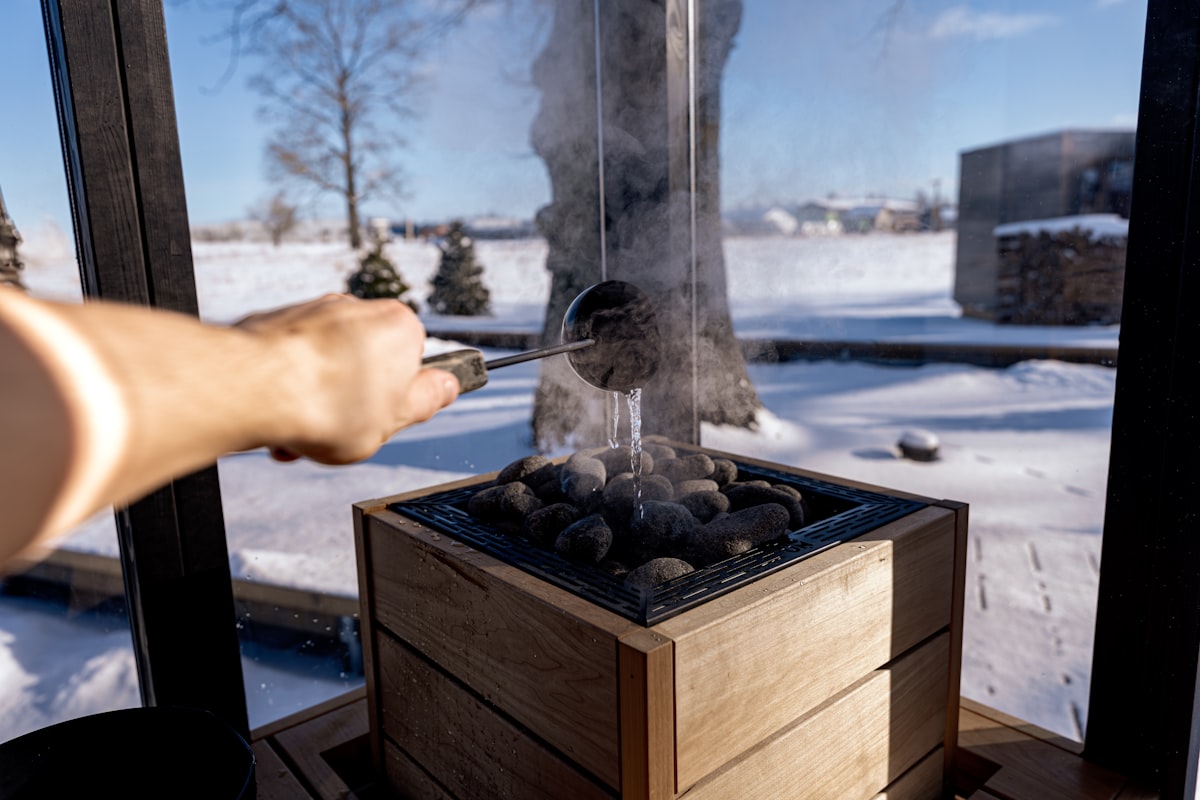
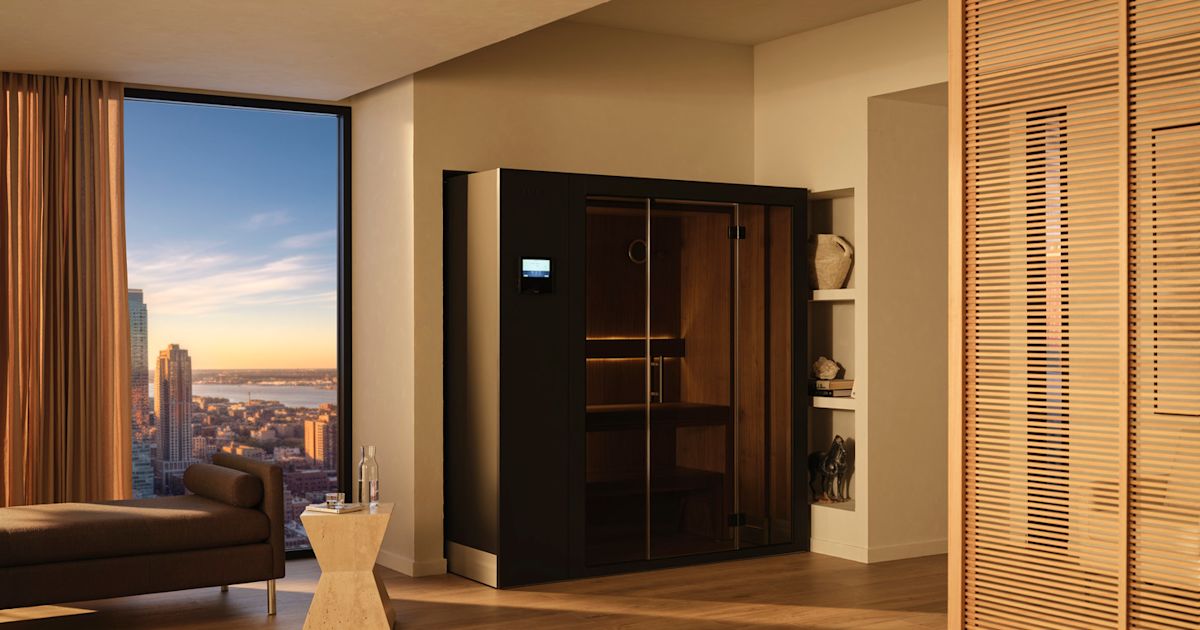
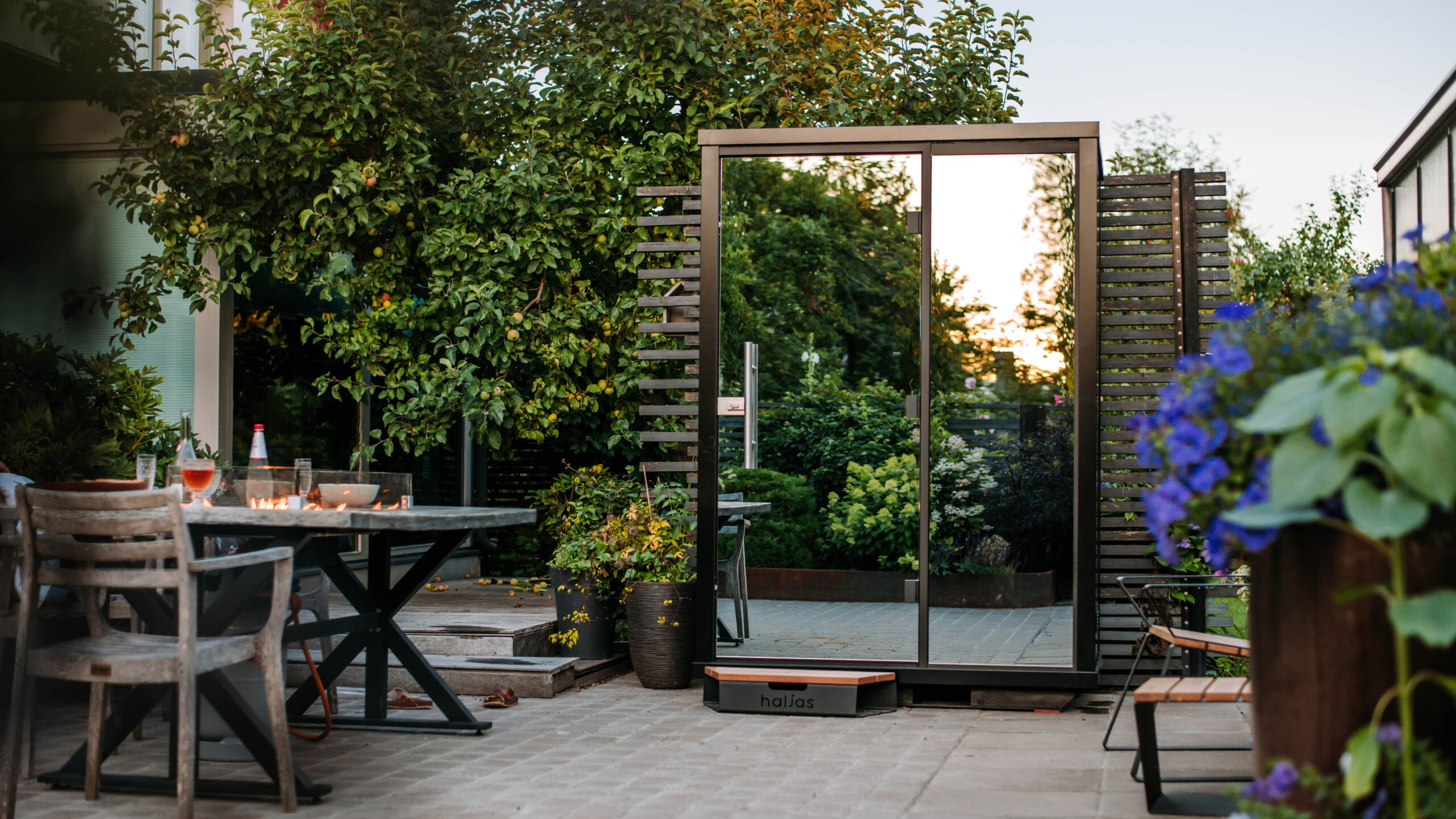
On paper, the Hele Nano reads like a conventional small sauna: thermo-alder interior, CLT (cross-laminated timber) structural panels, glulam posts, double-glazed mirror glass on the exterior. It seats two. It accepts a 3 to 6 kW electric heater. In the US, retailers pair it with a HUUM heater that complements the Nano’s compact interior.
But the real story is what the spec sheet implies rather than what it states. At 1,146 pounds and roughly 5 feet 3 inches long by 3 feet 9 inches wide, the Hele Nano ships fully assembled on a standard freight pallet. A pallet jack rolls it off the truck. Two people position it. That is the entire delivery process.
Larger prebuilt saunas sold in the US typically need a crane, a forklift, or both. That is not a minor distinction. Crane rental adds $500 to $1,500 to a residential installation, requires advance scheduling, and introduces the kind of logistical complexity that makes homeowners hesitate. The Nano sidesteps all of it.
The SaunaNews team has first-hand experience with the Hele Nano, and the build quality matches the design ambition. The mirror glass exterior gives it a presence that belies its footprint, and the thermo-alder interior produces a clean, even heat profile. It works indoors or outdoors, and because it arrived on a pallet jack, it can leave on one too: genuine portability for renters, renovators, or anyone who does not want a sauna permanently fixed to a foundation. An electrician is still required for the 240V connection, but that is the only professional trade involved in setup.
The Tarantula: design for the overlooked
The Tarantula firewood carrier is a different kind of design statement. Where most wood carriers are afterthoughts (a canvas bag, a metal rack from the hardware store), the Tarantula is an intentionally crafted object meant to sit beside a wood-burning sauna stove without clashing with the room it serves. It earned its Red Dot on the strength of that ambition: treating a mundane accessory as worthy of genuine design attention.
It is a smaller story than the Nano, but it speaks to the same design-first philosophy that increasingly separates European sauna manufacturers from their competitors. Every touchpoint matters, even the ones that carry firewood.
Estonia’s quiet streak
Haljas is part of a broader pattern in Estonian manufacturing. The country, with a population smaller than Philadelphia’s, has produced an outsized share of the world’s sauna hardware over the past decade. Companies like Thermory, HUUM, Saunum, and Auroom have built global distribution from Estonian production facilities. Haljas, founded in 2021 by CEO Otto Täht alongside CPO Karl Joonas and COO Rauno Palmi, is the newest entrant in that lineage, and three Red Dots in four years puts them on a design trajectory that more established competitors should watch.
The prebuilt and modular sauna segment is growing fast in the US, driven by buyers who want sauna access without the cost and timeline of custom construction. The Hele Nano sits at the intersection of that demand and the kind of design credibility that a Red Dot confers. It is not the cheapest prebuilt option on the market, but it may be the most thoughtfully resolved.
Why it matters
Three dynamics converge here. First, the US prebuilt sauna market is crowded but undifferentiated: most entries compete on price, not design. The Hele Nano competes on both delivery simplicity and aesthetic seriousness, backed by independent design recognition. Second, the no-crane delivery model is not a marketing talking point; it is a structural cost advantage for buyers. Removing crane logistics from a residential sauna installation saves hundreds of dollars and eliminates the single biggest friction point in the purchase decision. Third, Haljas’s pace of innovation (three awards with roughly five employees in four years of existence) signals a company operating well above its weight class.
Bottom line
Haljas Houses is a small company that keeps collecting big design trophies. The Hele Nano is now available in the US, where its combination of proven heater compatibility, genuine portability, and Red Dot credentials makes it one of the more interesting prebuilt options on the market. If you are shopping for a personal sauna that shows up on a pallet jack and still wins design awards, the shortlist just got shorter.
Correction, September 25, 2026: an earlier version of this article described the 2022 Red Dot winner, the Hele Glass (Hele Single), as a compact one-person sauna with a full glass front. It is an octagonal panoramic sauna with mirrored glass walls that seats up to seven around a central heater, per the Red Dot jury’s project page.