She Designs for MoMA and Louis Vuitton. Effe Asked Her to Rethink the Sauna.
Patricia Urquiola has designed for Cassina, the Four Seasons, and MoMA. Her new collaboration with Italian manufacturer Effe, a modular sauna and hammam system called Baluar, is the strongest signal yet that the thermal room is becoming an architecture problem.

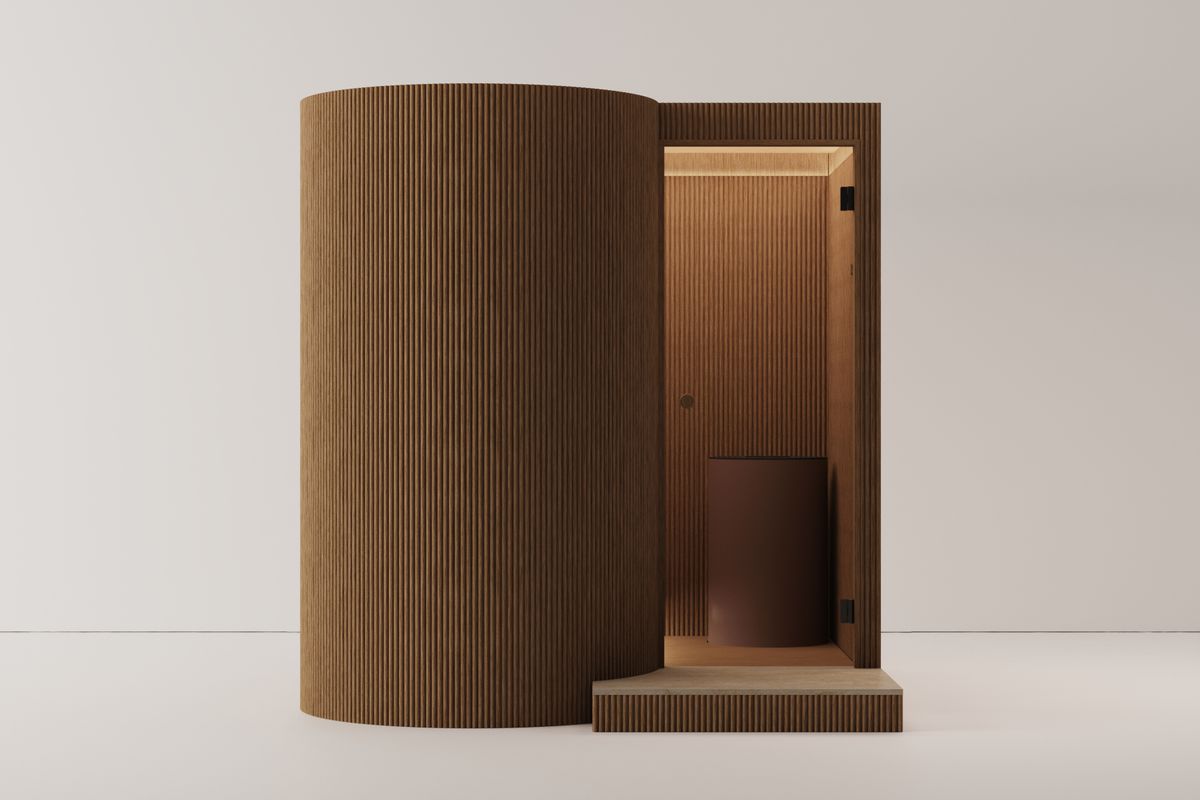
Effe Baluar modular sauna module in heat-treated linden wood, designed by Patricia Urquiola. Image courtesy of Effe.
Patricia Urquiola’s latest design project is a sauna.
That deserves a moment to land. Urquiola has been Creative Director of Cassina since 2015. She has designed for Louis Vuitton, Flos, Kvadrat, B&B Italia, Moroso, Agape, Kettal, and Mutina. Her architecture and interiors portfolio includes the Il Sereno Hotel on Lake Como, the Four Seasons Hotel Milan spa, and the Mandarin Oriental Hotel in Barcelona. Her work is held in the permanent collections of MoMA, the Victoria and Albert Museum, and the Vitra Design Museum. Studio Urquiola, the Milan practice she founded in 2001 with Alberto Zontone, works across industrial design, architecture, hospitality, retail, residential projects, and exhibitions.
And Effe, the 30-year-old Italian sauna and hammam specialist, just convinced her to rethink the thermal room.
The result is Baluar, a modular sauna and hammam collection unveiled at Salone del Mobile 2026. The collaboration is described as an ongoing partnership, not a one-off licensing arrangement. Wallpaper reported that Urquiola wanted to redefine the concept of wellness spaces by focusing on the relationship a person has with their own place of regeneration. Effe’s own language frames Baluar as a protected retreat: a compact volume that extends outward while sheltering an intimate interior.
In a global sauna market that Grand View Research estimates at $954 million in 2025, projected to $1.56 billion by 2033, the question of who designs the thermal room is becoming a question worth real money. The Global Wellness Institute values wellness real estate at $584 billion. At those numbers, the sauna is no longer a line item in the mechanical specification. It is becoming an architecture problem. And Effe just hired the kind of architect who solves problems at the highest level.
Key Facts
- Product: Baluar, a modular sauna and hammam collection.
- Manufacturer: Effe (Italy).
- Designer: Patricia Urquiola / Studio Urquiola.
- Debut: Salone del Mobile 2026, S.Project, Hall 22, Stand B11-B15.
- Format: Standalone sauna or hammam modules, or a paired sauna-plus-hammam system.
- Dimensions: Single module approximately 7 feet 3 inches square by 7 feet 7 inches tall. Paired system approximately 14 feet 5 inches by 7 feet 3 inches by 7 feet 7 inches tall.
- Materials: Heat-treated linden wood cladding (light and dark variants) with vertical ribbed surface. Hammam interiors in Conchiglia or Nocci mosaic.
What Effe Built
Baluar pairs a dry sauna and a wet hammam inside a compact architectural volume clad in ribbed, heat-treated linden wood. A single module occupies roughly 52 square feet. A paired configuration doubles that to about 104 square feet. The modules can stand alone, sit side by side, or integrate into a larger wellness area.
The design language draws on the bastion, a fortified medieval structure built to project strength outward while sheltering what is inside. The exterior cladding is heat-treated linden wood (sometimes translated as lime wood in European trade press; linden, lime, and basswood are all common English names for the Tilia genus), offered in light and dark variants with a vertical ribbed or grooved surface. Hammam interiors come in two mosaic finishes, Conchiglia and Nocci. Overhead lighting is integrated into the system.
Dimensional reporting from Il Bagno News puts a single module at about 7 feet 3 inches square by 7 feet 7 inches tall. The combined system measures about 14 feet 5 inches by 7 feet 3 inches by 7 feet 7 inches. Some trade outlets reported a single module as “220 sq cm,” which appears to be a conversion error rather than a publishable specification.
Why This Hire Matters
The sauna industry has not lacked for product. It has lacked for prestige. The typical thermal room is specified by a spa planner or a wellness equipment dealer, sourced from a catalog, and installed as a component. The architect who designs the building rarely designs the sauna. Urquiola’s arrival changes that dynamic.
Her network runs through architecture studios, luxury residential developers, and hospitality design firms. If Baluar reaches those channels, Effe competes less against other sauna catalogs and more against the broader question of what a designed room should look like. That is a different buyer, a different margin, and a different conversation entirely.
The Thermory Design Awards, which put sauna builders in front of an architecture-press audience for the first time this year, suggest that Effe is not alone in seeing this opportunity. But Effe is the first major manufacturer to put a name at Urquiola’s level on a modular thermal-room system. The closest comparison in strategy, if not in product, would be when luxury appliance brands began commissioning name designers to elevate the kitchen from utility to showroom. The sauna is having that moment now.
A Market Moving Toward Enclosure
Baluar also makes a specific argument about what the premium thermal room should feel like. Where much of the industry still leads with floor-to-ceiling glass, saunas that photograph well and let operators supervise occupancy, Effe’s design goes the other direction: enclosed, opaque, and deliberately heavy. The wood surface, the ribbed texture, and the architectural mass are the primary design elements. The experience is inside, not on display.
Across our reporting in the first half of 2026, SaunaNews has tracked a consistent shift in how architects and operators are specifying thermal rooms. The all-glass front that dominated commercial sauna design from roughly 2019 through 2024 is giving way to enclosed, low-stimulus environments built around what designers increasingly describe as meditative experience rather than visual spectacle. We have seen it in this year’s Thermory Design Award entries, where winning projects favored timber enclosure and indirect light over transparency. We have seen it in operator buildouts from New York to Manchester, where new rooms are darker, quieter, and deliberately harder to see into. Glass still has a place in supervision-heavy public facilities. But the premium end of the market is moving toward retreat. Baluar is designed for that current.
Where Effe Is Coming From
Baluar is not Effe’s first move toward design-led thermal rooms. The company sells integrated sauna-plus-hammam systems, standalone saunas, hammams, steam generators, and sensory showers for residential and public installations. Effe’s technical documentation notes that saunas and hammams have fundamentally different requirements: saunas use dry heat reaching 194 to 212 degrees Fahrenheit and rely mostly on wood construction, while hammams operate at lower temperatures with much higher humidity and require water-repellent materials throughout. Combining both programs in one modular system is a genuine engineering challenge, not a marketing conceit.
At Salone del Mobile 2025, Effe presented the Petra SH modular system, which combined sauna, hammam, and plunge-bath concepts. Wallpaper described Baluar as a continuation of that direction. Effe also showed its Cabanon outdoor sauna at the 2025 Elle Decor Alchemica exhibition, which Urquiola organized and art-directed. The Baluar collaboration formalizes a relationship that was already forming.
From Salone to Job Site
The design is persuasive. The question that follows is whether Effe can deliver the documentation that turns Baluar from a Salone presentation into a product architects and builders can actually permit and install.
In hospitality, multifamily, and high-end residential projects, the real footprint is the total room package. A dry hot room and a wet steam room need different materials, different drainage, different ventilation, and different service access. Add circulation space, mechanical access, and controls, and the installed footprint expands well beyond the module dimensions. Baluar may fit inside 52 square feet. The room it lives in will not. The modular commercial sauna conversation in the U.S. has moved toward factory-built rooms precisely because the utility package is easier to standardize when the whole assembly ships as a unit. Whether Effe intends Baluar to be factory-built, panelized, or site-assembled has not been disclosed.
In European manufacturing, where Effe builds, dual-climate thermal rooms are governed by CE marking and local codes. In North America, the path is less standardized. Effe lists IMQ, CE, SVGW, IEC-IECEE, and CSA among its general certifications, but whether Baluar carries UL, CSA, or ETL listing for North American projects has not been confirmed. The same gap extends to heater specifications, steam-generator details, electrical requirements, and drainage conditions. Effe does list a North America contact in Brooklyn and says it supports projects from concept through maintenance. For Baluar to succeed in the market Urquiola’s name opens, that support will need to include North American code compliance, installer training, and service logistics.
A useful reference: KLAFS’s S1, another premium compact sauna aimed at design-conscious buyers, already publishes exact dimensions, UL certification status, electrical requirements, and U.S. availability on its product page. The two serve different segments (KLAFS S1 is a retractable single-function sauna; Baluar is a modular dual-program system), but the contrast in documentation is instructive. For a trade increasingly focused on standards, the distance between a beautiful object and a specified product is measured in paperwork.
Effe made the most significant design hire the sauna industry has seen. The product that hire produced is ambitious, well-timed, and genuinely new in its format. What happens next is the part that has always separated Salone presentations from installed, operating rooms: the certification, the installer network, and the willingness to publish the details that make a beautiful object buildable. Urquiola brought the sauna into the architecture conversation. Effe’s job now is to keep it there.
Arlene Scott
Senior Wellness Correspondent & Hospitality Consultant
Arlene Scott brings over fifteen years of reporting and consulting experience across energy infrastructure, sustainable design, and thermotherapy-focused hospitality.
Full byline
Arlene Scott is a Senior Wellness Correspondent for SaunaNews.com, bringing over fifteen years of experience at the intersection of energy infrastructure, sustainable design, and thermotherapy. Her work focuses on the physiological benefits of passive heat therapies and the sustainable integration of sauna culture into modern wellness routines.
Arlene's background is rooted in the clean energy transition. She was a founding writer at MicrogridMedia.com, where she covered the technical and economic viability of desalination projects, microgrid deployments, and distributed renewable energy systems. During the mid-2010s, she was a regular contributor to Greentech Media (GTM) during its independent era — prior to the Wood Mackenzie acquisition in 2016 — reporting on the early integration of thermal energy storage and sustainable infrastructure.
Transitioning her focus from macro-energy systems to human-scale wellness, Arlene now applies her technical background to the hospitality sector. She operates as an independent consultant, advising boutique hotels and eco-resorts on the design, energy efficiency, and historical authenticity of commercial sauna and thermal spa installations. Her consulting work ensures that high-end wellness facilities balance traditional Nordic bathing principles with modern sustainable engineering.
Arlene holds a specialized certification in Applied Thermic Wellness from the Nordic Institute of Passive Heat Studies (NIPHS) and is a recognized associate member of the International Sauna Association (ISA). When she isn't reviewing the latest innovations in infrared technology or consulting on a new resort project, Arlene can be found tending to her own traditional wood-fired sauna in the Pacific Northwest. You can read her complete archive of essays on energy, wellness, and sustainable living at www.arlenescott.com.