Alexander Stubb Takes Sauna Diplomacy Into the NATO Era
Finland's president used sauna at Davos to explain de-escalation over Greenland. The better story is the pattern: three public sauna-and-cooldown references in six months, each tied to NATO posture, the Greenland dispute, a $6.1 billion icebreaker deal, or the global order.


Winter swimming in Helsinki, Finland. Stubb has used a Finnish sauna-and-cooldown formula in three public security or world-order settings since October 2025. Photo: Mika Ruusunen / Unsplash.
Alexander Stubb’s Davos sauna line was easy to treat as a Nordic joke. It reads differently after three public uses in six months.
Since October, Finland’s president has reached for the same Finnish-calm formula whenever the questions get hard: slow down, go to the sauna, cool the body, find the next move. The Davos version, on January 20, was the sharpest. Asked by Washington Post columnist David Ignatius how to defuse the Greenland dispute that was dominating the World Economic Forum, Stubb said: “Sometimes it’s good to slow down, go to the sauna, take a nice bath, and then find a solution.” When Ignatius pushed the thought toward Donald Trump, Stubb went one step further. “From golf diplomacy to sauna diplomacy.” The exchange is in the Washington Post Live transcript.
Most outlets ran it as a quip. Our read is that the line was more than a quip. It was the third documented use in six months of a near-identical sauna formula, attached to three different hard-security or world-order settings. Sauna was doing real work for Stubb.
What it was doing matters for the sauna industry, because the work was not wellness branding. It was Finland translating a posture for the NATO era: keep personal channels open, lower the temperature in public, treat a sovereignty fight as a security problem, and trust that ritual can do something that protocol cannot.
- What: Stubb invoked “sauna diplomacy” during a Washington Post Live interview at Davos while discussing Greenland, Trump, NATO, and Arctic security. (WaPo Live transcript)
- When: January 20, 2026, during the World Economic Forum’s annual meeting in Davos-Klosters. The forum theme was “A Spirit of Dialogue.”
- The pattern: Three documented public uses of Stubb’s sauna-and-cooldown formula in six months, attached to NATO posture, the Greenland dispute, and the global order. Sources: Reuters (Oct. 9, 2025), the Washington Post Live transcript (Jan. 20, 2026), and the Office of the President of Finland (Raisina Dialogue, March 2026).
- Why it matters for sauna: Stubb tied sauna to de-escalation in a live security dispute, not to lifestyle branding. That puts the practice inside a public conversation about NATO and the Arctic, where Finland has more than a cultural argument to make.
The Line Came During a Greenland Crisis, Not a Wellness Panel
Stubb was not speaking on a spa stage. He was in Davos during a week when Greenland, Denmark, the United States, NATO, and Arctic security were all colliding inside the same conference center.
The Office of the President of Finland said Stubb attended the World Economic Forum from January 19 to 22, joining high-level panels including one on European security and holding bilateral meetings with other heads of state. The Associated Press reported that Trump pushed for immediate negotiations to acquire Greenland from Denmark while saying he would not use force, and later signaled a new framework with NATO on Arctic security. Stubb publicly framed the best outcome as de-escalation, an exit route, and a stronger Arctic security component inside the alliance. He told Bloomberg he believed Greenland tensions could be “defused” by the end of the week.
That is the room the sauna line landed in. Not a wellness summit. A foreign-policy crisis playing out on global media.
The point for a sauna publication is not that sauna solved Greenland. No public source supports that. The point is that sauna became a live metaphor for de-escalation at the exact moment leaders were trying to keep a territorial dispute from breaking allies apart. That is not a small thing for a category that usually shows up in lifestyle media.
He Has Used the Same Line Before. Three Times.
The Davos quote was not a one-off.
On October 9, 2025, three months before Davos, Stubb stood next to Trump at the White House to sign a memorandum of understanding on icebreaker cooperation. Asked by reporters about assessments that Russia could invade a NATO country in coming years, Stubb told Reuters: “To be honest, I think people need to be a bit more Finnish, which means be calm, cool, collected, take a sauna or take an ice bath. Prepare.”
That was the first public use of the formula we can document, and it was attached to a hard-security question about NATO posture, not a cultural exchange.
The Davos line in January 2026 was the second. He swapped “ice bath” for “a nice bath,” added the “golf diplomacy to sauna diplomacy” pivot, and pointed it at the Greenland dispute.
The third use came in March 2026 at the Raisina Dialogue in New Delhi, where Stubb told an Indian audience that when things get tough, a Finn goes to sauna and takes an ice bath to clear the mind, take a breather, and understand what is happening in the world. Different stage, different audience, same formula.
Three documented uses, in Washington, Davos, and Delhi, across six months, all attached to crisis management. That is more than a quip. It looks like a deliberate diplomatic device.
For sauna readers, the pattern matters more than any single sentence. Stubb is using sauna and cold water as a repeatable metaphor for calm under pressure. He is using it to translate Finland to audiences that do not share Finland’s bathing culture. And he is using it precisely when other leaders would reach for tougher language.
Sauna Diplomacy Is Old. The Map Has Changed.
Sauna diplomacy is not new in Finland. What is new is what it now sits beside.
In a 2010 speech to the XV International Sauna Congress in Tokyo, then-Finnish Secretary of State Pertti Torstila walked through the canon. President Urho Kekkonen, who served for more than 25 years, kept guests in his sauna until they reached an agreement. In 1960, Kekkonen reportedly held Soviet leader Nikita Khrushchev in the sauna until 5 a.m., and the visit ended with Soviet support for Finland joining a free-trade area, opening Finland’s path to integration with the West. In 1978, when Soviet Defense Minister Dmitri Ustinov suggested joint Finnish-Soviet military maneuvers in the sauna, Kekkonen threw water on the stones and dismissed the idea. There was no Soviet rejoinder.
Torstila’s most-quoted line still explains why the practice travels. “In sauna all are equals,” he said. “There are no superpowers or minipowers in a sauna, no superiors or servants. You don’t keep your politics up your sleeve when you are not wearing sleeves.” The Finnish Sauna Society awarded the Ministry for Foreign Affairs its Löylynhenki Prize in 2011 for sauna diplomacy and Finnish diplomats. The award has been given since 1988.
That is the old version. The map underneath it has changed.
An open-access 2025 paper in Cooperation and Conflict by Bradley Reynolds, a senior researcher at the University of Turku, argues that Finland has spent the past 15 years deliberately re-narrating sauna diplomacy. In Reynolds’s reading, the practice moved from a Cold War curiosity that some American and Western European diplomats viewed as “Eastern” or “oriental” to a recognized symbol of Finland as a responsible Western actor. Diplomatic sauna clubs now operate on the Washington, London, Brussels, and Berlin circuits. The Finnish Diplomatic Sauna Society in Washington has run since 2008 and is, according to Foreign Policy’s 2023 feature, one of the more sought-after invites in the city.
The Brussels version paused last spring. Politico reported in April 2025 that the famed sauna inside Finland’s permanent representation, which has hosted Stubb in his earlier roles and inspired copycats inside the Berlaymont and at NATO HQ, closed for an estimated year of renovations. The Finnish mission said the Diplomatic Sauna Society would carry on at the ambassador’s residence and other Brussels saunas. The institution traveled with the people, not the building.
What changed at Davos is that the new sauna diplomacy is also a public signal, delivered on a global media stage, in plain English, by a NATO-era president. Reynolds calls it a “re-narration.” In our read, that is the right word for what Stubb is doing in real time.
The NATO-Era Version Is About Arctic Security
Stubb could make the sauna line because Finland had more to offer than a cultural image. The harder argument was already on the table.
Finland joined NATO in 2023. By Davos 2026, Stubb was talking about Arctic defense from inside the alliance. In recent interviews he has set out the case in concrete terms: roughly one million Finns trained through obligatory military service, a force the country can mobilize for Arctic conditions, the largest artillery in Europe alongside Poland, and a fighter fleet moving from 62 F-18s to 64 F-35s. Finland’s defense posture, in his framing, is built on Arctic capability.
The industrial side of that argument was signed in October.
The October 9, 2025, memorandum of understanding between the United States and Finland set the framework for up to 11 new medium icebreakers, formally classed as Arctic Security Cutters. According to the Finnish Government, Reuters, and the White House Fact Sheet, four are slated for construction in Finland, with seven more in U.S. shipyards using Finnish design and expertise. The total deal value reported by maritime trade press is approximately $6.1 billion, with the first vessel targeted for delivery by 2028. The Finnish-built ships are split between Helsinki Shipyard, owned by Canada’s Davie, and Rauma Marine Constructions. The U.S. side involves Bollinger Shipyards in Houma, Louisiana, and Davie’s recently acquired yard in Texas, working with Finnish design partner Aker Arctic and Canadian builder Seaspan.
For context: Finland’s government has previously said Finnish companies designed about 80% of the world’s existing icebreakers and built about 60% of them. The U.S. Coast Guard had two operational Arctic Security Cutters before the deal. Russia operates roughly 40 icebreakers, including nuclear heavy units. China runs five medium icebreakers and has been pushing into Arctic waters.
- 3 - Documented Stubb uses of the sauna-and-cooldown formula in six months (Washington, Davos, New Delhi)
- 11 - Arctic Security Cutters covered by the U.S.-Finland memorandum signed October 9, 2025
- $6.1 billion - Reported total deal value, the largest icebreaker order in years
- 4 in Finland, 7 in U.S. - Construction split, with Helsinki Shipyard and Rauma Marine in Finland and Bollinger in Louisiana plus Davie in Texas
- 2028 - Targeted delivery of the first vessel
- 62 to 64 - Finland’s fighter fleet, moving from 62 F-18s to 64 F-35s alongside the largest artillery in Europe (with Poland)
This is why the Davos exchange lands differently than a standard cultural anecdote. Finland’s sauna diplomacy now sits beside NATO membership, Arctic defense, a multi-billion-dollar industrial agreement, and named American shipyards. The sauna line softens the tone. The country behind it is making hard-security arguments and turning them into memoranda, contracts, and shipyard work.
Golf Won the Audience. Sauna Is Branding the Solution.
The other half of Stubb’s pivot, “from golf diplomacy to sauna diplomacy,” was not random.
Ignatius opened the Davos session by introducing Stubb as a former member of Finland’s national golf team and described the golf connection as part of why Stubb has unusually personal access to Trump among foreign leaders. Stubb gave the careful diplomatic answer: for a small country, personal relationships matter, and forming a channel with a U.S. president on a golf course or anywhere else can be useful.
That answer was not theoretical. Stubb visited Trump unofficially in March 2025, played a round at Trump’s golf club, and spent roughly seven hours together. Trump publicly called Stubb a championship-caliber partner. According to a September 2025 essay by the Zebr Institute, by the end of that day Trump had committed to buying icebreakers from Finland. The October 9 MOU was the formal version of an agreement that started with a personal afternoon and an athletic resume.
Read in that order, the line at Davos resolves into something more interesting than wordplay. Golf was the personal channel that won Trump’s attention. Sauna is the older, broader Finnish channel that brands the solution. One leader, one room, one round wins the audience. A country’s ritual brands the cool-down. Stubb at Davos was telling a global audience that Finland’s diplomatic toolkit has both, and that both are meant to lower temperature, not raise it.
One media-intelligence analysis of Davos 2026 coverage, built from Omniscan data, ranked Stubb among the more visible European leaders at the forum, with 1,274 quotes and high positive sentiment. We treat that as directional media context rather than proof of strategy. The pattern of three documented sauna uses in six months is the harder evidence.
What Sauna Operators Should Hear
It is fair to read this far and wonder what NATO and icebreakers have to do with a U.S. bathhouse P&L. The connection is brand authority. Country-level cultural authority does not transfer automatically to a bathhouse, hotel spa, heater brand, or recovery club. Stubb can use sauna this way because Finland has a long, specific, and earned claim to the practice. The credibility comes from context: ritual, equality, restraint, heat, cooling, and a shared understanding that sauna is a serious place even when the setting is informal. Strip the context and you do not get a softer power move. You get a wood-clad room.
That is useful for the U.S. industry, because the U.S. sauna market often flattens sauna into a generic recovery amenity. The Davos moment points in the other direction. Sauna becomes more valuable, not less, when it is specific enough to carry meaning beyond temperature.
Three operator-level reads come out of this story.
The first is that ritual is a form of trust. The room works because people understand how to behave inside it. We have argued this before in our coverage of Aufguss as a U.S. operator playbook: the show is the product, but only because the rules and pacing of the room are.
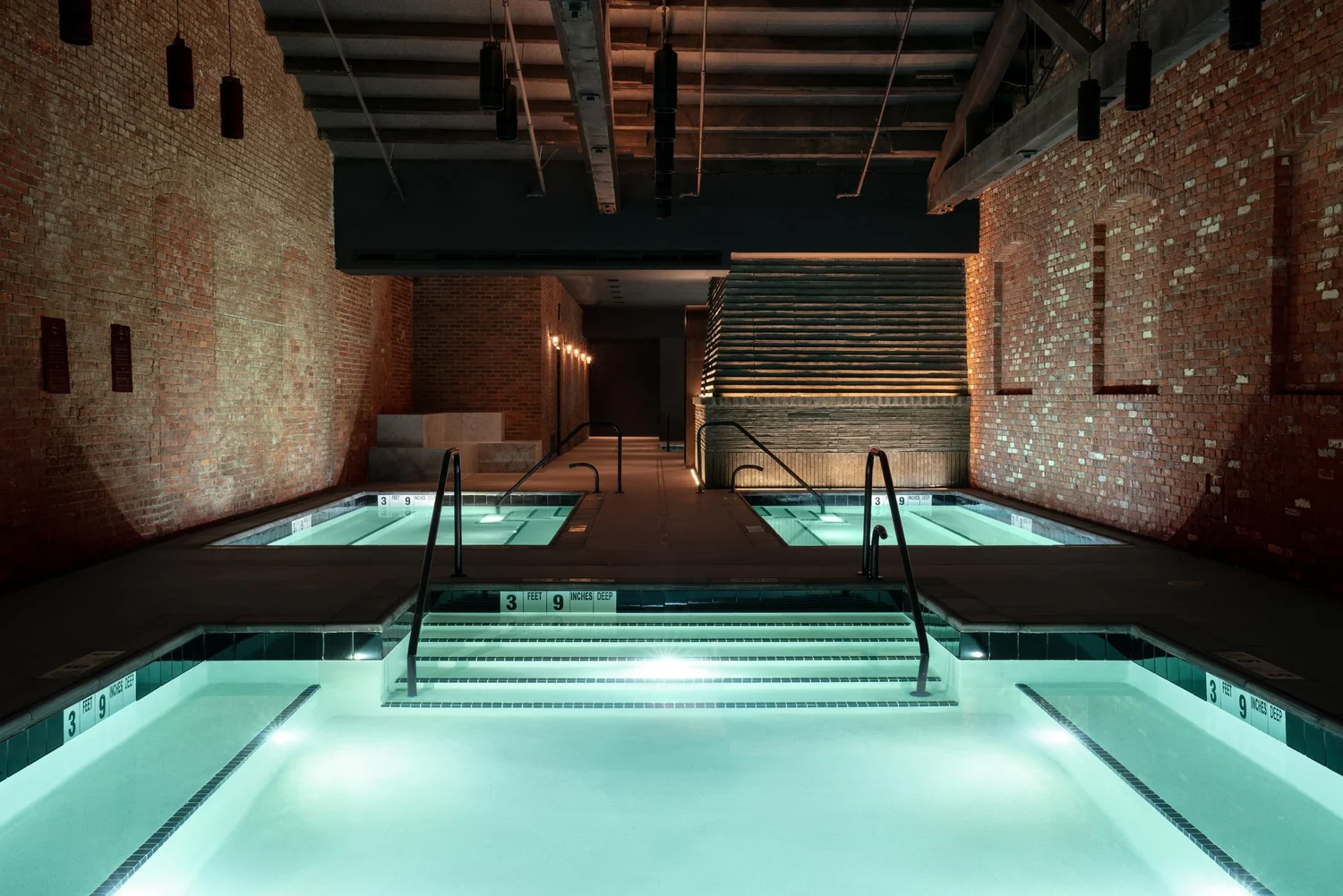
The second is that authenticity is operational before it is visual. A cedar box with Nordic words on the wall is not the same as a bathing practice with rules, sequence, and social meaning. World Spa’s bet in Brooklyn is interesting precisely because the authenticity shows up in materials, room logic, and circuit design rather than only in interior moodboards. Paris’s Sant Roch makes a related bet on the other axis: the operators sell only half their sauna seats to protect the ritual. Both choices treat ritual like an operating system, not a vibe.
The third is that small-country authority is earned by specificity, and lost by dilution. Estonia built global manufacturing weight by being concrete about what it does well. Finland has built diplomatic weight the same way. Finnish sauna expert Lassi Liikkanen has been clear with us about the design mistakes Americans keep making, and most of them come from copying the visible parts and skipping the operational ones. Stubb’s Davos line works because Finland has not skipped them.
The takeaway for U.S. operators is not to copy Finnish diplomacy. It is to understand why the Finnish example has authority in the first place.
What Remains Unknown
Two points need discipline.
First, no public source confirms that Stubb formally invited Trump to a real sauna. The Washington Post transcript shows Ignatius suggesting that getting Trump into a sauna would achieve something, followed by Stubb’s “golf diplomacy to sauna diplomacy” line. Several secondary outlets compressed that exchange into a flat invitation. The transcript is more cautious. We are reading it the same way the transcript reads.
Second, the English transcript says Stubb referred to sauna and a “nice bath.” His earlier Reuters comment in October said “take a sauna or take an ice bath,” and his later Raisina Dialogue speech in March used the more recognizable Finnish pairing of sauna and ice bath. Finnish coverage, including Sauna-lehti’s framing of the moment, has rendered the same thought as sauna plus avanto, the winter ice hole. That distinction matters. We are quoting each occurrence as it appeared, and we are not retrofitting the more vivid Finnish image onto the Davos transcript.
There is also a larger caution worth keeping in view. Reynolds’s 2025 paper warns that diplomatic prestige can become bluff when appearance outruns substance. Some Finnish diplomats interviewed for earlier academic work on sauna diplomacy were even more direct: in their experience, sauna diplomacy is closer to hosting and trust-building than to hardline peace brokering. That nuance should travel with this story. Sauna can lower the temperature in a room. It does not solve Greenland, Ukraine, or the Arctic by itself. It does not replace policy, military capability, treaty language, or the consent of the people whose territory is being discussed.
Stubb’s Davos line was sauna news because it showed sauna operating at the highest level of public language: not as wellness content, but as Finland’s shorthand for trust, restraint, and de-escalation. In the NATO era, sauna diplomacy is no longer only a Cold War memory or an embassy novelty. It is part of how Finland explains itself as an Arctic security actor and how a small country secures industrial standing with a much larger one.
The sauna did not solve Greenland. It did something smaller and more believable. It gave Finland a human way to argue for cooling the room before the room caught fire. For U.S. operators, the lesson is the same one our archive keeps surfacing: authenticity is operational before it is visual, and the brands that earn cultural weight will be the ones that treat the room like an operating system, not a backdrop.
Arlene Scott
Senior Wellness Correspondent & Hospitality Consultant
Arlene Scott brings over fifteen years of reporting and consulting experience across energy infrastructure, sustainable design, and thermotherapy-focused hospitality.
Full byline
Arlene Scott is a Senior Wellness Correspondent for SaunaNews.com, bringing over fifteen years of experience at the intersection of energy infrastructure, sustainable design, and thermotherapy. Her work focuses on the physiological benefits of passive heat therapies and the sustainable integration of sauna culture into modern wellness routines.
Arlene's background is rooted in the clean energy transition. She was a founding writer at MicrogridMedia.com, where she covered the technical and economic viability of desalination projects, microgrid deployments, and distributed renewable energy systems. During the mid-2010s, she was a regular contributor to Greentech Media (GTM) during its independent era — prior to the Wood Mackenzie acquisition in 2016 — reporting on the early integration of thermal energy storage and sustainable infrastructure.
Transitioning her focus from macro-energy systems to human-scale wellness, Arlene now applies her technical background to the hospitality sector. She operates as an independent consultant, advising boutique hotels and eco-resorts on the design, energy efficiency, and historical authenticity of commercial sauna and thermal spa installations. Her consulting work ensures that high-end wellness facilities balance traditional Nordic bathing principles with modern sustainable engineering.
Arlene holds a specialized certification in Applied Thermic Wellness from the Nordic Institute of Passive Heat Studies (NIPHS) and is a recognized associate member of the International Sauna Association (ISA). When she isn't reviewing the latest innovations in infrared technology or consulting on a new resort project, Arlene can be found tending to her own traditional wood-fired sauna in the Pacific Northwest. You can read her complete archive of essays on energy, wellness, and sustainable living at www.arlenescott.com.