Heat, Cold, and the Question Science Hasn't Actually Answered
A new narrative review in the International Journal of Biometeorology asks the contrast-therapy boom a question its marketing has been quietly avoiding, while several million Finns continue to ignore it.


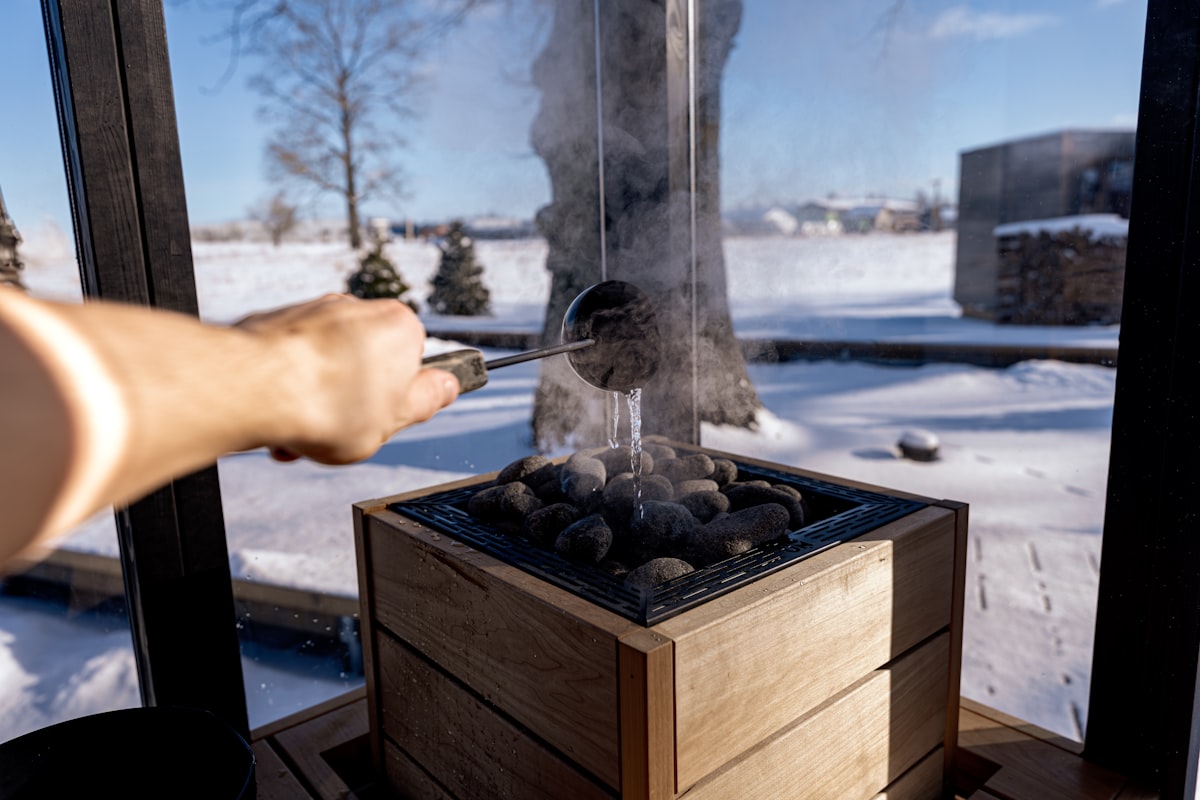
Cold plunges have moved from Finnish lakes to American studio amenities in less than a decade. Photo: Unsplash.
If you have walked into a wellness studio in the last eighteen months, whether in Manhattan or Manly, Paris or Denver, you have heard some version of the same pitch. Sit in the heat. Plunge in the cold. Repeat. The combination, you will be told, does something that neither modality can do alone. A vascular pump. A nervous-system reset. Recovery on a different timescale.
A new review in Springer Nature's International Journal of Biometeorology does not say any of that is wrong. It says, more pointedly, that nobody has actually proven it.
Heat and cold interventions: unveiling synergistic and counteractive mechanisms for health benefits, the narrative review published March 27 by Wafa Douzi, Erich Hohenauer, Benoit Dugué and colleagues, lands in a moment when the contrast-therapy industry is sprinting ahead of the science. Studios are opening at a clip across three continents, and regulators are still figuring out how to classify them. Manufacturers are racing to bundle saunas and cold plunges as integrated products. Consumers are paying premium prices for the assumption that hot-then-cold is meaningfully greater than the sum of its parts.
The paper's central claim is more cautious than any of that. "Although the effects of heat and cold exposures have been widely investigated," the authors write in the abstract, "it remains uncertain whether combining these two stimuli offers greater, lesser, or simply different benefits compared with each modality alone. Relatively few studies directly compare these protocols."
In a field where confidence is sold by the session, that sentence is the news.
Who wrote it, and why their priors matter
The corresponding author, Wafa Douzi, is an associate professor at the MOVE laboratory at the University of Poitiers in France, a research group that has spent more than a decade studying how cold exposure affects autonomic, cardiovascular, and respiratory function in athletes and patients. Her doctorate, completed in 2018, was titled The Use of Cold in the Context of Recovery and Physical Exercise.
Her co-author Erich Hohenauer leads research at SUPSI in southern Switzerland and is the first author of the foundational 2015 PLOS One meta-analysis on post-exercise cryotherapy. Last year he published a randomized controlled trial in women that found neither cold-water nor hot-water immersion accelerated recovery from exercise-induced muscle damage compared with a control group, a result that ought to give every operator who sells either modality some pause.
The third senior author, Benoit Dugué, is a long-running cryostimulation researcher at MOVE and co-edited Springer's 2024 reference book on whole-body cryostimulation.
This matters because none of these researchers are sauna industry voices. They are, if anything, sympathetic skeptics: scientists who have built careers on cold exposure and post-exercise recovery, and whose collective body of work has consistently found that the subjective benefits of these modalities (people feel better) tend to outpace the objective benefits (measurable physiological recovery markers move less reliably).
A narrative review by these three authors, in other words, is not a promotional document. It is an audit.
What the paper agrees with
The individual cases for heat and cold are not what is in question. The abstract is explicit: "Thermal strategies such as cold exposure and sauna bathing have been used for centuries to enhance recovery, with documented effects on improving cardiovascular health, reducing inflammation, and improving well-being."
For sauna specifically, the evidence base is substantial. The Finnish Kuopio cohort under Jari Laukkanen has produced two decades of observational data linking frequent sauna use to lower cardiovascular and all-cause mortality. A separate January 2026 review in Quality in Sport described the cardiovascular mechanisms in detail, including improved endothelial function, lowered arterial stiffness, and blood-pressure reductions that compound with frequency. Cold exposure has its own well-mapped effects: a sympathetic surge followed by a parasympathetic rebound, brown-fat activation, anti-inflammatory signaling, and a documented improvement in subjective recovery markers like delayed-onset muscle soreness.
Neither of those bodies of evidence is what the new review challenges. What it challenges is what happens when you put them together.
The synergy question
The popular theory, repeated across studio websites, manufacturer marketing pages, and social-media protocol guides, is that heat and cold combine into a vascular pump. Sauna dilates blood vessels. The cold plunge constricts them. The rapid alternation, the theory goes, drives circulation, flushes metabolic waste, and trains the cardiovascular system in ways that single-modality exposure cannot.
The Douzi review treats this as a hypothesis, not a settled finding. The abstract notes that the paper "explores their individual and combined physiological mechanisms" and "examines how contrast therapy may induce synergistic benefits or potentially negate the effects of each modality."
The two operative words there are may and or.

What the surrounding 2024 to 2026 literature suggests, however, is that synergy is real for some outcomes and absent (or actively counterproductive) for others. A 2024 network meta-analysis in BMC Musculoskeletal Disorders found that contrast water therapy was the single most effective intervention for recovering creatine kinase, a marker of muscle damage. But for soreness and jump performance, cryotherapy alone outperformed it. A 2023 Sports Medicine review found that air cryotherapy beat cold-water immersion for muscular strength and immediate power, with both single-modality cold approaches generally outperforming contrast.
In other words: the evidence supports a more granular reading of contrast therapy than "better than the sum of its parts." It is sometimes better. Sometimes equivalent. Sometimes worse.
The counteractive question
The more uncomfortable claim the new paper raises is that the two modalities can interfere with each other. "The opposing physiological responses of each therapy may interfere with each other," the authors write, "thereby compromising their effectiveness."
The clearest case in the existing literature is muscle adaptation. A 2022 review in Sports Medicine - Open by Chaillou and colleagues, cited in the Douzi paper's reference list, found that chronic post-exercise cooling, applied repeatedly across weeks, measurably blunts strength adaptations from resistance training. The cold reduces the inflammatory and reactive-oxygen signals that the body uses to remodel muscle. Used acutely after a single workout, this may not matter. Used as a daily habit by someone who lifts, it does.
This is not a theoretical caution. It is a documented effect, and it directly contradicts a piece of advice repeated in countless contrast-therapy guides: cold immediately after sauna, immediately after lifting, every day.
What is missing from most marketing
The consequence of all this, and the reason the new review will be uncomfortable reading for parts of the industry, is that several confident claims in current contrast-therapy marketing are not actually settled science.
- The 3:1 hot-to-cold ratio. No comparative trials have established it as optimal.
- Always end on cold. A common protocol heuristic, popularized by the Søberg principle, but not the product of a randomized controlled trial.
- Heat-then-cold, never cold-then-heat. Heat-first is the dominant approach in research, but the reverse sequence has been understudied rather than disproven.
- Faster than the sum of its parts. The exact claim the new review identifies as unsupported.
A studio operator is not lying when they tell members these things. They are repeating common knowledge that has settled into the practice. The honest update, and one that this paper invites, is to add one word: plausibly. Plausibly faster. Plausibly synergistic. Plausibly optimal. The evidence stops short of proven.
What the review does not say
It is worth being precise about what this paper is not. It does not say contrast therapy is useless. It does not tell people to stop. It does not contradict the established benefits of sauna alone or cold immersion alone. It is a narrative review, a synthesis of existing studies rather than new data, and its central conclusion is that direct comparative trials are scarce and that the field needs more rigorous research on which protocols actually optimize which outcomes.
What the review is asking for is intellectual honesty. The contrast-therapy boom, with new studio openings in Paris, Quebec, and Australia, the integrated heat-and-cold product lines from Sun Home and Clearlight, and the membership models from XtraClubs and ROK SPAS, is built on a story about combined modalities that the underlying research has not fully validated. That commercial energy is part of the same broader shift in which contrast-therapy studios are competing for evening hours against bars and restaurants, not just gyms.
That does not make the practice wrong. It makes the storytelling premature.
What centuries of Finnish practice do that the labs do not measure
One thing the contrast-therapy debate often loses is that the practice is not new and was not invented in California. Finns have been alternating intense heat with cold-water immersion for centuries, frequently by cutting a hole in a frozen lake (the practice is called avantouinti) and dipping after a sauna session. Finland has roughly three million saunas serving five and a half million people, more saunas than cars, and active winter-swimming associations whose memberships run well into five figures.

The Kuopio cohort that produced the foundational sauna mortality data is drawn from a population in which post-sauna cold dipping is a normalized cultural practice. The outcomes that body of work measures are also different from what the recovery literature looks at. Not creatine kinase or vertical jump, but lower cardiovascular mortality, lower all-cause mortality, lower dementia incidence, and reduced risk of pneumonia, all observed across two decades of follow-up.
If contrast bathing were physiologically counterproductive in a meaningful way, those signals would be very hard to explain.
That is not a refutation of the Douzi review. The Finnish data is observational, the Kuopio researchers themselves are careful about causal claims, and the cold-dip component cannot be cleanly separated from the sauna component or from the broader Finnish lifestyle. But it does suggest that the question the lab review asks, which is whether contrast therapy adds up to more than its parts on a recovery timescale, may not be the only question worth asking.
The mood story the recovery science does not capture
There is a more uncomfortable possibility that the recovery framing tends to miss. A 2000 paper in the European Journal of Applied Physiology by Šrámek and colleagues measured what cold-water immersion does to circulating catecholamines, the neurochemicals associated with arousal, focus, and drive. Noradrenaline rose by roughly 530 percent. Dopamine rose by roughly 250 percent. Both stayed elevated for an hour or more after the dip. Subsequent work, including studies popularized by the Danish researcher Susanna Søberg, has reproduced the basic finding.
That subjective shift, often described by practitioners as a clean and surprisingly long-lasting high, may be the part of the contrast experience that most reliably works. It is also the part that best explains why the ritual persists culturally, even when the muscle-soreness and jump-test data are mixed.
It is worth saying this dimension out loud because it is not small. Finland has been ranked first in the World Happiness Report every year since 2018. That ranking is driven by many factors that have nothing to do with bathing: social trust, low corruption, generous public services, predictable institutions. No serious researcher would credit the lakes alone. But the Finnish lifestyle as a system, including the near-universal availability of saunas and the cultural habit of post-sauna cold dipping in winter, is at least adjacent to the mood-regulation effects that the cold-exposure literature documents at the level of individual neurochemistry.
None of this answers the synergy question the new review raises. It does suggest, however, that the question itself may be slightly miscalibrated. If the recovery markers are mixed, the cardiovascular and longevity signals are strong, and the mood effects are real, the right framing is probably not "does contrast therapy add up to more than the sum of its parts?" but rather "more of what, and over what timescale?"
The Douzi review is asking the lab question. The Finnish answer is the population question, accumulated over generations rather than weeks. They are not the same question, and they should not be expected to have the same answer.
What to do with this if you are a reader
Three practical takeaways for SaunaNews readers, drawn from the review and the surrounding literature:
One. If the goal is the cardiovascular and longevity benefits associated with regular sauna use, the evidence for sauna alone is well-established. Adding a cold plunge is not necessary to achieve them.
Two. If the goal is athletic recovery, the evidence is genuinely mixed and depends on what you are recovering from. Subjective soreness reductions are well-supported. Objective performance recovery is less consistent. And if you are chronically lifting and chronically cold-plunging immediately after, you may be working against yourself.
Three. If the goal is the contrast experience itself, including the ritual, the alertness, and the feeling of having done something, the science neither confirms nor denies that you are getting a uniquely valuable physiological dividend on top of what each modality offers separately. You may simply be enjoying it. That, too, is a reasonable thing to pay for. Just call it what it is.
The Douzi, Hohenauer, and Dugué review will not end the contrast-therapy boom. Nor should it. What it should end is the casual confidence that the science is settled. It is not. The honest version of the practice, the version SaunaNews would like to see operators and brands move toward, would say so out loud, and would also acknowledge that several million Finns figured out the basic shape of this ritual long before any wellness studio existed to charge a membership for it.
Arlene Scott
Senior Wellness Correspondent & Hospitality Consultant
Arlene Scott brings over fifteen years of reporting and consulting experience across energy infrastructure, sustainable design, and thermotherapy-focused hospitality.
Full byline
Arlene Scott is a Senior Wellness Correspondent for SaunaNews.com, bringing over fifteen years of experience at the intersection of energy infrastructure, sustainable design, and thermotherapy. Her work focuses on the physiological benefits of passive heat therapies and the sustainable integration of sauna culture into modern wellness routines.
Arlene's background is rooted in the clean energy transition. She was a founding writer at MicrogridMedia.com, where she covered the technical and economic viability of desalination projects, microgrid deployments, and distributed renewable energy systems. During the mid-2010s, she was a regular contributor to Greentech Media (GTM) during its independent era — prior to the Wood Mackenzie acquisition in 2016 — reporting on the early integration of thermal energy storage and sustainable infrastructure.
Transitioning her focus from macro-energy systems to human-scale wellness, Arlene now applies her technical background to the hospitality sector. She operates as an independent consultant, advising boutique hotels and eco-resorts on the design, energy efficiency, and historical authenticity of commercial sauna and thermal spa installations. Her consulting work ensures that high-end wellness facilities balance traditional Nordic bathing principles with modern sustainable engineering.
Arlene holds a specialized certification in Applied Thermic Wellness from the Nordic Institute of Passive Heat Studies (NIPHS) and is a recognized associate member of the International Sauna Association (ISA). When she isn't reviewing the latest innovations in infrared technology or consulting on a new resort project, Arlene can be found tending to her own traditional wood-fired sauna in the Pacific Northwest. You can read her complete archive of essays on energy, wellness, and sustainable living at www.arlenescott.com.