
World Spa’s Big Bet Is Authenticity at Scale

By Arlene Scott
Correspondent, Research and Industry
- Published
- Reading time
- 9 min
SaunaNews is published by SaunaShare, Inc., which also runs SaunaShare.com and SaunaMarketplace.com, where we sell many of the products we write about. That experience may change what we write about and what we don't. Who owns SaunaNews · The ownership announcement
Brooklyn’s 50,000-square-foot World Spa puts Russian banya, Finnish sauna, Moroccan hammam, Turkish hammam, clay-and-hay heat, Japanese-style onsen pools, snow-room cooling, dining, events, and private rentals in one three-story building. It is harder to build and harder to copy than a two-hour contrast club.
In this story6 sections
World Spa in Brooklyn is a 50,000-square-foot, three-story urban bathhouse that puts Russian banya, Finnish sauna, Moroccan hammam, Turkish hammam, clay-and-hay heat, Japanese-style onsen pools, snow-room cooling, dining, events, and private rentals under one roof. It is harder to build and harder to copy than a two-hour contrast club.
Leonid Khanin, World Spa’s co-founder and design director, recently described the project less as a replica of the bathhouses he knew growing up and more as a correction to them. In a webinar with Cedar & Stone Nordic Sauna, he recalled older post-Soviet bathhouses as culturally powerful but often hard to enjoy. World Spa keeps the ritual, adds hospitality, and explains the rooms to first-timers without stripping out the traditions behind them.
US bathhouses are splitting into distinct formats. Some operators are building event-led, nightlife-adjacent formats. Luxury hotel groups are treating thermal suites as primary draws rather than spa add-ons. World Spa is a third kind: the large-format urban bathhouse, which competes on breadth, dwell time, and serving several kinds of visit under one roof rather than on programming or a single signature room.
Video context: This Finlandia Foundation panel includes Leonid Khanin of World Spa and was published on YouTube as part of National Sauna Week programming.
A bathhouse built like a museum
The project turned a disused Brooklyn parking lot into a 50,000-square-foot, three-story wellness facility after nearly a decade of work by BK Developers and RYBAK Development. The mandate, according to the company, was total authenticity, with materials and equipment sourced directly from the traditions being interpreted.
Khanin’s design background helps explain why the place reads differently from a typical American day spa. In the webinar, he framed the goal as building something interactive, an experience people would feel with their bodies and with their skin rather than only understand intellectually. His museum and immersive-design background shows in the way World Spa organizes the property as a sequence of rooms, each with its own material language, thermal profile, scent palette, and sonic identity.
World Spa includes a Grand Banya and Petite Banya, an Event Sauna, Clay & Hay Sauna, Infrared Sauna, Aroma Sauna, Moroccan Hammam, Turkish Hammam, Snow Room, Himalayan Salt Room, hydrotherapy pool, vitality pool, onsen pools, cold plunge, private hammam rooms, and private Venik Platza rooms. Each room has its own heat and humidity settings.
Imported tile, kelo pine and European equipment
The company says it imported handmade Moroccan and Turkish tiles for its hammams, Kelo pine from Northern Europe for its saunas and banyas, and equipment from European manufacturers specializing in thermal environments.
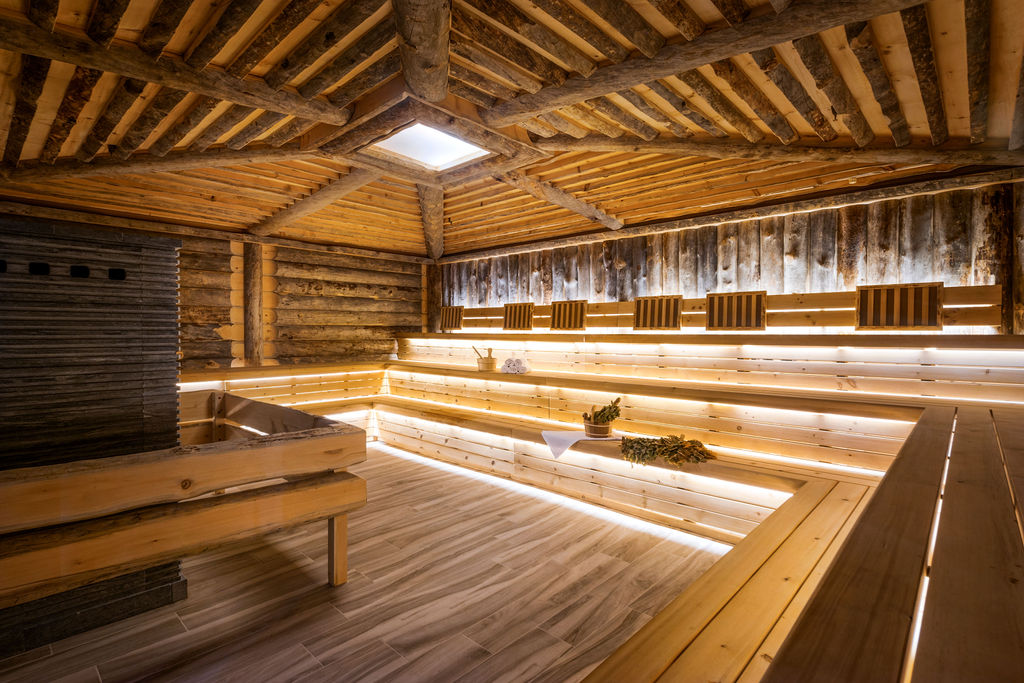
The sourcing is most visible in the Grand Banya. World Spa describes it as operating at 176°F to 194°F and 60% humidity, and says the room is built from rough kelo wood. The room copy also calls it the largest banya in the US. Nearby, the Event Sauna runs at 160°F to 194°F and 10% humidity and is built around group aufguss programming rather than solitary use. The Clay & Hay Sauna goes another way, using handmade adobe-style walls, a custom German heater, and a scheduled herbal bucket ritual to create a very different sensory profile.
The project is translational rather than purist. In the webinar, Khanin described wanting the environments, materials, and craft of the source cultures, but also a level of beauty and welcome that would make the rooms work for Brooklyn now, and for more than insiders who already know the code. World Spa is not Sanduny transported whole into Midwood. It is a hospitality version of the source traditions, staged for a wider audience.
Treatments sit on top of the circuit
At a standalone bathhouse the product is the circuit, not the treatment room. World Spa’s official site repeatedly nudges guests toward sequencing: heat, cool down, rest, repeat. The Snow Room is positioned as a gentler alternative to cold plunging; the onsen trio spans 52°F, 101°F, and 104°F; the Event Sauna is paired with nearby experiential showers; the hammams are framed as part of a broader hot-cold sequence.
Design for Leisure, which worked on the project, has argued for years that guests want hydrothermal circuits and that self-service thermal areas can produce stronger returns than labor-heavy treatment rooms that sit idle. The Global Wellness Institute’s hydrothermal standards describe these spaces as technically demanding, capital intensive, and unforgiving if underplanned, and, when done correctly, as the main attraction rather than a side amenity.
World Spa layers treatments on top of the circuit. The property offers 70-plus treatments, but it also has a lounge, a members club, private event lodges, cabanas, and private rental formats that turn a visit into a four-hour-or-longer occasion instead of a 50-minute appointment. On its private-events page, the company pitches corporate meetings, birthdays, wine tastings, and product launches.
Close to 200,000 visits, mostly local, mostly women
In the Cedar & Stone webinar, Khanin said World Spa is approaching 200,000 visits and employs about 170 people, with a large food-and-beverage component attached to the business. He described the audience as more local than tourist, drawing heavily from Brooklyn and Manhattan, and said roughly 70% to 75% of guests are women. He also said return visits are strong: once guests learn the circuit, they come back for it.
The Global Wellness Summit has identified social saunas and bathhouses as emerging third spaces, partly because younger consumers are looking for healthier, alcohol-light places to spend time together. World Spa is a third space in the form of a very large, very literal bathhouse rather than a breathwork party or a hotel thermal suite.
The building can handle the solo recovery guest, the first-time tourist, the bachelorette group, the private business event, the regular local who knows exactly how long to stay in each room, and the couple who want dinner built into the day. That range is what big-footprint operators buy with extra square footage.
Khanin’s warning: don’t plan it like a hotel spa
Khanin argued in the webinar that many consultants still think like hotel-spa planners, where the thermal area exists to support room nights rather than to stand on its own P&L. If you build a bathhouse as though it is a hotel amenity subsidized by guestrooms you do not actually have, he said, the model can break quickly.
Current hydrothermal planning guidance says the same: seek specialist advice early, avoid cutting corners in wet areas, understand audience fit, and account for plant-room, maintenance, water-egress, and acoustic realities before final layouts are locked.
World Spa’s project was in motion years before opening, and Khanin said the hardest parts included pandemic-era delays, technical sourcing, direct manufacturer relationships, staffing, and getting local approvals.
Harder to copy than it looks
New York’s bathhouse market is getting crowded, and Khanin said directly that he welcomes that competition. His argument was that the operators are not building the same thing. Some are optimized for shorter, class-based visits. Some lean harder into sleek social programming. Some minimize amenities. World Spa has chosen the opposite path: more room types, more dwell time, more back-of-house complexity, more food and beverage, more event capacity, and more cultural references.
That makes the venue expensive to build and operationally harder to run. It also makes it harder to clone. A stripped-down contrast club can be copied relatively fast if the neighborhood and capital stack are right. A 50,000-square-foot bathhouse built around imported materials, multiple thermal identities, dining, rentals, and a full-day guest visit is a different proposition.