
Sauna Marathons Are Multiplying. Here Is What the Format Looks Like.

By Arlene Scott
Correspondent, Research and Industry
- Published
- Updated
- Reading time
- 8 min
SaunaNews is published by SaunaShare, Inc., which also runs SaunaShare.com and SaunaMarketplace.com, where we sell many of the products we write about. That experience may change what we write about and what we don't. Who owns SaunaNews · The ownership announcement
One group of friends in southern Estonia invented the sauna marathon in 2007. Eighteen years, two Guinness World Records, and at least five events later, the orienteering-style format draws thousands across Europe and doubles as a mobile sauna exhibition.
In this story5 sections
In 2007, a group of friends in Otepää, a small town in southern Estonia known as the country’s winter sports capital, decided to combine their two favorite hobbies: running and saunas. They mapped every sauna they could find in and around town, formed teams of four, and raced between them. Each team member had to sit in each sauna for at least three minutes. The team that hit the most saunas in the allotted time won a hot tub.
Eighteen years later, that improvised afternoon has a Guinness World Record, draws participants from 20 countries, and has spawned at least four offspring events across Europe. The sauna marathon is now a format with events in several countries (start at saunamarathon.com).
Key facts
- European Sauna Marathon (Otepää, Estonia) Founded 2007. 16th edition scheduled March 5–6, 2027. ~1,000 participants from 20+ countries. 21 saunas. Teams of 4 with car and driver.
- Saunamarathon Schaffhausen (Switzerland) Founded 2023. 3rd edition held Feb. 20–21, 2026. 2,000 participants. 25 locations across old town, Rhine, Munot fortress, Rhine Falls. Walkable (no cars).
- Kerkonkoski Saunamaraton (Finland) Village event, 2nd edition June 2024. 10+ saunas, ~70 participants. Walk-and-ferry format.
- Sarvenperän Saunamaraton (Finland) Six-mile walking route through 13–15 saunas near Jyväskylä. Next edition Aug. 2026.
- Nordic Saunathon (Helsinki) 24-hour relay, March 19–20, 2026, at Uusi Sauna. About 150 participants. Guinness World Record for longest sauna session marathon relay.
- Guinness World Records Otepää holds “longest running annual sauna marathon event.” Helsinki holds “longest sauna session marathon relay.”
The original: Otepää and the orienteering model
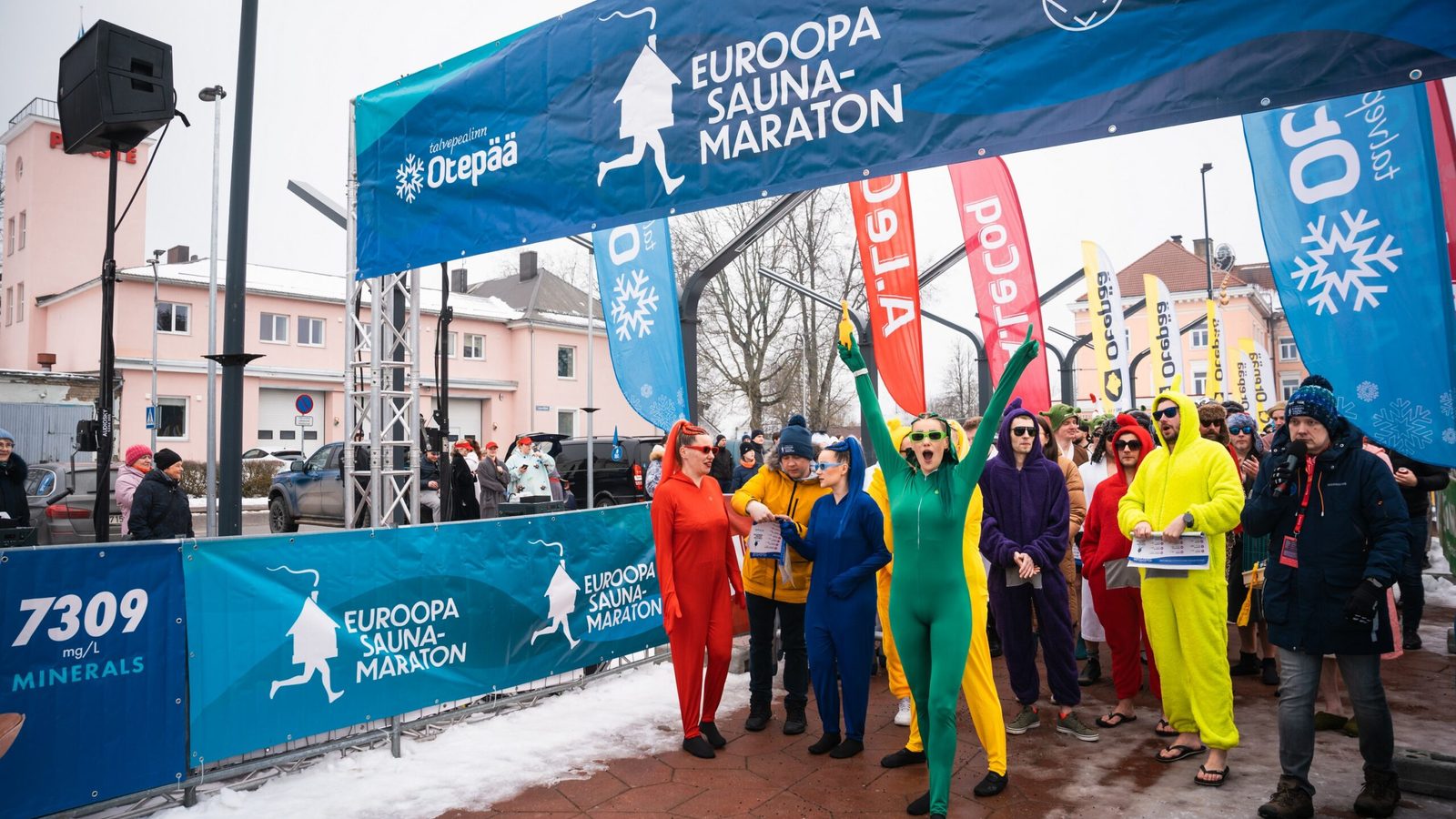
The European Sauna Marathon in Otepää runs like a sauna-themed orienteering race. Teams of four receive a map with every participating sauna marked on it. They have roughly five hours to visit as many as possible, spending a minimum of three minutes in each. A car and designated driver are mandatory because the saunas are scattered across the countryside around town.
The 14th edition in March 2025 drew nearly 1,000 participants from 16 countries, including teams from Brazil, Japan, and six teams from Switzerland. By 2026, VIP tickets for the 15th anniversary edition sold out months in advance.
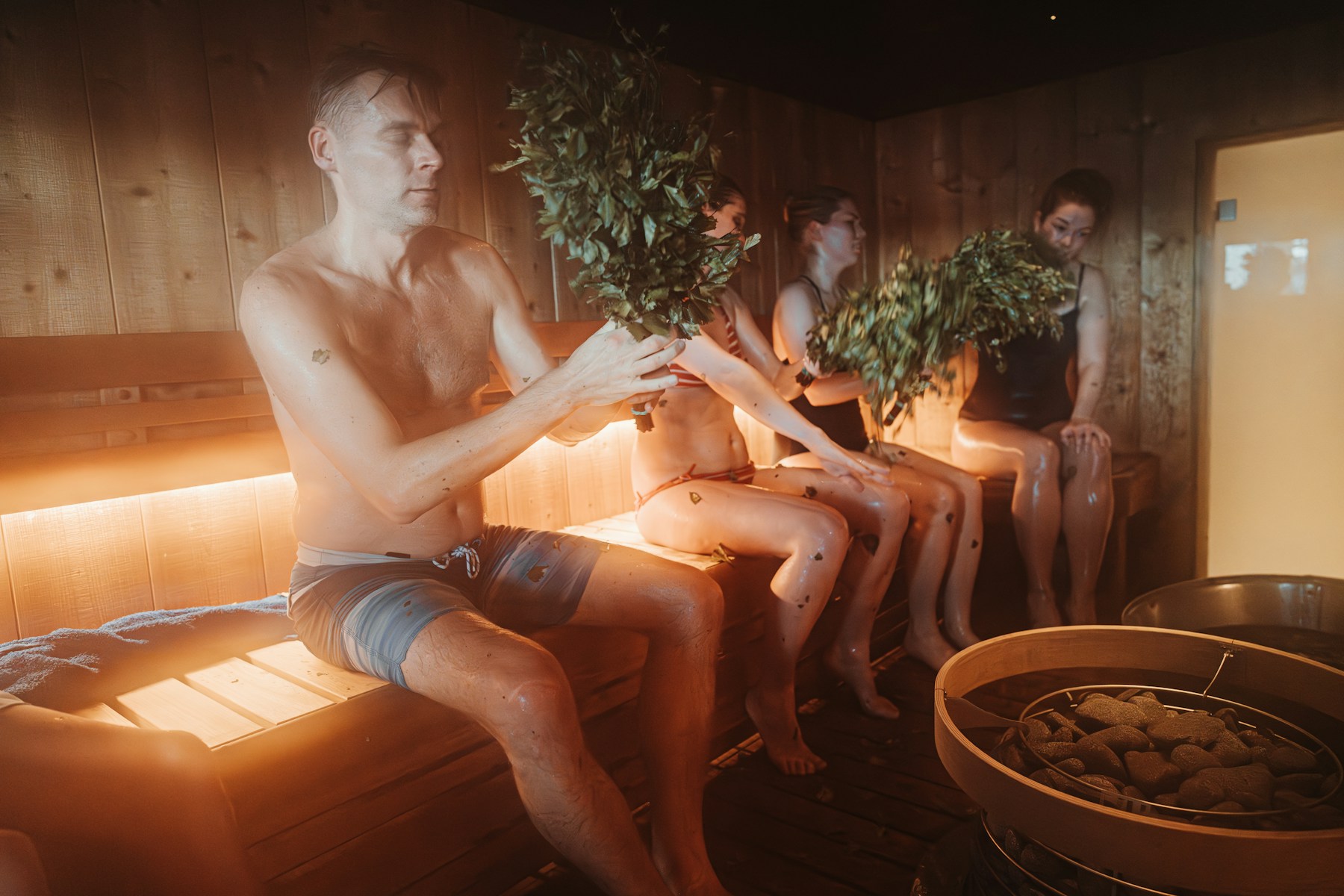
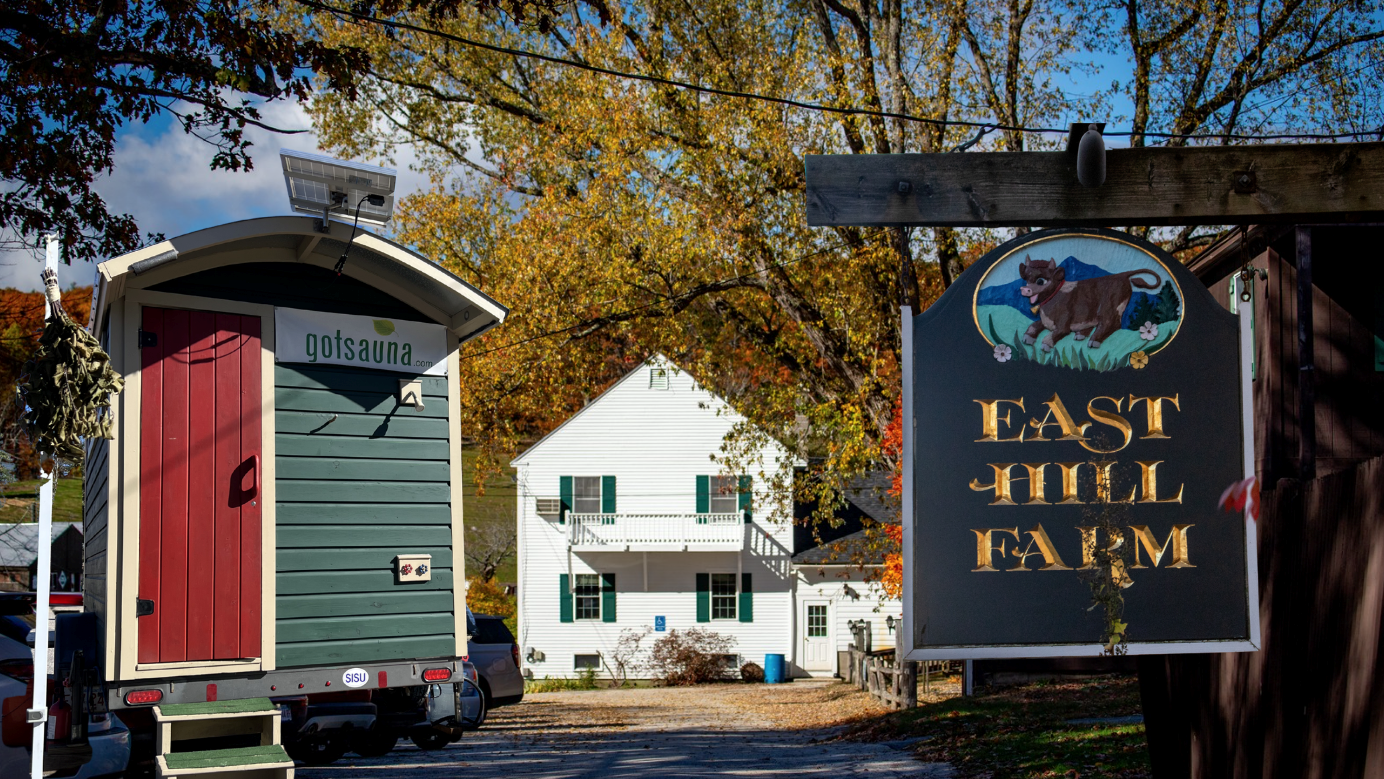
Otepää’s draw is the variety of saunas. The 2024 edition included a sauna inside a decommissioned tram car, another suspended from a crane between earth and sky, a cave sauna, and a modern smoke sauna called ÖÖ. Residents open their private saunas to competitors, and mobile saunas arrive in the shape of barrels, huts, igloos, and tents. Costumes are encouraged (the private Saturday sauna in Estonia is traditionally nude, but the marathon invites participants to dress up). Prizes go to the fastest team, the best costumes, and the best “sauna enthusiasts,” a category that rewards spirit over speed.
“Their main goal is to break the myth or tradition influenced by Germany in their countries, where saunas are silent spaces,” chief organizer Ago Arro told Euronews about the growing international contingent. “They prefer our style, where it’s fun and enjoyable.”
The event is organized by NGO Otepää Sport in cooperation with the Otepää Municipal Government, and the goal, per the organizers, is “to preserve and develop Estonian sauna culture in a unique and athletic festival format.” Estonia’s Võromaa smoke sauna tradition was inscribed on the UNESCO Intangible Cultural Heritage list in 2014, and the marathon has become one of southern Estonia’s signature winter tourism events.
The Swiss adaptation: Schaffhausen doubles the original
In 2023, a group centered around the Rhysauna association in Schaffhausen, Switzerland (founded 2019, roughly 300 members) launched their own version. A delegation from the organizing committee had traveled to Otepää, was “warmly welcomed at Otepää Town Hall,” and returned inspired.
What they built is recognizably the same format but adapted for a dense medieval city rather than a dispersed rural setting. The key differences: Schaffhausen is walkable (no cars needed, free public transit included with the ticket), costumes are not part of the culture, the time window is eight hours rather than five, and the locations extend across Schaffhausen’s historic old town, the Rhine riverfront, the Munot fortress, a working steel foundry, and (new for 2026) the Rhine Falls in Neuhausen.
By its third edition in February 2026, the Saunamarathon Schaffhausen drew roughly 2,000 participants, double the Estonian original. The organizers describe it explicitly as “not about speed, but about socialising and enjoyment.”
Mobile sauna makers use the event to show their work. The 2026 edition featured Thermic Vibes, which presented what it calls the world’s largest pop-up sauna tent (roughly 16 feet in diameter with four wood-burning stoves) alongside the world’s smallest (about five and a half feet), both made by Alpine Sauna of Switzerland. The Saunah association brought three mobile saunas including a glazed unit called Lasi (Finnish for “glass”). An international Banja-Team coordinated by Anton Bolilyi, co-organizer of the Berlin Banya Festival, brought two original banya yurts and three sauna tents with masters from ten countries.
International Aufguss talent also showed up. Tobias Johansson, founder of Bastupaus and organizer of the festival near Malmö, and Roger Huerta, the 2025 Swedish Saunagus Champion, both traveled to Schaffhausen for the event. The Friends of Finland group cooked sausages on the sauna stove using the traditional makkarapussi method.
Registration teams have come from as far as North Vancouver. “The international resonance confirms that the format and the idea behind the sauna marathon appeals to people around the world,” co-organizer Manuel Gruber told Schaffhausen24.
Finland’s grassroots variants
Finland has its own grassroots sauna marathons, at a smaller scale.
The Kerkonkoski Saunamaraton in central Finland launched in 2023. The 2024 edition attracted roughly 70 participants who walked between 10 saunas in the village, with a ferry carrying groups across Niinivesi lake to reach three of them. Saunas included a caravan sauna and a boat sauna. Registration filled so quickly the organizers had to close it early. The event explicitly frames itself as non-competitive: the point is to “enjoy the löyly of as many saunas as possible, pleasant company, and the scenery of a beautiful village.”
The Sarvenperän Saunamaraton near Kuohu in the Jyväskylä region takes a different approach: a roughly six-mile walking route through 13 to 15 saunas, including shoreline saunas, tent saunas, and mobile saunas. Scheduled for August 2026, it includes breakfast, soup lunch, and dinner, and issues certificates of completion. It is designed for first-timers.
Then there is the Nordic Saunathon, a different take on the “marathon” idea. From 4 p.m. on March 19 to 4:06 p.m. on March 20, 2026 (International Day of Happiness, and the year Finland was named the world’s happiest country for the ninth consecutive time), about 150 participants in a relay organized by Hanken Business Lab rotated through a single sauna at Uusi Sauna in Helsinki, in shifts of five to ten minutes with handoffs under ten seconds, for 24 hours and six minutes. A Guinness World Records adjudicator verified the attempt on site. The event was framed as a celebration of collective wellbeing rather than a race.
What the format has in common
Despite the variations, every sauna marathon shares a core structure. Teams or individuals move between multiple saunas within a defined time window. There is always a map. There is always a minimum time per sauna. The competition, where it exists, rewards strategy and endurance (choosing the best route, managing transitions) rather than raw speed inside the sauna.
The events also double as mobile sauna exhibitions. In Otepää, residents and builders bring their most creative saunas to the event. In Schaffhausen, professional mobile sauna makers like Alpine Sauna and the Saunah association use the marathon as a product demo. The Aufguss scene has noticed: the Schaffhausen event now draws named performers from Sweden and Denmark.
Host towns get the visitors. Otepää (population roughly 2,200) absorbs 1,000 visitors on a single winter weekend. Schaffhausen draws 2,000. The organizers of both events recommend that out-of-town visitors stay the full weekend. Hotels, restaurants, and local producers benefit directly. The Schaffhausen event includes a local producers’ market on the central square, and the ticket includes free public transit, Rhine Falls boat trips, and entry to a closing afterparty.
Guinness already lists the format
Guinness World Records already recognizes the format as a category, recording both the “longest running annual sauna marathon event” (Otepää, since 2007) and the “longest sauna session marathon relay” (Helsinki, 2026). The record page notes that “similar events are now held in Switzerland and Finland, among other countries.”
The Winter Sauna Carnival at Ikaalinen Spa & Resort in Finland, while not branded as a marathon, follows a similar logic: a weekend where attendees move between dozens of mobile saunas, vote for their favorite, and attend Aufguss rituals. SaunaShare’s Ikaalinen guide covers the resort’s regular sauna world and private smoke-sauna bookings. It drew nearly 1,000 attendees in January 2026 and is expanding for 2027. The World Sauna Forum in Jyväskylä (June 2026) runs concurrent sauna tours across the region during its week-long program.
The Swiss delegation that launched Schaffhausen flew to Estonia to learn the format first. The Finnish village events started independently. Guinness’s recognition of “sauna marathon” as a record category gives any new event a benchmark.