
Ceramic Sauna Stones Outlast Natural, and a Researcher Calls the Bans Unjustified

By Arlene Scott
Senior Wellness Correspondent & Hospitality Consultant
- Published
- Reading time
- 6 min
SaunaNews is published by SaunaShare, Inc., which also runs SaunaShare.com and SaunaMarketplace.com, where we sell many of the products we write about. Assume that experience shapes what we cover and what we don't. Who owns SaunaNews · The ownership announcement
Independent durability testing by Saunologia’s Lassi Liikkanen shows ceramic sauna stones lasting close to four times longer than natural alternatives. Liikkanen writes that manufacturer bans on ceramic stones are not justified by his data. Harvia’s manuals ban ceramic stones; IKI’s ban all but Kerkes.
In this story5 sections
Sauna researcher Lassi Liikkanen has published the results of what he calls the world’s first realistic durability test for sauna stones, and the findings rewrite assumptions that operators have relied on for years. Using a protocol he developed at Saunologia, Liikkanen ran natural and ceramic stones through hundreds of heating cycles and thousands of water throws in a laboratory heater, then modeled their long-term survival rates. Ceramic stones outlasted every natural variety he tested. The gap between the worst-performing ceramic and the best-performing natural stone was close to fourfold.
That number matters because it lands in a market where several major heater manufacturers explicitly prohibit ceramic stones in their installation manuals, warning that ceramics can damage heating elements. Liikkanen writes that those bans are not justified by his data, and that the heater itself survived ceramic use well, though one heating element was damaged during the test in a way he ties only indirectly to the stones.
Key Facts
- Protocol 150 heating cycles, 450 heating hours, and 2,100 water throws per standard test in a 3 kW heater (up to 40 samples per batch)
- Extended test Ceramic stones ran for twice the standard duration, nearly one-third of a year of continuous cycling
- Natural stone ranking (best to worst survival) peridotite, olivine, vulcanite, olivine diabase
- Ceramic result Both ceramic varieties outlasted natural stones on the cracking criterion; on strict survival, 20 of 21 Kerkes stones survived against 15 of 34 Tiileri pieces, which left Tiileri level with olivine diabase
- Modeled lifetime gap Close to fourfold between the worst ceramic and the best natural stone, using an exponential survival model
- Heater impact The heater survived ceramic use, though one element’s sheath was damaged by the test heater’s divider mesh and both elements were replaced afterward
- Testing period The heater has been running in Saunologia’s stone laboratory since late 2018
- Publication date June 30, 2026 (results); June 10, 2026 (protocol methodology)
What the protocol actually measures
Liikkanen developed the Saunologia Sauna Stone Protocol 1.0 to fill a gap he identified in existing research: no credible, repeatable method for measuring how long sauna stones last under realistic conditions. The only prior study he cites is a 2005 fragmentation test by TM Rakennusmaailma, which used thermal shock methods borrowed from industrial ceramics rather than simulating actual sauna use.
His protocol subjects stones to repeated heating cycles with directed water throws in a 3 kW heater, simulating the thermal stress and thermal shock a stone experiences over months of regular sauna sessions. The primary measurement is survival rate at the end of the test, supplemented by visual inspection of cracking, crumbling, surface discoloration, and stacking collapse. For natural stones, the standard protocol ran 150 cycles. For ceramics, he doubled the duration to avoid ceiling effects, since early results suggested ceramics might survive the standard test with minimal degradation.
The exponential model he uses to compare varieties projects the daily rate of decay from a single known data point (survival at day X) rather than assuming a constant linear decline. That approach produces more realistic estimates of when a batch of stones would cross a replacement threshold, but it relies on extrapolation rather than observed multi-year field data.
Natural stones: moderate differences, clear winner
Among natural stones, the spread between the weakest and strongest performers was about 30 percentage points in survival rate. Peridotite came out on top, followed by olivine, vulcanite, and olivine diabase. Larger olivine diabase stones were more durable than smaller ones, but still trailed the other stone types.
Using linear extrapolation (which Liikkanen flags as likely optimistic), the most durable natural stone could remain usable roughly three times longer than the weakest. For an operator following recommended maintenance schedules, that translates to the difference between replacing stones once a year and replacing them every two to three years, depending on session frequency.
The qualitative differences mattered too. Stones did not just shrink uniformly. Surface stones showed heavy discoloration from water evaporation, stacking collapsed as stones crumbled into debris, and the resulting fragments fell into the heating element channel. That debris pattern is what makes stone aging an operational cost, not just a materials cost: a clogged element channel restricts airflow, slows heating, increases energy consumption, and, in commercial settings, can trigger downtime.
Ceramic stones: longer life, and a heater that survived
Ceramic stones were not part of the original natural-stone study. Liikkanen added them as a follow-up in winter 2019 to 2020 after finding that earlier studies by others had failed to produce clear durability data on ceramic products. Using the extended protocol (twice the standard duration, nearly one-third of a year of continuous cycling), he tested two ceramic varieties against the natural-stone baseline.
Both ceramics outlasted the natural stones on the cracking criterion used in earlier studies. Between the two, the answer depends on the yardstick. On that cracking criterion Tiileri came out more durable, largely because of its larger piece count; on strict survival, 20 of 21 Kerkes stones survived against 15 of 34 Tiileri pieces, which put Tiileri level with olivine diabase. The largest difference was in surface integrity: 86% of the Kerkes stones stayed smooth and uniform, while 53% of the Tiileri pieces had begun to flake substantially. Tiileri still cracked far less than natural stone, which keeps the stacking from shifting and wedging against the heating elements.
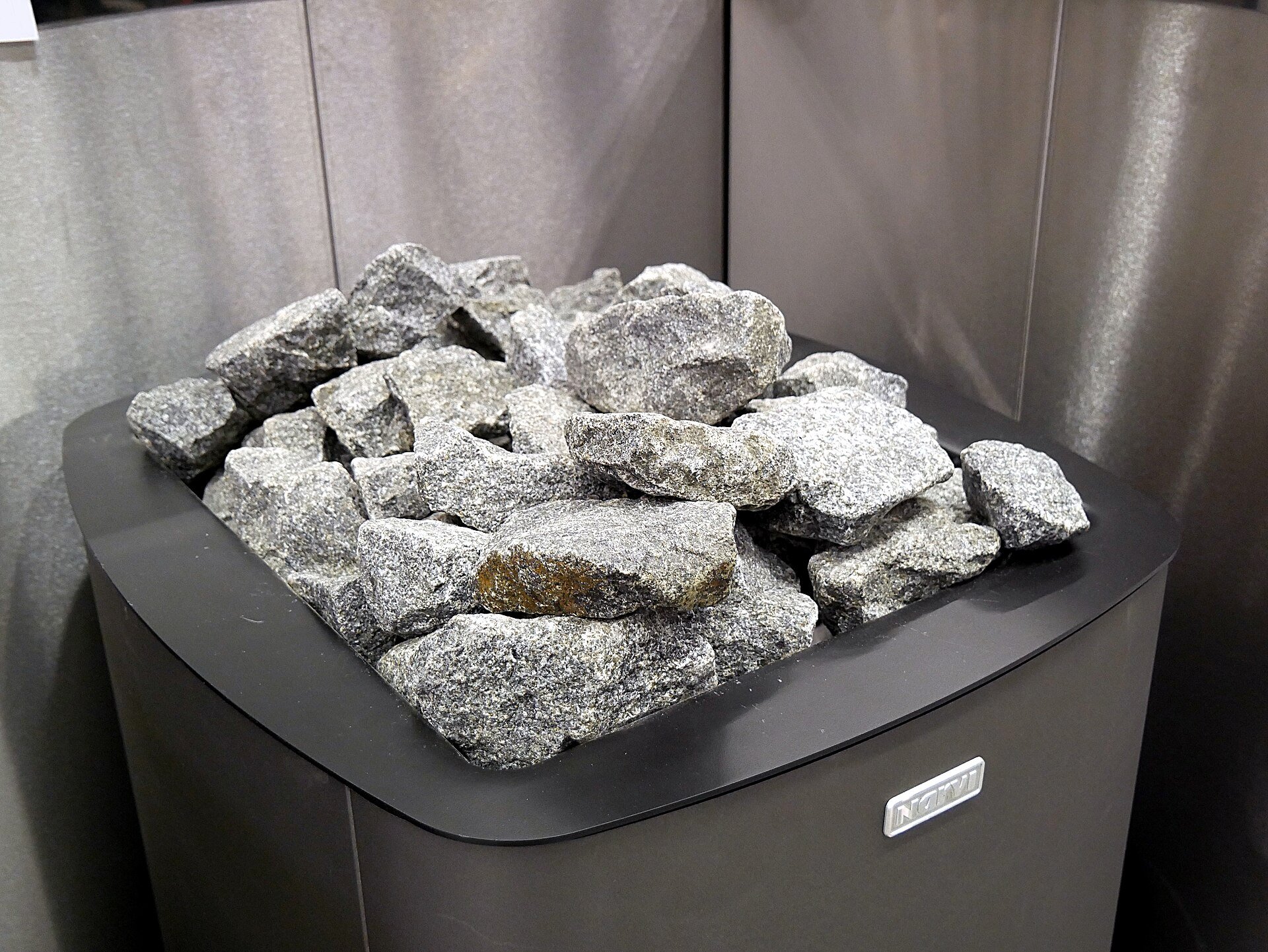
Kerkes is the Finnish ceramic-stone brand most visible in this debate. Prisma’s product listing for Kerkes Tetra identifies the stones as made in Finland and describes them as ceramic heater stones fired above 2,370 degrees Fahrenheit, while IKI singles out Kerkes as the ceramic exception in its professional-heater instructions.
The exponential survival model showed close to a fourfold gap in estimated lifetime between the worst ceramic and the best natural stone. That figure comes with caveats: it is an extrapolation from a limited run, not a direct observation over years of field use, and the fourfold ratio specifically compares the weakest ceramic performer against the strongest natural performer, not averages across categories.
Liikkanen also reports that the heater itself survived the ceramic test well, which cuts against warnings in several manufacturer manuals. It was not entirely unscathed: one heating element’s sheath was damaged when the steel mesh separating the test heater’s stone compartments came into contact with it, and he replaced both elements after the test. He ties that fault only indirectly to the stones.
What the manuals actually say
Harvia, one of the world’s largest sauna companies by revenue, prints the following warning in multiple heater manuals, including the TRC70XE/TRC90XE, the Spirit, and models sold through its North American channel: “Neither light, porous ceramic ‘stones’ nor soft soapstones should be used in the heater. They do not absorb enough heat when warmed up. This can result in damage in heating elements.” The warranty explicitly excludes faults resulting from using stones “not recommended by the heater manufacturer.”
IKI-Kiuas takes a different approach. Its Pillar and Monolith installation manuals state that “the use of ceramic heater stones (other than those from kerkes.fi) is prohibited,” while simultaneously recommending Kerkes ceramic stones around the heating elements in communal and professional saunas because they “support and help preserve the heating elements and they do not disintegrate prematurely.”
IKI’s manuals permit Kerkes ceramic stones and prohibit other ceramic brands; they do not say why other ceramic brands are excluded. Finnish heater makers generally recommend peridotite, olivine-dolerite, and olivine as approved stone types, with annual re-piling and replacement of weathered stones as standard maintenance.
What this means for operators
For commercial operators running heaters on heavy duty cycles, the maintenance math changes substantially if ceramic stones hold up the way Liikkanen’s data suggests. Stone mass is a core design parameter in modern heaters, and the cost of stones themselves is modest compared to the labor, downtime, and energy-efficiency losses that come with a degraded stone bed.
If an operator using olivine diabase (the weakest natural performer in the Saunologia test) replaces stones annually, and ceramic stones last four times as long, the replacement interval extends to roughly every four years. The stone cost itself might be comparable or slightly higher per purchase, but the labor and downtime savings compound. In a commercial facility running daily sessions, each stone replacement means taking a room offline, unpacking the heater, restacking, and running a break-in cycle. Cutting that from once a year to once every three or four years is a meaningful operational improvement.
The caveat is that Liikkanen’s protocol uses a 3 kW residential heater, not a commercial-grade unit running at 10 kW or higher on 208-volt three-phase power with daily duty cycles. Commercial heaters subject stones to more aggressive thermal stress, higher peak temperatures, and more frequent water contact. Whether the fourfold ratio holds under those conditions is an open question that his data cannot answer.
There is also the warranty question. An operator who loads ceramic stones into a Harvia heater is voiding the stone-related portion of the warranty, regardless of what Liikkanen’s data shows. Until manufacturers revise their manuals, operators choosing ceramics are accepting that trade-off.
Why It Matters
Sauna stones are the only heater component that operators replace on a recurring schedule, and until now the replacement interval has been set by manufacturer guidance rather than independent data. Liikkanen’s protocol gives the industry its first empirical baseline for comparing stone types under realistic conditions. The ceramic findings are striking because the durability gap is wide enough to reshape replacement schedules, and because they put direct pressure on the ban language in major manufacturer manuals. When one company (IKI) recommends ceramics from a specific brand while banning all others, and independent testing shows ceramics outlasting natural stones in Liikkanen’s test, Liikkanen argues the case for blanket ceramic prohibitions is weaker than manuals suggest. Operators now have a data point to weigh against the manual. What they still lack is long-term field confirmation at commercial scale.
The Bottom Line
Saunologia’s stone-focused research fills a gap that the industry has left open for decades. The next step is for someone to run these tests at commercial wattage and duty cycles, and for manufacturers to publish the engineering data behind their ceramic-stone guidance.
Harvia events
1 event