
Homecraft Apex Mini Launches in 6, 7.5, and 9 kW: Big Stone Mass in a Short Tower

By Arlene Scott
Senior Wellness Correspondent & Hospitality Consultant
- Published
- Reading time
- 9 min
SaunaNews is published by SaunaShare, Inc., which also runs SaunaShare.com and SaunaMarketplace.com, where we sell many of the products we write about. Assume that experience shapes what we cover and what we don't. Who owns SaunaNews · The ownership announcement
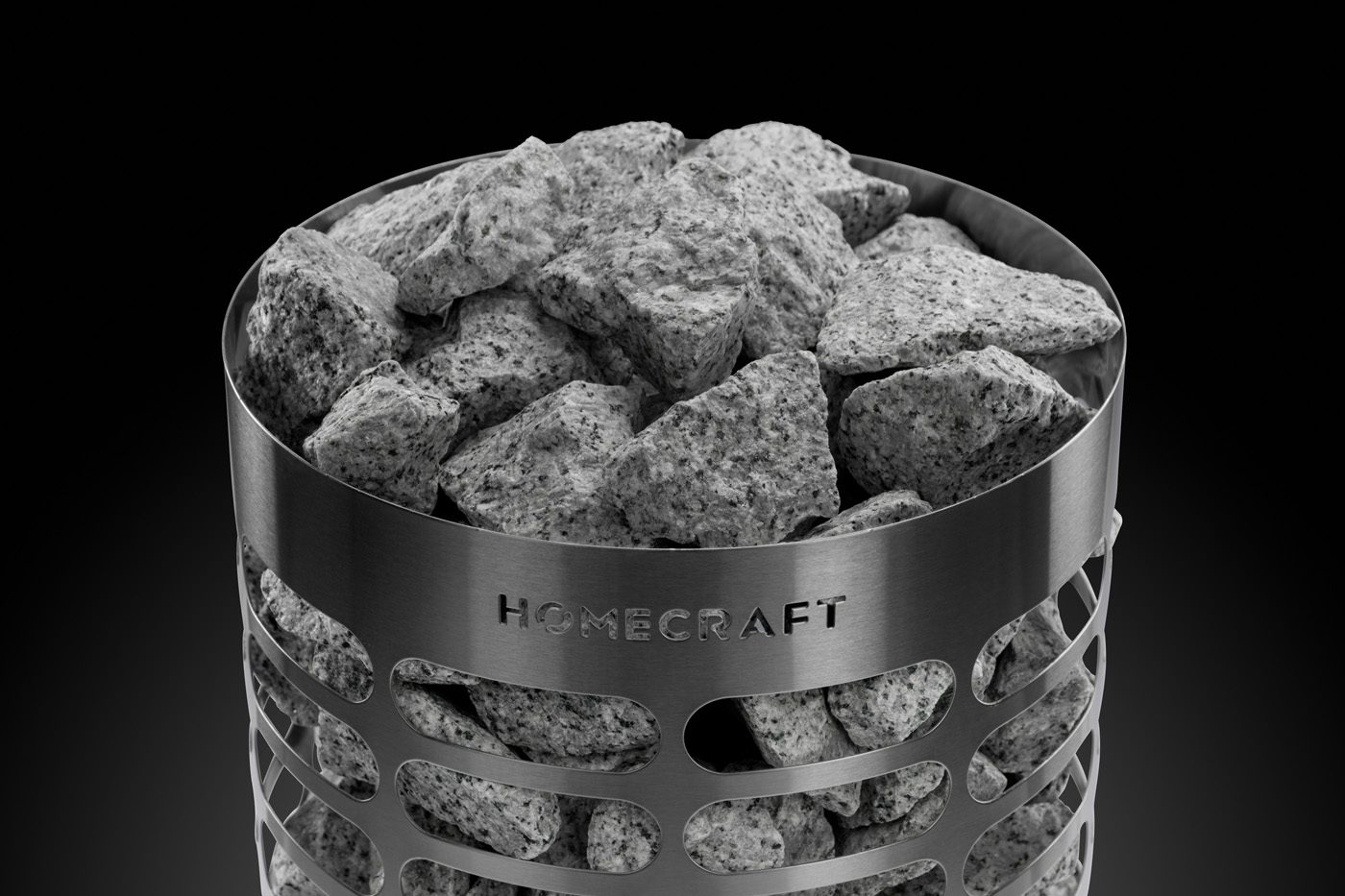
The Canadian heater maker’s new compact tower holds up to 100 pounds of stone at just 32 inches tall, a deliberate answer to the bench-height headaches that tall pillar heaters create in home saunas.
In this story8 sections
Homecraft, the Surrey, BC heater maker that has been quietly supplying a meaningful share of North American residential sauna builds since 1988, is launching the Apex Mini. It is a compact, floor-standing tower heater that slots below the full-size Apex line and ships in three power ratings: 6 kW, 7.5 kW, and 9 kW. The target rooms run roughly 200 to 450 cubic feet, depending on model. The product has been teased on distributor pages for several years, and Homecraft’s own store has shown the line as released. US buyers can expect availability through Homecraft’s existing Canadian and US-facing distribution network.
The interesting thing about the Apex Mini is not that it exists. Homecraft already sells a large-format Apex and a slim Revive series. The interesting thing is what it’s trying to solve.
The bench height problem
Talk to anyone who has designed a home sauna around a tall pillar heater and you will hear the same complaint. Most pillar heaters stand 36 to 40 inches tall. Safety convention says the top bench should sit at or above the top of the stones, so your feet are not over the hottest part of the room. Combine a 36-inch heater with the clearance to the bench and the minimum ceiling-to-heater distance, and you end up with a sauna that needs 8 foot or taller walls to work properly. That is not what most basement and outbuilding projects can deliver.
Homecraft’s Apex Mini is listed at 32 inches tall. That four to eight inches back is meaningful. It is the difference between a top bench that fits under a standard 8 foot ceiling with correct clearances and one that does not. Builders working in retrofit basements and backyard kit saunas are the target market, and they have been asking for exactly this kind of product for years.
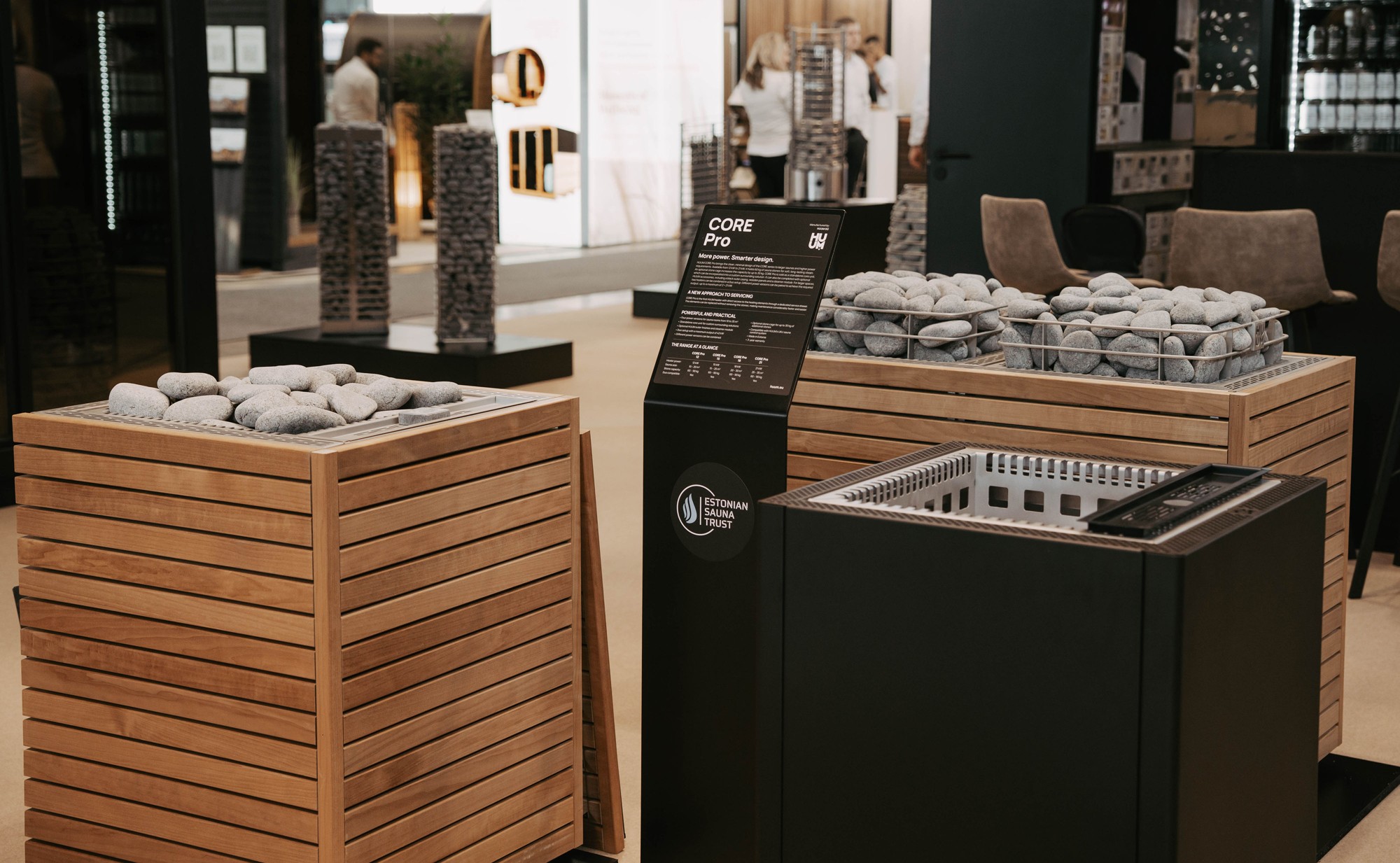
Competitors have noticed. The HUUM HIVE Mini takes a similar compact-pillar approach but goes wider and rounder, stacking more stones into a shorter cylinder. Harvia’s Cilindro line offers integrated controls on some variants, simplifying installation at the cost of flexibility. Apex Mini stakes out a middle ground: a squared-off, stainless steel tower with a big stone load and external controls that keep the architecture modular.
The specs that matter
Here is what the install manual and distributor listings actually say across the three Apex Mini variants:
6 kW: 200 to 325 cu ft room. 240V 1-phase draws 25.0A on a 40A breaker with #8 Cu. 208V 3-phase draws 16.7A on a 30A breaker.
7.5 kW: 250 to 370 cu ft room. 240V 1-phase draws 31.2A on a 40A breaker with #8 Cu. 208V 3-phase draws 20.8A on a 30A breaker.
9 kW: 325 to 450 cu ft room. 240V 1-phase draws 37.5A on a 50A breaker with #8 Cu. 208V 3-phase draws 25.0A on a 40A breaker.
All three: 14 by 14 by 32 inches. 100 lb rock capacity on Homecraft’s product page, which calls for five boxes of rock. 3.5 inch clearance to combustibles. 47 inch minimum clearance from heater to ceiling, and a heat shield on ceilings of 78 inches or lower. Stainless steel construction. CSA and UL 875 certified.
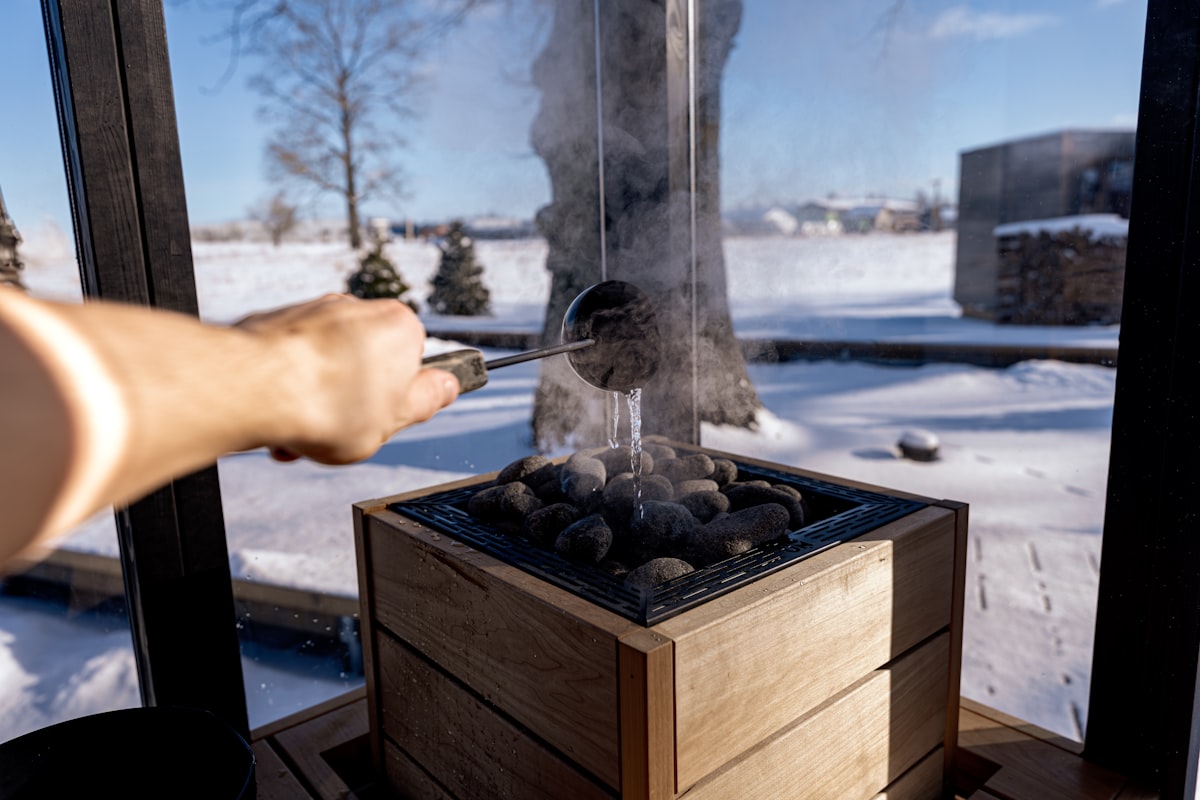
Stone capacity is the headline number. Homecraft lists 100 pounds of rock, against the 30 to 60 pounds most wall heaters in this power class carry. Packing that much stone into a 14 by 14 inch footprint and 32 inch height has real performance implications: longer heat-up time, more stable temperatures once hot, and a lot of capacity to absorb water throws without the room dropping out.
Install complexity is real
Apex Mini is not a plug-and-play heater. If you are used to wall-mounted units that come with integrated controls, the Apex Mini architecture will feel like a step up in complexity and cost. The manual calls for three separate electrical paths:
First, a high-voltage feed from the main panel to a relay or contactor box. The contactor box must be installed outside the sauna room. Second, a high-voltage run from the contactor box to the heater itself. Third, a low-voltage control loop, typically 18/4 conductor, running from a wall-mounted touchpad outside the room back to the contactor box. A temperature sensor lives inside the sauna near the ceiling, wired back to the touchpad on 18/2 low-voltage cable.
The TKE2-2 controller (1-phase) or TKE2-3 (3-phase) is Homecraft’s usual pairing, and a WiFi-enabled version is available for remote start and scheduling. The 3-phase variant also requires a phase-shift transformer to power the low-voltage control circuit, a detail that DIY builders should factor into their planning before they open a wall.
For outdoor sauna builds, which Harvia says are increasingly common in North American backyards, the TKE platform supports a weatherproof outdoor contactor box with conduit entry from below to prevent water ingress. That matters. Outdoor kits that ship with integrated-control heaters can be simpler to wire, but they also lock you into whatever controller the manufacturer decided to ship. Apex Mini’s split architecture is more flexible at the cost of more thought up front.
Controls and the WiFi question
Homecraft has been in the smart-control game longer than a lot of buyers realize. The TKE2-2 WiFi controller gives Apex Mini owners phone-based remote start, temperature scheduling, and session timers, operated through Homecraft’s mobile app. The controller locks the top temperature at 194°F and the timer at 60 minutes per cycle, which is the North American safety posture. That 60-minute cap is worth knowing up front: if you are running a high-mass stone load and it takes 45 minutes to come up to temperature, your usable session window is shorter than your one-hour cycle suggests.
The controller locks are not arbitrary. Both values come from UL 875 compliance, the same standard that has long governed North American heater certification. Every heater sold through reputable US and Canadian channels is playing by the same rulebook, regardless of brand.
A handful of enthusiasts have documented swapping in third-party WiFi modules to gain features Homecraft’s app does not offer, but that is firmly in the hack territory and not something any responsible reviewer would recommend to buyers under warranty.
What Apex Mini does not come with
A few things worth flagging before the listings go live:
No integrated IP rating. Homecraft’s manuals use language like “splash-proof construction” and “conducting parts protected against water,” but there is no formal IPX rating published for either the heater or the control system. Wet-area sauna conditions are fine. Direct spray from a hose is not.
Element coverage depends on the installation. Homecraft’s manual gives residential buyers a two-year warranty on manufactured components, including the heating elements, and one year on other consumable parts. Commercial installations get a one-year warranty that excludes consumables such as heating elements.
No CE or RoHS markings. Homecraft is a North American brand sold into a CSA/UL regulatory framework. If you are importing one to Europe or shipping to a project that specifies CE compliance, Apex Mini is not your product.
Pricing and availability
Homecraft’s direct listing shows the 9 kW Apex Mini at $1,800 CAD (roughly $1,315 USD at current exchange rates), with a “set for release” note on earlier page iterations indicating staged availability. Distributor pricing at Bsaunas runs $1,900 (6 kW), $1,950 (7.5 kW), and $2,000 (9 kW) in CAD, which translates to approximately $1,390 to $1,460 USD. These are heater-only prices. Controls (TKE2-2 or TKE2-2 WiFi) and stones are additional.
For context, a 9 kW HUUM HIVE Mini starts at about $2,794 USD at mainstream retailers. A comparable Harvia Cilindro runs similar money depending on specification. Apex Mini is priced to undercut both, and it is built in Canada, which matters for buyers navigating the current US tariff environment on European-origin heaters. Homecraft heaters that enter duty-free under USMCA are not subject to the 10% Section 122 surcharge, in place through July 2026, on EU-made heaters such as HUUM, IKI, Narvi and Harvia’s European-made models.
Authorized dealers stock Homecraft’s Apex line and WiFi controllers for US buyers, and new Homecraft releases typically roll out quickly across that channel. Expect the Apex Mini to follow the same pattern.
Who should actually buy this
If you are building a 6 by 8 or 6 by 7 residential sauna and you want softer, more stable heat than a wall heater can produce, Apex Mini is a serious option. The larger stone load will deliver the back-to-back löyly that small-stone wall heaters cannot, and the 32-inch height will not force you to redesign your bench geometry around a tall pillar.
If you are building a backyard kit sauna in the 300 to 400 cubic foot range and you want a heater that will not look out of place visually, Apex Mini’s stainless tower styling is clean and squared-off in a way that reads modern without being fussy.
If you are a DIY builder who is confident wiring a contactor box and running low-voltage control cable, the install complexity is manageable. If you are not, budget for a licensed electrician. The clearances, sensor placement, and outside-the-hot-room control requirement are not optional, and getting any of them wrong can produce nuisance high-limit trips or, worse, a failed inspection.
If you are looking for plug-and-play and the shortest path to hot stones, this is not your heater. A good wall-mounted unit with integrated controls will get you there faster and cheaper, at the cost of the steam character that high stone mass provides.
What we want to test
Homecraft’s published specs are solid on electrical and install, but there is no third-party performance data on Apex Mini yet. That is the case for most new heater launches: marketing copy tells you what the manufacturer wants to sell, and real performance comes from instrumented testing in representative rooms. For a compact high-mass heater, the tests that matter are heat-up time to 170°F and 180°F at bench level, the vertical temperature gradient between head height and foot height, the löyly recovery time after standardized water throws, and the hysteresis around the thermostat setpoint.
SaunaNews plans to run Apex Mini through that matrix once units are available in the US market. Initial impressions from the larger Apex series suggest a pattern: slower heat-up, very stable once hot, excellent water tolerance. If Apex Mini delivers the same behavior in a smaller package, Homecraft has a winner.
The Apex Mini is not a category-breaking product, and Homecraft is not pitching it as one. What it is, is a thoughtful answer to a real problem: builders want big-stone-mass performance in rooms that do not have clearance for tall pillar heaters. The 32-inch height and pillar-style stone load solve that problem with little compromise. Priced below HUUM and Harvia equivalents, built in Canada outside the EU tariff regime, and backed by a controller platform Homecraft has been refining for years, Apex Mini should find a clear audience among DIY sauna builders and mid-market dealers. The open question is whether Homecraft can ship it in volume fast enough to convert the demand before competitors close the gap.