
ThermaSol’s New Premium Saunas Include Cabins Built in Finland by Harvia-Owned Kirami

By Arlene Scott
Senior Wellness Correspondent & Hospitality Consultant
- Published
- Reading time
- 16 min
SaunaNews is published by SaunaShare, Inc., which also runs SaunaShare.com and SaunaMarketplace.com, where we sell many of the products we write about. Assume that experience shapes what we cover and what we don't. Who owns SaunaNews · The ownership announcement
The premium sauna lineup launching under Harvia’s 2024-acquired American steam brand is built in Sastamala, Finland by Kirami, the wood-fired hot-tub maker Harvia bought in 2021. The same cabins ship as FinVision® in Europe.
In this story8 sections
The fourteen new sauna SKUs at thermasol.com, the ones Harvia is using to push its American business up-market against Auroom Wellness and KLAFS, are built in Sastamala, Finland by Kirami, the wood-fired hot-tub maker Harvia bought in May 2021 for EUR 7 million plus an earnout of up to EUR 4 million. The same cabins ship in Europe under the Kirami FinVision® nameplate. Image filenames on Kirami’s own website carry the pattern kiramibyharvia_kir-XXXX.png. The literal “Kirami by Harvia” file naming makes the supply chain visible. ThermaSol’s American product pages say “designed and crafted in the U.S.A.” Kirami’s product pages say “designed and manufactured in Finland.” Both can be true at the same time, but the production fact is the more interesting one.
This is Harvia going up-market in North America with a Finnish-built lineup. The Finnish manufacturer already owned the entry-level position through Almost Heaven Saunas, which it bought in 2018 and operates out of Lewisburg, West Virginia. It owned the heater shelf through the Harvia and EOS brands. The premium cabin gap, the part of the American market where Auroom’s premium sauna cabins and KLAFS have been quietly winning specifications, was the missing piece. When Harvia paid $30.4 million for ThermaSol in July 2024, the obvious question was why a Finnish heater giant would buy a 66-year-old American steam company. The answer is now a fourteen-SKU lineup of Sastamala-built sauna cabins distributed through ThermaSol’s American plumbing-wholesale and kitchen-and-bath channels, priced from $30,393 for an indoor Lumaria Medium to $107,182 for the flagship outdoor Ombra.
Key facts
- Built by Kirami Oy, Villiläntie 2, FI-32730 Sastamala, Finland. Dedicated Sauna Factory opened November 2020. More than 32,000 square feet (3,000 square meters) of heated space at its Sastamala facilities.
- Owned by Harvia Group (Helsinki listed). Kirami acquisition closed May 28, 2021 for EUR 7 million plus an EBITDA-linked earnout of up to EUR 4 million (EUR 2.5 million was paid in December 2023).
- Sold as Kirami FinVision® in Europe. ThermaSol in the United States.
- Lineup 14 SKUs across 11 named cabin models plus a Custom Cut program.
- Mix 8 outdoor cabins, 3 indoor cabins, plus the modular Nordic Misty (FinVision® Misty) add-on system.
- Price band $30,393 (Lumaria Medium indoor) to $107,182 (Ombra outdoor).
- Heaters Every cabin ships with a Harvia heater. Virta Combi on most models, Spirit on Nordic Dawn, Delta with solar on the Solaris.
- Wood Heat-treated aspen benches across the line. Heat-treated spruce panels on most models. IPE Lapacho on Ombra (Velden XL). Tile Oak on Solaris (FinVision® Zero). Heat-treated pine on Nordic Dawn (FinVision® Dawn).
- Awards Vue (2026 LUXE RED, HD Awards finalist). Solaris (TIME Best Inventions of 2025).
Built in Sastamala by Kirami

Kirami was founded as a wood-fired hot-tub maker, and it is still one of the largest outdoor hot-tub manufacturers in the Nordics. The company’s factory at Villiläntie 2 in Sastamala, about 120 miles by road northwest of Helsinki, is its production base. Kirami launched the FinVision® outdoor sauna in the 2019 to 2020 period, and the line’s popularity led the company to open a separate Sauna Factory in November 2020. In May 2021, Harvia paid EUR 7 million up front, plus an EBITDA-linked earnout of up to EUR 4 million, to acquire Kirami, citing expected synergies of roughly EUR 1 million per year by the end of 2023.
The acquisition logic at the time was that Kirami’s hot-tub channel and the Harvia heater channel were adjacent. Buyers shopping for a wood-fired outdoor hot tub were the same buyers shopping for an outdoor sauna, and Kirami’s distributor network in Northern Europe handled both. In hindsight, Kirami’s Sauna Factory, opened in November 2020, became the production base for the American premium lineup. The pieces fit together in retrospect: Kirami brought a Finnish-built sauna cabin program, Almost Heaven brought the West Virginia entry-level cabin factory, and ThermaSol brought the American plumbing-wholesale and kitchen-and-bath distribution. Harvia now controls all three.
The FinVision® lineup on kirami.com currently shows five core saunas and five modular add-ons. The five saunas map cleanly to the ThermaSol catalog. The Kirami FinVision® M Misty is the cabin sold in the United States as the ThermaSol Nordic Misty Large. The Kirami FinVision® S Misty is the Nordic Misty Small. The Kirami FinVision® M Dawn is the Nordic Dawn, spec for spec. The Kirami FinVision® M Zero and S Zero are the medium and small Solaris, the off-grid solar cabins TIME named to its Best Inventions of 2025. ThermaSol has not said where the Vue, Ombra, Spectra, Vera, Fortis and indoor models are made.
The modular Nordic Misty system in ThermaSol’s American catalog is the Kirami FinVision® Misty modular system in Europe. The five add-ons are identical: a Medium Lounge, an XL 1-Entrance Lounge, an XL 2-Entrance Lounge, a Terrace canopy, and a Pergola. Compatibility is engineered into the connector hardware, which means a Sastamala-built Misty cabin and a Sastamala-built Pergola will clip together regardless of whether they arrive with European or American badging.
The outdoor eight
The outdoor lineup is where Harvia is making its strongest American statement. The cabins are not interpretations of European DIY kits. They arrive on a flatbed, fully assembled, pre-wired, and ready to drop into a backyard with a forklift or crane.
Vue: the architectural showpiece
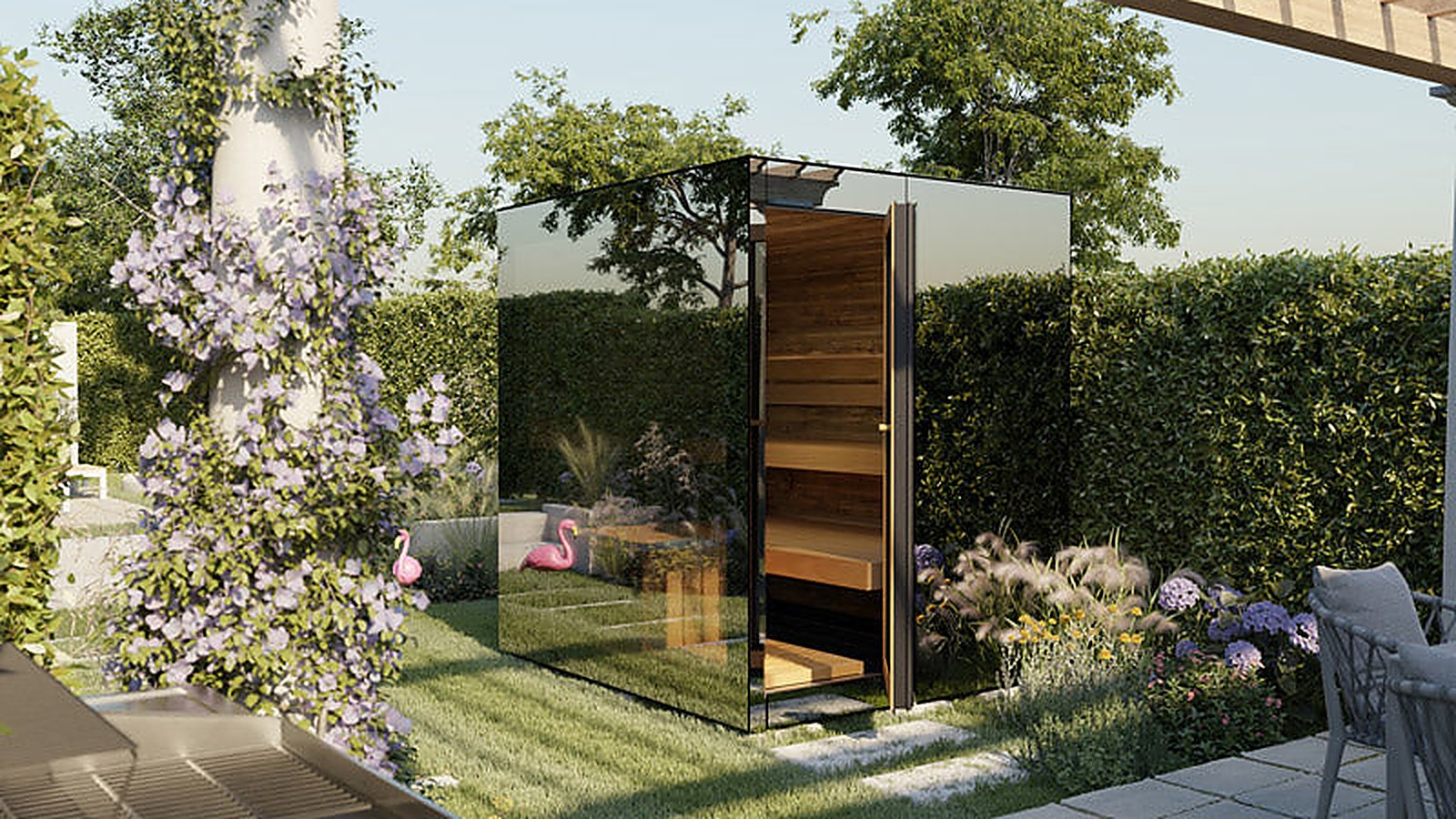
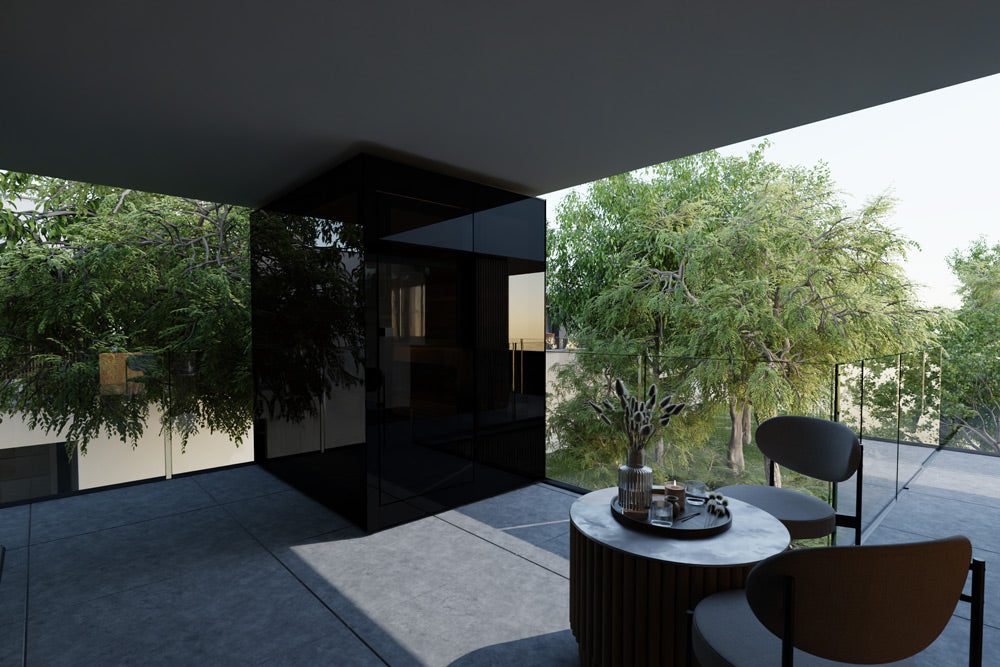
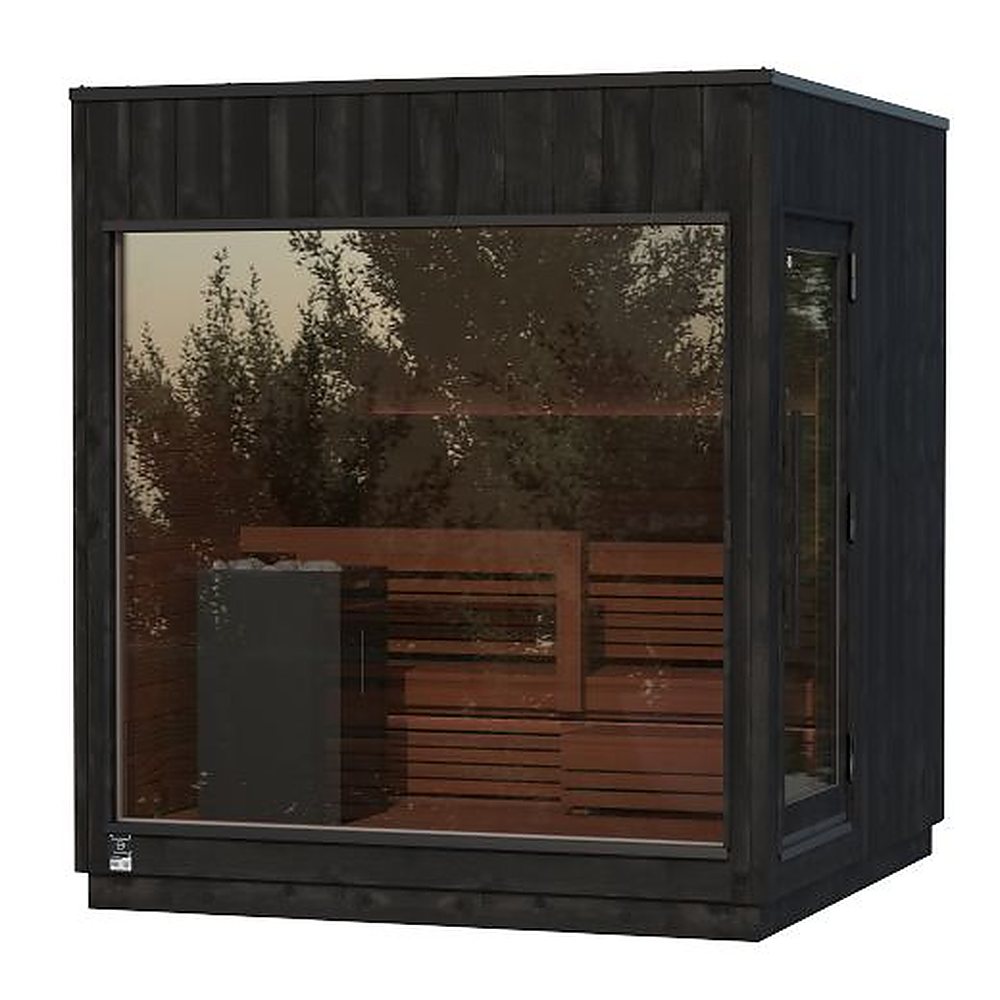
The Vue is the one that is going to land in shelter magazines. Its name is the French word for “view,” and the design earns it. Floor-to-ceiling mirrored thermal glass wraps three walls behind a black-enamel frame, and the 1.3-inch (34 mm) glazing is engineered for both privacy and reflectivity. From outside, the cabin disappears into the trees and sky it reflects. From inside, the mirror inverts to a panoramic window. The Vue won the 2026 LUXE RED Award and was named a finalist in the Hospitality Design Awards. It seats three to four, runs a 9-kilowatt Harvia Virta heater controlled by a Harvia Xenio CX45 Wi-Fi unit, and lists at $72,958. Built in Sastamala.
Ombra: the hospitality flagship
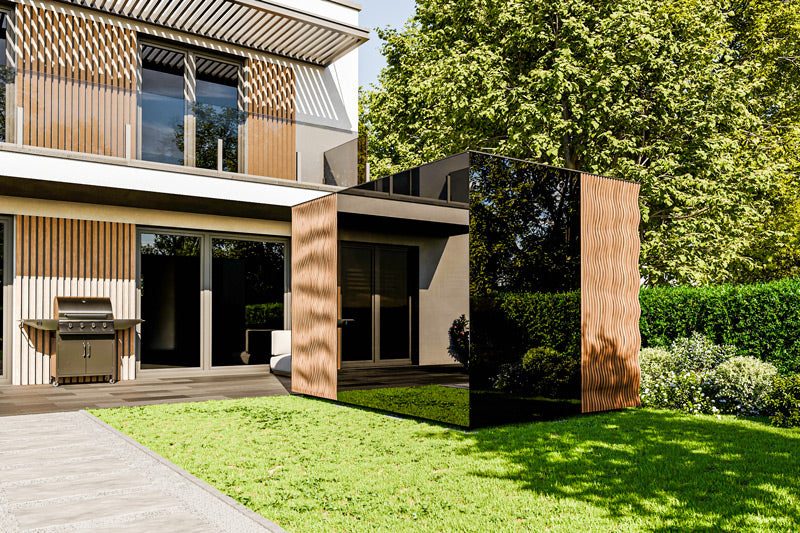
If Vue is the design statement, Ombra is the destination installation. At 130 inches wide and 4,607 pounds assembled, the Ombra is the largest cabin in the lineup, and at $107,182 it is also the most expensive. Its name is the Italian word for “shadow,” and the front carries semi-panoramic Stopsol Bronze tinted glass with thermal properties. The exterior is thermally modified IPE Lapacho hardwood, applied as a wave-pattern accent across the cladding, and a skylight floods the cabin with overhead light. There is a private dressing lounge before you reach the sauna room itself. The heater is a 10.5-kilowatt Harvia Virta. The Kirami image filenames for this configuration carry the “Velden XL” label, which is the working name Kirami uses for the IPE-clad bronze-wave variant in markets outside the United States.
Spectra and Fortis: the mid-tier workhorses
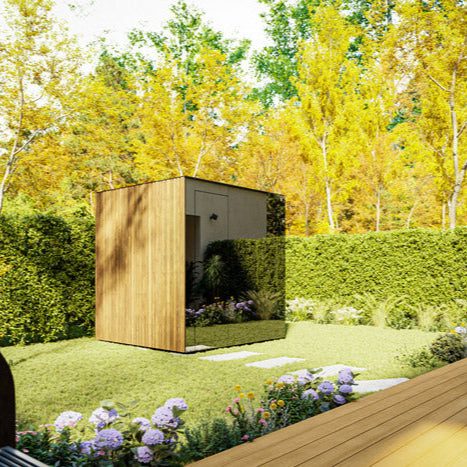
The Spectra and Fortis sit at $51,559 and $52,312, the price tier where most premium American backyard installations actually clear. Both are 3-to-4 person cabins with 8-kilowatt Harvia Virta heaters. The Spectra carries a single 1.3-inch (34 mm) Parsol Dark Grey glass front in a black aluminum frame with thermally modified Tyrol panels everywhere else, plus STEICO wood-fiber insulation and a Firestone EPDM roof. The Fortis takes the same internal logic and dresses it in an eave-style roofline with brushed Tyrol facade and 0.3-inch (8 mm) PSDG glazing. Both configurations come off the same FinVision® production line in Sastamala.
Vera: the patio and rooftop cabin
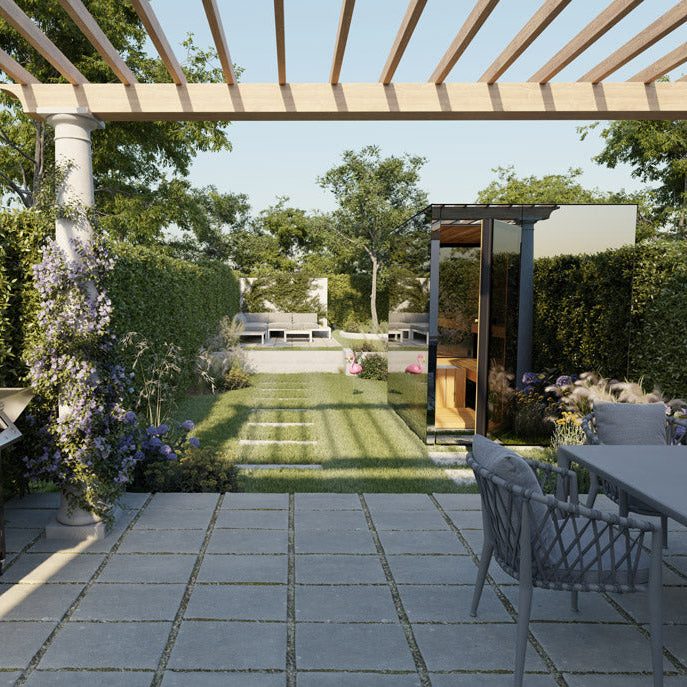
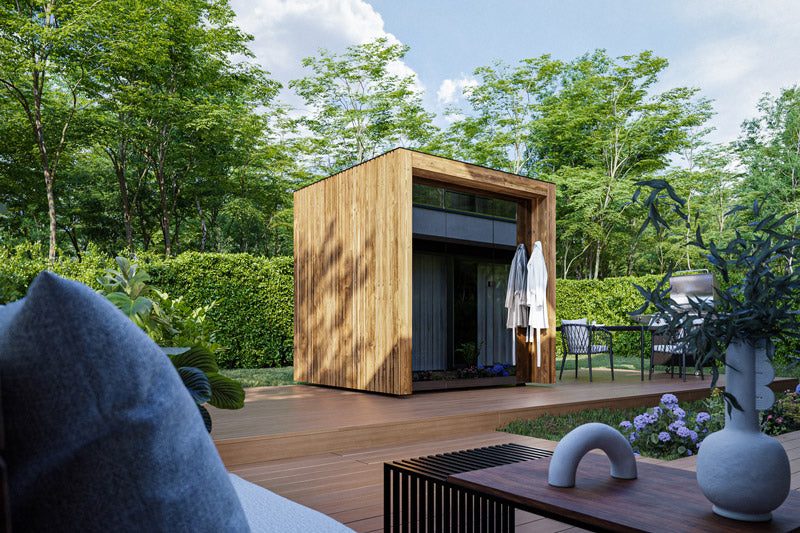
Inspired by the Italian word veranda, the Vera is the smallest outdoor cabin, sized for 2 to 3 people on a 63-by-87-inch footprint. Dual mirrored Parsol glass walls on opposite sides reflect the surroundings while concealing the interior. At $70,144 with an 8-kilowatt Harvia Virta heater, the Vera is the cabin Harvia wants in front of high-rise condominium buyers and rooftop terrace clients in Manhattan, Miami, and Toronto. Same factory, smaller footprint.
Solaris: the Kirami FinVision® Zero
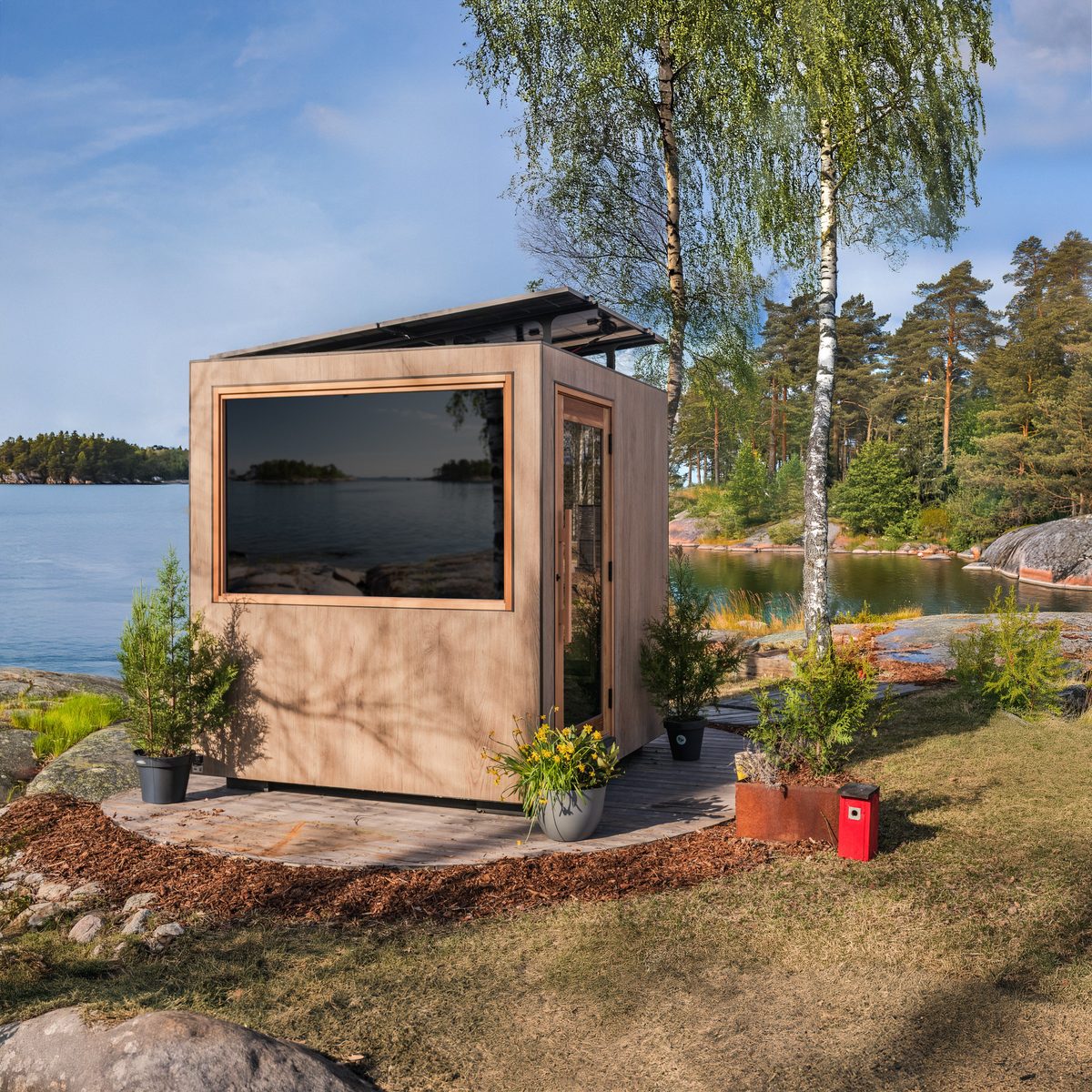
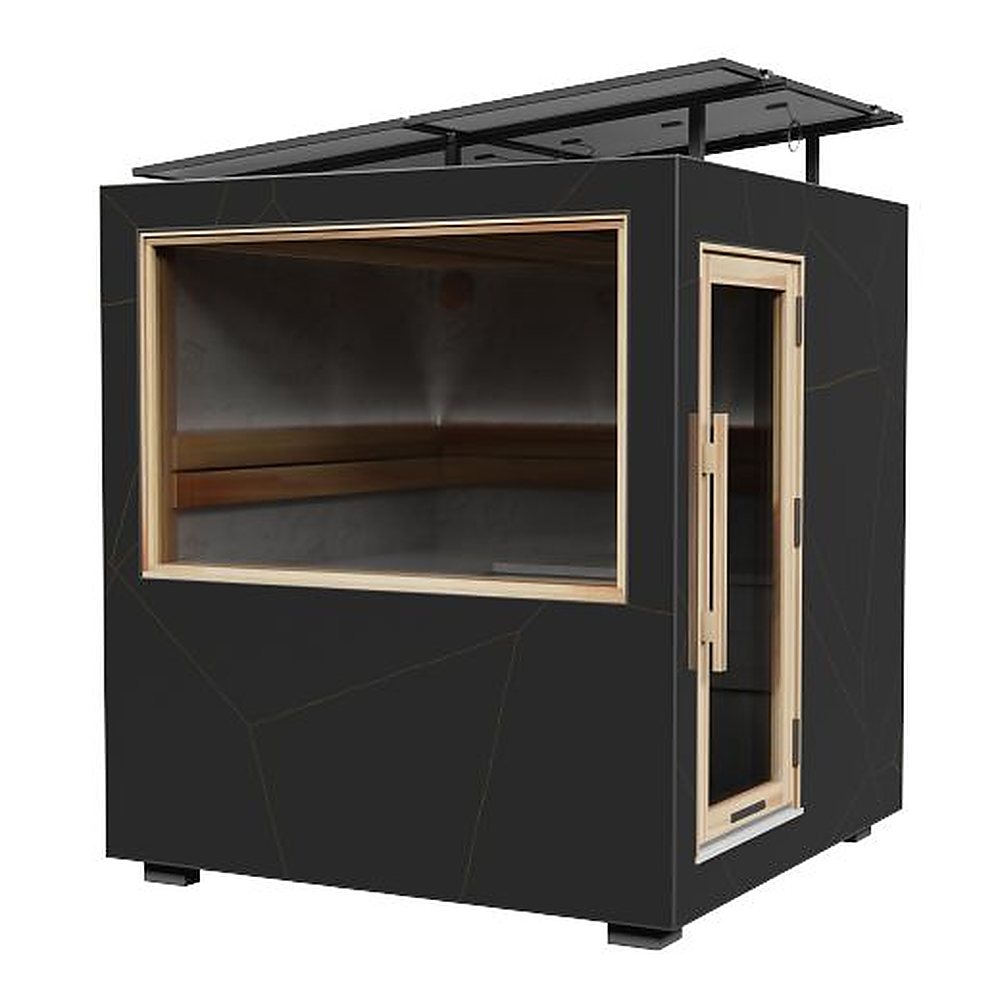
The Solaris is the cabin that puts Harvia in conversations it would not otherwise be in. Roof-mounted and wall-mounted solar panels charge an integrated battery pack, and a Harvia heater runs the cabin entirely off-grid. The marketing language is direct: one day of sunshine charges enough to deliver 2 to 3 hours of sauna use, sometimes 5 on a very sunny day, and the cabin reaches 170 degrees Fahrenheit in roughly 40 minutes. TIME’s Best Inventions of 2025 list picked it up. The exterior is Tile Oak cladding, the benches are brushed Alder, and the cabin ships in two sizes: $95,207 for the small (2 to 3 people) and $101,019 for the medium (4 to 5 people). In Europe the same product is the Kirami FinVision® Zero, available in S and M sizes with a Harvia Delta 3.6-kilowatt heater paired to the solar battery system. The American configuration uses a slightly different heater badging but the underlying cabin, glass, and solar electronics are identical Sastamala output.
Nordic Dawn and Nordic Misty: the Finnish-pine pair
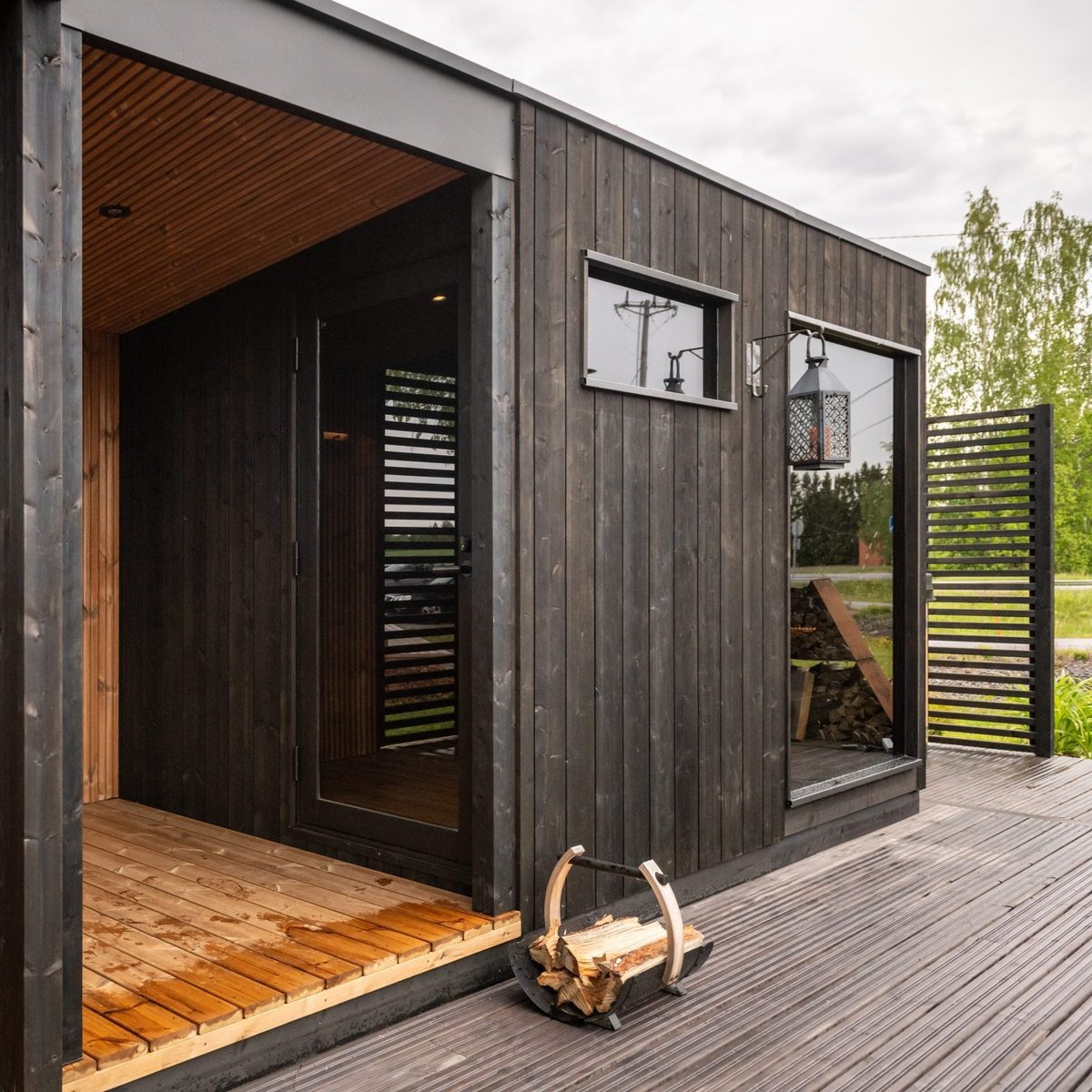
The Nordic Dawn carries the most traditional aesthetic in the lineup. The construction is heat-treated Finnish pine inside and out, with a full-width double-glazed window built around argon insulation, an outward-opening glass door with a safety latch and exterior padlock, and a pre-installed metal roof. The heater is a 9-kilowatt Harvia Spirit, the only model in the line to use Spirit instead of Virta. In Europe the same product ships as the Kirami FinVision® M Dawn, with a 51.7-square-foot (4.8-square-meter) floor plate, an 8-foot-3-inch (2.51-meter) overall height, and capacity for 4 to 6 people in the European spec. ThermaSol markets the same cabin to 4 to 5 people in the American spec.
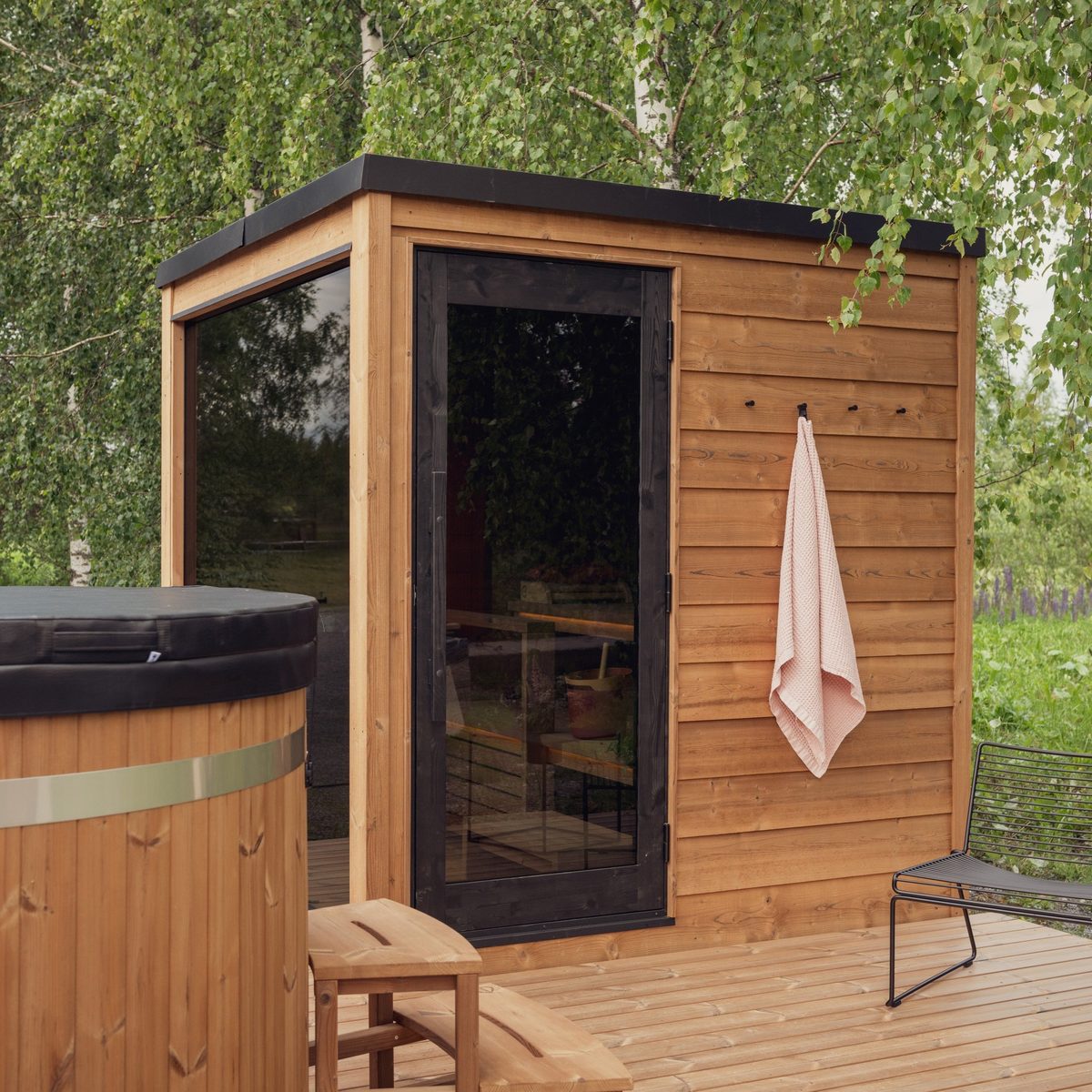
The Nordic Misty is the most operationally interesting cabin in the new American lineup, because it is not really one cabin. It is a modular system. The base sauna is dark Nordic thermo-spruce outside, heat-treated aspen inside, with a full-length tinted glass wall and door. Owners can clip on a Medium Lounge, an XL 1-Entrance Lounge, an XL 2-Entrance Lounge, a Changing Room, a Pergola, or a Privacy Fence panel, and assemble compounds that scale from a 2-person box to a multi-room outdoor wellness suite. Nordic Misty is also the only cabin in the lineup that offers a wood-burning heater option as an alternative to the 9-kilowatt Harvia Virta. Both Nordic models ship with a 2-year warranty rather than the 1-year warranty on the rest of the outdoor line. The product is the Kirami FinVision® S Misty and M Misty in Europe, with the same modular Annex system.
The indoor three
The indoor cabins are quieter, but they are the part of the line a residential builder is most likely to specify. All three sit between $30,393 and $33,782, all three run 9-kilowatt Harvia Virta heaters, and all three are corner-friendly cabins designed to fit into the awkward L-shaped footprints that come out of basement renovations and primary bath remodels. The indoor production line shares the Sastamala factory floor with the outdoor program, but the interior cabins ship as components for assembly on site rather than fully built shells.
Aalto: the sculptural corner
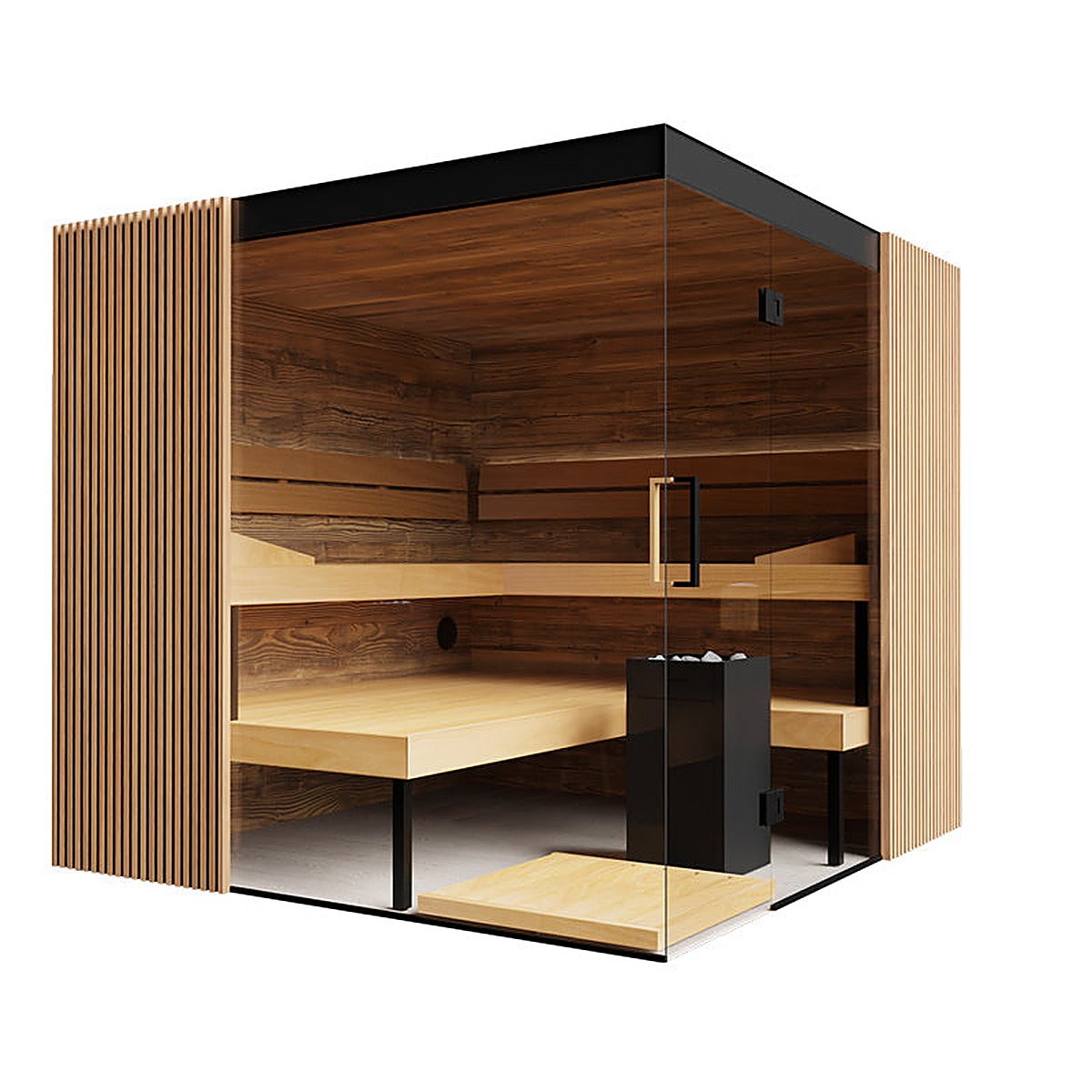
Named for Finnish architect Alvar Aalto, this is the design-forward indoor cabin. Brushed Tyrol wood walls with a textured grain, heat-treated aspen benches, a semi-panoramic transparent glass front, and RGB color-therapy LEDs running under the benches and behind the backrests. List price: $33,507. Capacity: 3 to 4. Pre-assembled from the factory, and offered with left or right entrance to suit the floor plan.
Astra: the disciplined corner
Astra is essentially the same architecture as Aalto in a slightly more compact footprint, with a clean glass-panel front and the same Tyrol-and-heat-treated-aspen interior. List price: $33,719. The marketing copy positions it as “minimalism meets serenity,” which is dealer language for a cabin that gets specified when the Aalto’s sculptural details would distract from the rest of the bath.
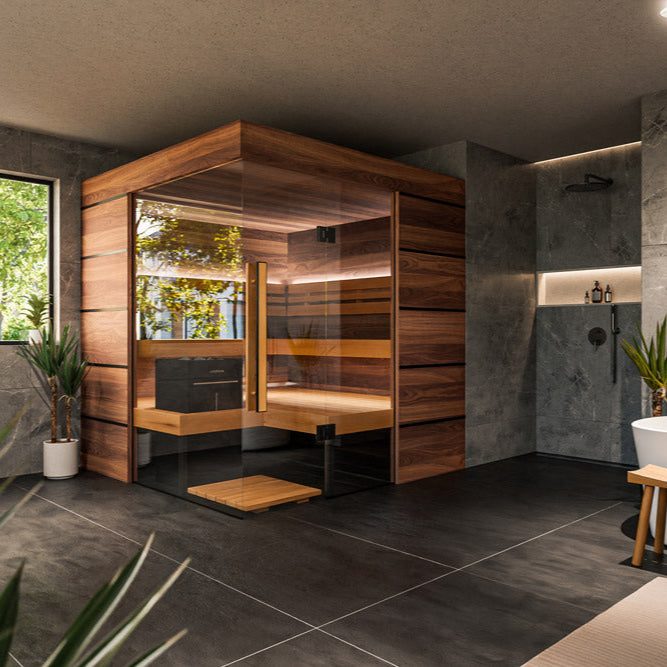
Lumaria: the volume indoor
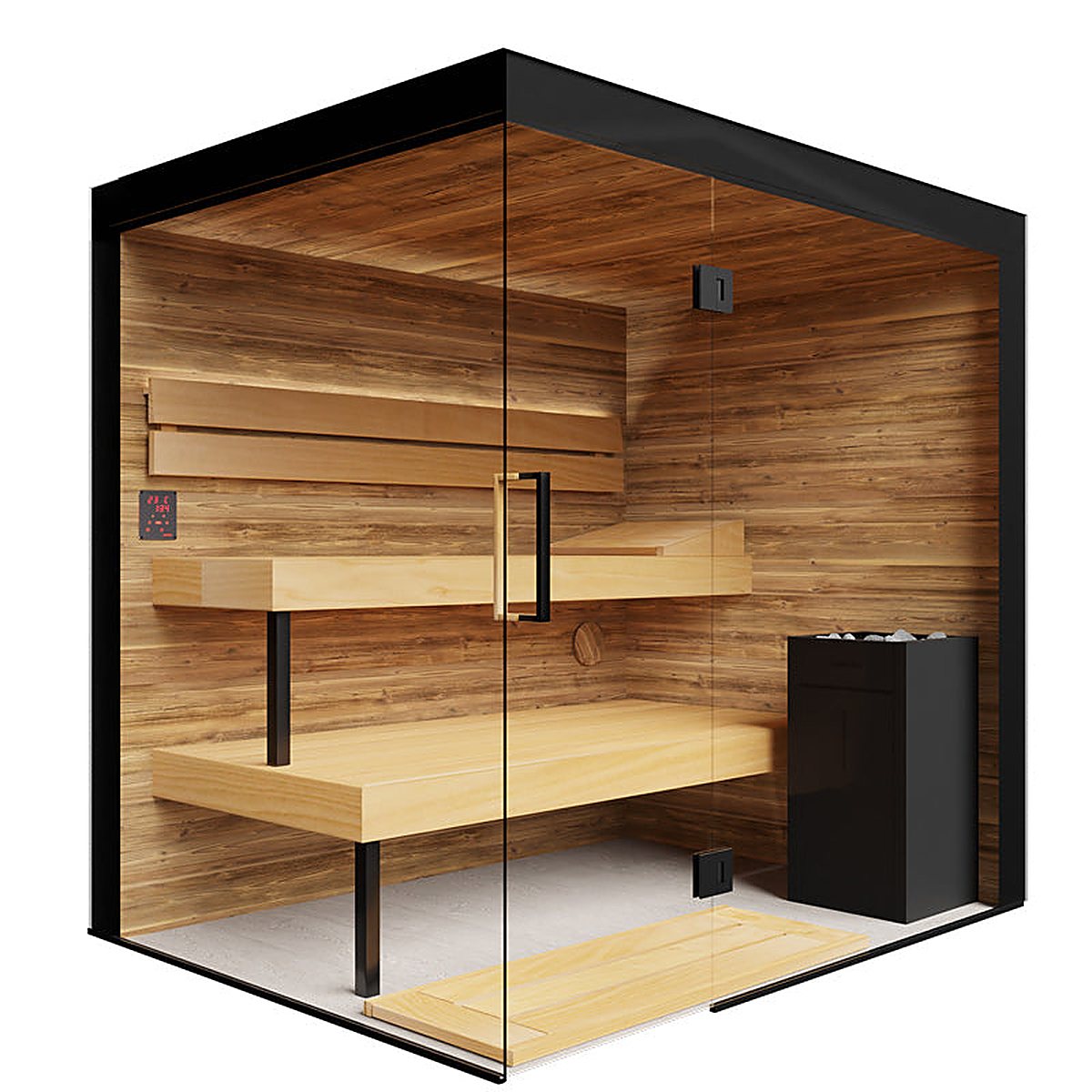
Lumaria is the entry point. Two sizes, $30,393 for the medium (2 to 3 people) and $33,782 for the large (4 to 5 people), with the same Harvia Virta 9-kilowatt heater across both. Panoramic transparent glass front, the same heat-treated aspen and Tyrol interior, the same RGB color-therapy LEDs. This is the cabin a builder writes into the spec when the homeowner has asked for a “real Finnish sauna” but is not paying for the Aalto’s sculptural finish.
Why ThermaSol, not Almost Heaven
Harvia’s American footprint before this launch was already substantial. Harvia’s 2025 financial reporting shows North American revenue of EUR 75.8 million, up 22.1 percent year over year, representing 38.1 percent of group revenue and now Harvia’s single largest region. The bulk of that volume runs through Almost Heaven, the West Virginia cabin builder Harvia bought in 2018, plus heater dealer sales. Almost Heaven’s saunas are excellent, well-priced, and exactly where you would expect them to be: in the $4,000 to $20,000 range, sold to homeowners who want a real sauna without taking out a second mortgage.
The premium tier above Almost Heaven was open. KLAFS, owned by Kohler since January 2024, sells through Design for Leisure as the consultative hospitality channel with made-to-measure pricing that starts around $25,500 for a Valora installation and runs into six figures for full custom hotel-grade builds. Auroom Wellness, the Estonian sauna brand spun off from the Thermory Group in April 2021, sells through dealer networks and design firms with prices that cluster in the $20,000 to $50,000 range for outdoor cabins.
ThermaSol changes the geometry, and the Kirami factory is what made it possible. The brand was founded in 1958 by David Altman, who designed the first electric residential steam shower for an apartment on New York’s Park Avenue. Its headquarters and factory are now in Round Rock, Texas. By the time Harvia paid $30.4 million for it, ThermaSol already had distribution into plumbing wholesalers, kitchen and bath showrooms, and roughly 2,500 dealers across North America and Europe. That is a different distribution surface than Almost Heaven’s. It is also different from Auroom’s. Plumbing wholesalers do not specify Auroom. They specify ThermaSol because they have for decades. Pair that retail surface with Kirami’s Sastamala-built FinVision® cabins, badge them with American product names, and you have a Finnish premium sauna lineup walking into showrooms that already carry ThermaSol steam generators.
Harvia described the ThermaSol acquisition logic at the time as “delivering the full sauna experience” and growing in North America “across price points, categories, and channels.” With the Kirami connection visible, that quote reads more specifically. The channels are ThermaSol’s. The price points are Almost Heaven at the bottom and the FinVision® cabin lineup at the top. The categories are heater, hot tub, steam, indoor sauna, outdoor sauna. Every box on the Harvia organization chart is now filled.
The marketing-naming question
Every outdoor product page on thermasol.com carries the line “Designed and crafted in the U.S.A.” Every Kirami product page says “Designed and manufactured in Finland.” Both are official corporate statements from companies under the same parent.
ThermaSol’s “designed and crafted in the U.S.A.” wording does not say which steps happen in Finland and which in the US. The arrangement is consistent with the Harvia playbook: European-built cabins, American-led distribution, local final-mile handling.
The marketing critique that follows from this is whether American buyers would value the Kirami connection if they were told about it. The Finnish sauna heritage carries cultural weight in the United States, and the wave of premium sauna interest among American operators and homeowners has been driven in part by an appetite for Finnish authenticity. Kirami is a 25-year-old Finnish wood-fired hot-tub maker that built a dedicated Sauna Factory in November 2020 and has been shipping cabins to European dealers ever since. That is a stronger marketing story than “designed and crafted in the U.S.A.” It is also the story Kirami’s own image filenames already tell. The literal file naming kiramibyharvia_kir-XXXX.png across the FinVision® product photography on kirami.com makes the supply chain visible to anyone who right-clicks on a hero image.
The Auroom question
ThermaSol’s new cabins now compete with Auroom for the same premium buyer.
Both companies build cabins from thermally modified wood, both use panoramic glass walls and architectural framing, both are leaning into RGB color-therapy LEDs and integrated sound, both are offering pre-assembled turnkey delivery rather than DIY kits. The biggest design difference is that Auroom’s lineup runs heavily on alder and aspen with an Italian-architect-led aesthetic from Luca Donazzolo on its Lumina, Natura, and Irradia models, while Kirami’s FinVision® runs on Tyrol panels and heat-treated aspen with what reads as a more North American luxury-residential vocabulary by the time it arrives in the United States as ThermaSol. Same category, different idiom, different factory.
The question is whether the dealer network ThermaSol inherited can outsell the design firms and architectural-spec channels Auroom has been winning. Auroom’s saunas are in specifications at hotel and residential projects across the United States. ThermaSol’s are not yet, because the lineup is new. Six months from now, that comparison will tell the story.
What the numbers already say
By the numbers
- EUR 7M What Harvia paid up front for Kirami in May 2021, with up to EUR 4M in additional EBITDA-linked earnout payments.
- $30.4M What Harvia paid for ThermaSol in July 2024.
- EUR 75.8M Harvia’s North American revenue in 2025, up 22.1 percent year over year.
- 38.1 percent Share of Harvia group revenue now coming from North America. Largest single region.
- EUR 24.4M Harvia’s North American revenue in Q1 2026, up 12.0 percent reported and 21.1 percent in local currency.
- EUR 17.2M Steam product revenue for Harvia in 2025, the first full year ThermaSol consolidated. 8.7 percent of group total.
- 32,000+ sq ft (3,000+ sq m) Heated space at Kirami’s Sastamala facilities, which added a separate Sauna Factory in November 2020.
- 2,500 Approximate authorized dealers and Premier Partners across North America and Europe selling under the ThermaSol nameplate.
The headline number is the third one. North America is now Harvia’s largest region, larger than Europe excluding Finland and larger than Finland itself. It has been Harvia’s largest reported region since 2023. The 22.1 percent growth in North America during 2025 was the engine that pulled the group’s overall growth to 13.5 percent. Steam product revenue at EUR 17.2 million in 2025 was up sharply because ThermaSol consolidated for a full year, but the trend in Q1 2026 was softer (EUR 4.3 million, down 11.4 percent), reflecting key-account timing and a weaker US dollar against the euro.
The cabin lineup is the bet that goes beyond steam. If the 14 SKUs sell at even modest volume in 2026, the strategic case for both the ThermaSol acquisition and the Kirami acquisition compounds. The fixed cost of building a premium American sauna lineup has now been absorbed at the factory in Sastamala. Every cabin Harvia sells under the ThermaSol nameplate going forward is incremental revenue that did not exist twelve months ago, sourced from production capacity that did not exist before November 2020.
What to watch
Three things will determine whether this lineup defines the next phase of the American premium sauna market. The first is hospitality. Harvia needs Vue and Ombra cabins specified into a flag hotel project, the way Design for Leisure has placed KLAFS Valora rooms into Canyon Ranch and Six Senses properties. The Denver showroom that opened in August 2025 at the Ultra Design Center is a clear bid for that audience. The second is residential architecture. Watch which firms list ThermaSol in their preferred-vendor sauna section. Auroom currently dominates that list among design-forward studios. The third is dealer-network conversion. ThermaSol’s dealers were trained to sell steam. Selling a $107,000 outdoor sauna with IPE Lapacho cladding requires a different conversation.
Harvia’s H1 2026 half-year report on August 6, 2026 will be the first quarterly update where the cabin lineup is fully accounted for. By then, the comparison to the Q1 2026 numbers will tell us whether the Sastamala-built cabins are pulling their weight on the American side or just adding noise to the steam line.
Why it matters
The American premium sauna market has been culturally Finnish for years, but most of the cabins arriving in American backyards were either built in Estonia (Auroom), built in Germany (KLAFS), or built in West Virginia with European heaters (Almost Heaven). Harvia has now closed the loop. The premium cabins it ships to American customers under the ThermaSol nameplate are built in Sastamala, Finland by Kirami, at a Sauna Factory that opened in November 2020 specifically to feed an outdoor cabin program that has now scaled across two continents. That is a different competitive picture than the one that existed in 2024. The American market is no longer choosing between an Estonian premium maker and a German hospitality specialist. It now has a Finnish premium maker on the showroom floor, distributed through ThermaSol’s plumbing-wholesale channel and badged with American product names.
Bottom line
Harvia’s American up-market thesis is no longer hypothetical. It is fourteen Sastamala-built sauna SKUs, a Denver showroom, a TIME Best Inventions winner, and a LUXE RED Award-winning architectural piece. The product brand is ThermaSol. The cabin builder is Kirami. The heater is Harvia. The distribution is American. If Harvia can convert the ThermaSol dealer network from selling steam generators to specifying Finnish-built premium sauna cabins, the American premium sauna market gets a third serious player by the end of 2026, with a production line in Finland that is already running.
Harvia events
1 event