Tulikivi’s Russia Exit Activates Saunologia Partnership as Kevo Heater Targets America
The Finnish soapstone company ended its Russian subsidiary on April 1, clearing the condition Dr. Lassi Liikkanen attached to a 2026 editorial partnership. Combined with UL safety certification tests on the Kevo electric heater for North American launch, Tulikivi is buying two kinds of trust at the same time.

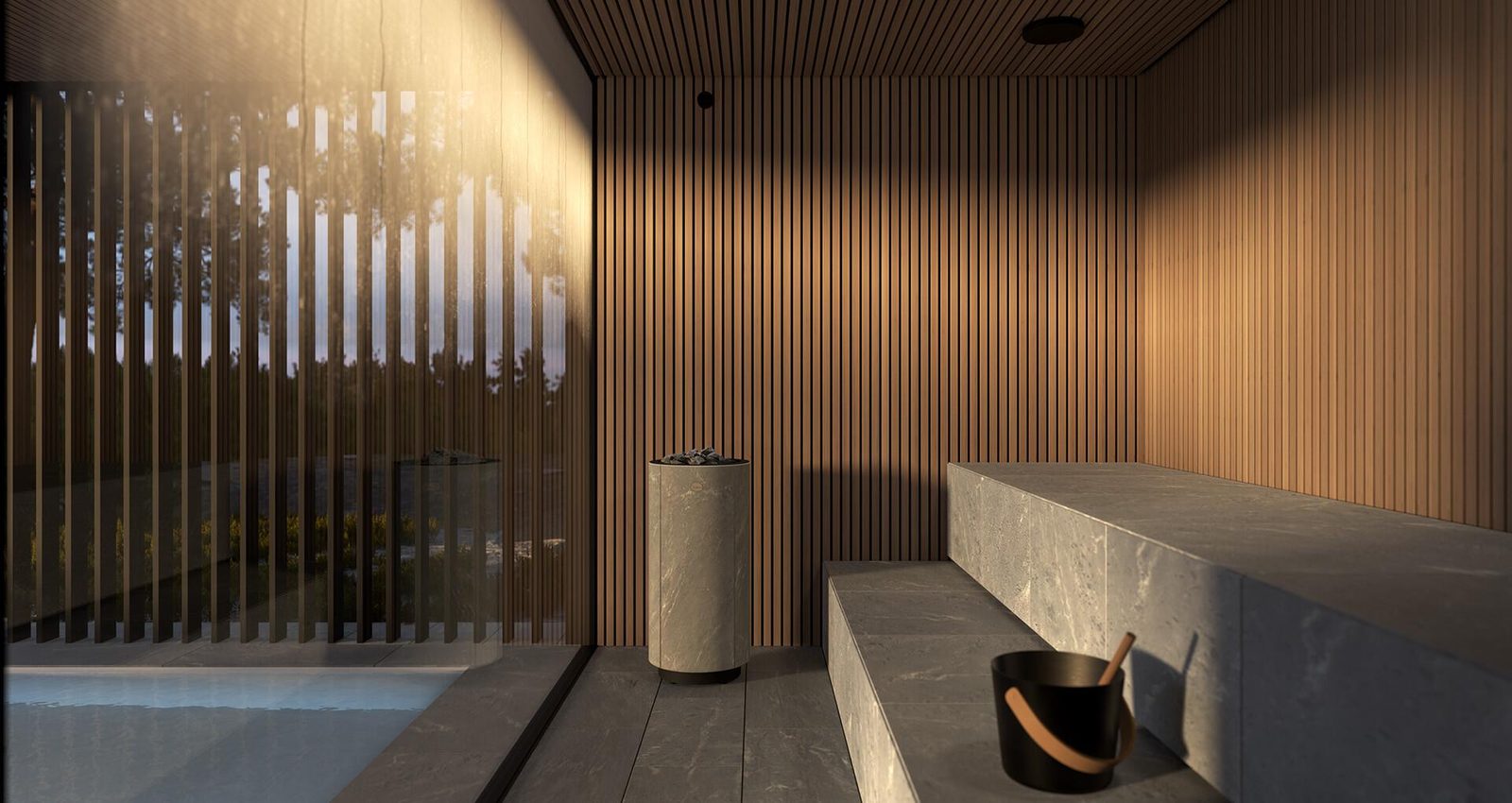
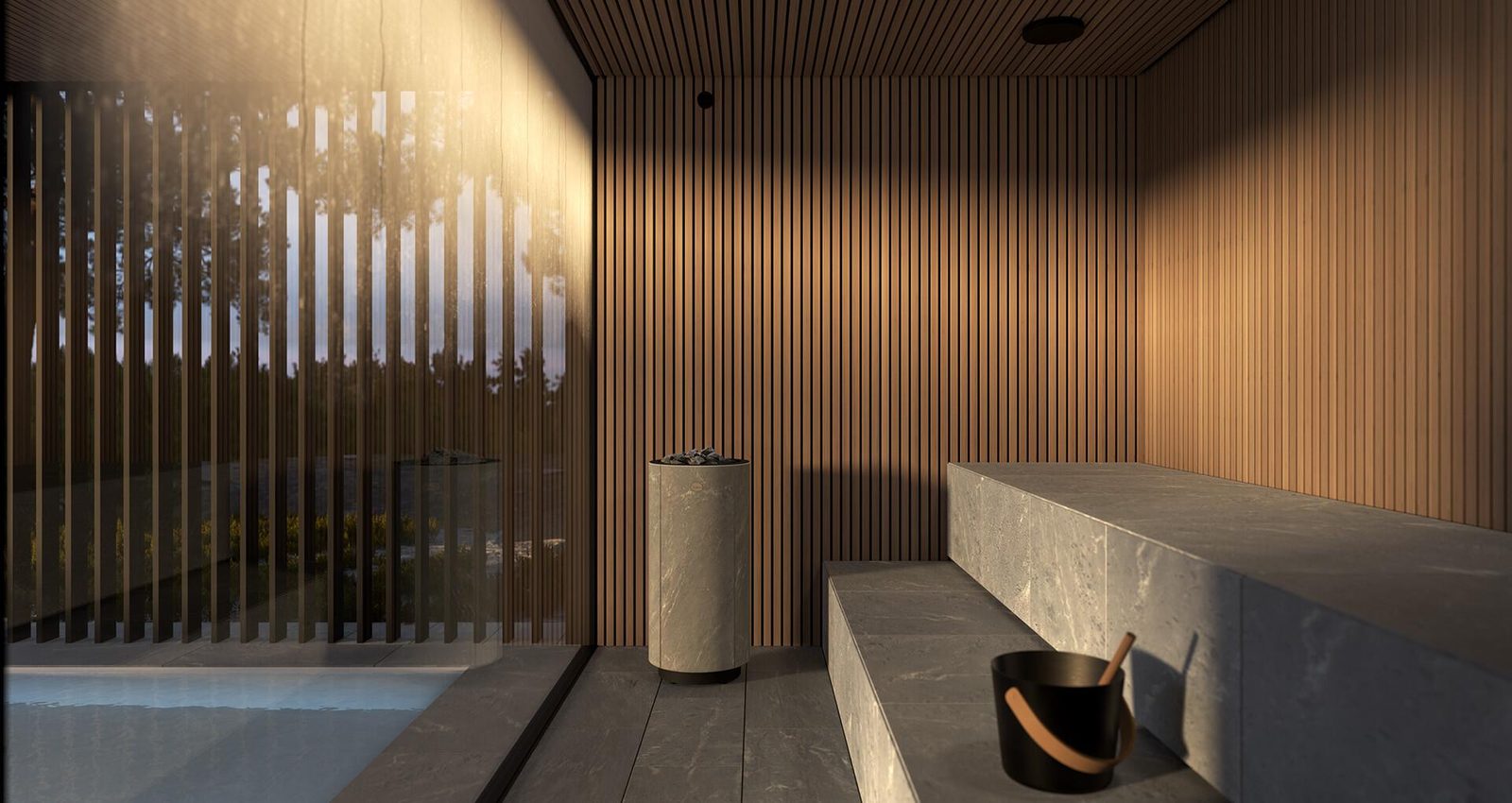
The Tulikivi Kevo Kaarna Classic, a soapstone-clad electric sauna heater headed for UL certification and North American launch. Photo: Tulikivi Corporation.
Tulikivi Corporation disclosed in its Q1 2026 interim report on May 8 that it is running UL safety certification tests on its Kevo electric sauna heater collection for North American launch during 2026. The same report confirmed the company ended all operations in Russia on April 1. What the quarterly filing did not mention: that Russia exit appears to clear a condition Dr. Lassi Liikkanen, founder and editor-in-chief of Saunologia, attached in February to a 2026 editorial partnership with Tulikivi.
Two signals in one filing. In the United States, Tulikivi (Helsinki: TULAV) is buying compliance credibility through a UL listing on its Kevo heater. In Europe, it is buying editorial credibility through the most widely read independent sauna publication in the Nordic countries. The 130-year-old Finnish soapstone company is not just going west. It is stacking trust on both sides of the Atlantic in the same calendar year, and the Russia exit is the hinge that makes both plays possible.
Key Facts
- Company: Tulikivi Corporation (Helsinki: TULAV), headquartered in Juuka, Finland. Approximately 250 employees. Factories in Juuka, Heinävesi, and Suomussalmi.
- Q1 2026 net sales: EUR 6.3 million (up 3.8 percent from EUR 6.0 million in Q1 2025)
- Q1 2026 operating loss: EUR 0.8 million (versus EUR 0.7 million loss in Q1 2025)
- US market entry: UL safety testing underway on the Kevo electric heater collection. Target: North American sales during 2026
- Kevo collection: Three model lines (Kaarna soapstone, Pyry cast stone, Usva steel), 4.5 to 10.2 kW, CE certified, cool-touch exterior surfaces
- Russia exit: OOO Tulikivi operations ended April 1, 2026. EUR 0.3 million write-down recorded in FY 2025
- Saunologia partnership: Named as 2026 industry partner by Dr. Lassi Liikkanen on Feb 20, alongside longstanding partner Narvi. Conditional on Russia divestment completion. No separate activation confirmation published as of May 10
- Sauna from Finland: Strategic partner since February 2024. Main Partner of World Sauna Forum 2026
- Japan: Distribution partnership with Metos Inc. (Tokyo) announced November 2024
- Head of Sauna Business: Mikko Kuoppa, appointed October 2024 (new position). Previously at BMI Group, London
- FY 2025 revenue: EUR 29.5 million. Long-term target: exceed EUR 50 million by end of 2030
What the Q1 Report Says
Tulikivi’s Q1 revenue of EUR 6.3 million edged up 3.8 percent year over year, but the quarter posted an operating loss of EUR 0.8 million. Managing Director Heikki Vauhkonen called the result “slightly improved but at a low level” and attributed the weakness to seasonal demand patterns and low consumer confidence across the company’s main European markets. Order intake fell to EUR 6.8 million from EUR 7.8 million in the prior-year quarter.
The sauna business section carried the real news. In Tulikivi’s own words: “Product development in the sauna business focused on preparing for the launch of sales in North America by carrying out the tests required under UL safety standards. The aim is to launch sales during 2026.” The company named the Kevo electric sauna heater collection as the vehicle and highlighted competitive differentiators for North America: “high-quality design, energy efficiency, original materials and safe exterior surfaces that do not become hot.”
The Saunologia Condition
On February 20, Liikkanen published a 10th-anniversary post announcing that Saunologia would shift to primarily English-language content and naming its 2026 industry partners. Narvi, a longstanding collaborator, was renewed. Tulikivi was new. But the Tulikivi partnership came with an explicit condition, written in Finnish and translated here: the cooperation “is based on the undersigned’s assumption that the company is committed to its January-announced plan to wind down Russian business operations during the current year.”
Liikkanen went further, stating that “Saunologia as a company supports a total trade embargo on [Russia] until a peace acceptable from Europe’s standpoint is achieved in Ukraine.” The condition was unusually specific for a content partnership announcement: Saunologia would align with Tulikivi’s heater brand, but only if Tulikivi followed through on exiting Russia.
Tulikivi’s Q1 2026 report, published 11 weeks later, confirmed the exit happened on April 1. Saunologia has not yet published a separate confirmation that the partnership is now formally active, but the condition Liikkanen set appears to have been met.
For context: Saunologia has published more than 420 sauna articles across its decade of operation and draws roughly 400,000 readers per year, according to figures Liikkanen shared in the anniversary post. He holds a doctorate and reviews heater performance, bench ergonomics, and construction practices with a technical rigor that is unusual in the sauna media space. A Saunologia review of the Tulikivi Kaarna, published on February 6 (two weeks before the partnership announcement), tested the heater over a month of household use, praising its heat-up speed and safety features while noting stone-temperature challenges in certain room configurations. Tulikivi was also a Gold sponsor of the Saunologia Innovation Conference in December 2025, alongside Narvi and Saunum, suggesting the editorial relationship had been building for months before the formal announcement.
The Kevo Collection
Kevo is a family of tower-style electric sauna heaters that Tulikivi launched in 2024, built around a height-adjustable frame (31 to 37 inches) and a shared 66-pound stone compartment. All models run on 400-volt three-phase power, with output ranging from 4.5 kW (covering rooms of roughly 105 to 210 cubic feet) to 10.2 kW (covering up to approximately 530 cubic feet). The collection carries CE certification in Europe.
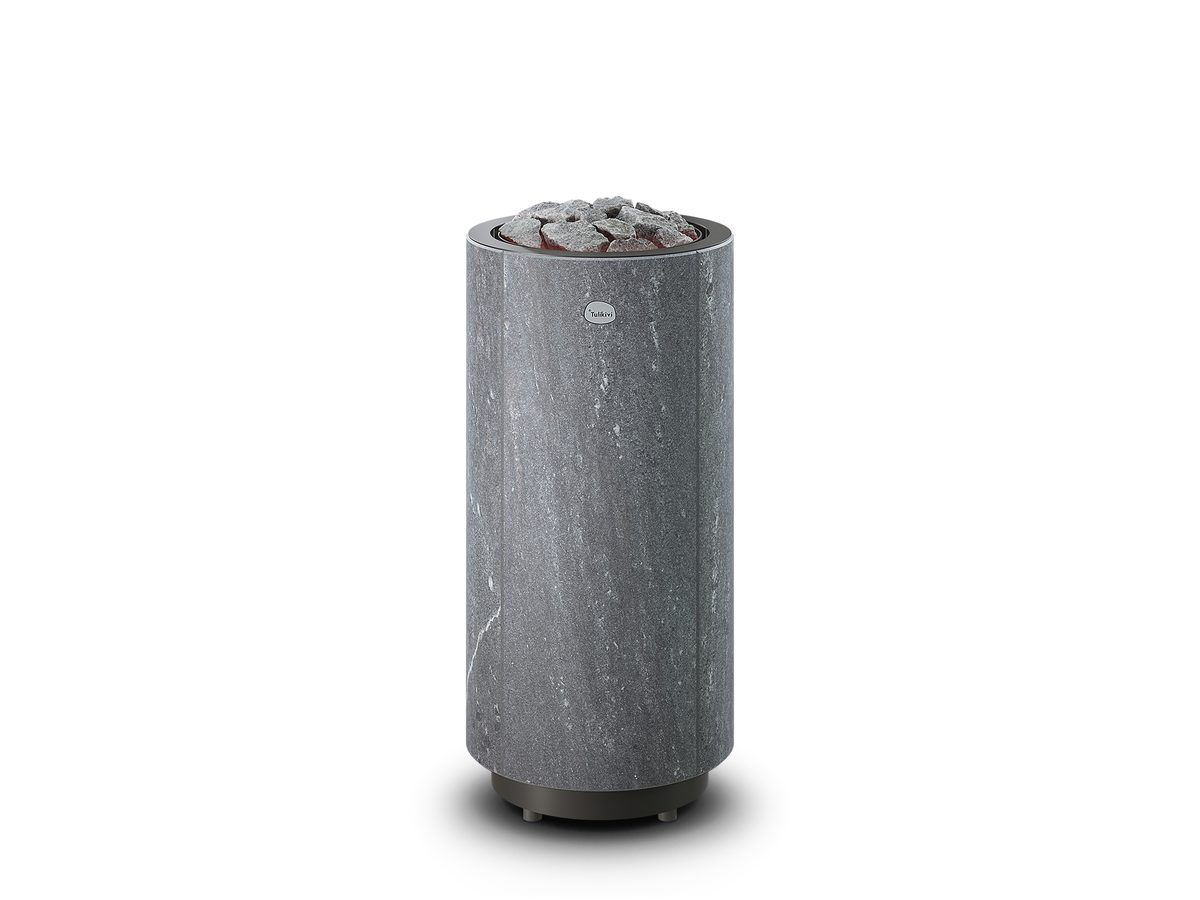
Three cladding options define the lineup:
- Kaarna (soapstone): The flagship. Available in Classic and Nobile finishes, using the same Finnish soapstone that Tulikivi has quarried and processed for over a century. The soapstone exterior stays cool during operation thanks to a multi-layer construction. Weighs 159 pounds without stones. Safety clearance to the side wall is roughly 4 inches.
- Pyry (cast stone): A white cast-stone surface made from recycled ceramics industry material. Lighter at 97 pounds without stones. Side-wall clearance drops to roughly 2 inches.
- Usva (steel): Black or white powder-coated steel. The lightest option at 57 pounds. Same 2-inch side-wall clearance as the Pyry.
All three share a touchscreen control panel that can be wall-mounted in wet or dry areas, plus WiFi app connectivity. The heating elements are adjustable within the stone compartment, allowing room temperature and steam intensity to be tuned independently.
Why a UL Listing Matters Now
Any electric sauna heater sold in the United States must carry a listing from a Nationally Recognized Testing Laboratory to satisfy building codes and electrical inspectors. Historically, UL 875 was the governing standard, and its requirements (including a prescriptive thermostat sensor location and a conservative auto-shutoff threshold) made certification more difficult and more expensive for European-designed heaters.
That changed in June 2025 when UL published UL 60335-2-53, a new standard harmonized with the international IEC 60335-2-53 framework that European manufacturers already build to. The new standard allows sensor relocation to the seating area, raises the high-temperature trip threshold, and adds air-venting flexibility that matches how Nordic saunas are traditionally designed. A European heater collection already carrying CE certification faces a substantially lower testing hurdle under UL 60335-2-53 than it would have under the legacy UL 875.
Buying Trust on Two Continents
Read in isolation, any one of Tulikivi’s recent moves looks like a standard market-entry play. Stacked together, they form a pattern. In the United States: UL certification tests, an existing subsidiary (Tulikivi U.S. Inc., incorporated in Charlottesville, Virginia, with an export manager covering the US and Canada), and a regulatory environment that just became friendlier. In Europe: a Saunologia editorial partnership, a strategic partnership with Sauna from Finland dating to February 2024, and a Main Partner role at the World Sauna Forum 2026. In Japan: a distribution deal with Metos Inc. announced in November 2024, with CEO Vauhkonen personally visiting Tokyo for the product launch.
“We are opening new markets, which makes this year especially important for us,” Mikko Kuoppa, Tulikivi’s Head of Sauna Business, said in a February 2026 World Sauna Forum profile. Kuoppa was appointed to the newly created role in October 2024 after a career in building-products sales at BMI Group’s London headquarters. That the sauna division now has its own seat on the management team tells you where Tulikivi is placing its bets.
The contrast with Harvia’s Q1 2026 report, published one day earlier, is instructive. Harvia posted record revenue of EUR 58.6 million, with North America heating equipment up 21.0 percent. Harvia has an established distribution network, a US subsidiary (ThermaSol, acquired in 2024), and the pricing power to manage tariff headwinds through commercial actions. Tulikivi, with FY 2025 revenue of EUR 29.5 million across all product lines, has not sold a single heater in the United States.
But Tulikivi is not trying to compete with Harvia on volume. The Kevo collection targets the premium specialty segment where soapstone cladding, minimal safety clearances, and cool-touch exterior surfaces matter. And where Harvia’s trust in North America is built on scale and distribution, Tulikivi is building trust through a different stack: compliance certification (UL), independent editorial endorsement (Saunologia), industry-body alignment (Sauna from Finland, World Sauna Forum), and a century-plus track record in soapstone.
The Russia Exit
The interim report confirmed that operations of OOO Tulikivi, the company’s wholly owned Russian subsidiary established in 2005, ended on April 1, 2026. Tulikivi had announced a specific wind-down plan in January 2026, though the broader intention to exit dated to the period following Russia’s full-scale invasion of Ukraine. The company described the process as “a deliberate, controlled, and phased” effort focused on sanctions compliance, asset repatriation, and resolution of local obligations. EUR 0.3 million in related write-downs were recorded in FY 2025.
The revenue impact is modest (the company did not break out the Russian contribution). The strategic impact is not. The exit clears a potential compliance overhang for US entry, where anti-Russia trade sentiment is a factor for commercial buyers. And it satisfies, at least on paper, the explicit condition Liikkanen attached to the Saunologia partnership. One divestment, two credibility gates opened.
Why It Matters
Tulikivi’s 2026 is not a single market-entry story. It is a coordinated credibility build across multiple geographies. UL certification buys the compliance signal that American building inspectors and code officials require. The Saunologia partnership buys editorial credibility with the technically minded professionals, designers, and enthusiasts who read Liikkanen’s work. The Sauna from Finland and World Sauna Forum relationships buy industry-body alignment. The Metos deal buys a distribution beachhead in Japan. All of this from a company that posted a EUR 0.8 million operating loss last quarter.
For operators and dealers in the US market: watch for Tulikivi sales activity in the second half of 2026. The company has a US subsidiary and an export manager already covering North America. For the European trade and product specifiers: the Saunologia partnership, if and when Liikkanen confirms its activation, signals that Tulikivi’s Kevo line will receive the kind of independent technical review that Finnish heater makers competing for international attention increasingly need. Two Finnish companies released Q1 2026 results within 24 hours of each other, both pointing at the same North American demand curve from opposite ends of the revenue scale. But only one is also buying editorial trust in Europe at the same time.
Arlene Scott
Senior Wellness Correspondent & Hospitality Consultant
Arlene Scott brings over fifteen years of reporting and consulting experience across energy infrastructure, sustainable design, and thermotherapy-focused hospitality.
Full byline
Arlene Scott is a Senior Wellness Correspondent for SaunaNews.com, bringing over fifteen years of experience at the intersection of energy infrastructure, sustainable design, and thermotherapy. Her work focuses on the physiological benefits of passive heat therapies and the sustainable integration of sauna culture into modern wellness routines.
Arlene's background is rooted in the clean energy transition. She was a founding writer at MicrogridMedia.com, where she covered the technical and economic viability of desalination projects, microgrid deployments, and distributed renewable energy systems. During the mid-2010s, she was a regular contributor to Greentech Media (GTM) during its independent era — prior to the Wood Mackenzie acquisition in 2016 — reporting on the early integration of thermal energy storage and sustainable infrastructure.
Transitioning her focus from macro-energy systems to human-scale wellness, Arlene now applies her technical background to the hospitality sector. She operates as an independent consultant, advising boutique hotels and eco-resorts on the design, energy efficiency, and historical authenticity of commercial sauna and thermal spa installations. Her consulting work ensures that high-end wellness facilities balance traditional Nordic bathing principles with modern sustainable engineering.
Arlene holds a specialized certification in Applied Thermic Wellness from the Nordic Institute of Passive Heat Studies (NIPHS) and is a recognized associate member of the International Sauna Association (ISA). When she isn't reviewing the latest innovations in infrared technology or consulting on a new resort project, Arlene can be found tending to her own traditional wood-fired sauna in the Pacific Northwest. You can read her complete archive of essays on energy, wellness, and sustainable living at www.arlenescott.com.