Saunas Belong in Senior Living. A Teenager Made the Case First.
Families choosing senior living are asking about brain health. Finnish research says sauna belongs in the conversation. A high school student in New Jersey was the first to put the business case on paper.

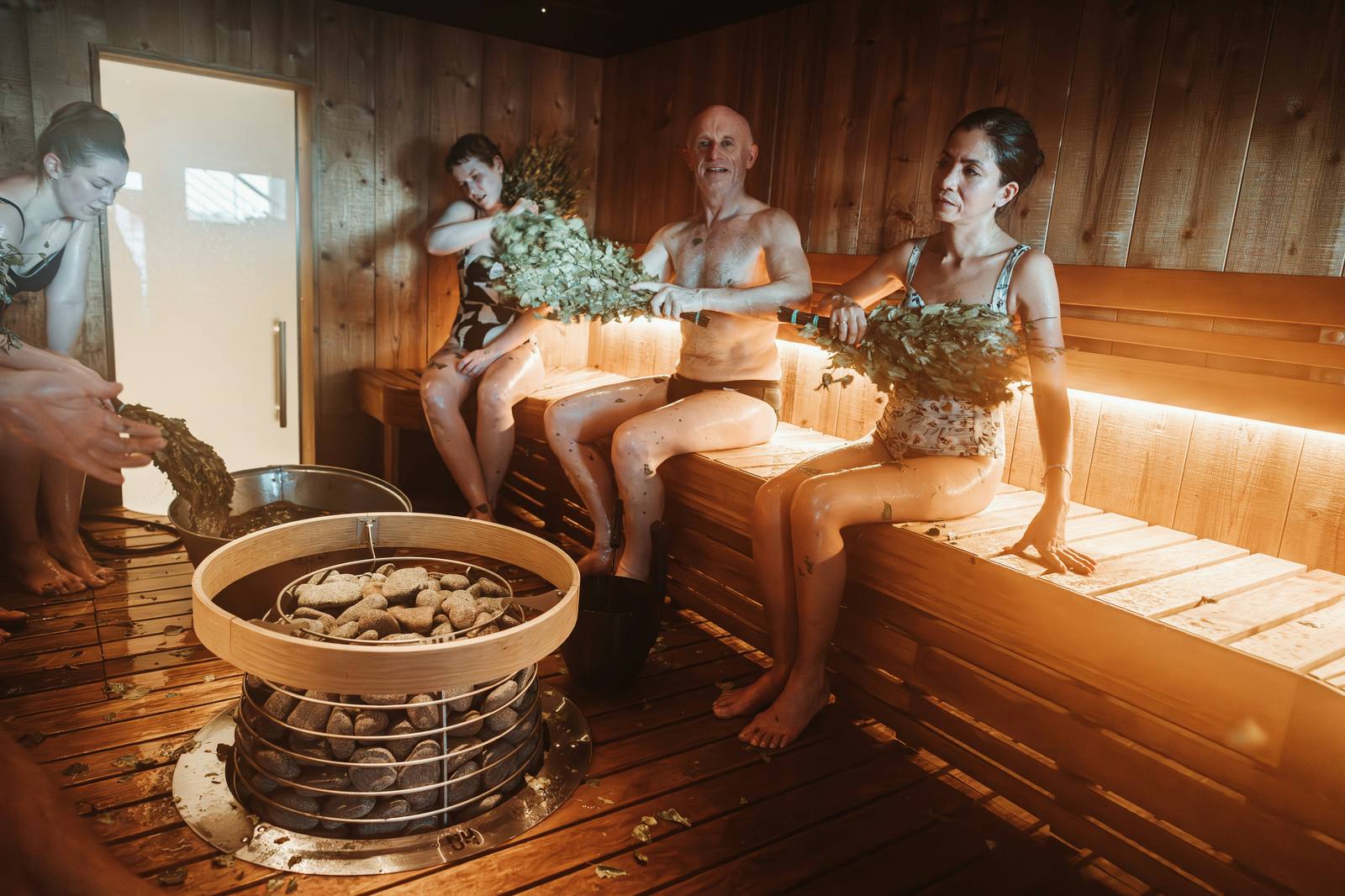
A traditional sauna interior. New air-blending technology from manufacturers like Saunum means accessible low-bench saunas can now deliver meaningful heat at seated height, making ADA-compliant installations viable for senior living facilities. Photo: HUUM / Unsplash.
Families choosing senior living facilities are increasingly asking about brain health. Finnish population data gives them good reason: regular sauna use is associated with a 65% lower risk of dementia. The demand is real. The research is encouraging. And almost none of the roughly 29,000 assisted living communities in the United States have a sauna.
The first person to put that gap on paper was not a sauna manufacturer or a senior living operator. It was a high school student in New Jersey named Ethan Abramovitz, who built a backyard sauna with his father, watched two great-grandparents decline from dementia, and decided to do something about it. He founded a nonprofit called Sauna for Seniors in 2025 and published a cost-benefit analysis in December of that year. His headline finding: outfitting 39 senior-focused facilities in southern New Jersey with prefabricated saunas would cost $378,750 per year and could generate $5.6 million to $18.8 million in avoided healthcare costs over five years.
The idea may be even better than the paper realizes. Here is why.
Key Facts
- Organization: Sauna for Seniors, Voorhees, New Jersey (nonprofit)
- Founder: Ethan M. Abramovitz, Eastern Regional High School
- Paper published: December 14, 2025
- Study area: Southern New Jersey suburbs outside Philadelphia
- Target locations: 39 (20 senior residential developments, 15 senior activity centers, 4 YMCAs)
- Locations with existing saunas: 8 of 39 (20%)
- Target cohort: 12,888 adults aged 65+
- Paper’s cost per unit: $7,500 (prefabricated residential sauna)
- Realistic commercial installed cost: $50,000 to $100,000 (ADA-compliant, traditional commercial sauna)
- Paper’s projected five-year savings (2.5% adherence): $5.6 million to $18.8 million
- Key underlying source: Laukkanen et al., Age and Ageing, 2017
What the Paper Does
The analysis is not a clinical study. It is an economic model that counts where seniors in one New Jersey region congregate, estimates how many are living with or at risk of neurodegenerative disease, and calculates what it would cost to put a three-person prefabricated electric sauna in each location.
Abramovitz identified 39 candidate sites, including 20 senior residential developments (home to an estimated 8,888 residents aged 65 and older), 15 senior activity and recreation centers, and four YMCA locations. Only eight of the 39 already had saunas. Using 2025 Alzheimer’s Association data, the paper estimates that 10.9% of the cohort is living with dementia and 1.9% with Parkinson’s disease.
The paper then applies a figure from Finnish epidemiological research: a 65% lower risk of dementia associated with frequent sauna use. At a conservative 2.5% adherence rate, the projected five-year savings come to $5.6 million to $18.8 million against a program cost of $378,750 per year.
The Finnish Data That Drives the Model
The research behind this figure is specifically about traditional Finnish sauna, not infrared. The 65% risk-reduction figure comes from a 2017 paper published in Age and Ageing by Tanjaniina Laukkanen, Setor Kunutsor, Jussi Kauhanen, and Jari A. Laukkanen, drawing on the Kuopio Ischaemic Heart Disease Risk Factor Study (KIHD), a long-running Finnish cohort that has produced some of the most-cited findings on sauna and health.
Men who used a sauna four to seven times per week had a hazard ratio of 0.34 for dementia (95% confidence interval: 0.16 to 0.71) and 0.35 for Alzheimer’s disease (95% CI: 0.14 to 0.90), compared to men who used a sauna once per week. It has been widely cited across the wellness and longevity industries ever since.
But the KIHD cohort consisted of 2,315 men, all middle-aged (42 to 60 years old) at baseline, all living in eastern Finland, followed for 20.7 years. No women. No elderly participants at enrollment. And the traditional sauna culture in eastern Finland (high-heat dry sauna with löyly, 175 to 195 degrees Fahrenheit, often multiple times per week as a lifelong practice) is different from what any institutional installation in the United States would deliver. No infrared sauna studies were part of this cohort. A broader study by Knekt and colleagues in Preventive Medicine Reports (2020), which included 13,994 men and women over 39 years, found a more modest hazard ratio of 0.81. The gap between observational association and causal intervention remains open.
What a Commercial Sauna Actually Costs
The paper prices each installation at $7,500. That is the lower to low-mid range of the home sauna market and well below what a commercial installation in a senior living facility would actually cost.
A prefabricated three-person residential sauna is built for a duty cycle of roughly 100 to 150 heat cycles per year. A sauna in a senior living community, open to dozens or hundreds of residents, will see 700 or more. Residential warranties are typically voided under commercial use. The heater, the hardware, and the cedar thickness (half an inch in residential units versus three-quarters in commercial) are all designed for a different use case.
Then there is the Americans with Disabilities Act. Federal accessibility standards (2010 ADA Standards, Sections 241 and 612) require a 60-inch wheelchair turning circle inside the sauna room, a fixed accessible bench at least 42 inches long and 17 to 19 inches high rated for 250 pounds, a door clear width of at least 32 inches, a maximum threshold height of half an inch, and controls accessible at 15 to 48 inches above the floor. A standard three-person prefabricated sauna cannot meet these requirements without structural modification that would cost more than the unit itself.
SaunaNews covers commercial sauna projects across the United States, and the pricing we see tells a consistent story. A properly specified commercial traditional sauna installation in a senior living facility, including commercial-grade heater, ADA-compliant room build-out, electrical, ventilation, permitting, and labor, typically lands in the range of $50,000 to $100,000. Larger wellness suites with multiple rooms or architectural integration run higher. The $7,500 figure in the paper would not cover the heater, the ADA modifications, and the electrical work for a single compliant room.
At $75,000 per installation instead of $7,500, the paper’s program cost for 39 locations rises from $378,750 to roughly $2.9 million. That changes the benefit-to-cost math. It does not necessarily change the conclusion, but the honest version of the model needs the honest version of the cost.
The Technology That Solves the Low-Bench Problem
There is a reason traditional saunas have tall benches. Hot air rises. In a conventional sauna, the air near the ceiling can reach 226 degrees Fahrenheit while the air at floor level sits around 80 degrees. The best heat is at the top. To get a real sauna experience, you climb.
That physics problem collides directly with the ADA requirements described above. An accessible bench at 17 to 19 inches sits in the coldest zone of the room. Building an ADA-compliant sauna with a conventional heater means giving the accessible user warm air, not hot air. It is a sauna in name but not in practice.
New climate technology changes that equation. Saunum, an Estonian manufacturer, developed a patented air-blending system in collaboration with Tallinn University of Technology that draws superheated air from a ceiling-corner intake cap, mixes it inside the unit with cooler air pulled from about 12 inches off the floor, and discharges the blended mixture at and below bench height. The result, according to Saunum’s published testing data, is a reduction in the ceiling-to-floor temperature differential from roughly 146 degrees Fahrenheit to about 78 degrees, with the air at floor level rising to approximately 149 degrees. The company describes the effect as 60% temperature equalization across the vertical profile of the room.
The Saunum Air L is the model gaining traction in accessible and commercial installations. It is an all-in-one unit combining a 9.8 to 15.2 kilowatt electric heater with the air-blending climate system. It is UL-listed, runs on 240-volt single-phase power, and prices at $3,595 to $5,880 depending on configuration. The discharge air is directed under the bench, meaning a single-level low-bench sauna receives meaningful heat at the seated position rather than the 80-degree air a conventional heater would deliver at that height.
For facilities that already have a heater and want to add the climate system separately, the Saunum AirSolo Wall installs flush behind the sauna wall with only two grilles visible inside the room. At $1,895, it adds zero protrusion into the space, preserving the 60-inch wheelchair turning diameter that ADA requires. It can retrofit an existing accessible sauna without structural changes to the room.
The implication for senior living operators is practical: an ADA-compliant sauna equipped with air-blending technology can deliver a genuine sauna experience at accessible bench height. That was not true five years ago. It means the accessibility requirement is no longer a reason to build a sauna that only works for able-bodied users who can climb to the top bench. It is a reason to build one that works for everyone in the building.
The Business Case the Paper Misses
The Sauna for Seniors model projects avoided healthcare costs at a societal level: $5.6 million to $18.8 million in reduced dementia care spending. That is a public health argument, and it is the right argument to make to a government agency or a public health foundation. The challenge is that realizing those savings means persuading Medicare, Medicaid, or private insurers to fund sauna access as preventative care. That is a long regulatory road with no clear precedent. The operator of a senior living facility does not capture those savings. Medicare does. Medicaid does. Families do. The operator captures rent.
The stronger business case for saunas in senior living is simpler: demand. People want them, and increasingly, people need to believe they are doing something about the disease they fear most.
Dementia is not just a health crisis. It is the health fear that keeps older Americans and their families up at night. In a national survey conducted by Marist Poll for Home Instead Senior Care, 44% of Americans named Alzheimer’s their single most feared disease, ahead of cancer at 33%. Among adults 65 and older, the number rose to 56%. A 2026 Alzheimer’s Association survey of 3,800 adults aged 40 and older found that more than two-thirds worry about developing Alzheimer’s or another form of dementia, and 88% rate brain health as “very important.” The USC Schaeffer Center puts the total cost of dementia in the United States at $781 billion in 2025. Those numbers are not abstract to the adult daughter researching options for her mother at 11 p.m. on a Tuesday.
And she is the one making the decision. According to DHD Chicago and data published in the Journal of the American Geriatric Society, 80% of senior living facility decisions involve adult children. They search online first, comparing amenities, reading reviews, and looking for anything that signals their parent will be safe and cognitively engaged. A facility that can point to a sauna backed by Finnish research on brain health speaks directly to the fear that is driving the search in the first place.
The senior living industry already knows wellness sells. The National Investment Center for Seniors Housing and Care and the International Council on Active Aging launched a joint education course on “Wellness ROI” for investors and operators, framing wellness not as a nice-to-have but as a business performance driver. The ICAA projects that 71% of senior living communities will be wellness-centered by 2030. Ventas, one of the largest senior housing REITs, reported that wellness-oriented renovations across 215 properties generated a 6.5% increase in revenue per occupied room and a 530-basis-point increase in occupancy.
Then there is length of stay. An independent living resident stays an average of 32 months. A memory care resident stays roughly 17 to 22 months at $5,500 to $8,600 per month. If a wellness amenity helps delay a resident’s cognitive decline by even six months, the operator keeps that resident in independent living (lower staffing cost, higher margin) rather than transitioning them to memory care or losing them entirely. FOX Rehabilitation reported that communities using its wellness programming achieved an average assisted living length of stay of 33 months, compared to a national average of 23 months, with 30% lower annual turnover.
A sauna that costs $75,000 to install and helps keep one resident in independent living for an extra year at $3,000 per month pays for itself in under three years. That is not a public health argument. It is a real estate argument. And it is one senior living operators already understand.
The Trial Worth Watching
The scientific question underneath all of this may be closer to an answer. The FIGHT-AD trial (NCT06023407), published in protocol form in Frontiers in Neurology, is the first randomized controlled trial designed to test whether heat therapy can reduce Alzheimer’s disease risk. Results are pending. If positive, the case for saunas in senior living shifts from “the epidemiology is suggestive” to “there is interventional evidence,” and operators who already have the infrastructure will have a head start.
The mechanistic groundwork is in place: heat exposure upregulates heat shock proteins implicated in clearing misfolded proteins, modulates inflammatory pathways, and improves cerebrovascular function. A 2021 paper by Patrick and Johnson in Experimental Gerontology reviewed the broader case for sauna use as a lifestyle practice to extend healthspan. The sauna industry has the science. What it has not had is a deployment strategy for the demographic that needs it most.
The Founder and the Organization
Abramovitz launched Sauna for Seniors from Voorhees, New Jersey, while still in high school. The organization runs educational presentations at senior centers, a mobile sauna program in partnership with unnamed partners in the North American sauna movement, and a sauna donation program. Glenn Auerbach at SaunaTimes profiled the organization in June 2025 and has served as an informal advisor. South Jersey media covered the group’s first presentation at Parkers Bend Retirement Community in Moorestown.
The commercial cost estimates in the paper will need to come up, and the benefit model would be stronger if it spoke the language operators actually use: occupancy, rent growth, and length of stay. But those are refinements, not refutations. Abramovitz, still in high school, identified a deployment gap that the sauna industry, with all its trade shows and R&D budgets, has not addressed. The adult children doing the Googling at 11 p.m. are looking for exactly this kind of amenity. The operators who listen first will fill their buildings first.
Why It Matters
The sauna industry sells to hotels, gyms, and homeowners. It has largely overlooked the 55+ residential sector: roughly 29,000 assisted living communities and tens of thousands of independent senior developments in the United States. The Sauna for Seniors paper underestimates what commercial installations cost and models a societal benefit that operators do not directly capture. But the real market signal is not in the spreadsheet. It is in the search bar. Families are researching brain health, cognitive wellness, and dementia prevention when choosing where their parents will live. A $50,000 to $100,000 commercial sauna installation that helps a facility win one additional move-in per quarter, or keeps residents in independent living six months longer, will pay for itself without a single avoided Medicare claim. The question is not whether the Finnish data justifies the public health investment. The question is whether operators will recognize the demand signal before their competitors do.
Arlene Scott
Senior Wellness Correspondent & Hospitality Consultant
Arlene Scott brings over fifteen years of reporting and consulting experience across energy infrastructure, sustainable design, and thermotherapy-focused hospitality.
Full byline
Arlene Scott is a Senior Wellness Correspondent for SaunaNews.com, bringing over fifteen years of experience at the intersection of energy infrastructure, sustainable design, and thermotherapy. Her work focuses on the physiological benefits of passive heat therapies and the sustainable integration of sauna culture into modern wellness routines.
Arlene's background is rooted in the clean energy transition. She was a founding writer at MicrogridMedia.com, where she covered the technical and economic viability of desalination projects, microgrid deployments, and distributed renewable energy systems. During the mid-2010s, she was a regular contributor to Greentech Media (GTM) during its independent era — prior to the Wood Mackenzie acquisition in 2016 — reporting on the early integration of thermal energy storage and sustainable infrastructure.
Transitioning her focus from macro-energy systems to human-scale wellness, Arlene now applies her technical background to the hospitality sector. She operates as an independent consultant, advising boutique hotels and eco-resorts on the design, energy efficiency, and historical authenticity of commercial sauna and thermal spa installations. Her consulting work ensures that high-end wellness facilities balance traditional Nordic bathing principles with modern sustainable engineering.
Arlene holds a specialized certification in Applied Thermic Wellness from the Nordic Institute of Passive Heat Studies (NIPHS) and is a recognized associate member of the International Sauna Association (ISA). When she isn't reviewing the latest innovations in infrared technology or consulting on a new resort project, Arlene can be found tending to her own traditional wood-fired sauna in the Pacific Northwest. You can read her complete archive of essays on energy, wellness, and sustainable living at www.arlenescott.com.