The $1.42T Men's Wellness Market Is Wide Open for Sauna. The Proof Is Already Built: 2,315 Men, 20 Years.
Research and Markets sizes men's wellness at $1.42 trillion, and Pinterest's 2026 men's report describes a customer who wants group time, a workout and no phone. Neither mentions sauna, which has what almost nothing else in that market has: 2,315 men followed for 20 years, users who already skew male and come for the company, and a bipartisan Office of Men's Health bill about to ask who reaches men. The opening, and what to do with it on the schedule, the FAQ and the deck.

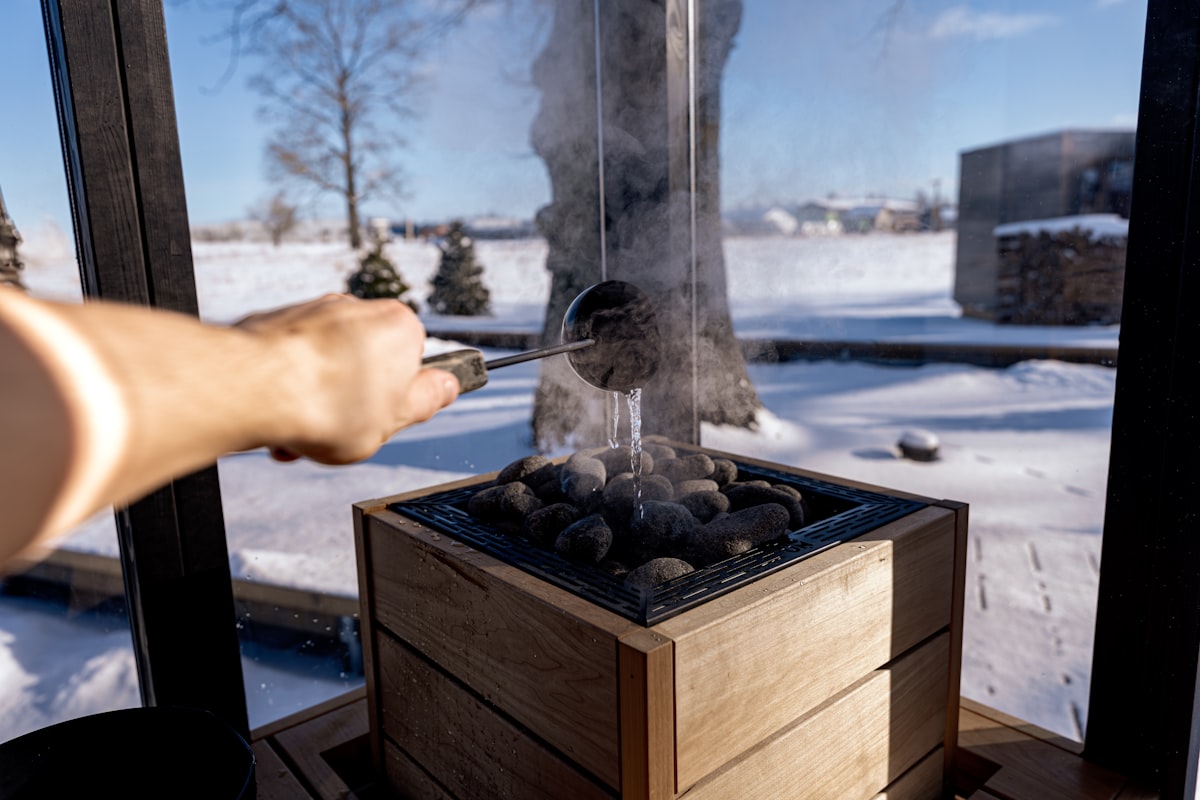
A bather ladles water onto the stones. In the best survey of why people sauna, men go more often than women and rank company as their first reason. Photo: HUUM / Unsplash.
Sauna is walking into the men's wellness market with something almost nobody else there has: 20 years of outcome data on men. Research and Markets sizes men's health and wellness at $1.42 trillion, heading for $2.88 trillion by 2030. Pinterest's 2026 Men's Trend Report, out September 9, has men searching for running clubs (up 749%), cottage weekends with friends (up 126%) and ways to leave the phone behind (up 581%). Fitt Insider rolled it up on September 18 as "Men Lean Into Wellness." None of the three mentions sauna yet, and that is the opening. The customer the boom describes, a man who wants to sit with other men after a workout with his phone in a locker, is the customer sauna already has: 2,315 of him were enrolled in eastern Finland from 1984 and followed for 20 years, and a Swedish survey finds men bathe more often than women and go for the company. Few products in that $1.42 trillion can point to a cohort like it, and nobody in sauna is selling it that way yet.
The market figure is a vendor's forecast and should be read as one. The data underneath it is not, and it hands an operator or brand three things to do now at almost no cost: what to put on the schedule, what to put in the FAQ, and how to put the Finnish cohort on the first slide.
What the $1.42 Trillion Counts
Research and Markets defines the market as men's "physical, mental and social well-being" and splits it five ways: beauty and personal care, physical activity, health and wellness food, wellness tourism, and other. Beauty and personal care held the majority of the 2024 total, health and wellness food is the fastest-growing segment, North America is the largest region, Asia Pacific the fastest-growing, and online sales took the majority share. The compound growth rate of about 12% for 2025 through 2030 is the kind of number that survives in a pitch deck and not in a pro forma; it is a global figure that includes shampoo. Sauna is not a segment. If it appears anywhere in the report's arithmetic it is inside physical activity or wellness tourism, and the summary does not say.
Pinterest's report is narrower and more useful. It is search data from one platform, presented as percentage changes in search interest, organized around what the company calls "the intentional man." The section it titles Third Space Season is the one to read closely: "cottage retreat" up 126%, "forest retreat" up 85%, "wellness retreat" up 83%, "running club" up 749%, "Hyrox" up 193%, "padel tournament" up 103%, "no phone hobbies" up 157%, "game night with friends" up 39%. Men, on Pinterest's reading, are planning offline time with other men, in groups, around a physical activity, and increasingly away from home. That is a description of a sauna evening. The report never says the word, which means nobody has claimed those searches yet.
Sauna Already Owns the Men's Health Data
Every sauna sales deck quotes the Kuopio Ischaemic Heart Disease study. Fewer say who was in it. The 2015 paper in JAMA Internal Medicine behind the 40% cut in all-cause mortality followed 2,315 men from eastern Finland, aged 42 to 60 at enrollment between 1984 and 1989, for a median of 20.7 years. The same cohort produced most of what else the trade quotes, and every one of those papers is men only.
| Finding | Paper | Who was studied | Result, most frequent bathers vs once a week |
|---|---|---|---|
| Cardiovascular and all-cause death | Laukkanen et al., JAMA Internal Medicine, 2015 | 2,315 men, 42 to 60 | 4 to 7 sessions a week: sudden cardiac death hazard ratio 0.37, all-cause mortality 0.60; 30.8% of that group died during follow-up against 49.1% of once-a-week bathers |
| Dementia and Alzheimer's | Laukkanen et al., Age and Ageing, 2017 | 2,315 men, 42 to 60 | 4 to 7 sessions: dementia HR 0.34, Alzheimer's HR 0.35 |
| New hypertension | Zaccardi et al., American Journal of Hypertension, 2017 | 1,621 men without hypertension at baseline | 4 to 7 sessions: HR 0.53 over a median 24.7 years |
| Psychotic disorders | Laukkanen et al., Medical Principles and Practice, 2018 | 2,138 men, 42 to 61 | 4 to 7 sessions: HR 0.21 over a median 24.9 years |
| Psychosis and fitness | Kunutsor et al., Journal of Psychiatric Research, 2024 | 2,221 men, 42 to 61 | 3 to 7 sessions vs 2 or fewer: HR 0.49, independent of cardiorespiratory fitness |
The cohort was extended to women once. A 2018 paper in BMC Medicine followed 1,688 people aged 53 to 74, 51.4% of them women, for a median of 15 years and found the same direction: 4 to 7 sessions a week carried a hazard ratio of 0.23 for cardiovascular death after full adjustment. As SaunaNews reported when the Swedish sex-split survey came out, the women-only estimate in that paper did not reach statistical significance, which the authors put down to a low number of events, and their test for a sex difference found none. So the honest summary is: the strong sauna numbers are men's numbers, the women's numbers point the same way at lower confidence, and no comparable long-run cohort of American bathers of either sex has been published.
For a brand, that is not a weakness to hide. It is a men's health claim with a 20-year prospective cohort behind it, which is more than most of the $1.42 trillion can say for itself, and it is sitting there unclaimed: the trade quotes the number and has never sold the man. The only condition is quoting it as what it is: 2,315 Finnish men, 42 to 60, and a habit of four or more sessions a week, not a promise to a 34-year-old in Denver who goes on Sundays.
Men Bathe More, and They Come for Company
The best current survey of why people sauna splits by sex, and men lead on frequency. In the 588-person Swedish study published in July in the International Journal of Circumpolar Health, 52.7% of men said they sauna several times a week against 32.3% of women, and 28.9% of women go less than weekly against 9.9% of men. Asked why, women put mental recovery first (36%) and men put social togetherness first (38%). The authors read that through Swedish men keeping fewer close contacts outside their partner: the sauna is a place where sitting and talking with other men is normal.
The US data on men's social lives says the same thing from the other side. The Survey Center on American Life found in 2021 that 15% of men reported no close friends, up from 3% in 1990, and that the share of men with six or more close friends had halved, from 55% to 27%. Pew's January 2025 report on 6,204 adults found men and women equally likely to say they feel lonely all or most of the time, 16% each, but only 38% of men would turn to a friend for emotional support against 54% of women. Gallup's 2023 and 2024 World Poll data put US men aged 15 to 34 at 25% reporting they felt lonely a lot of the previous day, against 18% for young American women and a 15% median for young men across the OECD. The Bureau of Labor Statistics' 2024 time-use survey has men spending 5.48 hours a day on leisure and sports to women's 4.67, and about 34 minutes of it socializing to women's 37. More free time, less of it with people.
A UK study SaunaNews covered in August tied sauna's mental health gains to ritual and weekly attendance and opened on that country's loneliness figures. The industry has already met the man this describes. Culture of Bathe-ing, the newsletter Therme Group backs, introduced "Sauna Bro" in November 2024: he "listens to the Huberman podcast," tracks his biometrics, and "may be sucking the fun out of the room." The piece described the shift as a protocol-ization of the sauna, from ritual to regiment. That is a customer description, and a fairly precise one.
The clearest US precedent for programming around him is the Russian & Turkish Baths on East 10th Street in Manhattan, which lists men-only hours on Thursdays from noon to 5 p.m. and Sundays from 9 a.m. to 2 p.m., co-ed the rest of the week, at $60 a visit. US social sauna operators keep their customer sex split to themselves, so the public data on the question is Swedish. Your booking system already knows yours. Pull it before you program anything, because the Swedish data says the frequent bather is a man who came to talk.
Washington Is Building the Frame, and Sauna Fits It
The State of Men's Health Act, H.R. 7602, was introduced February 20, 2026, by Rep. Troy Carter (D-LA) with Rep. Greg Murphy (R-NC), a urologist, and has 16 cosponsors and a referral to the House Energy and Commerce Committee. Sens. Ruben Gallego (D-AZ) and Roger Marshall (R-KS) filed the identical S. 5113 on July 23; it sits in the Senate health committee. The bill orders a Government Accountability Office study of men's health within a year, an Office of Men's Health inside HHS within 18 months, and a report to Congress within two years, all from existing appropriations. The American Medical Association, the American Urological Association, Men's Health Network and ZERO Prostate Cancer endorse it. The American Institute for Boys and Men counts at least 15 such bills across nine Congresses since 2000, none of which got a committee vote. This is the first with a caucus and a bipartisan Senate companion behind it.
The numbers the bill is written against are federal. The National Center for Health Statistics' Mortality in the United States, 2024 puts life expectancy at birth at 76.5 years for men and 81.4 for women, a 4.9-year gap, down from 5.3 in 2023 because men's figure rose faster. Suicide killed 48,824 people in 2024, 38,977 of them men, and the male age-adjusted rate of 22.3 per 100,000 is about four times the female 5.6. That male rate was 18.2 in 2001 and peaked at 23.0 in 2022, so the rise of roughly a quarter since the turn of the century that men's health advocates cite is real and has only just started to come off its high. Movember's Real Face of Men's Health report for the United States, published October 8, 2025 with the University of Pennsylvania's men's health equity program, found the majority of American men's deaths happen before 75, put the 2023 cost of five preventable causes at $120 billion in direct medical spending and $300 billion in lost productivity, and reported more than one in four men aged 18 to 34 experiencing mental ill-health in the previous year.
Nothing in the bill mentions sauna, heat or bathing, and nothing in it will. What it changes is the frame. The first product of the law, if it passes, is a GAO report on how men engage with health care and which federal programs reach them at all. A category whose only long-run outcome data is a male cohort, and whose regular users are disproportionately men who come to talk, has the best seat in that conversation, if it shows up with numbers rather than a mood.
The Two Caveats That Make the Pitch Stronger
Two findings belong in the men's FAQ, and they make the claim stronger, not weaker, because a men's health pitch that carries its own caveats is the one a customer trusts. The first is fertility. A 2013 study in Human Reproduction from the University of Padua put 10 men with normal semen through two 15-minute sessions a week at 176°F to 194°F for three months. Sperm count and motility fell significantly by the end, sex hormones did not change, and every measure was back to baseline six months after the men stopped. Ten subjects is a small study, but the direction is not in dispute, and a customer trying to conceive should hear it from you, not from a forum. The second is expectation. In the Swedish survey, women reported better sleep and less pain after sauna; men reported no significant change on either. The men kept coming anyway, for company. Sell that, and the sleep claim stays honest.
How to Take It: the Schedule, the FAQ and the Deck
Program the run club, not the men's night. Pinterest's biggest number is "running club" at +749%, with "Hyrox" at +193% and "padel tournament" at +103%. Those are groups of men who already meet at a set time near your door and finish hot. A standing post-run block, priced as a group and sold to the club organizer rather than one runner at a time, fills the same hour a men's-only session would and skips the question of who is allowed in. If you want a sex-restricted hour anyway, the Russian & Turkish Baths runs two a week in New York; put the question to your lawyer in writing under your state's public accommodation law before it goes on the schedule.
Take the phones at the door. "No phone ideas" up 581% and "offline hobbies" up 551% describe the same customer the Swedish women did when they wrote "time without a screen." A phone locker and a posted rule cost less than a heater and turn a hot room into the third place men are searching for. Othership built an evening business on it, which SaunaNews covered as wellness coming for nightlife. Gallup's August 2026 poll has 54% of US adults drinking, level with 2025 and the lowest in nearly 90 years of tracking, and its 2025 poll had young adults at 50%. The alcohol-free evening out is not a forecast anymore. It is the baseline.
For residential brands, the retreat is the cabin. "Cottage retreat" up 126% and "forest retreat" up 85% describe the buyer behind the outdoor sauna demand the residential market has reported since 2025: a man planning a weekend with friends around a place he owns. The product page that sells to him is a bench count and a heater spec, not a skincare routine.
Build the deck. Quote the cohort as 2,315 Finnish men aged 42 to 60. Quote the 40% as all-cause mortality at four or more sessions a week over a median 20.7 years. Quote the dementia and psychosis numbers as the same men. Cite the 2018 extension when a woman asks, and say plainly that the women-only estimate did not reach significance. Put fertility in the FAQ. None of that costs anything, and it turns a number the trade has quoted for a decade into a men's health claim that survives a GAO analyst.
Arlene Scott
Senior Wellness Correspondent & Hospitality Consultant
Arlene Scott brings over fifteen years of reporting and consulting experience across energy infrastructure, sustainable design, and thermotherapy-focused hospitality.
Full byline
Arlene Scott is a Senior Wellness Correspondent for SaunaNews.com, bringing over fifteen years of experience at the intersection of energy infrastructure, sustainable design, and thermotherapy. Her work focuses on the physiological benefits of passive heat therapies and the sustainable integration of sauna culture into modern wellness routines.
Arlene's background is rooted in the clean energy transition. She was a founding writer at MicrogridMedia.com, where she covered the technical and economic viability of desalination projects, microgrid deployments, and distributed renewable energy systems. During the mid-2010s, she was a regular contributor to Greentech Media (GTM) during its independent era — prior to the Wood Mackenzie acquisition in 2016 — reporting on the early integration of thermal energy storage and sustainable infrastructure.
Transitioning her focus from macro-energy systems to human-scale wellness, Arlene now applies her technical background to the hospitality sector. She operates as an independent consultant, advising boutique hotels and eco-resorts on the design, energy efficiency, and historical authenticity of commercial sauna and thermal spa installations. Her consulting work ensures that high-end wellness facilities balance traditional Nordic bathing principles with modern sustainable engineering.
Arlene holds a specialized certification in Applied Thermic Wellness from the Nordic Institute of Passive Heat Studies (NIPHS) and is a recognized associate member of the International Sauna Association (ISA). When she isn't reviewing the latest innovations in infrared technology or consulting on a new resort project, Arlene can be found tending to her own traditional wood-fired sauna in the Pacific Northwest. You can read her complete archive of essays on energy, wellness, and sustainable living at www.arlenescott.com.