Bathhouses Are Closing and Saunas Are Opening in Six Countries, a SaunaNews Count of Government Records Finds

Research, standards and the sauna industry
- Published
- Reading time
- 6 min
SaunaNews is published by SaunaShare, Inc., which also runs SaunaShare.com and SaunaMarketplace.com, where we sell many of the products we write about. That experience may change what we write about and what we don't. Who owns SaunaNews
Government records from Japan, Korea, the UK, Norway, Sweden and Finland show neighborhood hot-water baths closing while sauna rooms and small sweat studios open.
In this story5 sections
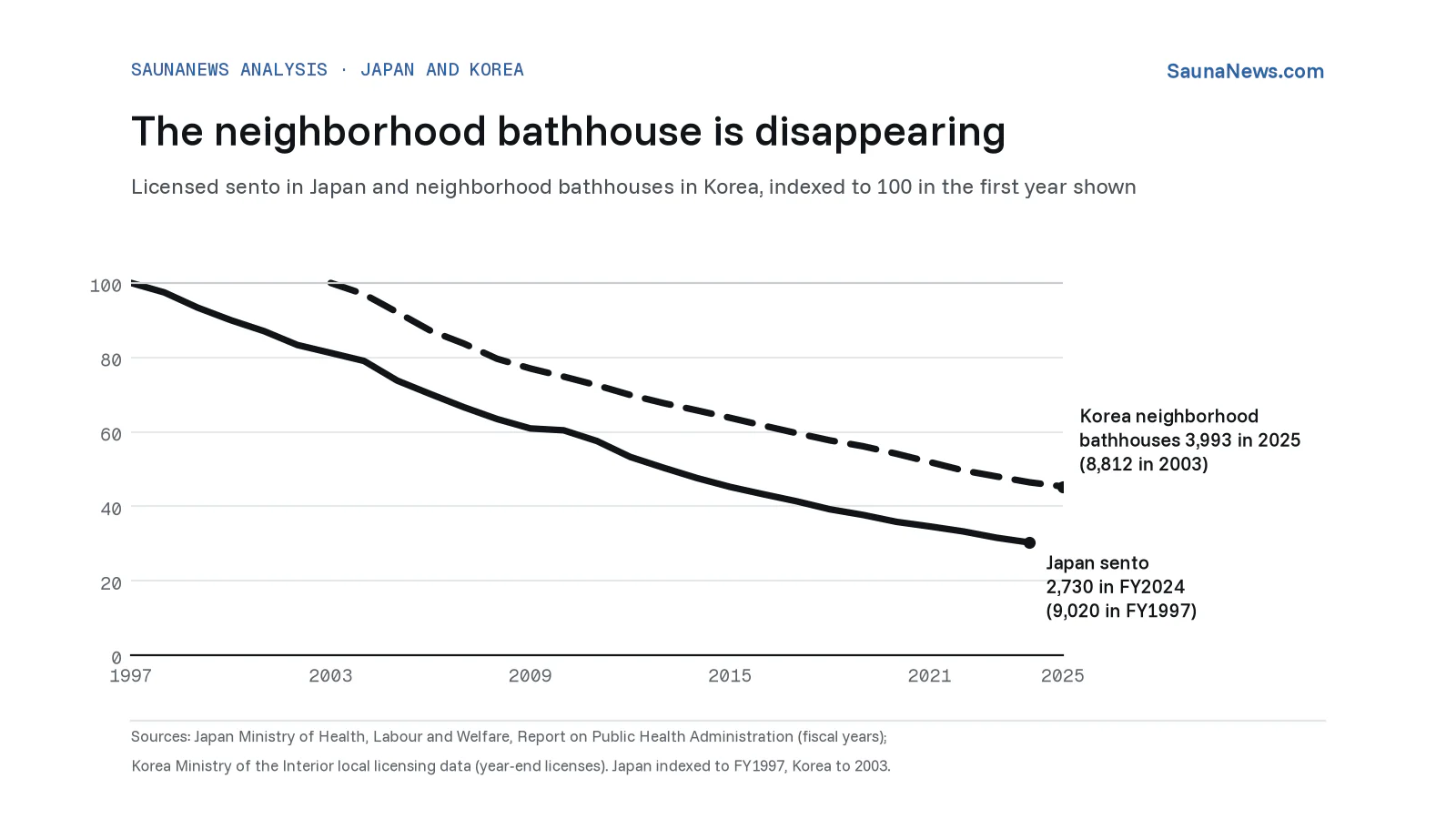
Japan had 2,730 sento at the end of March 2025, down from 9,020 at the end of fiscal 1997, according to the health ministry’s public bath report. Korea’s national licensing file shows 3,993 neighborhood bathhouses at the end of 2025, down from 8,812 in 2003. Over the same stretch, Japan’s licensed sauna baths rose 49% in four years, Britain registered more than twice as many sauna companies in 2025 as in the whole of the 2010s, and new sauna businesses kept coming in Norway, Sweden and Finland.
Those figures come from a SaunaNews count of government licensing files and company registers in six countries. The pattern holds in each one. The businesses closing sell hot water at a low price to a neighborhood. The ones opening sell heat by the session.
Neighborhood baths that sell hot water are closing
Japan counted 16,866 sento in 1977, the earliest year in the ministry’s long-run table. The Report on Public Health Administration counted 2,730 at the end of fiscal 2024, a drop of 70% since fiscal 1997 alone. Each prefecture caps sento admission, at 550 yen (about $3.80) in Tokyo, while the fuel for the boilers has no cap. This spring’s oil shock made that worse, as SaunaNews reported in its look at Japan’s sento operators and fuel costs.
Korea’s count comes from every bathhouse license on record, with its opening and closing dates. Licensed bathhouses peaked at 9,919 at the end of 2003 and stood at 5,656 at the end of 2025, a drop of 43%. The 2025 figure matches the health ministry count that a lawmaker released in April, as reported by Hankyung, while a separate national series cited by Korea JoongAng Daily puts the peak at 10,098 in 2001.
The plain neighborhood bathhouse has fallen furthest, down 55% since 2003. Jjimjilbang, the large sweat-room halls, held up better: 572 licenses at the end of 2003, a peak of 1,421 in 2012 and 1,118 at the end of 2025. The bathhouses that remain are old, and so are many of their owners. The median bathhouse that closed in 2025 had held its license for 22 years, against about 10 years for closures in 2010. A 75-year-old operator in Seoul’s Mapo District told Korea JoongAng Daily that his winter city gas bill reaches about 12 million won ($8,800) a month.
Both countries count licenses, not open doors. A business can stay on the books after it stops trading, so the real decline may be steeper.
Sauna rooms and small sweat studios are what’s opening
Japan’s licensed sauna baths fell by half between fiscal 1997 and fiscal 2020, to 1,365, then rose to 2,031 by the end of fiscal 2024. The count rose in 45 of 47 prefectures and held steady in the other two. At that pace, Japan will have more licensed sauna baths than sento within about two years. That projection is ours, not the ministry’s. The category leaves out gym saunas and most hotel saunas, so the real number of saunas is higher. The first report in this series has the Japan numbers, prefecture by prefecture.
Korea’s total license count rose this year for the first time since 2003, to 5,736 by mid-October. Plain bathhouses kept falling. The growth came from small standalone sweat rooms, a license category that recorded 93 new businesses in the first nine and a half months of 2026, against 16 in all of 2025. Forty-nine were licensed in September alone. Their median floor area is about 480 square feet.
Thirty-one of the 93 carry “jumping” in the name, as in trampoline fitness studios, and 30 use words for heat, body temperature or diet. Some use both. In a March 2025 sweep, Seoul’s city government caught 19 gyms and trampoline studios running half-body bath machines and sauna equipment without the bathhouse license the law requires. The licensing file doesn’t say why so many studios registered this year.
In Northern Europe, sauna companies keep arriving
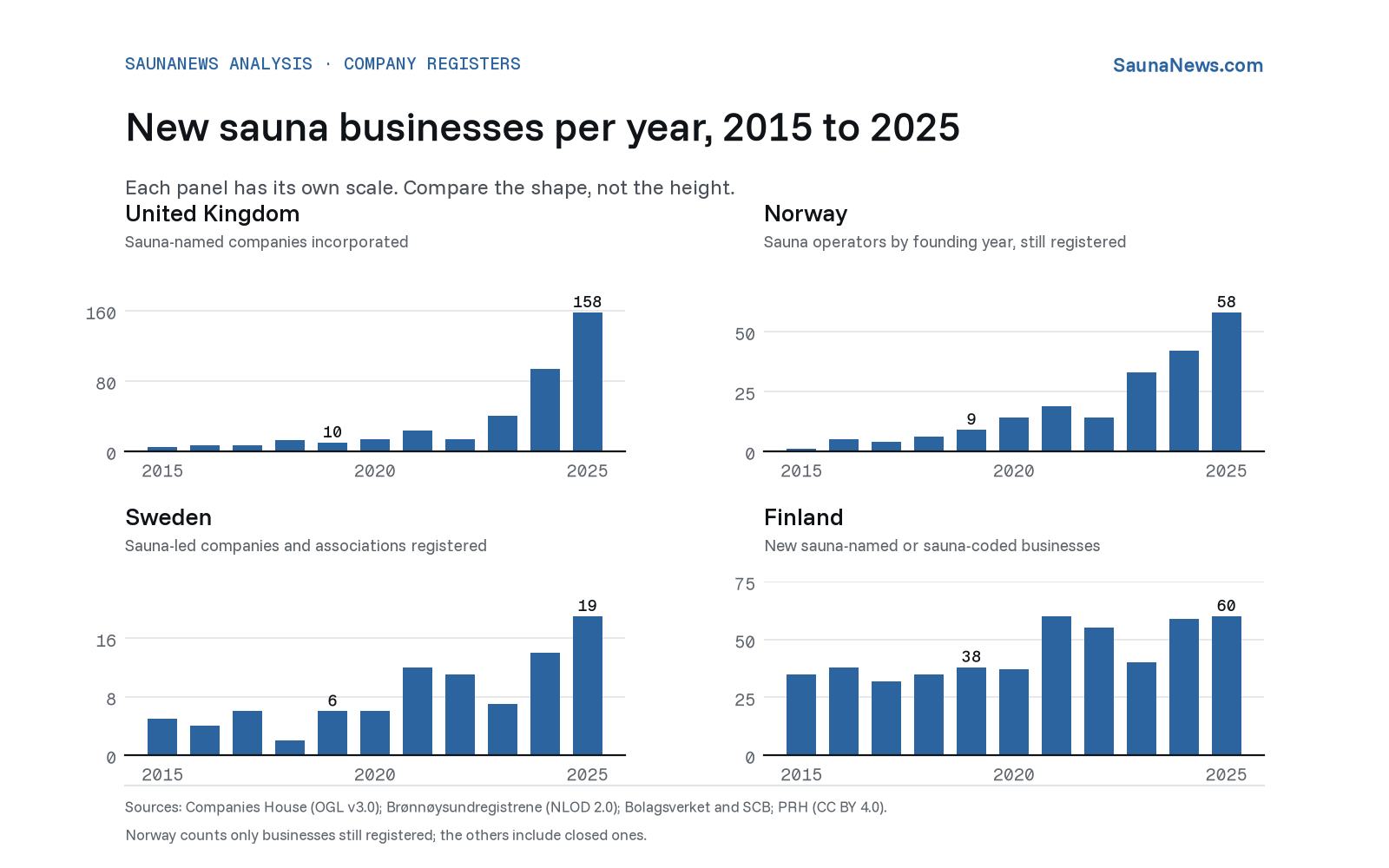
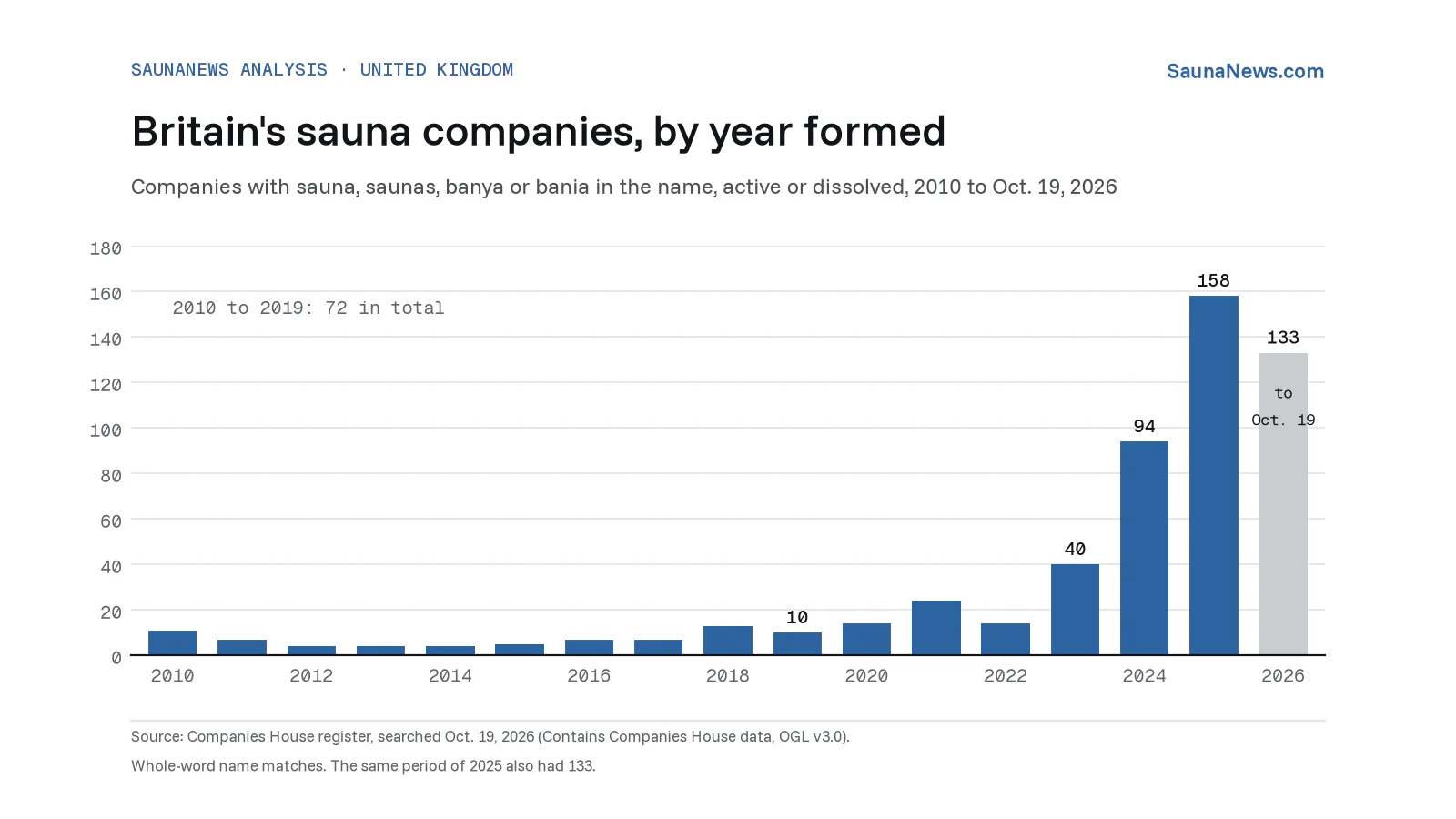
Britain registered 158 companies with “sauna” or “banya” in the name in 2025, against 72 in the whole of the 2010s, according to Companies House. Scotland has had 59 since 2023, against one on record from 2000 through 2019. The UK breakdown covers the nations, the community saunas and the companies already closing. Thirty-seven sauna-named companies have been dissolved this year, the most since at least 2010.
Norway’s company register shows fewer than 10 new sauna operators a year before 2020 and 33 to 58 a year from 2023 to 2025, counting only businesses still registered. Revenue is rising with them. The 57 sauna-led companies that filed accounts for both 2023 and 2025 took in NOK 159.1 million (about $15 million) in 2025, up 75% from 2023, according to the Brønnøysund accounts register. DAMP, which runs floating saunas around Stavanger, and PUST in Tromsø each roughly doubled revenue in two years, to NOK 23.0 million and NOK 22.5 million (about $2.2 million each). Oslo Badstuforening, the members’ association that runs saunas on Oslo’s waterfront, took in NOK 57.3 million (about $5.5 million). Profits haven’t kept pace: 61% of sauna-led companies reported a profit for 2025, down from 68% for 2023.
Sweden’s free company files list 117 sauna-led companies and associations in October 2026, up from 56 at the end of 2020, after a decade at roughly the same level. A registration doesn’t prove a business is trading. Swedes are regular users: 48% take a sauna at least once a year and 16% at least once a month, according to the University of Gothenburg’s SOM surveys.
Finland registered 274 new sauna businesses from 2021 through 2025, against 180 in the five years before, per the PRH company register. Its oldest public saunas are in swimming halls. The national LIPAS facility database records 632 sauna rooms in 143 of Finland’s 192 public swimming halls, and the median hall was built in 1977. Cities are replacing them. Rauma closed its 1972 hall in April 2025 and moved swimmers to a hall at the Kari campus with two saunas and a steam room on each side plus two separate saunas, according to the city.
US searches for sauna run more than seven times those for cold plunge
No US agency counts saunas the way Japan’s and Korea’s health ministries count public baths. Search interest is the nearest national measure. Google Trends interest in “sauna” in the US from January through September 2026 was 28% above the same months of 2025, and the 2025 average was 3.2 times the 2016 average. Interest in “cold plunge” rose 7% over the same months, and “sauna” drew about 7.5 times its interest. “Infrared sauna” rose 65%. Trends measures relative search interest, not visits or sales. SaunaNews has already looked at what the infrared market data shows.
What the six countries’ records mean for a US operator
The closings in Japan and Korea are old businesses with capped or low prices and a big hot-water bill. The openings are rooms sold by the session, often in small spaces. Korea’s new sweat studios have a median footprint under 500 square feet, and Norway’s fastest-growing operators float their saunas on the harbor. Put the water-heating load on its own line when you price a project, since fuel is the cost bathhouse owners in Korea and Japan name first. Check what license your city requires for a sweat room before you build one. Seoul referred all 19 unlicensed studios it found for investigation.