Bangor Is Collecting Session Data for Evidence-Based Sauna Guidelines
Bangor said it would produce guidance on sauna frequency, duration, break times and cooling method. The survey collecting the human half of it is open and unannounced, and the group's own trial found 90 seconds of cold took most of the heat load out of a two-round sitting.

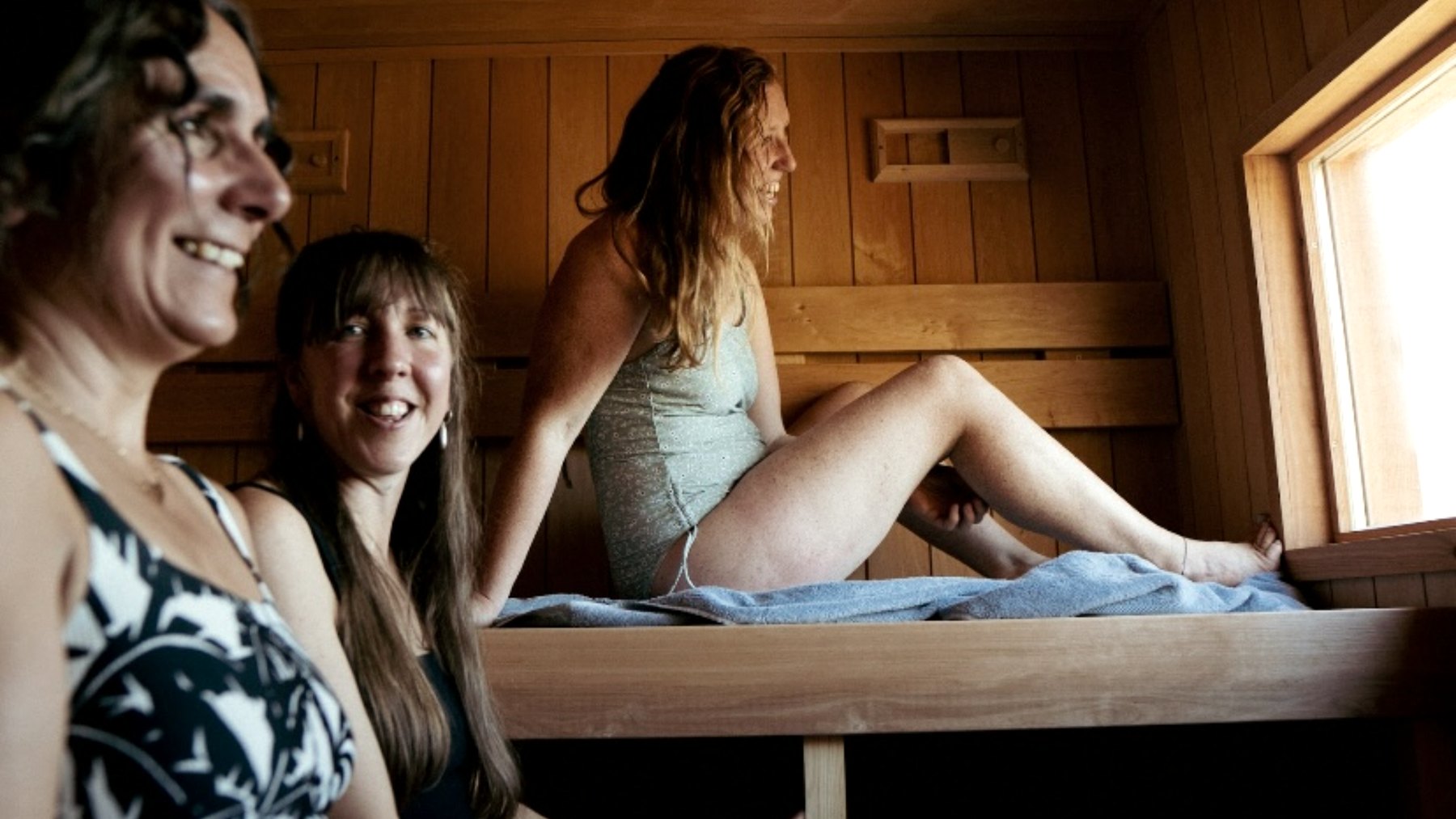
The photograph Bangor University put on its recruitment poster for the survey. How many rounds these three did, and what they did between them, is exactly what sauna research has almost never written down. Image: Bangor University.
In March 2025, Dr Geoff Coombs of Bangor University announced a research partnership with a sauna company in north Wales and set out what his group meant to produce. It would "develop evidence-based guidelines for effective sauna bathing," he told the university's news page, and he listed what those would cover: "the frequency of sauna bathing, duration, break times and what type of cooling down method between sauna rounds is recommended."
Those four are the variables an operator sets, and no industry guideline covers any of them. We reported in May that the operator side of this business has no standard to match the ones the room and the heater now carry. Eighteen months on, the questionnaire that would collect the human half of the Bangor guidance is open, run by Coombs's and Sam Oliver's own doctoral student, and it has had no announcement at all. Bangor's news feed carries 493 English-language and 487 Welsh-language items between June 2024 and this month. Exactly one is about sauna, and none is about the survey. What public recruitment we can find is a poster, a short Instagram video, and posts from the sauna company that hosted the group's earlier lab work.
Where the Standards Stop
EN 18164 covers the room, UL 60335-2-53 covers the heater, and both arrived with committees, budgets and enforcement behind them. Nobody certifies the person deciding how long your guests sit, how many times they go back in, or what they do in between. The white paper we covered made the obvious point: if operators don't define what good looks like, a litigator or a local ordinance eventually will.
Here is the harder problem underneath that. If the trade convened a committee tomorrow, the research it would reach for cannot answer the question, because sauna studies have almost never written down what a session contained.
Take the number every heater rep quotes. The Kuopio cohort sorted 2,315 Finnish men by how long a single session lasted: under 11 minutes (1,065 men), 11 to 19 minutes (722), and over 19 minutes (528). The longest group carried an adjusted hazard ratio of 0.48 for sudden cardiac death against the shortest, roughly half the risk across the follow-up. That is where "19 minutes" comes from. What the study recorded was weekly frequency, session duration and sauna temperature. It says nothing about how many times those men went back in, or what they did while they were out.
Owen and his co-authors make the point themselves, at the close of their own trial in Experimental Physiology. The studies behind that threshold, they write, "do not report whether sauna exposure was continuous, whether breaks were taken, or which cooling modalities" were used. Their recommendation to the rest of the field is this survey's thesis in one line:
those completing future sauna research are encouraged to report cooling break practices in detail (i.e., mode, duration and temperatures).
They are not the first to say it. Reviewing the field in 2018, Joy Hussain and Marc Cohen concluded that "the great heterogeneity of studies makes meaningful comparisons across studies difficult and provides insufficient evidence to recommend specific temperature, frequency, or duration of sauna bathing for any specific health outcome." And the one cohort that did model session structure found nothing either way: Knekt and colleagues followed 13,994 Finns for 39 years and tested heat sessions per bath against dementia risk, returning a hazard ratio of 0.98 for two sessions and 0.95 for three or more against a single one. That is not a result against multi-round bathing. The confidence interval on three or more runs from 0.76 to 1.18, wide enough to hold a real benefit or a real harm, and their exposure data was collected between 1973 and 1976. Nobody has powered a study to settle it since.
The Cooling Break Is the Dose
Owen's own experiment is why cooling gets its own block of questions. It ran at Sawna Bach, a wood-fired sauna on Llyn Padarn in Llanberis, while the room stayed open to the public, where customers sometimes poured water on the stones, a customary practice the authors note briefly raises humidity and heat stress. Sixteen adults, eight of them women, did the same session twice: two 15-minute bouts at about 184°F, each followed by a 10-minute break in 73°F air. The only difference between visits was 90 seconds of immersion to the neck at 68°F, taken immediately on leaving the room.
Ninety seconds of cold did not just trim the peak. It took out most of the core-temperature rise. Across the air-only session core temperature climbed 1.31°F; with the immersion it climbed 0.36°F, which the authors report as not statistically distinguishable from where the participants started. At the end of the second bout the cold-break arm sat at 99.6°F against 100.5°F for air-only, with heart rate at 108 bpm against 125. On the standard scales people moved close to a full descriptor, from "very hot," "very uncomfortable" and "very difficult to tolerate" in the air-only arm down to "hot," "uncomfortable" and "fairly difficult to tolerate."
Three things bound that result and all three matter commercially. The trial recruited people who used heat or cold no more than once a week, so it describes a first-timer and not your Tuesday regular. Nobody measured a heat illness; the paper's language about reducing heat-illness risk is inference from temperature, heart rate and perceived tolerance. And the cold was open lake water, not refrigeration at a setpoint: the authors raised their sample size partly for "the possibility of warmer lake water temperatures," and the immersion averaged 68°F with a spread of nearly 6°F between sessions. This is not a chiller spec.
The cooling break is the part of a session an operator actually designs, and this is the first controlled number attached to it. It also inverts the usual assumption that the plunge is the intense half of the circuit. The authors write that adding immersion, "alongside limiting heat exposure, may be particularly advised for sauna-naive individuals or those with reduced heat tolerance," which describes most people walking into a new US bathhouse. Note the coupling: their recommendation pairs the cold with less heat, not with the same heat. And the plunge does not erase the whole exposure. It removed most of the core-temperature rise, while skin temperature at the end of the bout and sweat losses were statistically unchanged. The authors' own read is that the smaller strain "may be a sufficient stimulus to achieve the health benefits associated with regular sauna," which is a hypothesis they offer, not a result they produced.
"Our Sauna Runs at 185" Is a Statement About One Bench
The paper's methodological-considerations section carries a number worth more to an installer than anything in its results. Explaining why they held participants to fixed seats, the authors report their own unpublished sensor observations from that room: roughly 159°F on the lower bench furthest from the heat source, and roughly 186°F on the upper bench nearest it.
That is a 27°F spread inside one cabin. It is an unpublished observation in a limitations paragraph, not a result, and it should be read as one. It is consistent with the heatmap work Coombs described in March 2025, and Coombs is a co-author on the paper. It also makes a spec-sheet temperature close to meaningless as a description of what a guest experiences. Two people in the same room on the same timer are not getting the same session, and there is no standard way to describe that on a spec sheet or a session policy.
What the Population Data Already Suggests
The little session-structure data that exists complicates the American circuit. The 2022 Northern Sweden MONICA survey asked its sauna bathers about bouts and minutes, and the pattern runs against the three-round loop. Among the groups it reports, the people bathing two to seven times a week were more likely to keep it to one or two bouts, at 61 of 72 respondents against 136 of 197 in the once-to-four-times-a-month group, and more likely to be out inside 20 minutes. Cold-water swimming in the past year was flat across both groups, at 12.3 percent of the weekly bathers and 12.6 percent of the monthly ones. The survey never asked how anyone cooled between bouts, which is precisely the gap Bangor's questionnaire is built to fill.
Handle those figures carefully. The paper stratifies only 271 of the 641 people it counts as sauna bathers, and the remaining 370 appear in no reported group, so this describes a slice rather than a population. Two of the table's own percentages do not reconcile with its own counts. And a cross-sectional count of what Swedes do is not a recommendation about what a US bathhouse should schedule. But the direction runs against the three-rounds-and-a-plunge circuit sold as authentic Nordic practice: in the Nordic data, the heaviest users run the simplest sessions. Åsa Engström and Hans Hägglund, two of the MONICA authors, went on to survey 588 Swedish bathers and found women and men reporting different things from the same room.
What It Costs a US Operator to Act on This
"Put 90 seconds of cold inside the break you already have" sounds free. In the United States it is a plan-review conversation. In all six state and city pool codes we checked, New York City, Washington, Minnesota, New Jersey, Texas and Colorado, the definition of a public spa reaches cold water as well as hot, so a shared recirculating plunge is regulated the way a hot tub is: disinfection, filtration, logged testing, permit. Washington's Department of Health put it flatly in September 2024 guidance, classing cold plunges as spa pools under the state code and saying it was not aware of any self-contained cold plunge tub that complies with all Washington requirements. The hinge is almost always whether the water is drained between users, which is why which legal identity your plunge ends up with is a commissioning decision rather than a purchasing one. Put the drained-between-users question to your own health department in writing before you order a tub, and ask which classification they intend to apply.
The hot side is not untouched either. New York City already caps sauna air at 194°F measured at eye height, already requires a posted sign in 24-point type telling bathers not to exceed 30 minutes, and already requires either a one-hour timer or attendant inspection at minimum 15-minute intervals. The code does not cite a dose-response study for that 30 minutes. Somebody had to write a number down.
Which is the argument for filling in the questionnaire. Session numbers end up in codes and house rules either way. The open question is what they rest on when they do.
The Ask
The survey is at bangor.ac.uk/sauna. Its participant information page states the purpose as understanding "sauna use, cooling practices, and their possible influence on mood, wellbeing, and sleep in adults," and says the questionnaire "should take approximately 10 to 20 minutes to complete." Per the study's background document, dated September 17, it is open internationally to adults 18 or over including people who never use a sauna, and it carries validated instruments for mood and wellbeing, the WHO-5 Wellbeing Index and the Brunel Mood Scale, alongside sleep and life-satisfaction questions. Responses are anonymous and IP addresses are not collected, and because the data is anonymous a response cannot be withdrawn once it is submitted. Put that line in the email if you send it to a member list.
It is run by postgraduate researcher Tomos F. Owen, who goes by Flynn, supervised by Professor Sam Oliver, Dr Geoff Coombs and Professor Ross Roberts, and approved by the Bangor University School of Psychology and Sport Science ethics committee under Project ID 1732. Owen is funded by the Wales Graduate School for the Social Sciences, backed by the Economic and Social Research Council and Medr, and the background document says no funding was received specifically for this survey. The earlier trial's industry partner, Sawna Bach, gave the researchers access to its Llanberis sauna and no money, and the paper records that it had no influence on data interpretation or the manuscript. It is also the company whose posts are doing much of the survey's public recruitment. The work of characterising what a sauna session actually contains is, for now, being paid for by a social science studentship.

US operators have a specific reason to push it. The evidence this trade quotes at its customers was built almost entirely on Finnish men and Nordic bathing habits, and the Swedish numbers above suggest Nordic habits are not American habits. The largest recent UK work on sauna and wellbeing measured exposure in its big cross-sectional arm with a single question offering rarely, monthly or weekly, and traced the wellbeing pathway in two much smaller before-and-after studies of 33 and 74 people. No arm of it measured heat dose, so it cannot rank ritual against heat. Nobody is going to collect the American session data unless American operators hand it over, and the review literature on contrast therapy is still waiting for someone to prove the thing everybody is selling.
There is no closing date, per the background document; recruitment runs until the sample is big enough. Bangor gave no date for the guidelines either.
Disclosure: the researcher supplied the recruitment poster, the print file and a background document for this coverage. SaunaNews has no role in the study and was not paid for this article.
Frequency is the one sauna variable the research is good at, and it is the one variable an operator does not set. You set bouts, minutes on the bench and what happens in the break, and the evidence base has essentially nothing to say about any of them. A lab in north Wales has said it intends to fix that and has a questionnaire open to do it. It costs your members 10 to 20 minutes, and New York City's 30-minute sign is what the alternative looks like: a number set before anyone collected the evidence to set it.
Arlene Scott
Senior Wellness Correspondent & Hospitality Consultant
Arlene Scott brings over fifteen years of reporting and consulting experience across energy infrastructure, sustainable design, and thermotherapy-focused hospitality.
Full byline
Arlene Scott is a Senior Wellness Correspondent for SaunaNews.com, bringing over fifteen years of experience at the intersection of energy infrastructure, sustainable design, and thermotherapy. Her work focuses on the physiological benefits of passive heat therapies and the sustainable integration of sauna culture into modern wellness routines.
Arlene's background is rooted in the clean energy transition. She was a founding writer at MicrogridMedia.com, where she covered the technical and economic viability of desalination projects, microgrid deployments, and distributed renewable energy systems. During the mid-2010s, she was a regular contributor to Greentech Media (GTM) during its independent era — prior to the Wood Mackenzie acquisition in 2016 — reporting on the early integration of thermal energy storage and sustainable infrastructure.
Transitioning her focus from macro-energy systems to human-scale wellness, Arlene now applies her technical background to the hospitality sector. She operates as an independent consultant, advising boutique hotels and eco-resorts on the design, energy efficiency, and historical authenticity of commercial sauna and thermal spa installations. Her consulting work ensures that high-end wellness facilities balance traditional Nordic bathing principles with modern sustainable engineering.
Arlene holds a specialized certification in Applied Thermic Wellness from the Nordic Institute of Passive Heat Studies (NIPHS) and is a recognized associate member of the International Sauna Association (ISA). When she isn't reviewing the latest innovations in infrared technology or consulting on a new resort project, Arlene can be found tending to her own traditional wood-fired sauna in the Pacific Northwest. You can read her complete archive of essays on energy, wellness, and sustainable living at www.arlenescott.com.