Your Cold Plunge Has Three Legal Identities. Which One You Get Is a Commissioning Decision.
New York already regulates most plunges as spa pools. California's bill to split the category stalled in the Assembly's appropriations committee in May. Utah's exemption covers a one-bather, 180-gallon tub that almost no commercial operator owns. Which one you are comes down to three decisions made at commissioning.

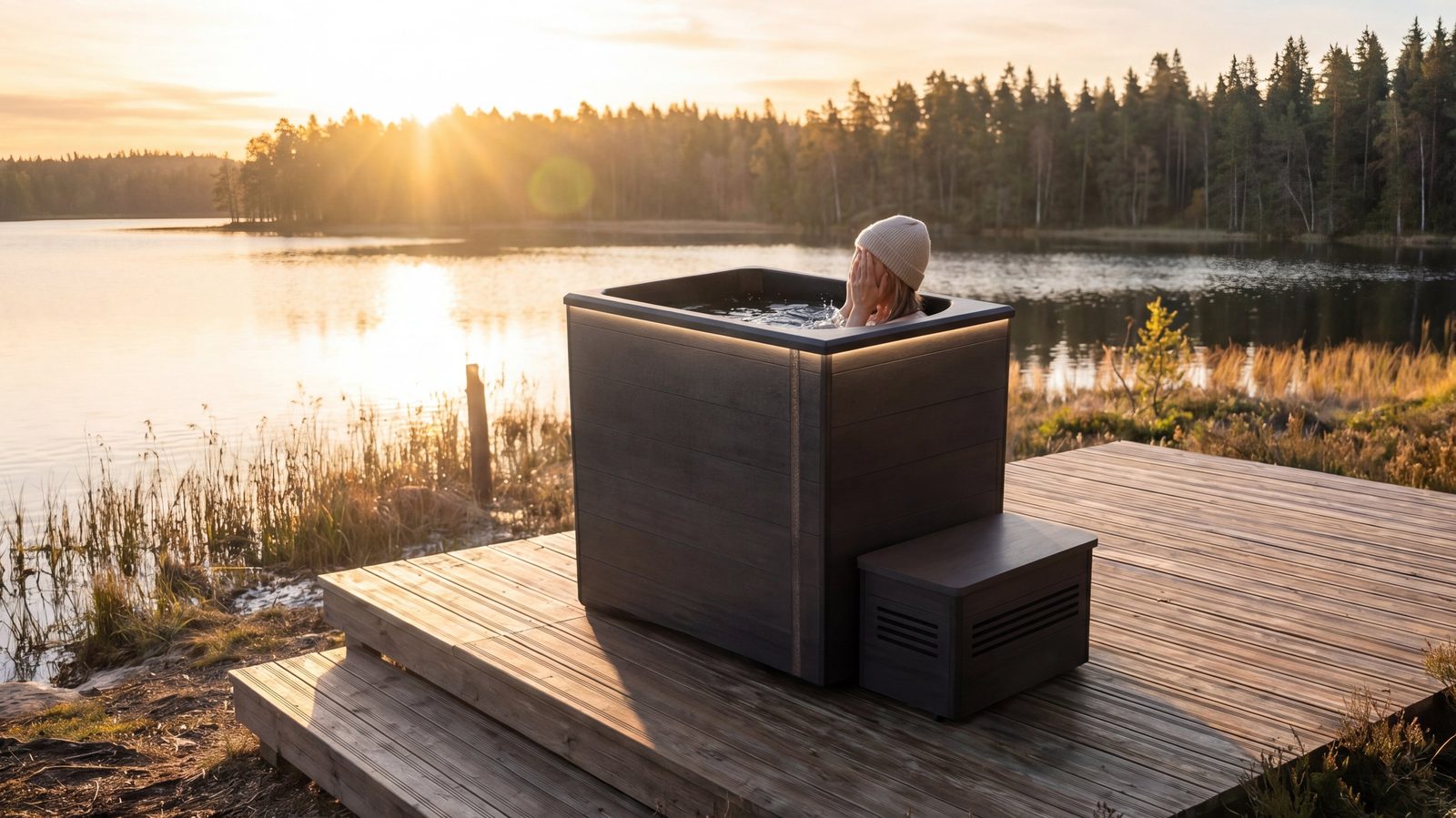
An aboveground, individual-use plunge with its chiller alongside. Under California's proposed definitions this shape is a cold plunge tub; sink the same water for multiple bathers and it becomes a cold spa, which is a public swimming pool. Photo: Auroom.
Three decisions made during commissioning determine what your cold plunge is in the eyes of the law: how many people sit in it at once, whether it is sunk into the floor or stands on it, and how often you drain it. Get those three right and in some states you fall outside the pool code entirely. Get them wrong and you are operating an unpermitted public swimming pool, which is the category that closes doors. All three decisions are cheap on a drawing and expensive once the concrete is poured.
Here is what three jurisdictions actually say. Two of the things this trade has been told about them are wrong, and one of the corrections changes what you should be building right now.
Key Facts
- New York: a plunge is very likely already a regulated spa pool, and therefore a public swimming pool. The hinge is whether the water is drained and refilled for each individual
- California: AB 2330 would split the category in two along an in-ground versus aboveground line. It is not law, and it stalled on the Appropriations suspense file on May 14, 2026
- Utah: the exemption is real but narrow. Utah Code 26B-7-124 reaches one bather at a time and no more than 180 gallons
- Utah, the fix that failed: HB 368 would have raised that to five bathers and 650 gallons. It never got a hearing and was filed on the last night of the session
- The three commissioning decisions: bathers at once, in-ground or aboveground, drain frequency
New York: You Are Probably Already Regulated
New York does not need a cold plunge bill, because its existing definition already swallows the category. Under 10 NYCRR 6-1.2, a spa pool is:
a swimming pool, primarily designed for therapeutic use or relaxation, which is normally not drained, cleaned or refilled for each individual. It may include, but is not limited to, hydrojet circulation, hot water, cold water, mineral bath, air induction, bubbles or any combination thereof. Spa pools are shallow in depth and are not designed for swimming or diving.
Read the third and fourth words of the list: cold water. The definition contemplated cold immersion long before anyone was selling memberships to it. And a spa pool is defined as a species of swimming pool, which puts it inside the permit and inspection regime that local health departments have run for decades.
The operative clause is the one nobody quotes: normally not drained, cleaned or refilled for each individual. That is the hinge. A recirculating plunge that runs all day on filtration and chemistry sits squarely inside the definition. A tub genuinely drained and refilled between users is arguably outside it. That is a plumbing and labor decision before it is a legal one. Put the question to your health department in writing before you build, not after an inspector has formed a view.
California: The Line Is In-Ground Versus Aboveground
California is trying to write the distinction New York never needed. AB 2330, carried by Assemblymember Boerner, would amend Health and Safety Code section 116025 and add sections 116026 and 116027. It creates two creatures where the trade assumes one.
A cold spa is an in-ground public swimming pool designed for brief therapeutic or recovery immersion, held between 35 and 60 degrees Fahrenheit by a mechanical chiller or other approved method, supporting multiple users. It is regulated as a spa, with carve-outs from the requirements that assume heated water.
A cold plunge tub is the opposite shape, and it escapes. The bill defines it as an aboveground, individual-use therapeutic tub that is chiller-maintained between 35 and 60 degrees, has mechanical recirculation, has an automatic disinfecting system dispensing chlorine or bromine (ozone or ultraviolet permitted as secondary), and is not used for swimming or general recreational bathing. It carries three operating conditions: it is drained at the end of each operating day and filled at the start of the next, it may not be placed or used within the same enclosure as a public pool or spa, and it must post a warning in one-inch lettering reading "This Cold Plunge Tub is not under health regulation as a public swimming pool, use at your own risk."
Meet all of it and the tub is not a public swimming pool and not subject to construction or sanitation standards. Miss any single element, add a second bather, sink it into the slab, put it in the same room as your pool, and it changes species.
The status matters more than the text, and this is where the circulating account is out of date. AB 2330 is not law and is not currently moving. It cleared the Assembly Health Committee 16 to 0 on April 14, 2026, was amended on April 16, and was re-referred to Appropriations on April 20. On May 13 it went to the suspense file, and on May 14 it was held under submission. In California practice, held under submission on suspense is where bills stop. Anyone specifying a build to AB 2330's carve-out today is designing to a bill that did not advance.
Utah: The Exemption Is Narrower Than the Headlines
Utah is the state operators most often believe has deregulated cold plunge, and it is the one where that belief is most likely to be wrong. The law is SB 106 of the 2024 session, enacted as Chapter 478 and codified at 26B-7-124, effective May 1, 2024. It is commonly cited as HB 106 in the trade. It is a Senate bill.
The definition is short enough to read in full, and worth reading in full:
(1) As used in this section, "public cold bath" means a tub or tank that: (a) is used by: (i) the general public, regardless of whether there is a charge or payment for use; and (ii) one bather at a time; (b) contains chilled water that is: (i) maintained at a temperature lower than 60 degrees Fahrenheit; (ii) no more than 180 gallons in volume; and (iii) at a depth that allows the bather to maintain the bather's head above the water while in a seated position; and (c) continuously filters and sanitizes the chilled water.
(2) The department may not adopt a rule that restricts, limits, or imposes requirements on the operation of a public cold bath.
Two things follow that operators consistently miss.
First, the shape. One bather, 180 gallons. A commercial plunge built to seat two or three, or holding the 300 to 600 gallons typical of a club installation, does not meet the definition and never did. The exemption describes a tub most commercial operators do not own.
Second, and more consequential, the scope of what is switched off. Subsection (2) bars the department, meaning the Utah Department of Health and Human Services, from making a rule. It does not touch building code, plan review, local health department permitting, occupancy, or anything else an inspector might arrive holding. "The state cannot write a rule about it" is a much smaller statement than "it is unregulated," and the gap between those two readings is where a closure happens.
Utah tried to fix the first problem this year and failed in a way worth knowing about. HB 368, Cold Plunge Amendments, sponsored by Representative David Shallenberger, would have struck "one bather" and replaced it with "up to five bathers at a time," raised 180 gallons to 650, and extended the exemption to the common areas of apartment buildings. That is close to the shape of a real commercial plunge.
It never got a hearing. Introduced January 26, first reading to House Rules the same day, fiscal note attached January 30, and then nothing for five weeks. On March 6 at 23:59, the last night of the session, the enacting clause was struck and the bill was filed in what the legislature's own records call the "House file for bills not passed." So the narrow 180-gallon definition remains the operative law in Utah, and the operators who were told relief was coming are still outside it.
The Three Decisions That Set Your Identity
Strip the three jurisdictions down and they turn on the same small set of facts about your installation.
How many bathers at once. Utah's exemption dies at two. California's carve-out is written around individual use, and multi-user immersion is what makes something a cold spa. If your business model is a shared plunge, assume you are regulated and design for it.
In-ground or aboveground. California draws its line here explicitly. It is also the most expensive decision on this list to reverse, because it is structural. An aboveground tub with a chiller beside it is a piece of equipment. A sunken plunge is construction, with plan review attached.
Drain frequency. New York's definition turns on whether the water is normally drained and refilled for each individual. California's carve-out requires a full drain and refill every operating day. Those are opposite ends of the same lever, and both are decided by your plumbing and your labor schedule. Daily drain and refill is a real water and payroll cost, and it is also the cheapest regulatory position available in two of these three states.
Why It Matters
Nothing here is exotic. It is a headcount, a slab detail, and a drain valve. But those three choices decide whether your plunge is a piece of recovery equipment or a public swimming pool, and the second one comes with plan review, permits, inspections, logs, and a health officer with authority to close you. The bathhouses opening in New York and the chains signing multi-metro leases are making these decisions right now, on drawings, mostly without knowing that they are legal decisions at all.
The Bottom Line
Ask your health department, in writing, which definition your tub falls under, before the drawings are final. In New York assume spa pool unless you are draining per user and have been told otherwise. In California build to today's law, not to AB 2330, because it stalled on suspense in May. In Utah check your own gallons and your own seat count against the 180 and the one, and remember that what the statute switched off is a state agency's rulemaking power, not your local inspector. The cheap version of this conversation happens at the drawing stage. The expensive version happens with an abatement order taped to the door.
Arlene Scott
Senior Wellness Correspondent & Hospitality Consultant
Arlene Scott brings over fifteen years of reporting and consulting experience across energy infrastructure, sustainable design, and thermotherapy-focused hospitality.
Full byline
Arlene Scott is a Senior Wellness Correspondent for SaunaNews.com, bringing over fifteen years of experience at the intersection of energy infrastructure, sustainable design, and thermotherapy. Her work focuses on the physiological benefits of passive heat therapies and the sustainable integration of sauna culture into modern wellness routines.
Arlene's background is rooted in the clean energy transition. She was a founding writer at MicrogridMedia.com, where she covered the technical and economic viability of desalination projects, microgrid deployments, and distributed renewable energy systems. During the mid-2010s, she was a regular contributor to Greentech Media (GTM) during its independent era — prior to the Wood Mackenzie acquisition in 2016 — reporting on the early integration of thermal energy storage and sustainable infrastructure.
Transitioning her focus from macro-energy systems to human-scale wellness, Arlene now applies her technical background to the hospitality sector. She operates as an independent consultant, advising boutique hotels and eco-resorts on the design, energy efficiency, and historical authenticity of commercial sauna and thermal spa installations. Her consulting work ensures that high-end wellness facilities balance traditional Nordic bathing principles with modern sustainable engineering.
Arlene holds a specialized certification in Applied Thermic Wellness from the Nordic Institute of Passive Heat Studies (NIPHS) and is a recognized associate member of the International Sauna Association (ISA). When she isn't reviewing the latest innovations in infrared technology or consulting on a new resort project, Arlene can be found tending to her own traditional wood-fired sauna in the Pacific Northwest. You can read her complete archive of essays on energy, wellness, and sustainable living at www.arlenescott.com.