Nordic Wood Imports Quadrupled Since 2019. DIY Sauna Builders Still Mostly Buy Local

Research, standards and the sauna industry
- Published
- Reading time
- 5 min
SaunaNews is published by SaunaShare, Inc., which also runs SaunaShare.com and SaunaMarketplace.com, where we sell many of the products we write about. That experience may change what we write about and what we don't. Who owns SaunaNews
The US bought $48.4 million of profiled wood from Estonia and Finland in 2025, and Lunawood’s US shipments rose sevenfold in three years. In 262 Reddit build threads, lumberyards still lead and price decides.
In this story5 sections
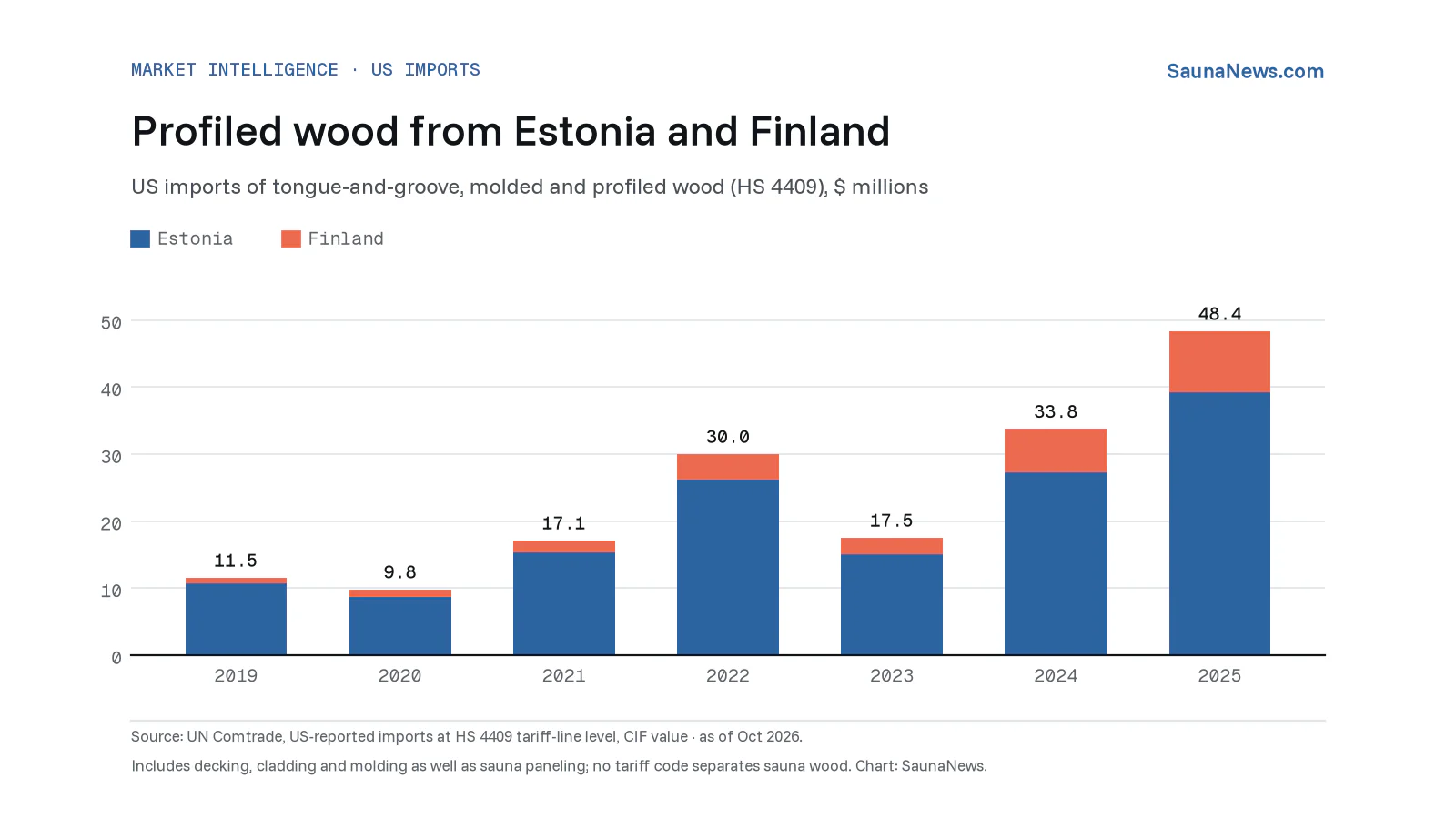
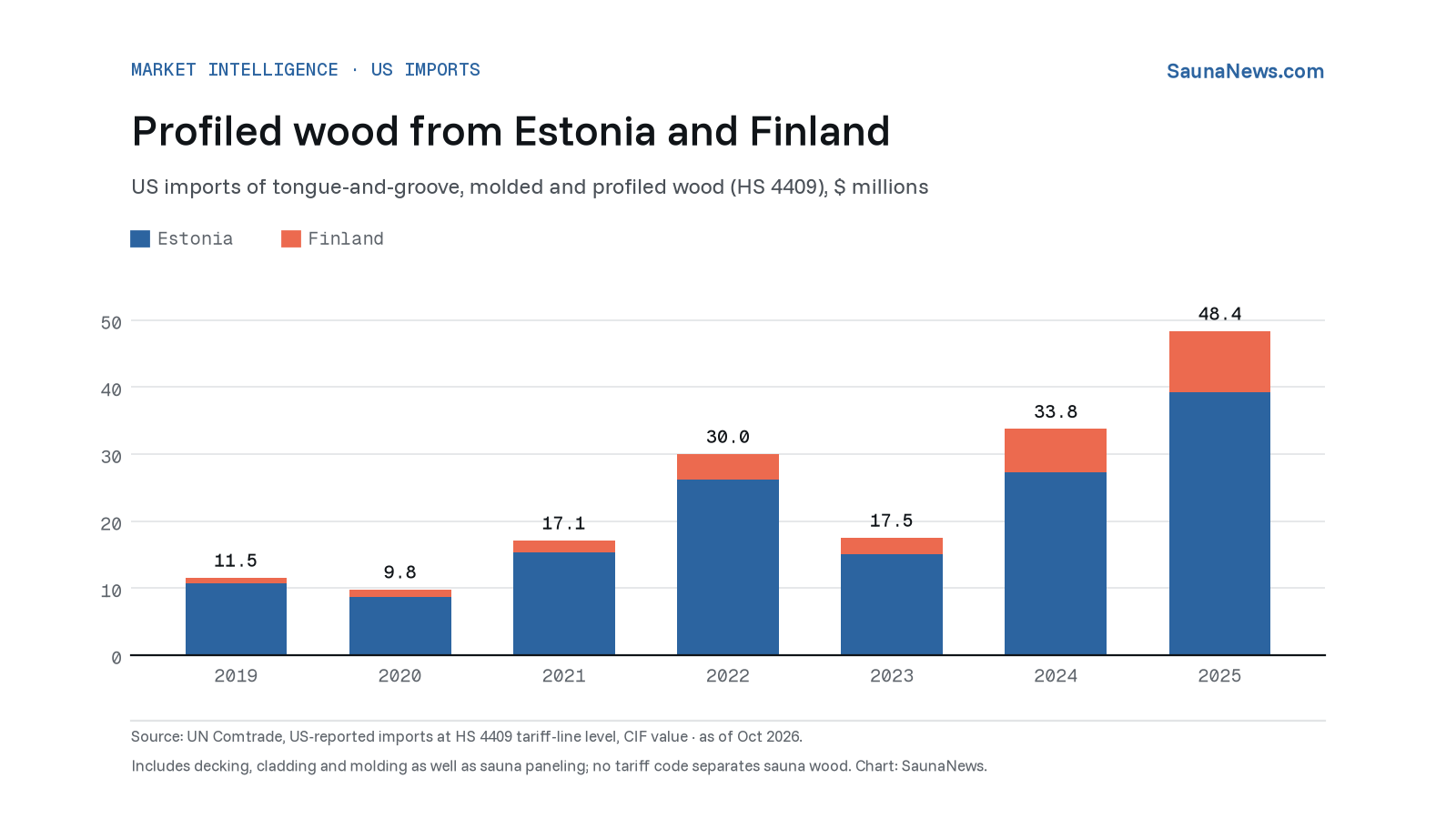
The United States bought $48.4 million of profiled wood from Estonia and Finland in 2025, four times its 2019 total. Finland’s Lunawood sent 86 shipments to US customers, up from 12 in 2022. The people building their own saunas still mostly buy wood close to home. In a SaunaNews review of 262 US DIY builds posted to Reddit since 2021, a local lumberyard or sawmill was the most common source among builders who said where their wood came from. Of the builders who gave a reason, 72% named price.
Much of the Nordic wood crossing the Atlantic is decking and cladding. The customs data can’t tell a sauna board from a siding board.
The customs code can’t see a sauna
Sauna paneling enters the US under heading 4409, the tariff heading for tongue-and-groove, molded and otherwise profiled wood. Deck boards, cladding and trim enter under the same heading. Thermal modification doesn’t get its own line either. In a 2005 ruling, US Customs and Border Protection found that “the ThermoWood process does not affect the tariff classification of wood products under Chapter 44” (CBP ruling L85728).
Within that limit, the direction is clear. US-reported imports under heading 4409 from Estonia rose from $10.7 million in 2019 to $39.3 million in 2025. Imports from Finland rose from $0.8 million to $9.1 million (UN Comtrade). Thermally modified aspen and alder paneling usually lands in 4409.29.91, the catch-all line for profiled hardwood. US imports from Estonia on that line came to about 2.2 million board feet, worth $12.9 million, in 2025. Ash decking and other hardwood profiles share it.
Thermory, the Estonian thermowood maker that US sauna builders name most often, shows how the numbers mix. Its audited accounts put US revenue at €10.0 million in 2019 and €34.8 million (about $39 million) in 2025. The US overtook Finland as its largest market in 2024 (Thermory AS 2025 annual report). Its 2025 group revenue breaks down like this:
- 82% planed material. The company’s category covers decking, cladding and sauna material together.
- 5% sauna products and elements.
- 13% finished saunas, mostly from its Auroom brand.
The filings describe the US subsidiary’s business as distributing thermally modified decking and exterior cladding. Our look at Estonia’s sauna manufacturing cluster covers how the country built that export base.
Lunawood’s US shipments rose sevenfold, mostly for outside walls
Lunawood, a Finnish ThermoWood producer, has grown quickly in US shipping records. Ocean bills of lading tie Oy Lunawood Ltd to 12 US shipments in 2022, 31 in 2023, 60 in 2024 and 86 in 2025. Another 77 had landed by October 10, which puts 2026 on pace to top 2025 (ImportInfo, Oy Lunawood Ltd). A typical load weighs about 37,000 pounds, is declared as profiled softwood boards and lands in Houston, Savannah or Newark.
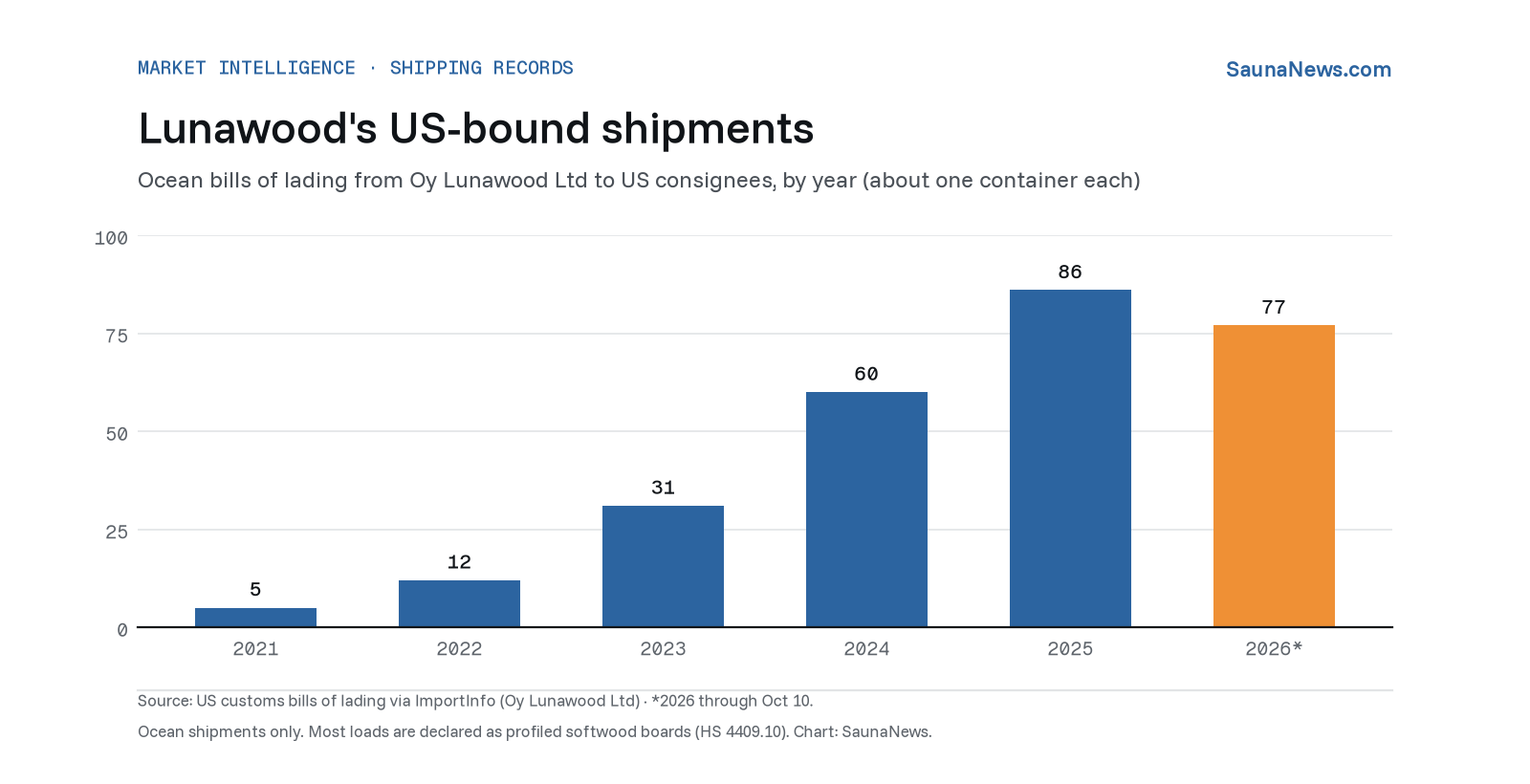
Since March 2025 most of it has gone to Lunawood LLC, the company’s US joint venture with Atlanta Hardwood Corporation. Before that, siding and cladding suppliers were the biggest receivers.
The joint venture’s Georgia mill, covered here in April, can modify about 4.2 million board feet a year. It handles only white ash and yellow poplar. Lunawood’s US sauna boards are still thermally modified Nordic pine and spruce from Finland, 3/4 to 1-1/4 inches thick, with no aspen or alder in the range.
Lunawood booked €65.6 million (about $74 million) of revenue in 2025. Group revenue grew 15% to €68.2 million, and its sustainability report says “demand remains strong in the U.S.” (Lunawood Sustainability Report 2025). Rogue Sauna in southern Oregon lines its flagship prefab with Lunawood panels. On Reddit’s r/Sauna, Lunawood came up in four posts in 2025 and 2026, against 57 naming Thermory.
Lumberyards beat specialty suppliers in the build threads
The build threads show why a fourfold rise in Nordic wood hasn’t changed the typical American sauna much. The 262 coded builds come from r/Sauna and r/woodworking, from 2021 to October 2026, and include a random sample of 162.
- Most builders never say where their wood came from. That was 117 of the 162 random-sample builds, or 72%.
- Lumberyards and sawmills lead among those who do. They supplied 31% of the 45 random-sample builds that named a source. Reclaimed, secondhand or self-milled wood was 24%. Big-box stores and specialty sauna-wood suppliers were 22% each.
- Thermory is most of the specialty share. It was named in 20 of the 24 builds that mentioned a specialty brand.
- Cedar is slipping but still leads. Its share of walls fell from 67% of builds in 2021 to 2023 to 47% in 2024 to 2026. Thermally modified walls rose from 6% to 10%. Pine, the budget choice, rose from 6% to 11%.
- Price decides. Of 114 builds that gave a reason for their wood, 72% cited price, budget or savings. Another 22% cited local availability.
A Reddit post isn’t a random draw from US sauna builders, and the bias probably runs toward specialty wood. A builder who orders a named brand tends to say so. A builder who drove to the yard often doesn’t mention it.
Imports went flat in 2026 while Canadian cedar’s tariffs rose
The import boom paused this year:
- Estonia: US imports of its profiled wood came to $21.7 million for January through July, down 2% from the same months of 2025.
- Finland and Sweden: US-recorded imports from Finland fell 31% and from Sweden 55%.
- The exceptions: Estonia’s hardwood profiles, the line that holds aspen and alder paneling, were up 12%. Lunawood’s shipment count is still rising.
Canadian cedar, meanwhile, got more expensive to import. Since August 22, the Section 338 list has added 50% to Canadian tongue-and-groove cedar paneling. Lumber duties fell on October 19, but that paneling still pays 74.75% in total, and since October 30 so do end-matched boards. Siding pays 24.75% (our breakdown of the new cedar rates). Our look at 2026 material costs covers freight and the wider lumber picture.
Compare wood delivered, grade for grade
- Price the whole room delivered. Freight often decides small orders, and a per-foot price leaves it out.
- Compare grade with grade. Price knotty against knotty and clear against clear, whatever the species.
- Ask a cedar supplier which tariff line the paneling entered under. Plain tongue-and-groove and end-matched boards from Canada pay 50 points more than siding.
- Ask a thermowood supplier which mill, species and treatment class you’re getting. Under the same customs code, a sauna board and a deck board look identical.
Disclosure: SaunaNews is owned by SaunaShare, Inc., which also operates SaunaMarketplace.com. Sauna Marketplace sells Thermory sauna wood in the US.