
Lunawood’s Georgia Mill and the Thermory Question

By Sofia Mäkelä
European Correspondent & Sauna Industry Analyst
- Published
- Reading time
- 8 min
SaunaNews is published by SaunaShare, Inc., which also runs SaunaShare.com and SaunaMarketplace.com, where we sell many of the products we write about. That experience may change what we write about and what we don't. Who owns SaunaNews · The ownership announcement
Lunawood’s new Cleveland, Georgia mill switches the Finnish thermowood maker from an export model to local US production and adds a domestically-grown hardwood line in Yellow Poplar and White Ash. It also puts Lunawood into direct category competition with Thermory, the incumbent with the larger North American distribution footprint.
In this story6 sections
Lunawood, the Finnish thermowood maker and a founding member of the International ThermoWood Association, has moved from exporting into North America to producing inside it. Through the Atlanta Hardwood Corporation joint venture that took effect January 1, 2025, all North American sales now run through Lunawood LLC. A new production mill at Atlanta Hardwood’s facility in Cleveland, Georgia came online in October 2025 and is now thermally modifying locally sourced US hardwoods on site. The company is layering a localized architectural line, branded the North America Collection and built around thermally modified Yellow Poplar and White Ash, on top of its established Nordic pine and spruce catalog.
The move puts Lunawood directly into the lane that Thermory has spent years building out in the US.
From export model to local production
In November 2024, Lunawood announced that effective January 1, 2025, Lunawood LLC would manage all North American sales and that the joint venture would build a production facility at Atlanta Hardwood’s Cleveland, Georgia plant, with full-range stock held at Cleveland and Clarksville. In October 2025, the company publicly marked the Cleveland grand opening and the start of thermal modification of locally sourced hardwoods on US soil. Current Lunawood US pages now describe Cleveland as a production mill and position the North America Collection as manufactured there.
Local inventory at Cleveland and Clarksville cuts lead times compared with trans-Atlantic shipping from Finland, the biggest operational disadvantage a European thermowood supplier carries into a US specification cycle. Local production removes the other half of that disadvantage: freight cost on finished board product sold by the full container. Lunawood has not published a route-specific freight or carbon comparison, so the size of the saving is not public.
The North America Collection: Yellow Poplar and White Ash
The North America Collection launched publicly in early 2025 and became operational with the Cleveland opening. Lunawood’s May 2025 collection leaflet and current US product pages describe Yellow Poplar panel systems in 1x4 and 1x6, 3D-look cladding in both Yellow Poplar and White Ash, White Ash flooring, White Ash and Yellow Poplar battens, and White Ash decking in 5/4x4 and 5/4x6. A 3/4 by 3-5/8 inch Yellow Poplar panel and a 1 by 5-1/2 inch White Ash decking profile are both listed as manufactured in the USA.
Lunawood’s North American hardwood datasheet gives thermally modified White Ash durability class 1 and use class 3, and thermally modified Yellow Poplar durability class 2 to 3 and use class 3. Thermal conductivity is 0.15 W/mK for White Ash and 0.13 W/mK for Yellow Poplar. Lunawood’s North American technical documentation also flags two cautions: the hardwood thermally modified line is not termite resistant, and minor release of natural color pigment can occur early in the life cycle and in humid spaces such as saunas and spas.
Thermo-D is the grade for saunas and spas
Lunawood’s ThermoWood materials are made using only heat and steam, without chemical preservatives, under the trademarked ThermoWood system that Lunawood helped codify as a founding association member. Lunawood’s general factsheet distinguishes LunaThermo-S (treated at about 374°F, suitable for indoor applications) from LunaThermo-D (treated at about 414°F, suitable for internal and external applications including humid spaces like spas and saunas). Thermo-D is rated use class 3 under EN 335 and durability class 2 under EN 350, with a Building Research Establishment endorsement supporting a 30-year expected service life for cladding and decking when correctly used.
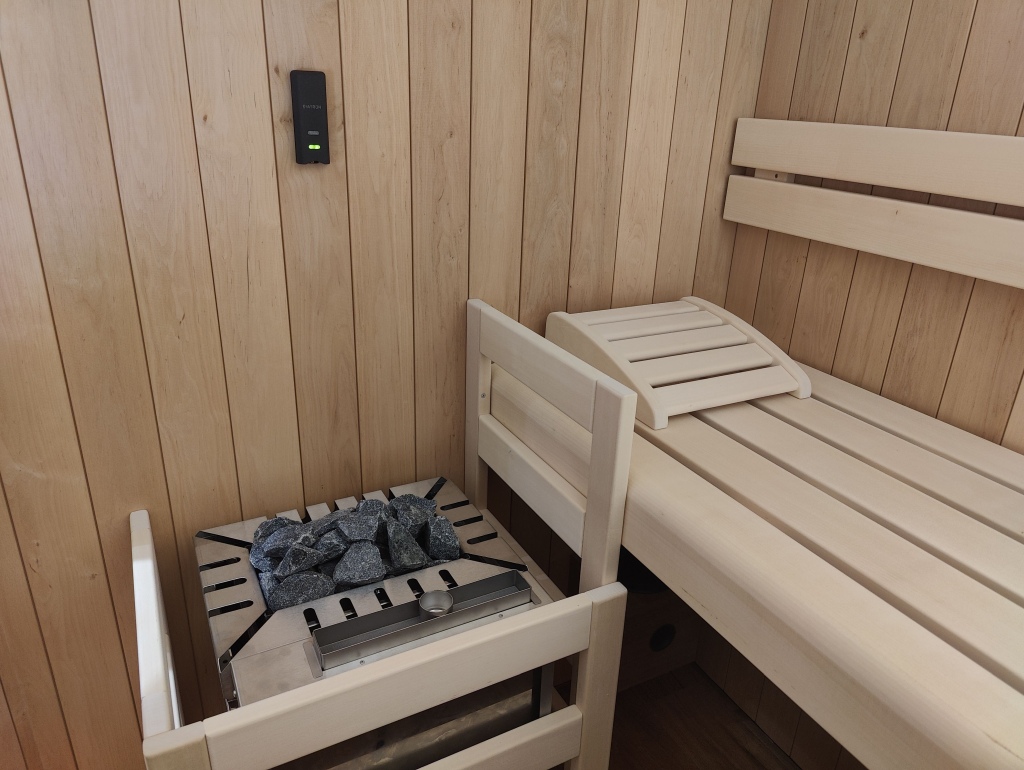
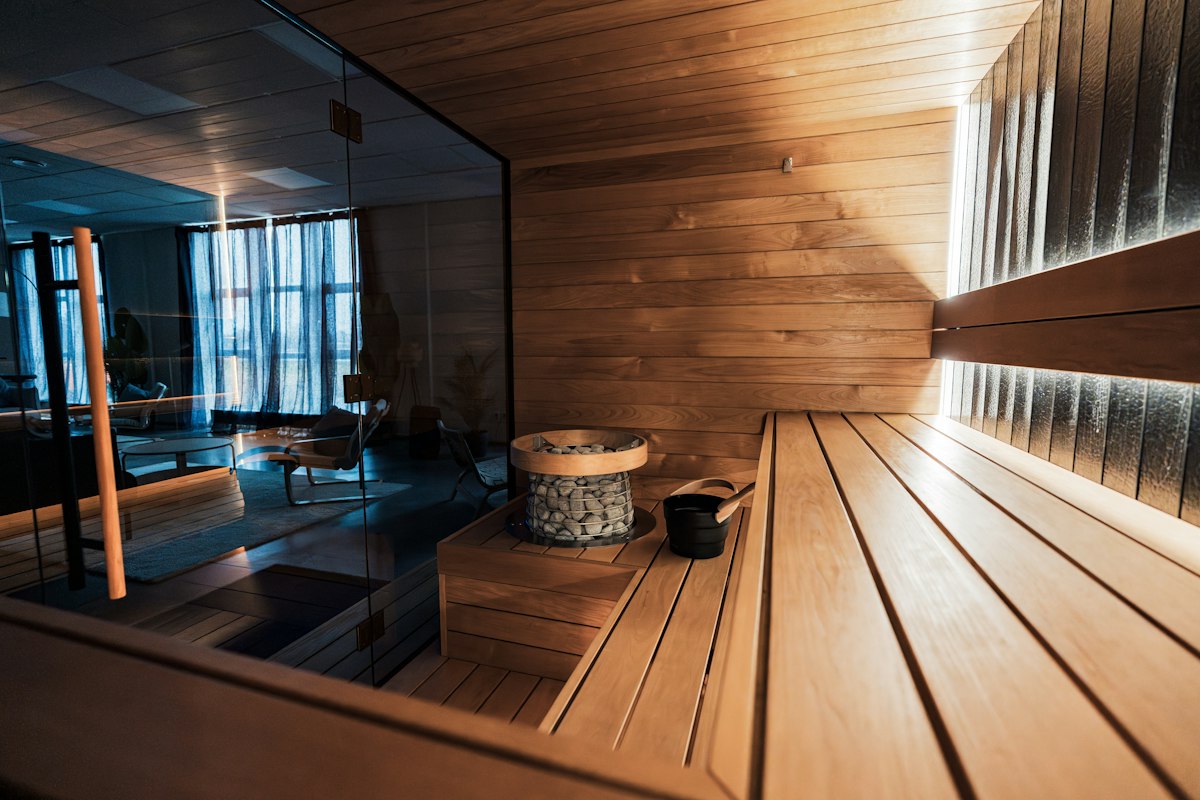
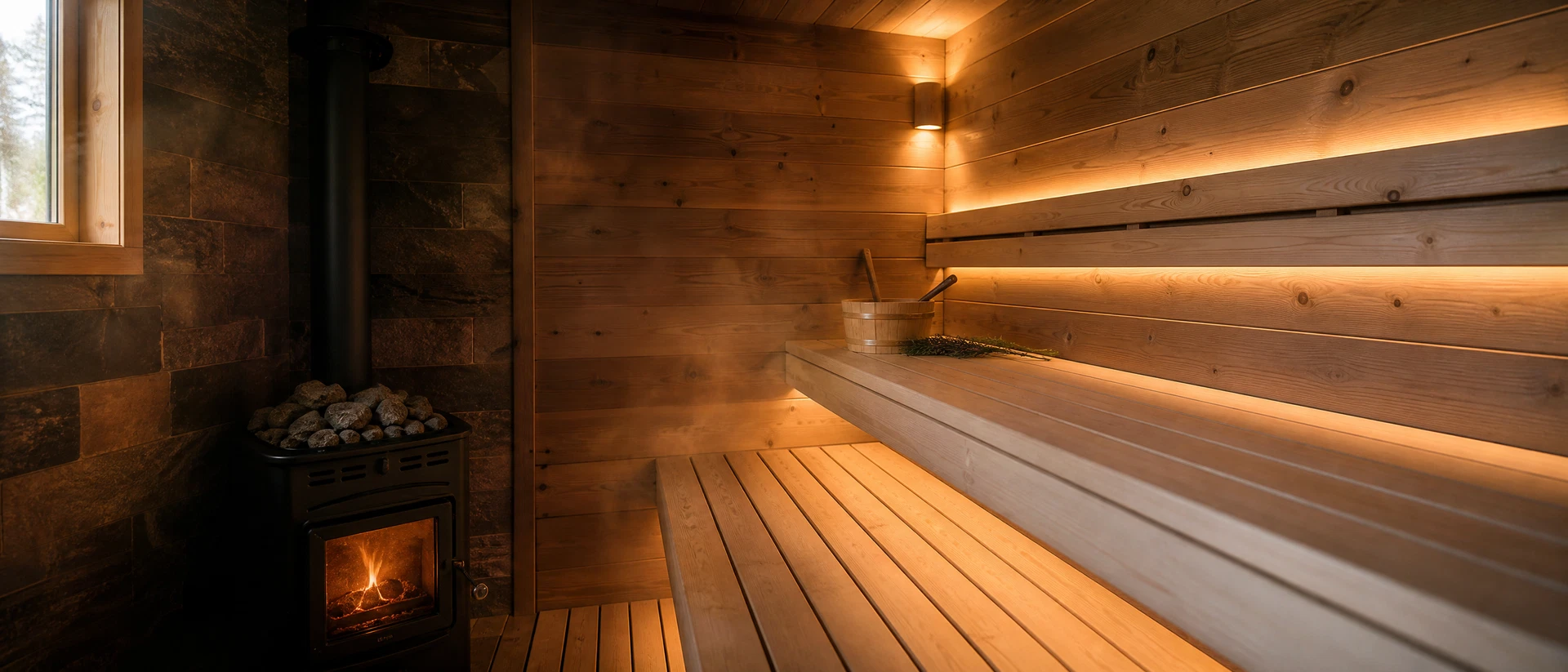
On the sauna side specifically, Lunawood’s 2025 sauna guide describes the material as resin-free, dimensionally stable, and exceptionally low in thermal conductivity, which is the mechanical reason properly-specified Thermo-D surfaces stay cool enough to touch in sustained heat. Current US-facing sauna and interior pages feature Luna Edge 3/4 by 4 and 3/4 by 5 as the prominent sauna and spa profiles with a hidden-fixing tongue-and-groove detail designed for horizontal paneling. Lunawood publishes a minimum 1-inch ventilation gap and 24-inch joist-spacing guideline for sauna installs.
Related: our coverage of how US operators are building performance saunas.
Thermory has the larger US network
Thermory describes itself as the world’s largest manufacturer of thermally modified wood and sauna materials, with production in Estonia and Finland, exports to more than 50 countries, and a leading position in sauna and spa. Its North American arm has built out a centralized US warehouse, added regional distributors, and maintains a state-by-state dealer network in the US and Canada. That is a larger global scale and a more mature North American distribution footprint than Lunawood carries into 2026.
Public market-share figures are not available for the thermally modified wood category in North America. Thermory has the established North American network; Lunawood has now localized production and added a US-grown hardwood line. Related Thermory coverage on SaunaNews: the 2024 ownership change to UG Investeeringud, the Bergman Japan partnership, and the Baltimore Ravens performance center install. For category context, see our pieces on Estonia as a sauna manufacturing powerhouse and Finnish lumber pricing.
The collection is mainly an architectural line
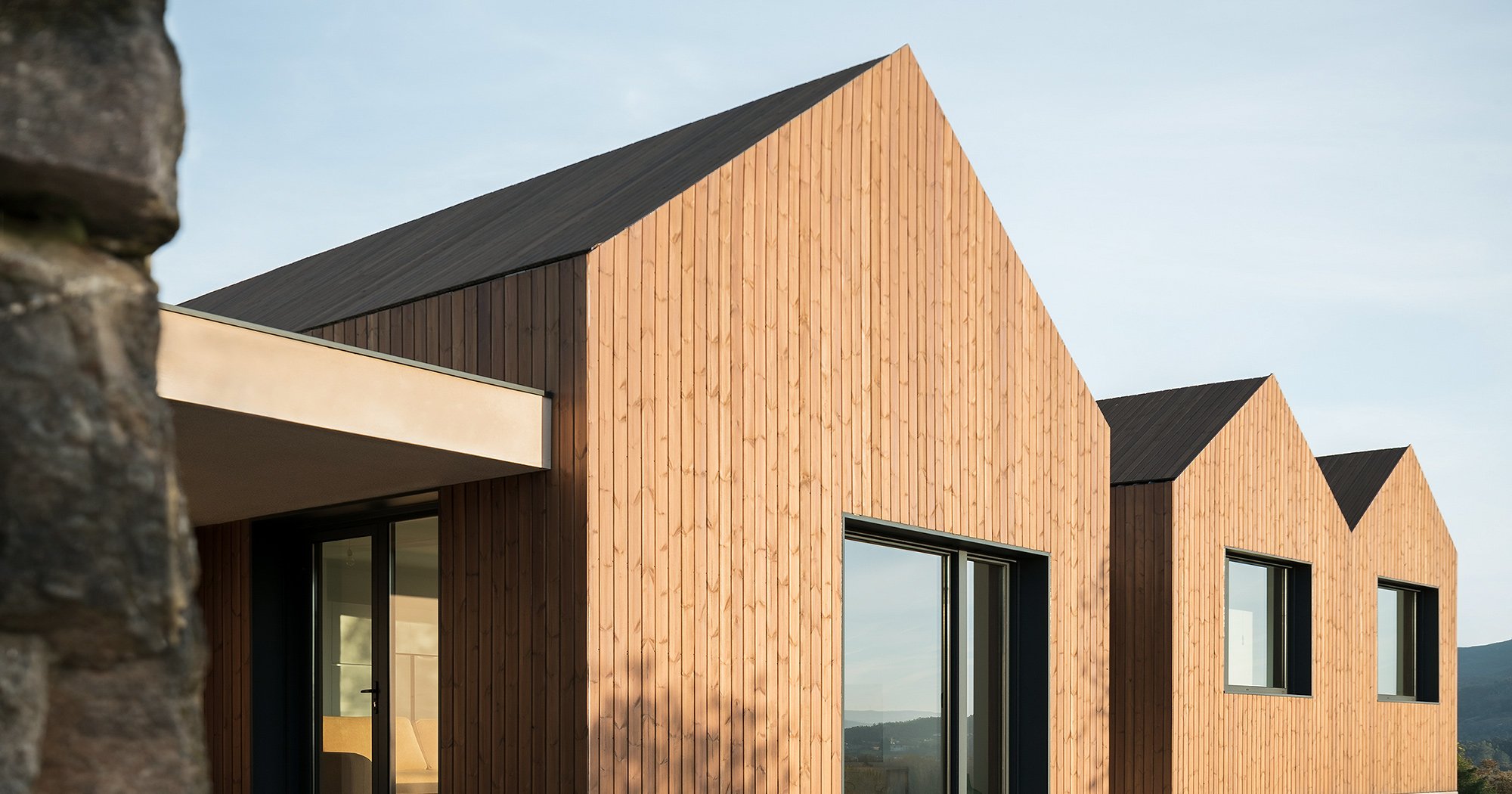
The North America Collection is first a localized architectural cladding, decking, and interior line that gives US specifiers a domestically grown alternative to tropical hardwoods and a more reliable North American supply chain. Lunawood itself positions White Ash as a sustainable alternative to tropical hardwood decking. The Cleveland mill is built for that architectural market more than for any single sauna SKU.
The sauna case is narrower. Current US-facing sauna guidance presents Thermo-D Nordic pine and spruce as the primary specification for humid spa and sauna rooms, with Luna Edge as the named current profile. Lunawood’s older catalogs show a mixed picture (for example, the 2020 portfolio lists Luna SHP Sauna 26x92 as Thermo-S, not Thermo-D), so “Lunawood only sells Thermo-D for saunas” is not quite right for the full historical catalog. For 2026 specification, the public guidance is what matters, and that guidance points to Thermo-D.
In the Lunawood-hosted webinar below, the company presents its thermowood case for contemporary sauna spaces.
Lunawood exhibits at IBS 2026
Lunawood LLC is an official exhibitor at the International Builders’ Show in Orlando from February 17 to 19, 2026, at booth W6090. Before 2025, Lunawood’s US presence leaned more on architectural specification channels than on mainstream builder trade floors.
Three things to track: the size and regional spread of Lunawood LLC’s named dealer and distributor list; named commercial and hospitality installs using the North America Collection (Yellow Poplar and White Ash specifications are the ones to watch); and any public comparative technical data from Lunawood on Cleveland-produced hardwoods versus imported Nordic pine and spruce.