How Long It Actually Takes From Permit to Opening for Public Saunas and Bathhouses in the US

Research, standards and the sauna industry
- Published
- Reading time
- 15 min
SaunaNews is published by SaunaShare, Inc., which also runs SaunaShare.com and SaunaMarketplace.com, where we sell many of the products we write about. That experience may change what we write about and what we don't. Who owns SaunaNews
SaunaNews traced 296 US public sauna and bathhouse projects through permits, registries and opening days. A sauna club opens about 11 months after its first building permit filing, a bathhouse or thermal spa about 15 and the biggest spas two years or more. Nearly half missed the first date they announced.
In this story12 sections
- 01A sauna club takes about 11 months; bathhouses and big spas take longer
- 02Plan review is the short part
- 03A cold plunge turns a sauna into a pool project
- 04New York City dropped a six-month step in 2021
- 05Money and leases start the clock before the first permit
- 06Franchise systems plan on six to 12 months
- 07Big projects run on years
- 08Nearly half missed their first date, often without a public reason
- 09Parks and waterfronts set their own calendars
- 1093 projects haven’t opened yet
- 11Plan for the last signatures, not the permit
- 12How we counted
A sauna club in the US opens about 11 months after its owners file their first building permit. A bathhouse or thermal spa takes about 15. The largest bathhouses and destination spas need two years from that first filing, and closer to four from the first public record of the project.
Those are the medians from a SaunaNews review of city permit records, state registries, zoning files, loan data and opening dates for 296 public sauna and bathhouse projects in the US: 134 that opened from 2021 through November 26, 2026, and 93 that haven’t opened yet. The rest are older venues, expansions, closures and openings that couldn’t be dated.
The permit itself is rarely the long part. City plan review took a median of 87 days. Most of the wait came after the permit was issued, in construction, inspections and the last signatures, and where a certificate of occupancy date is public, it arrived a median of two weeks before the doors opened.
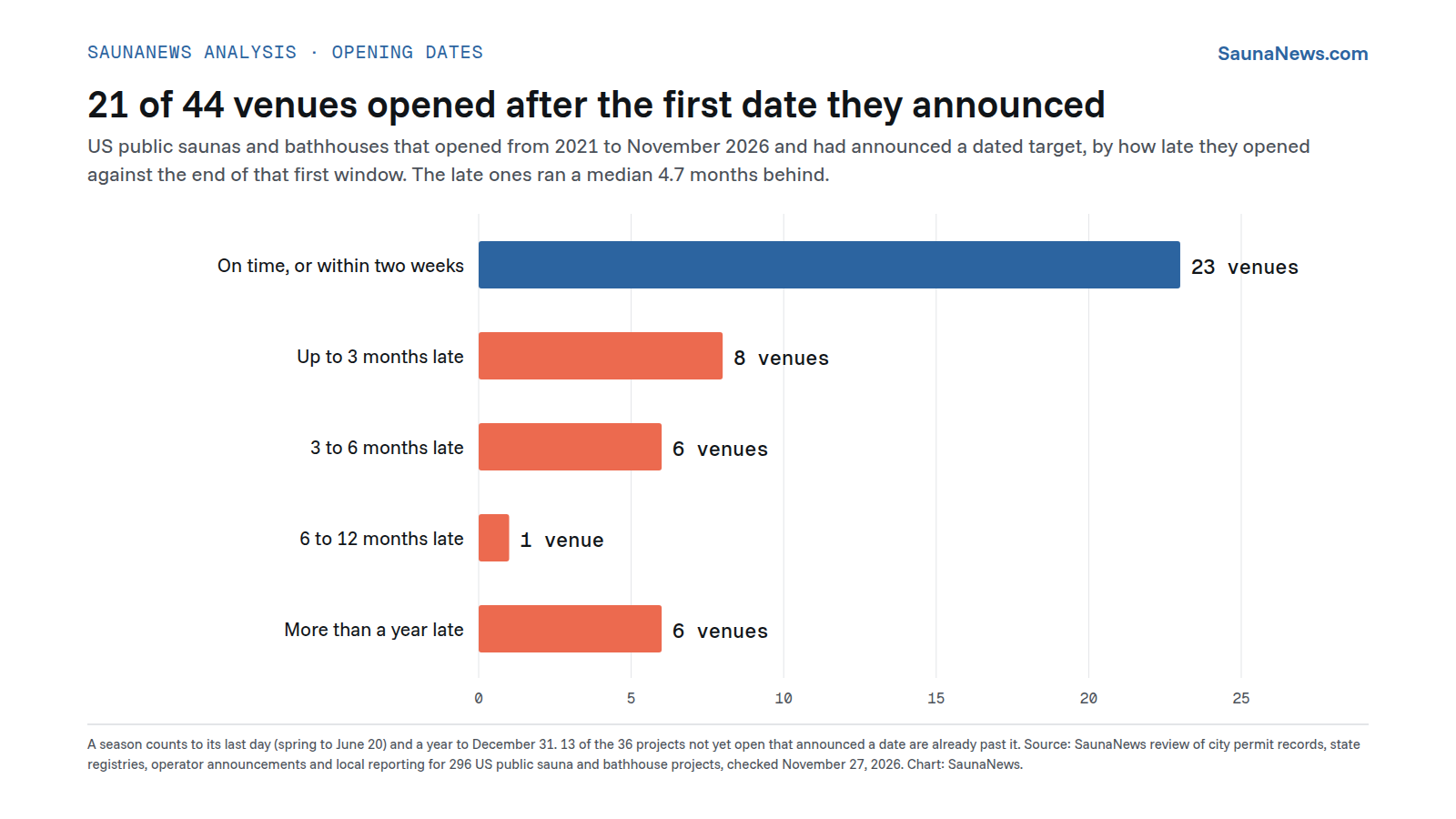
Nearly half the venues that announced an opening date missed it: 21 of 44, by a median of almost five months. For 10 of them, no public reason is on record.
Key Facts
- Sauna clubs and studios 10.8 months, median, from the first building permit filing to opening day (14 venues; the middle half took 6.0 to 12.8 months)
- Bathhouses and thermal spas 15.4 months (5 venues)
- Large bathhouses and destination spas 25 months from the first permit filing (4 venues) and 44 months from the earliest public record (14 projects)
- Pop-ups and seasonal saunas about two weeks (4 venues)
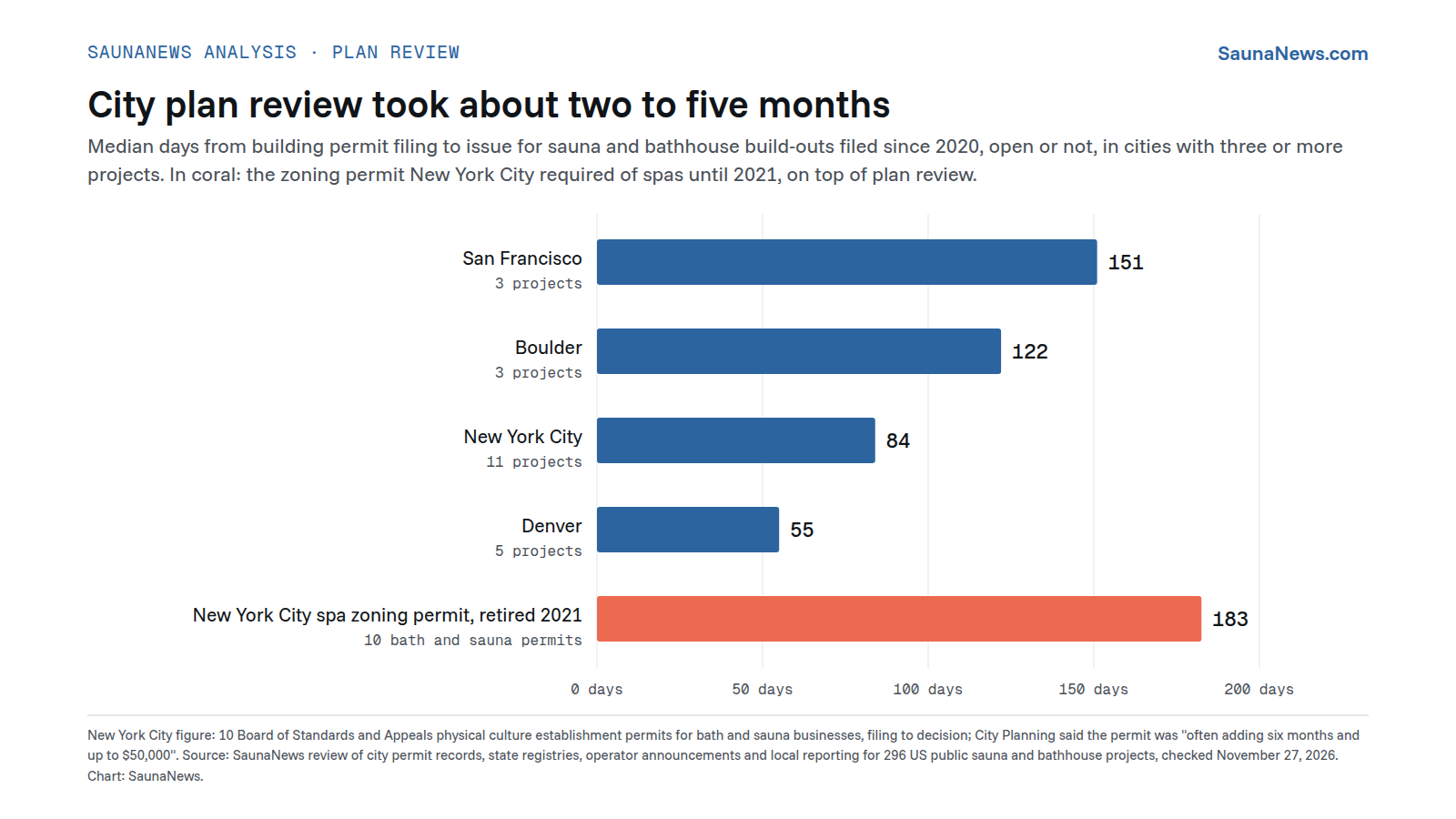
- City plan review 87 days, median, from filing to permit (28 venues); by city, counting projects still being built, 151 days in San Francisco, 122 in Boulder, 84 in New York City and 55 in Denver
- Certificate of occupancy to opening 14 days, median (11 venues)
- Missed first dates 21 of 44 venues opened after the end of the first window they announced, by a median 4.7 months
- Still to open 93 projects; 13 of the 36 that announced a date are already past it
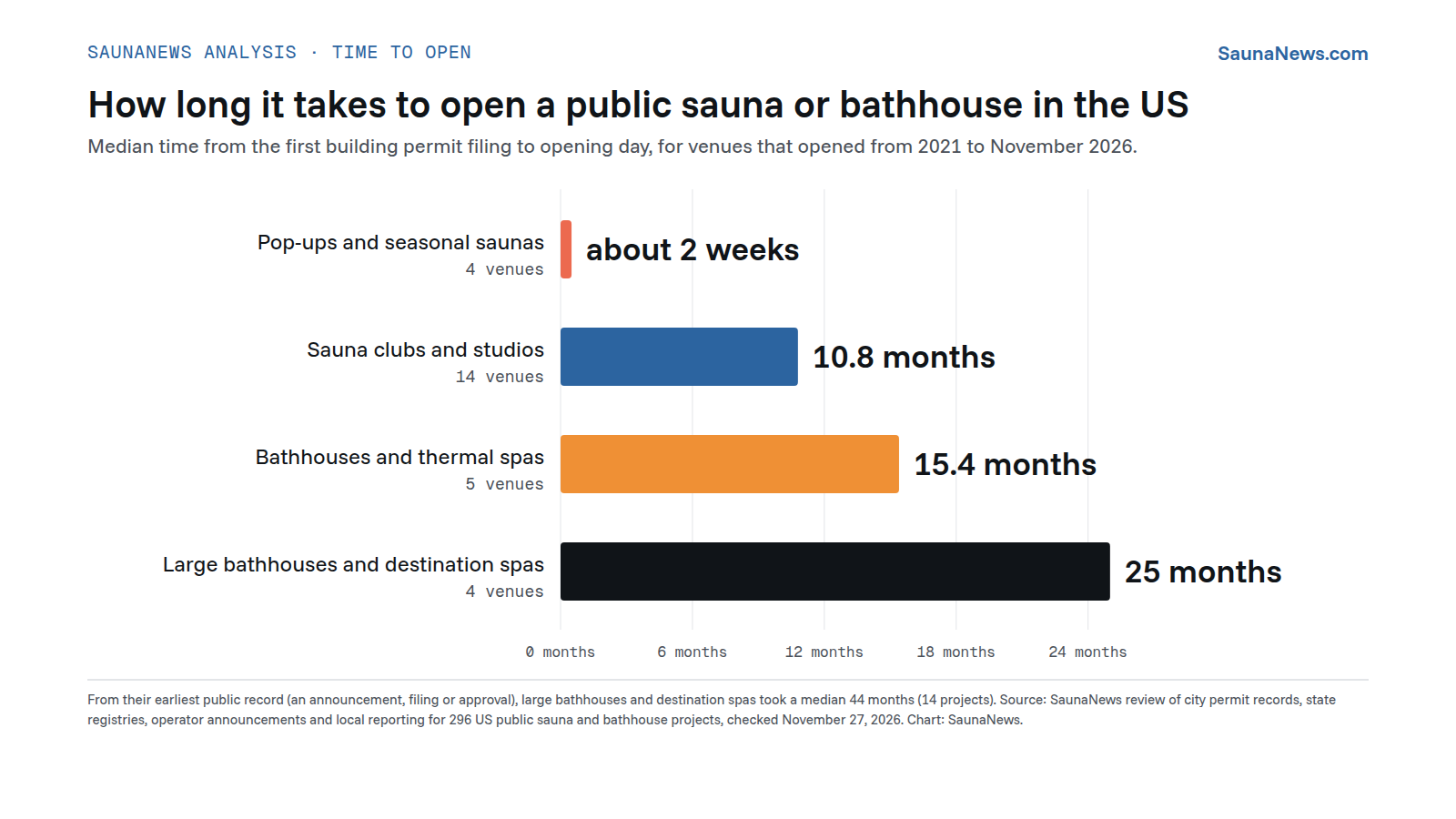
A sauna club takes about 11 months; bathhouses and big spas take longer
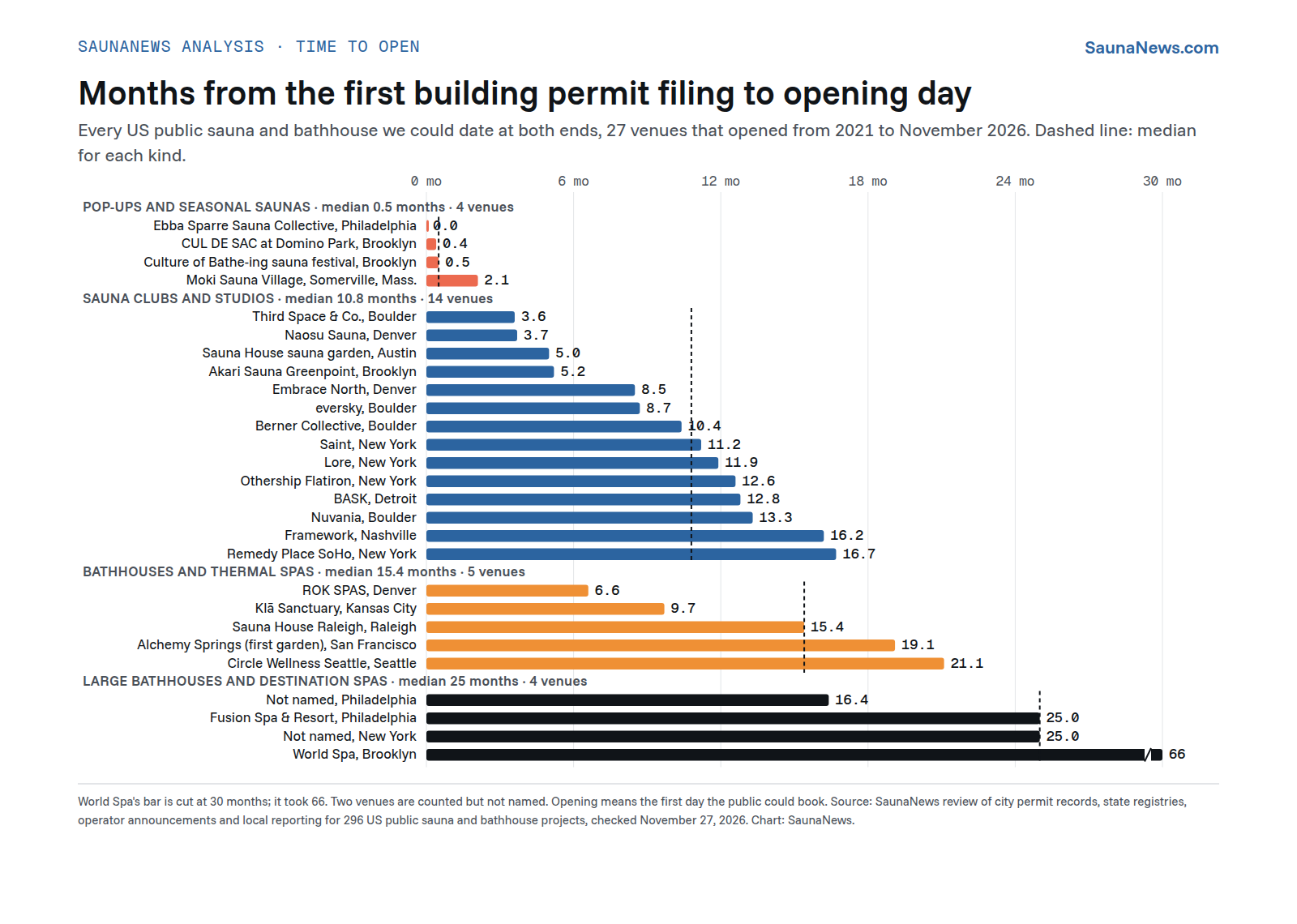
The quickest openings were temporary pop-ups. A permit for temporary and portable saunas at the Domino site in Williamsburg, Brooklyn, was filed with New York City on October 29 in the name of the owner, Two Trees, according to Department of Buildings records. CUL DE SAC opened its winter sauna village at Domino Park on November 9, 11 days later. Moki applied for a permit for a seasonal sauna village in Somerville, Massachusetts, on November 1, 2024, got it on December 27 and opened on January 3, 2025.
Sauna clubs in existing storefronts took most of a year. Saint, which rents private sauna rooms in Chelsea, filed its first building permit on March 11, 2025, got it on June 3 and opened in February 2026, about 11 months after the filing, according to city records and Time Out New York. Lore filed its first work for a NoHo storefront on May 15, 2025, and the change of use on July 1. Time Out reported in September that it would open that fall. It began a soft opening for members in December and opened officially on May 11, 2026.
Nuvania in Boulder, Colorado, filed for its permit on October 10, 2025, got it on February 27, 2026, and started construction in May. It aimed for October 1, waited on its certificate of occupancy and opened to the public on November 18, 13 months after the filing.
Bathhouses take longer, and new buildings longer still. Circle Wellness filed for a permit to build a modular building for its first US location, in Seattle, on November 27, 2024. The plans went through four review cycles, with 139 days out for corrections, before the city issued the permit on September 23, 2025, according to the city’s permit record. It scheduled its first sessions for September 1, 2026, 21 months after the filing. Sauna House’s Raleigh bathhouse took 15 months, from a December 2024 application to a March 2026 opening.
The slowest were the biggest. World Spa, a 50,000-square-foot bathhouse in Brooklyn, filed for its new building in June 2017, said in 2019 that it would open in 2020, and opened on December 8, 2022, five and a half years after the filing. Its co-founder, Leonid Khanin, has said the hardest parts included pandemic-era delays, sourcing, staffing and local approvals, as SaunaNews reported in April.
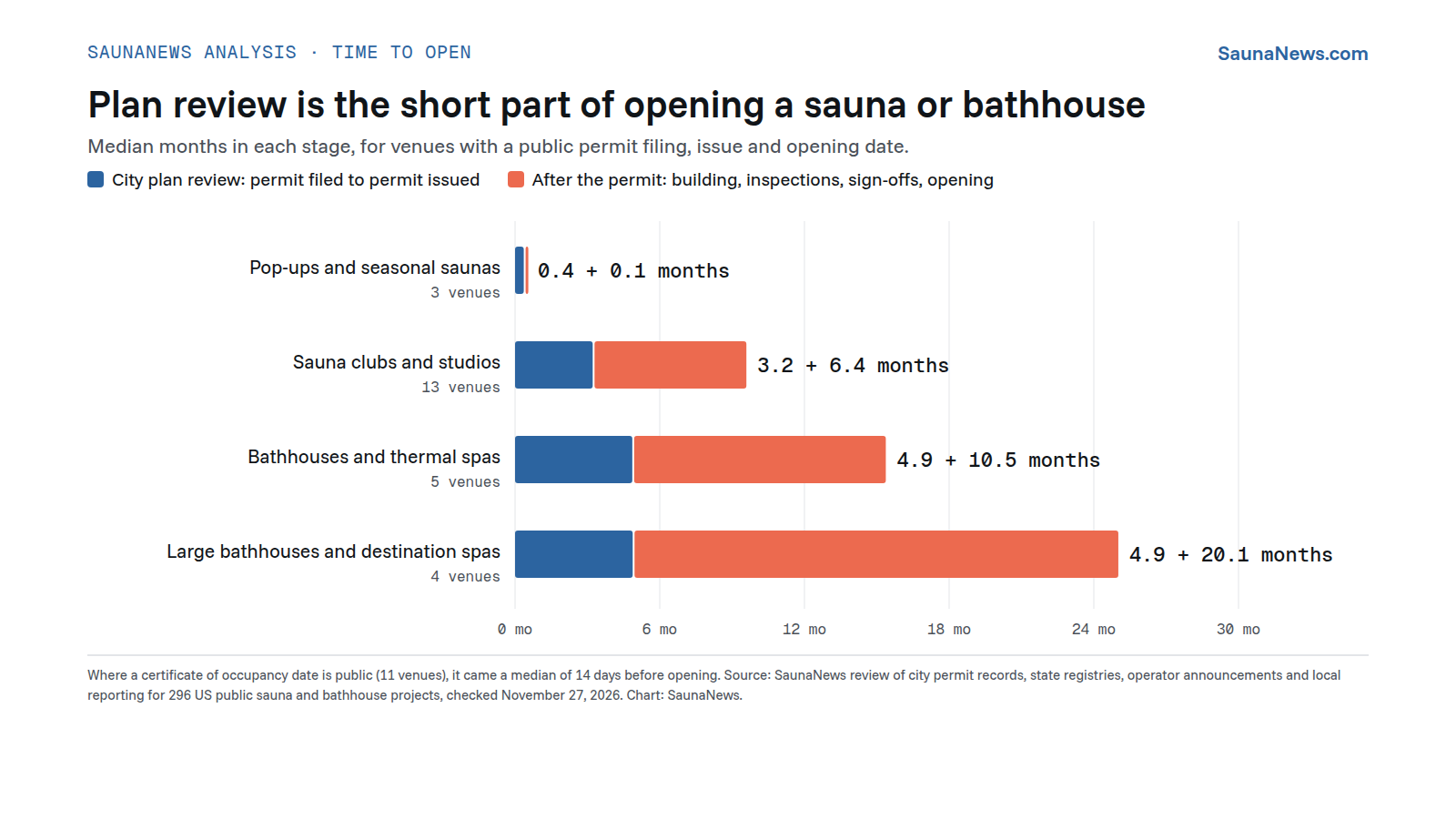
Plan review is the short part
For the 25 venues with a public permit filing, issue and opening date, city review was the smaller share of the wait. Sauna clubs spent a median of 98 days in plan review and 194 days after the permit was issued. Bathhouses and thermal spas spent 148 days in review and 320 after it, and large bathhouses and destination spas 149 and 613.
Review times varied by city. In the cities where at least three projects had both dates, counting ones still being built, plans spent a median of 151 days in review in San Francisco, 122 in Boulder, 84 in New York City and 55 in Denver.
How a project files matters as much as where. In New York City, an architect can certify that plans meet code, and the city issues the permit without a full plan exam. Seven self-certified filings for sauna, steam and cold-plunge work in commercial spaces got their permits in a median of 32 days. A change of use under a full plan exam, which a bathhouse in a former store usually needs, took about five to six months for gyms and spas across the city’s records.
The last signatures come at the end, and one waits on the other. In New York City, a sauna or steam room counts as a “bathing establishment” under the Health Code even without a pool, and the health department’s permit requires the building sign-off first. Florida law says a certificate of occupancy for a building with a public pool “may not be issued until such operating permit is issued” by the state health department, under section 553.79 of the Florida Statutes.
Grotto Baths in Miami shows how that last stretch plays out. Its building permit application went in on April 1, 2025, and the permit was issued on October 17. In October 2026, a founding partner told SaunaNews that Grotto’s opening depended on a temporary certificate of occupancy and final city approvals. The city recorded the temporary certificate on November 5. Members get in on December 1, and day passes start December 7, What Now Miami reported.
A cold plunge turns a sauna into a pool project
In Minnesota, Washington, Oregon, Texas, Florida and New York, the plunge, not the sauna, brings in the health department. A cold tub that recirculates its water and is shared between bathers is regulated like a pool or spa, which can mean engineered plans, a plan review before construction and an operating permit before it opens.
Minnesota’s health department puts it plainly: “Cold plunges are public pools when they are open to the public, whether for a fee or free of charge,” says its cold plunge fact sheet. Washington’s health department wrote in its cold plunge FAQ: “As of November 2026, DOH is not aware of any single-bather cold plunge tubs that comply with all Washington state requirements without modification.” Oregon’s health authority said the same of self-contained tubs, as of September 2025. Texas and New York define a tub of recirculating cold water as a spa.
Utah went the other way. A 2024 law, SB 106, barred the state health department from regulating cold tubs used by one bather at a time, kept below 60°F and holding up to 180 gallons, after an operator told legislators that a single tub built to pool rules cost more than $300,000, the Deseret News reported. For the legal background, see the three legal identities of a cold plunge.
Water and zoning can close a venue after it opens, too. Boulder shut two sauna clubs in May 2026 over “permitting and graywater compliance issues,” Boulder Reporting Lab reported. In Missoula, Montana Sauna Co. “was open for mere hours” at its October 4, 2024 grand opening before the city stepped in over zoning, according to The Pulp.
New York City dropped a six-month step in 2021
Until December 2021, a spa or gym in most of New York City needed a special permit from the Board of Standards and Appeals before it could open. City Planning said the process was “often adding six months and up to $50,000 in additional startup costs.” Ten special permits for bath and sauna businesses took between 98 and 412 days, according to the board’s records, including World Spa’s (322 days) and AIRE Ancient Baths’ for its Upper East Side spa (203).
The City Council ended the requirement on December 9, 2021, with the Health and Fitness text amendment, which allows gyms and spas in commercial and manufacturing districts as of right. AIRE’s Upper East Side spa, approved in January 2018, still took until March 1, 2025, to open. It sits at the base of a condominium conversion that stalled and was sold at a bankruptcy auction in 2020.
Money and leases start the clock before the first permit
The clock starts before the first permit. Across the venues with dates on record, opening day came a median of 10.3 months after a loan or investment round was approved (23 venues) and 14 months after the company registered with its state (31 venues).
All’s Well, a bathhouse in Minneapolis, applied for a Small Business Administration loan in July 2025 after about a year of talks with banks, the Star Tribune reported on November 9. A federal government shutdown delayed the financing, a change in a bank’s requirements added another hurdle, and the money came through in February 2026. All’s Well opened to founding members on October 3, three years after its founders began discussing the business.
Building to US code can reset a plan made elsewhere. Othership’s co-founder, Robbie Bent, told Canadian Business in July 2024 that the co-ed change rooms and custom-built ice baths of its Toronto locations weren’t up to code in the US, so the team dug out floors to sink the ice baths and rented extra basement space in New York. “It’s actually taken us two years from starting to get open,” Bent said. Othership’s Flatiron location opened that month, about a year after its first building filing.

In Gainesville, Florida, Connor Cornell expected four months of construction to turn a former storage unit into Gainesville Sauna House. It took 13 months, through bank loans and construction delays, Cornell told WUFT. The house opened to customers on September 14.
Franchise systems plan on six to 12 months
Franchisors state the expected time to open in Item 11 of their franchise disclosure documents, filed with state regulators. Portal’s 2026 disclosure says a club “typically opens between six and eight months after the Portal Club’s Franchise Agreement is signed.” Sauna House’s 2025 disclosure says: “We expect most franchisees will typically open within 12 months after signing the Franchise Agreement.”
Loan records give a rough check. Sauna House locations financed with SBA-backed loans opened about 8 months after the loan was approved in Charlotte, 12 in Raleigh and 15 in Knoxville, according to the agency’s 7(a) loan data. Summerville, South Carolina, approved for its loan in June 2025, had not opened by late November; its page says only that it is opening soon.
Big projects run on years
Destination thermal spas need approvals before they need permits, and the approvals set the pace. QC NY’s day spa on Governors Island won the Landmarks Preservation Commission’s approval in July 2015, when it was expected to open in summer 2017. It opened bookings in July 2021 for visits starting that September and welcomed its first guests on March 4, 2022.
Alyeska Resort in Alaska announced its Nordic spa in November 2019 for Christmas 2020. In June 2021, citing hotel representatives, the Anchorage Daily News reported that the $15 million spa was “a bit behind schedule, and in some areas costlier than expected.” In April 2022 the resort announced that the first phase had partially opened, “after a long wait due to pandemic-related disruptions,” as the paper put it.
Balian Springs, a 100,000-square-foot spa in Fairfax County, Virginia, filed for a special permit in November 2016, won it in September 2017 and opened on October 4, 2022. Fusion Spa & Resort in Northeast Philadelphia filed a zoning appeal in June 2021, won it in January 2023, got its building permit in March 2024 and opened just before Christmas 2025, after a certificate of occupancy on December 8.
Plans can hold. The Springs Resort in Pagosa Springs, Colorado, won final design approval for its expansion in October 2022, promised a second-quarter 2025 opening and opened its new pools on April 15, 2025.
Cascada’s 68-room thermal hotel in Bend, Oregon, waited 570 days for its building permit, from December 31, 2024, to July 24, 2026, according to the city’s permit records. “Permitting took significantly longer than we had hoped, but we’ve done our best to work with the city and their third-party reviewers,” the developer’s chief operating officer told Construction Equipment Guide. Cascada plans to open in late 2028.
Therme’s US projects sit at the long end. Washington signed an exclusive agreement with Therme in May 2023, chose it for Poplar Point in March 2025 and sent its ground lease to the D.C. Council in September 2026. Therme’s US chairman told Bisnow in October that the company hopes to finish around 2033. In November, Bisnow reported that the mayor-elect wants options beyond Therme’s proposal, and two council committees took up the land swap for Poplar Point but not the Therme lease. In Dallas, where Therme announced an $800 million resort in March 2025 that could open as soon as 2030, the City Plan Commission recommended the zoning change in August 2026. It still needs a City Council vote, and the target is now 2031.
Nearly half missed their first date, often without a public reason
Of 44 venues that opened after announcing a dated target, 23 opened on time or within two weeks of the end of the window they named. Eight were up to three months late, six were three to six months late, one was six to 12 months late and six were more than a year late. Among projects that haven’t opened, 13 of the 36 that announced a date are already past it.
“When I started working with my architect, I was hoping to be open in the new facility in January 2024, and that’s the date we broke ground,” Allen Penn, who runs Framework, a sauna and cold plunge studio in Nashville, told Nashville Voyager in April 2024. Framework opened the new building on January 3, 2025.
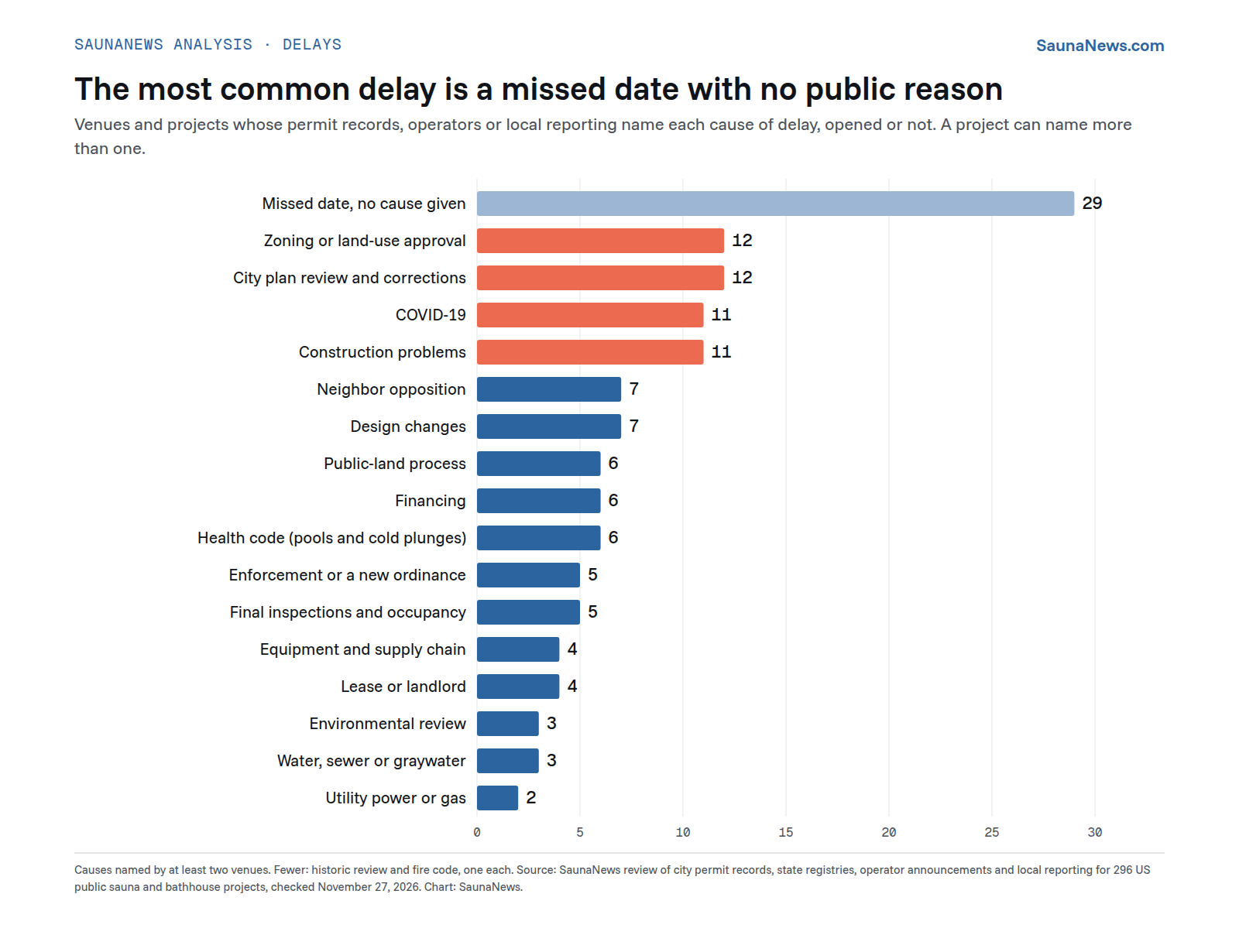
The most common delay in the data is a missed date with no public reason, at 29 venues and projects. Where a reason was given, it was most often zoning or land-use approval (12), plan review and corrections (12), COVID-19 (11) and construction (11), followed by design changes and neighbors’ objections (7 each) and public-land processes, financing and health codes (6 each).
Parks and waterfronts set their own calendars
On public land, the schedule belongs to the agency. Bend Park & Recreation District planned 49 days from its request for proposals for mobile sauna concessions in August 2025 to a vendor operating on October 1. Chicago’s FarWell Sauna applied to the Park District’s concession program in July 2025 and was told to wait for the October intake, the Hyde Park Herald reported. It opened at the 57th Street Beach on May 1, 2026.
St. Paul, Minnesota, adopted a license for mobile saunas on park property on November 18, 2026, five weeks after it was introduced. Seattle allows mobile saunas in parks only on day-by-day permits. In McCall, Idaho, 70% of 536 responses to a city survey opposed a proposed lakefront sauna, and the City Council tabled the application.
93 projects haven’t opened yet
The projects below are among the 93 that permits, registries, loans or their own announcements show are planned or under way and had not opened by November 26, 2026. Projects in the SaunaNews US bathhouse tracker link to their pages.
Selected US public sauna and bathhouse projects not yet open, November 26, 2026
| Project | Where | Status | Latest target |
|---|---|---|---|
| Grotto Baths | Miami | Temporary certificate of occupancy November 5 | Members December 1, day passes December 7, 2026 |
| Furoya | New York | Soft-opening visits booked for December 4 to 6 | Early or mid-December 2026 |
| Sauna House Summerville | Summerville, S.C. | Opening soon (no date posted) | Not dated (was November 2026) |
| Sensa | Miami | Permit issued July 9, 2026 | Fall 2026 |
| Sauna Jungle | Arlington, Va. | Under construction | January 2027 |
| AIRE Ancient Baths Los Angeles | Los Angeles | Under construction; permit issued November 26, 2025 | Winter 2026 to 2027 |
| Othership Upper East Side | New York | Mechanical permit issued September 1, 2026 | 2027 |
| Greenwich Village Baths | New York | Permit issued May 20, 2026 | Opening soon |
| Reunion Bathhouse | New York (Brooklyn) | Filed August 12, 2026 | Not announced |
| Submersive | Austin | Interior demolition permit issued November 16, 2026 | Summer 2027 |
| Ember | Seattle | Permit intake scheduled, $2.38 million fit-out | Fall 2027 |
| The Springs Outpost | Seattle | Permit filed July 27, 2026; corrections requested | 2026 for the saunas (was summer 2026); hot pool and cold plunge in 2027 |
| Coba (Colorado Bathhouse) | Denver | Demolition permit 2025 | 2027 |
| Elysian Nordic Spa | Pocono Mountains, Pa. | Under construction | Spring 2027 |
| The Depths | San Antonio | State accessibility registration, $8.4 million | Not announced (state filing estimates completion June 2028) |
| Cascada | Bend, Ore. | Permit issued July 24, 2026 | Late 2028 |
| Therme | Dallas | City Plan Commission recommended zoning, August 2026; awaits City Council | 2031 |
| Therme | Washington, Poplar Point | Ground lease before the D.C. Council | Around 2033 |
Plan for the last signatures, not the permit
For anyone planning a public sauna, the numbers point to six things to do early.
Ask the health department about the plunge before you design the room. Put the question in writing: is a shared, recirculating cold tub a public pool or spa here? In Minnesota, Washington, Oregon, Texas, Florida and New York it is, and that can mean engineered plans and a review before construction.
Budget three to five months of plan review, more for a change of use. Ask your architect whether the work can be self-certified; in New York City, seven self-certified filings for sauna, steam and cold-plunge work got permits in a median of 32 days.
Book final inspections early. The certificate of occupancy came a median of two weeks before opening. In New York City the health department’s bathing permit can only follow it, and in Florida the certificate itself has to wait for the state’s pool operating permit.
Hold the opening date until the permit is issued. Nearly half the venues that named a date missed it.
Start financing about a year out. The median venue opened 10 months after its loan or raise was approved, and a shutdown or a lender’s new requirement can add months.
Check that your zoning code lists what you’re building. A proposed bathhouse in Fairfax, California, needed a conditional use permit because the use isn’t listed for the town’s central commercial zone. The approval took six months.
How we counted
We counted US venues that sell sauna or bathing sessions to the public: sauna clubs and studios, bathhouses and thermal spas, banyas and Korean spas, community and waterfront saunas, pop-up and seasonal sauna villages, and destination spas that sell day passes. Infrared-only studios, gyms, hotel spas for overnight guests and adult bathhouses are not in the count. The list started from the SaunaNews bathhouse tracker and SaunaShare’s count of 339 US public saunas and grew through city permit searches, state business and accessibility registries, liquor and health records, zoning agendas, SBA loan data, franchise disclosure documents, operator announcements and local reporting, read from November 26 to 27, 2026.
The first permit filing is the first filing for the venue’s own build-out, not a landlord’s work on the base building. Opening is the first day the public could book a session; a members’ or soft opening counts only where no public date exists. Month-only dates are set to the 15th. A target counts as missed when a venue opened more than two weeks after the end of the first window it announced in public, with a season ending on its last day and a year on December 31. We use medians because a few large projects take many years. Some groups are small: the permit-to-opening medians rest on 14 sauna clubs, five bathhouses and thermal spas, four large projects and four pop-ups.
Several cities publish only issue dates, so some venues have no filing date, and some openings needed no permit that names a sauna. Opening days come from operators and the press and can differ by a few days. Four opened venues and 13 projects are counted but not listed individually. Before publication, two separate fact-checks reread the story’s dates, quotes and links against the original records and reports.
Last checked November 27, 2026. Tell us about an opening or a permit we missed at hello@saunanews.com.
Source data: city permit records, state business and accessibility registries, SBA loan data, franchise disclosure documents, operator announcements and local reporting. The opened venues with every date and interval, and the projects not yet open, are free to reuse with credit: download the opened venues or download the pipeline.