EOS Is Shipping a 120 kW Gas Heater to Bathhouse Philadelphia. Nothing Sold in the US Comes Close.
KUSATEK, the gas-fired commercial line from Harvia-owned EOS Saunatechnik, is coming to America: a 120 kW and a 60 kW system for the 800-plus-square-foot event sauna Bathhouse is building inside Philadelphia's 1904 Bellevue building. Every install on KUSATEK's public project list is European, the published spec sheets are too, and the missing US listing is the detail operators should watch.

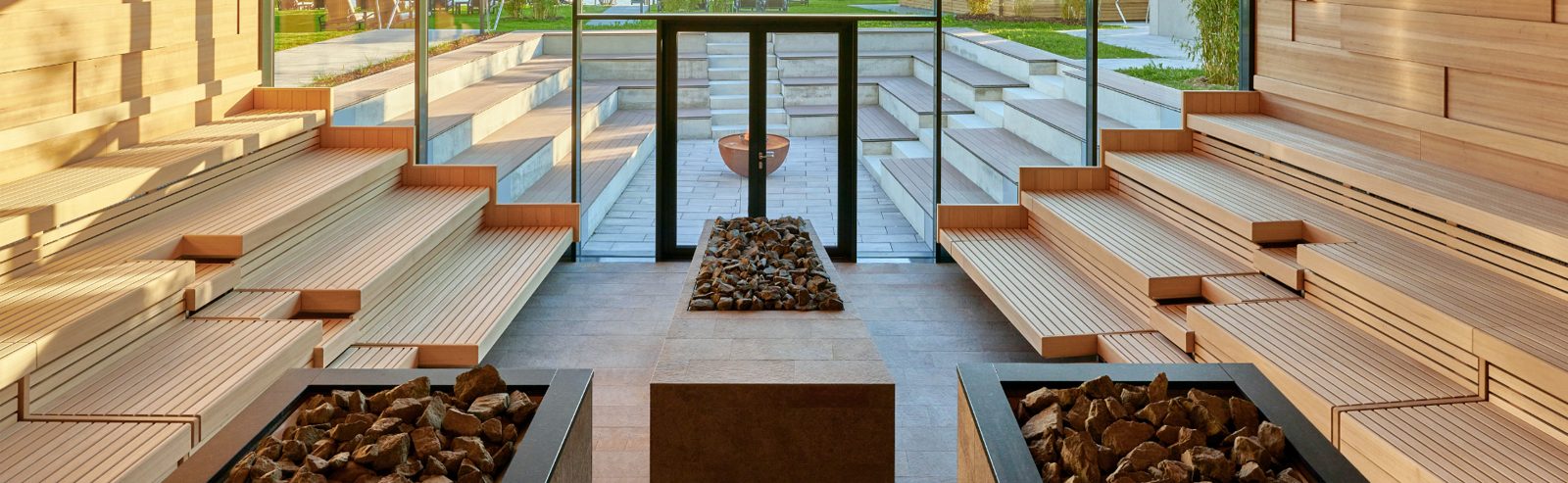
The theater sauna at Therme Lindau, Germany, where two 120 kW KUSATEK systems have run since 2021. Photo: KUSATEK / EOS Saunatechnik.
Bathhouse's Philadelphia location is getting a pair of gas-fired KUSATEK heater systems rated at 120 kW and 60 kW, EOS Saunatechnik announced on LinkedIn last week. They'll heat an event sauna of more than 800 square feet in the space Bathhouse is building out inside the 1904 Bellevue at Broad and Walnut. For scale: the most powerful commercial electric heaters sold in the US top out around 33 kW, and the biggest American-made gas sauna heater, Scandia's 80,000 BTU unit, works out to about 23 kW. The larger of the two Philadelphia systems delivers roughly 410,000 BTU per hour by itself.
Adrian Guckelsberger, who runs sales at EOS, introduced it on his LinkedIn page as "the most powerful sauna heater engineered for the U.S. market." EOS is saving the reveal for the finished room. Bathhouse's site still lists Philadelphia as coming soon with no date, with the entrance at 1418 Walnut Street on the Bellevue block; local reporting puts the opening in mid-2026, in roughly 36,000 square feet that include the former Tiffany & Co. space.
The Philadelphia install at a glance
- Heaters: two KUSATEK gas systems, 120 kW and 60 kW, 180 kW combined (about 615,000 BTU/hr)
- Room: an event sauna of more than 800 square feet, per EOS
- Building: the 1904 Bellevue at Broad and Walnut, Bathhouse's first location outside New York
- US context: commercial electric heaters sold here top out around 33 kW; the biggest US-made gas unit is 80,000 BTU (about 23 kW)
- Precedent: two 120 kW KUSATEK systems have run Therme Lindau's theater sauna in Germany since 2021
- Opening: no date from Bathhouse; local reporting says mid-2026
This hardware has been running Germany's theater saunas for years
KUSATEK is the commercial gas line from EOS Saunatechnik, the German manufacturer that has been majority-owned by Harvia since 2020. The Kusatherm system builds up from individual 10 to 30 kW burner modules into systems of 10 to 120 kW, feeding a double-spiral heat exchanger under as much as 1,500 lbs of stone. It runs on natural gas or propane, and units can be ganged for more output. Every reference install on KUSATEK's public project list is in Europe; Philadelphia would be its American debut.
The reference install is Therme Lindau on Lake Constance, where two 120 kW systems have heated a theater-style aufguss sauna since 2021. That's the room type Bathhouse is importing: tiered benches around a central heater, a sauna master, a show. Bathhouse hosted the Aufguss USA Nationals in May and programs aufguss at all three of its New York locations, so an 800-square-foot theater room in Philadelphia is less a novelty than the next unit of a format the company has been scaling all year.
It's also a quiet second story about Harvia. The group's North American growth so far has come from cabins, heaters, and big-box retail, and EOS's North American catalog, distributed through Harvia's Texas-based ThermaSol, holds back the big commercial iron: even the 42-to-72 kW Mega HD electric line isn't offered here. A KUSATEK install at a marquee US bathhouse brings the group's biggest commercial hardware across the Atlantic with a showcase attached.
The math that gets you to gas
Run the sizing rule printed in most heater manuals, roughly 1 kW per 45 cubic feet of hot room, against an 800-square-foot sauna with 10-foot ceilings and you need somewhere around 160 to 180 kW. The two systems EOS announced total exactly 180. The arithmetic checks out; what it implies is the interesting part.
Feeding 180 kW of electric heat means dedicating about 217 amps of 480-volt three-phase service, or 500 amps at 208 volts, to sauna heaters alone. In a 122-year-old building that already houses a hotel and a 100,000-square-foot athletic club, that service upgrade is a fight with the utility and the riser closets. Gas trades it for a different problem: flue routing and combustion air through a historic high-rise, which is a real permitting project but a mechanical one, solvable with money and a good engineer rather than a utility queue.
The listing is the detail to watch
What EOS hasn't published is the certification story. KUSATEK's spec sheets list DVGW certification and CE approval under the EU gas appliance regulation, with controls documented for European 230/400-volt, 50 Hz power. None of that satisfies a US mechanical inspector. Philadelphia permits gas appliances under a fuel gas code based on the International Fuel Gas Code, which wants equipment listed and labeled by a recognized testing lab, or an engineering evaluation in its place.
"Engineered for the U.S. market" implies a 60 Hz, US-code version of the line now exists, and an installation actually proceeding in Center City Philadelphia implies the approvals conversation is further along than the public spec sheets. EOS just hasn't said which path it took. Electric heaters are mid-transition to a new UL standard of their own, so the certification question is live on both sides of the aisle right now.
What it means for the event-sauna arms race
Bathhouse opened Atlantic Avenue in May with an event sauna that holds more than 100 guests, which Aufguss USA organizers called the largest in the country. The Philadelphia room plays in the same class, and the ceiling on rooms like these has always been heat: US operators have been stacking the biggest electric heaters the market sells and stopping where the switchgear stops.
A proven 10-to-120 kW modular gas line entering the US moves that ceiling from 33 kW to 120 in one step, before you start ganging units. Bathhouse, still spending its $35 million from Imaginary Ventures on a multi-city buildout, gets first-mover hardware. Everyone else gets a supplier to call.
Bottom line
If you're designing an event sauna for 2027, the electric ceiling around 33 kW per heater is no longer the planning constraint it was last quarter. Before you design around KUSATEK, get three things from EOS in writing: the US listing the heaters carry, the venting and combustion-air spec, and the lead time. And watch the Bellevue install through permitting, because the first big gas sauna through a major US city's approval process sets the template everyone else will follow.
Arlene Scott
Senior Wellness Correspondent & Hospitality Consultant
Arlene Scott brings over fifteen years of reporting and consulting experience across energy infrastructure, sustainable design, and thermotherapy-focused hospitality.
Full byline
Arlene Scott is a Senior Wellness Correspondent for SaunaNews.com, bringing over fifteen years of experience at the intersection of energy infrastructure, sustainable design, and thermotherapy. Her work focuses on the physiological benefits of passive heat therapies and the sustainable integration of sauna culture into modern wellness routines.
Arlene's background is rooted in the clean energy transition. She was a founding writer at MicrogridMedia.com, where she covered the technical and economic viability of desalination projects, microgrid deployments, and distributed renewable energy systems. During the mid-2010s, she was a regular contributor to Greentech Media (GTM) during its independent era — prior to the Wood Mackenzie acquisition in 2016 — reporting on the early integration of thermal energy storage and sustainable infrastructure.
Transitioning her focus from macro-energy systems to human-scale wellness, Arlene now applies her technical background to the hospitality sector. She operates as an independent consultant, advising boutique hotels and eco-resorts on the design, energy efficiency, and historical authenticity of commercial sauna and thermal spa installations. Her consulting work ensures that high-end wellness facilities balance traditional Nordic bathing principles with modern sustainable engineering.
Arlene holds a specialized certification in Applied Thermic Wellness from the Nordic Institute of Passive Heat Studies (NIPHS) and is a recognized associate member of the International Sauna Association (ISA). When she isn't reviewing the latest innovations in infrared technology or consulting on a new resort project, Arlene can be found tending to her own traditional wood-fired sauna in the Pacific Northwest. You can read her complete archive of essays on energy, wellness, and sustainable living at www.arlenescott.com.