A Wisconsin Sauna Builder Just Published Its Prices. Most of the Trade Still Won't.
Wisauna, which builds by hand near Eau Claire, lists builds from $12,000 and an average commission around $24,000. It also puts an R-value on the wall, which is the number that actually explains the price.

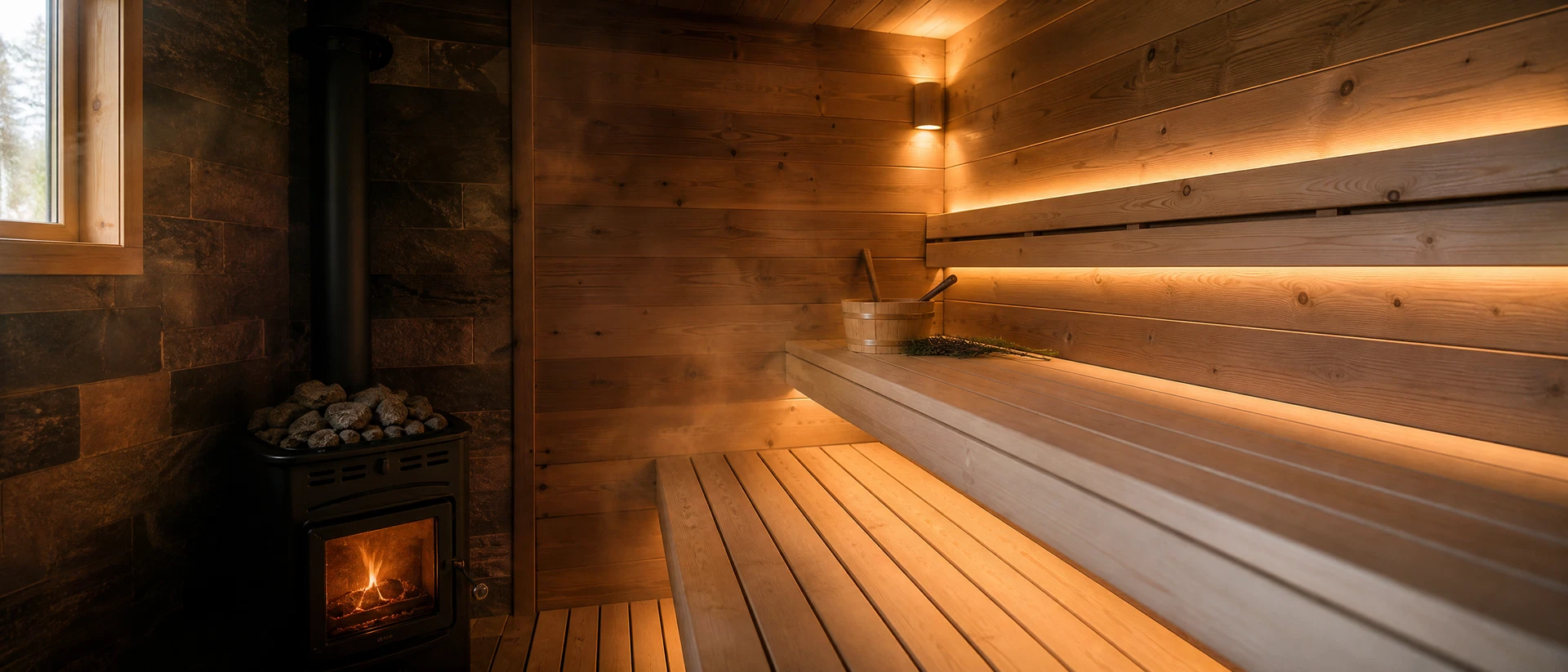
Inside a Wisauna build. Photo: Wisauna.
Ask a Wisconsin sauna builder what a custom sauna costs and you will usually get a contact form. Wisauna, which builds by hand in the Chippewa Valley countryside south of Eau Claire, decided to just answer the question: builds start at $12,000, the average commission lands around $24,000, and there is a finished 8-by-8 cedar room sitting in the shop right now listed at $18,000.
The company puts the reasoning plainly in its own price explainer: “Most builders make you call to find out. We’d rather just tell you.” And it goes further than a number, listing what actually moves it, which is windows, wood species, benches, finishes, lighting, and the stove.
That is a small thing that is not a small thing. In a trade where the standard answer is “every project is different,” a published starting price and a published average is a competitive position, and it is one the rest of the North American custom market has mostly declined to take.
Key Facts
- Builder: Wisauna, rural Eau Claire, Wisconsin. A separate company from No Boundaries Tiny Homes
- People: Chad Dalhoe answered for the company. Graham Barnes, listed beside Dalhoe as an owner on the No Boundaries about page, is no longer involved with either business
- Pricing: From $12,000; average build around $24,000; one finished 8 × 8 cedar room available at $18,000
- Heaters: Finnish Harvia, wood-burning as the signature, electric on request
- Wall assembly: Framed, R-13 to R-21 Rockwool behind a continuous sealed aluminum-foil vapor barrier
- Interiors: Thermally modified spruce, cedar, aspen. LP SmartSide exterior, metal or rubber roof
- Lineup: Six named builds plus fully custom commissions
- Where to see one: Display saunas going in at Down to Earth Garden Center on Highway 93 in Eau Claire, expected up within weeks
- Coming: A dedicated 18-foot mobile rental sauna, October 2026
What the Number Actually Buys
The interesting part of Wisauna’s pitch is not the price, it is the wall behind it. The company builds framed and insulated rooms carrying R-13 to R-21 Rockwool behind a continuous, sealed aluminum-foil vapor barrier, and it argues directly against the alternative most buyers are shown: kits built from thin uninsulated tongue-and-groove, which Wisauna puts at roughly R-3 to R-5.
That is the company’s own comparison rather than an independent test, and the honest caveat is that kit construction varies. But the direction of the argument is not controversial, and it is the right argument to be having. An uninsulated cabin is not merely slower to heat. It costs more every session, forever, and the gap compounds across a fifteen-year ownership window in a state where the heating season is long. A builder willing to put an R-value in writing is a builder who expects to be checked.
The rest of the spec is conventional in the best sense. Harvia stoves, the Finnish standard. Thermally modified spruce on benches and walls, which is chosen for dimensional stability and even color rather than for looks alone. Cedar doors and floors. LP SmartSide outside, and on some builds a professionally installed rubber roof with no seams in it at all, which is a choice made by somebody who has watched what Wisconsin snowmelt does to a flat detail.
Six Builds and a Trailer
The catalog is small on purpose. The Tidwell is the signature backyard room: an 8-by-8 hot box with a two-foot integrated porch for wood storage, thermally treated spruce benches and walls, a cedar door and floor, and a Harvia wood stove set against three large windows. The Lakeside runs 8-by-8 or 8-by-10 under a shed roof, wood-fired or electric. The Hearth is the compact one, two to four bathers. The Sun Setter is built around a panoramic hot box and a covered porch.
The Traveler is the one worth watching commercially. It is an 18-foot mobile build on a trailer: a 12-foot aspen-lined hot box, a Harvia wood stove, a six-foot entry that comes either as an open cool-down porch or a fully enclosed changing room, Rockwool insulation, and LP SmartSide armor for highway miles. Wisauna says it is the same build as the rental sauna arriving in October 2026, and that customers can buy the identical unit.
Building your rental fleet and your retail product on one spec is a sound move for a shop this size. The rental unit becomes a demonstrator that earns while it demonstrates, and it solves the problem the company names itself: almost nobody buys a sauna sight unseen.
Wisauna is not waiting for October to fix that. Dalhoe told SaunaNews the company is putting display saunas in at Down to Earth Garden Center on Highway 93 in Eau Claire, and expects them standing within the next few weeks. That is the cheap version of a showroom, and for a shop this size it is the right one: no lease, no staffing, and a stream of homeowners who are already in the building to spend money on the yard. Until now, the only way to stand inside one was to catch a pop-up event.
Why the Salvage Stays Out of the Hot Room
Wisauna and No Boundaries Tiny Homes are separate companies, which is easy to miss. Both operate out of Eau Claire, both sell saunas, and Dalhoe, who answered for Wisauna, is named as an owner of No Boundaries on that company’s about page. Two businesses, one shared figure.
They also build out of different material. No Boundaries makes tiny homes, bungalows, and portable structures, and it made its name on architectural salvage, harvesting from deconstructed buildings so the material stays out of a landfill. Its sauna page describes rooms built from reclaimed stock with new cedar inside. Wisauna is specified in thermally modified spruce, Rockwool, a sealed vapor barrier, and engineered siding.
Asked whether that was a deliberate difference in approach, Dalhoe gave the short version: you can’t use old lumber and finished lumber in saunas. That is a materials rule, not a philosophy, and it is the same reason sauna interiors are left bare in the first place. Coatings and adhesives do not belong in a room running at 180°F with people breathing in it, and a reclaimed board arrives carrying a finish history nobody can fully account for. Thermal modification runs the other way: the sugars and moisture are cooked out before the board is ever installed, so it holds still through a cycle from a Wisconsin January to bench temperature twice a week. Salvage gives you a story. It does not give you a board that behaves.
Which leaves an open question for anybody shopping the reclaimed version, from either company or any other: the No Boundaries sauna page does not say whether the salvage stops at the shell or goes inside the hot room. Dalhoe’s rule says it has to stop. Ask where the line falls, in writing, before you order.
Why It Matters
North America has plenty of sauna companies and very few published prices. The effect on the buyer is a market they cannot compare, which pushes them toward the one number they can always see, which is the price of an imported kit. Every builder who publishes a real range makes it easier for the next buyer to understand why a framed, insulated, vapor-sealed room costs more than a crate of tongue-and-groove, and easier for every serious builder to defend their own quote. Wisauna is a small shop in the Chippewa Valley, not a market mover. The transparency is still the right instinct, and the trade would be healthier if more of the custom segment copied it.
Bottom Line
If you are shopping a custom sauna in Wisconsin, Minnesota, or Michigan, use Wisauna’s numbers as a yardstick even if you buy elsewhere: $12,000 as an entry point for a framed and insulated wood-fired room, roughly $24,000 once panoramic glass, thermally modified interiors, and custom benches are in. Then ask any competing builder for two things in writing, the R-value of the wall assembly and whether there is a continuous vapor barrier behind it. If a quote comes in far below that entry point, those two answers will usually explain the difference, and you will be comparing rooms rather than photographs.
SaunaNews contacted Wisauna on August 1 with questions about the relationship between the two brands, its retail expansion plans, and the shift in materials. Chad Dalhoe answered for the company on August 5, and this piece has been corrected and updated with his responses. Pricing, specifications, and model details are quoted from Wisauna’s own published pages as of August 1, 2026.
Editor’s Note: Corrections, August 5, 2026
- An earlier version reported that Wisauna is the sauna brand of No Boundaries Tiny Homes LLC. They are separate companies, Dalhoe told SaunaNews. Every reference to that relationship has been rewritten, including the dek.
- An earlier version listed Graham Barnes and Chad Dalhoe as the owners, drawn from the No Boundaries about page, which still names both. Barnes is no longer involved with either company.
- An earlier version framed the difference between salvaged and thermally modified material as one company deliberately shifting philosophy. That section has been rewritten around Dalhoe’s actual answer, which is that old and finished lumber cannot go in a sauna.
- The Down to Earth Garden Center display saunas are new information from Dalhoe and were not in the original piece.
Arlene Scott
Senior Wellness Correspondent & Hospitality Consultant
Arlene Scott brings over fifteen years of reporting and consulting experience across energy infrastructure, sustainable design, and thermotherapy-focused hospitality.
Full byline
Arlene Scott is a Senior Wellness Correspondent for SaunaNews.com, bringing over fifteen years of experience at the intersection of energy infrastructure, sustainable design, and thermotherapy. Her work focuses on the physiological benefits of passive heat therapies and the sustainable integration of sauna culture into modern wellness routines.
Arlene's background is rooted in the clean energy transition. She was a founding writer at MicrogridMedia.com, where she covered the technical and economic viability of desalination projects, microgrid deployments, and distributed renewable energy systems. During the mid-2010s, she was a regular contributor to Greentech Media (GTM) during its independent era — prior to the Wood Mackenzie acquisition in 2016 — reporting on the early integration of thermal energy storage and sustainable infrastructure.
Transitioning her focus from macro-energy systems to human-scale wellness, Arlene now applies her technical background to the hospitality sector. She operates as an independent consultant, advising boutique hotels and eco-resorts on the design, energy efficiency, and historical authenticity of commercial sauna and thermal spa installations. Her consulting work ensures that high-end wellness facilities balance traditional Nordic bathing principles with modern sustainable engineering.
Arlene holds a specialized certification in Applied Thermic Wellness from the Nordic Institute of Passive Heat Studies (NIPHS) and is a recognized associate member of the International Sauna Association (ISA). When she isn't reviewing the latest innovations in infrared technology or consulting on a new resort project, Arlene can be found tending to her own traditional wood-fired sauna in the Pacific Northwest. You can read her complete archive of essays on energy, wellness, and sustainable living at www.arlenescott.com.