
Can Americans Get Past the Costco Sauna Phase?

By Arlene Scott
Senior Wellness Correspondent & Hospitality Consultant
- Published
- Reading time
- 8 min
SaunaNews is published by SaunaShare, Inc., which also runs SaunaShare.com and SaunaMarketplace.com, where we sell many of the products we write about. Assume that experience shapes what we cover and what we don't. Who owns SaunaNews · The ownership announcement
The entry-level sauna market is booming. Whether first-time buyers stay with sauna depends on what their first sauna teaches them.
In this story6 sections
Something interesting is happening in the American backyard. Saunas are showing up everywhere, tucked behind garages in the Midwest, decking out Airbnbs in the Rockies, anchoring “wellness spaces” in suburban renovations from Phoenix to Portland. The US sauna market generated roughly $250 million in revenue in 2024 and is forecast to grow at a 6.4% compound annual rate through 2029, according to market research cited by Sauna from Finland. After decades of being a niche pursuit for Scandinavian-Americans and cold-plunge devotees, the sauna is finally going mainstream.
And yet. Talk to any serious retailer, installer, or sauna educator in this country and a version of the same story comes up: a customer calls, frustrated, saying their sauna does not really work. They are cold. Their feet are freezing. The steam goes nowhere. The wood is warping. Or, more often than you would expect, they never experienced real steam to begin with, because they bought an infrared cabinet and did not know it was not a sauna.
What Costco actually sells
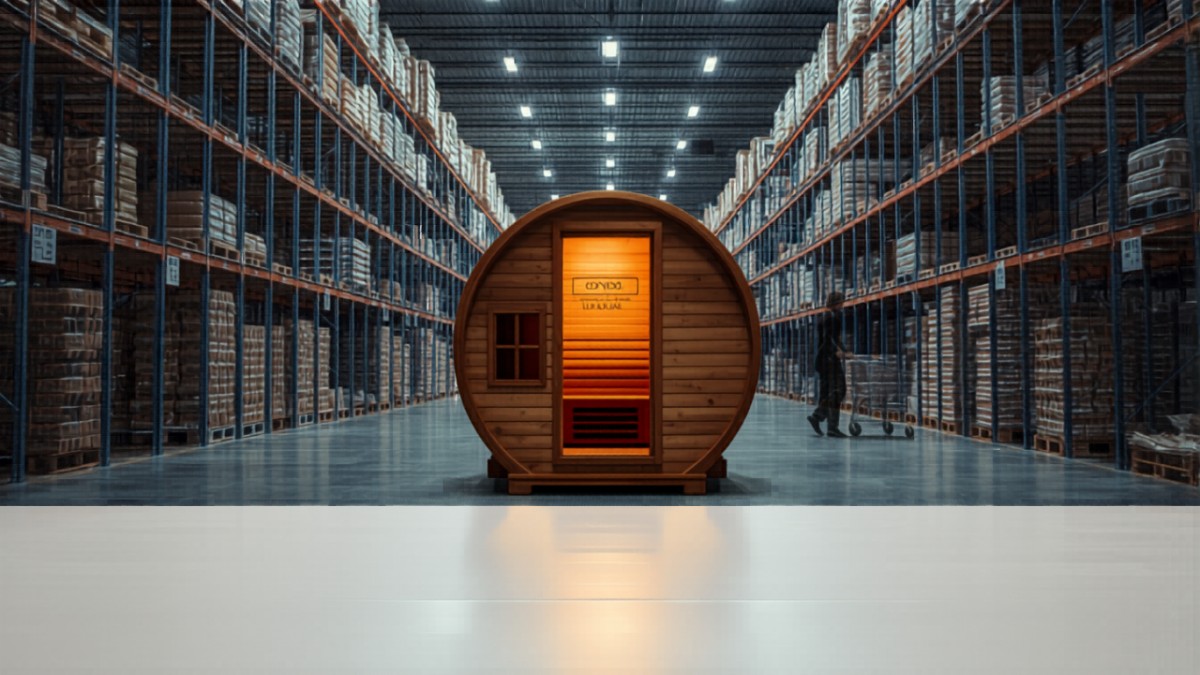
To be precise about what Costco carries: two product categories dominate their sauna floor space, both physical and digital. The first is the Dynamic or Golden Designs infrared cabin, a plug-in wood box with carbon or ceramic radiant panels, no heater, no stones, no capacity for steam. The second is the Almost Heaven barrel sauna, a cedar cylinder that arrives on a pallet and promises an outdoor Finnish experience for somewhere between $3,000 and $7,500.
These are not fringe products. Almost Heaven, owned by Finland’s Harvia since the end of 2018 (acquired for approximately EUR 4 million), has become one of the best-known barrel sauna brands in North America. Dynamic infrared saunas appear regularly in Costco’s sauna assortment.
The issue is not that Costco sells saunas. It is that Costco is one of the main places where Americans form their first opinion about what sauna is. In our view, both categories can give a first-time buyer an incomplete picture of it.
The infrared problem: a warm box is not a sauna
Start with infrared. The category has a genuine audience. People who want lower-temperature heat therapy, easy installation, and a plug-and-play setup have real reasons to consider it. Infrared cabins and traditional saunas are often sold under the same word, and buyers may not know how different the two experiences are. We broke the physiology, user experience differences, and evidence quality out in detail in our infrared vs traditional sauna data analysis.
Finnish saunas operate between 160°F and 195°F. The heat comes from the air itself, surrounding the body in convective warmth that works from the outside in. The cardiovascular research linking sauna use to reduced risk of cardiac death, dementia, and all-cause mortality, including the landmark Kuopio Ischemic Heart Disease study, was conducted in traditional high-heat environments, not infrared cabinets.
Infrared cabins typically operate between about 120°F and 140°F, well below a Finnish sauna. They heat the body through radiant panels rather than through hot air, which produces a fundamentally different physiological experience and a categorically different environment. And critically: you cannot throw water. There are no stones. There is no löyly, that burst of steam that is, in Finnish tradition and by definition, the entire point of the thing.
This is not a minor distinction. Löyly is how a sauna becomes a sauna. It is how you control the experience, open the pores, and get the full-body heat envelope that the Finnish population studies were actually measuring. Remove it and what remains is a box that gets warm, a wellness appliance, not a sauna.
The cardiovascular research on sauna was done in traditional high-heat saunas, not infrared cabins.
Barrel saunas: what to know about wood and roofs
Now for the barrel. The Almost Heaven models Costco carries, including the Morgan (4-person) and Vista and Emerson (6-person variants), are Western Red Cedar barrel saunas sold at prices that feel like a deal compared to specialty dealer options. At first glance, they have the right shape. Round. Wooden. They look like the real thing.
Start with the wood. Cedar expands and contracts significantly with moisture and temperature cycling. Outdoor cedar barrels generally last longer under a roof or cover; buyers should check whether one is included.
What happens to a cedar barrel without a roof is not pretty. Operators in the rental and hospitality space, where the consequences of product failure are immediate and public, have learned this the hard way. The wood loosens and warps. Hardware corrodes. Mold finds the damp spots that a roof would have shed.
The bench problem: cold feet by design
The structural issue that most buyers never think to ask about before purchase, but encounter immediately once inside, is the bench geometry. It does not matter how well the heater performs if the physics of the room are working against you from the moment you sit down.
Heat stratification is fundamental: hot air rises. In a sauna, this creates distinct temperature bands from floor to ceiling that can vary significantly. Finnish sauna design principles account for this by setting the top bench high, with 40 to 48 inches between the top bench and the ceiling in Lassi Liikkanen’s guideline, so bathers sit in the upper heat zone, not the cool air below the level of the stones. In a properly designed Finnish sauna, your feet should be at or above the level of the heater stones. Sitting in the lower third of the room is the cold zone. The good heat does not live there.
Barrel saunas cannot solve this problem. The barrel’s circular cross-section determines bench height. In a standard 6-foot-diameter barrel, you get one bench level, positioned by the curve of the walls at roughly mid-height in the barrel’s arc.
Bathers sit in the cool zone with hot heads and cold feet, wondering why the experience feels wrong. The steam stratification is worse. Löyly, when it is possible at all, rises from the stones and stays near the ceiling. In a properly designed cabin sauna with benches positioned correctly, bathers are enveloped by it. In a small barrel with a single low bench, the steam stays above you. Your body never receives it evenly. The ritual that defines the experience is happening over your head.
You can have a perfectly good heater, quality cedar, and a clean build, and the sauna still disappoints, because the geometry is fighting the physics from day one.
The “phase” framing: America is still setting its baseline
The temptation in this industry is to shrug. The Costco buyer is a different customer, the thinking goes. They are not really our market. Let them have their cedar barrel. When they are ready for the real thing, they will find us.
This misunderstands how consumer education actually works. The American sauna market is not mature. Unlike Finland, where cultural literacy about what good sauna feels like is essentially universal, the US is still building its baseline expectation for the product. Consumers who have never experienced a properly built sauna have no reference point for what they are missing. They do not know their feet should be warm. They do not know the steam should envelop them. They do not know the wood should not be warping after eighteen months.
What they know is: I bought a sauna. It was fine at first. Now it is not. Or: I tried sauna. I did not get it. Not for me.
Those consumers leave the market. They become ex-sauna buyers, the most expensive category in any product market, because they have already decided. Meanwhile the next consumer looks at the category and wonders why the reviews are split, why some people love it and others call it overrated, why prices seem to range wildly for products that look roughly the same from the outside.
The industry cannot outsource its credibility to a Costco product rotation and expect the category to grow into something healthy. When the dominant gateway product does not deliver the experience that creates lifetime sauna users, the industry is spending its future.
Harvia itself, the company that owns Almost Heaven, has been explicit on earnings calls about where it sees the US market going. CEO Matias Järnefelt said on the Q4 2025 earnings webcast that “sauna is becoming much more of a volume category” and that Almost Heaven is “the brand which you could consider as kind of like the IKEA of saunas.” That is an honest framing. Harvia’s CEO frames Almost Heaven as the volume, accessible-price brand in its portfolio. The question is whether the industry treats it as the entry point to a deeper category, or as the whole category.
What getting past the phase looks like
None of this is an argument for spending $20,000 or hiring a Finnish architect. The path forward is about education and construction fundamentals, not luxury.
For barrel sauna buyers: seek out thermally modified wood rather than untreated cedar. Species like thermo-spruce or thermo-ash have been heat-processed to dramatically reduce moisture absorption and dimensional movement. They do not warp the way cedar does. Require a roof. Find a model with dual-bench configuration that gives you some choice about where to sit, and look at interior diameter rather than person-count marketing claims. A 7-foot or larger barrel is a meaningfully different environment from a 6-foot barrel. Buy from a dealer who can talk about the physics of what you are buying, not a warehouse checkout lane. Several specialty sauna dealers offer selected options with support and spec transparency, including guidance on heater sizing for your climate.
For buyers who thought they wanted sauna and ended up with an infrared cabinet: go try a real one before you write the category off. Find a Nordic spa, a sauna club, or a quality showroom. Heat up to 175°F. Throw water. Sit for ten minutes, go outside, come back. It is a different product. Whether it is for you is a legitimate question. But you have not answered it yet.
For the industry: the Costco Sauna Phase is not a permanent feature of the American market. It is a moment, early adoption, dominated by price and availability, before consumer literacy catches up with consumer enthusiasm. The question is whether this industry will help accelerate that literacy, or cede the education entirely to warehouse retail and TikTok testimonials and whatever AI-generated listicle shows up on page one of Google.
America is trying to fall in love with sauna. The industry should be trying to make sure that romance does not die in a warped cedar barrel with cold feet and no steam.
The US sauna market is growing fast and the entry-level buyer is the largest segment. Every frustrated Costco customer who gives up on sauna is a lost lifetime customer. Brands and retailers who invest in consumer education now, explaining what a real sauna experience should feel like and why construction matters, are building the market that will sustain premium sales for the next decade. Ceding the education to warehouse retail is not a neutral choice. It is a slow, quiet bet against the category.
The Costco Sauna Phase is real, measurable, and fixable. But fixing it requires the industry to take some responsibility for the baseline consumer experience in this country. Cedar moves with moisture, bench height changes how hot a bather feels, and infrared cabins work differently from Finnish saunas. None of that will stop being true because nobody wants to say it out loud at a trade show.