A Spa Visit Runs About 11 Pounds of CO2. Therme and Surrey Published the Math.
A peer-reviewed method now puts a hard number on a single spa visit, and the operators who get caught out will be the ones still treating the utility bill as fixed overhead. What is metered, what is not, and why scale is turning into a decarbonization advantage.


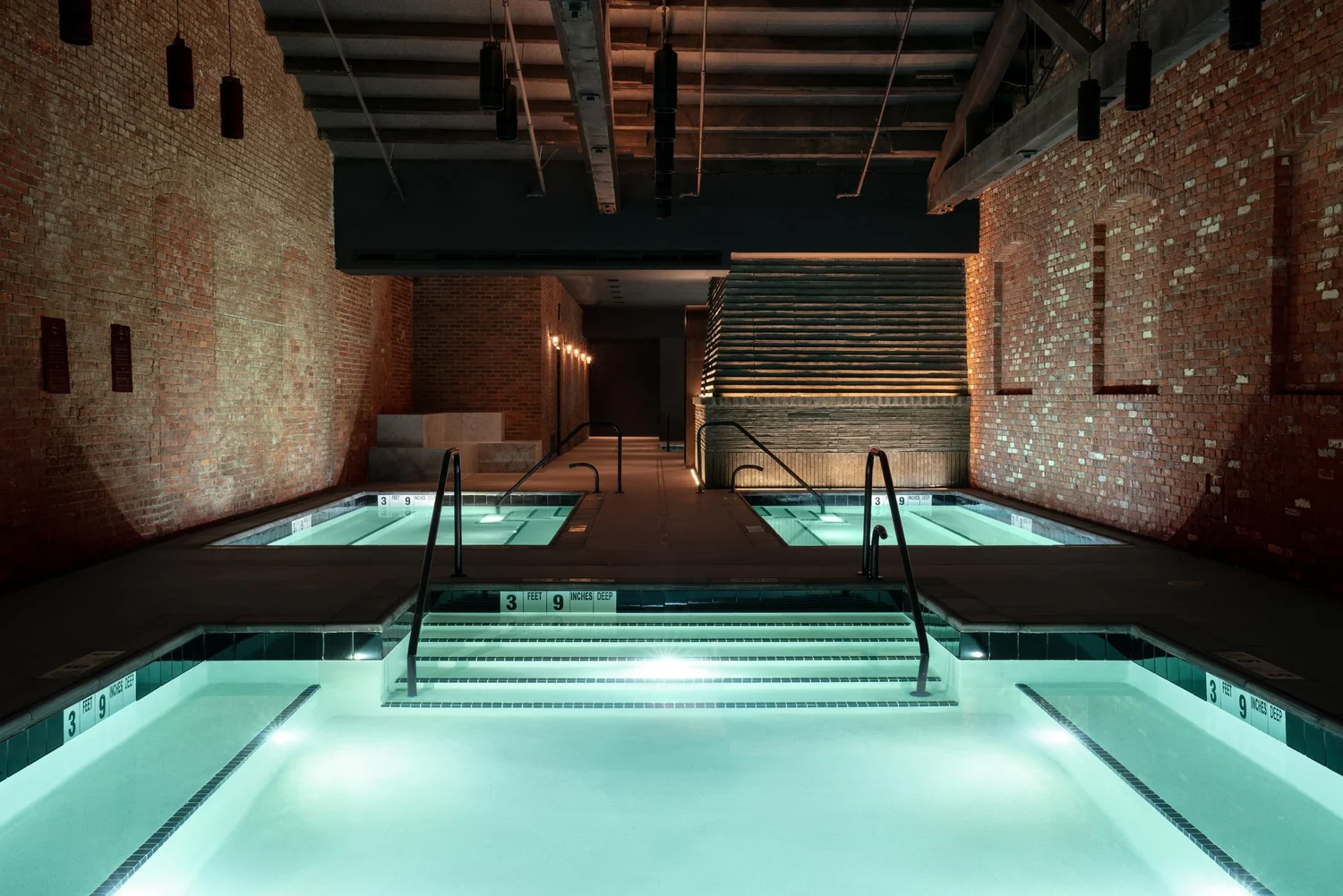
Therme Group published this image alongside its SPA-DEC announcement. The calculator's methodology was developed with the University of Surrey's Centre for Environment and Sustainability. Photo: Therme Group.
For years a bathhouse could bury its footprint inside an annual, facility-wide sustainability report, if it reported at all. That cover just got thinner. Therme Group and the University of Surrey have published a peer-reviewed method that puts a hard number on a single visit: roughly 11 pounds of CO2 equivalent at a large destination resort, roughly 7.7 at a small sports facility. It is a benchmark no operator asked for, and one they will be asked to answer to.
The tool is SPA-DEC, the Spa and Wellness Dynamic Emissions Calculator. It reads a building’s metered energy and water, adds normalized figures for waste and staff travel, covers all three scopes of the Greenhouse Gas Protocol, and divides the total across the people who came through the door. The number updates as the building runs.
Key Facts
- What: SPA-DEC, the Spa and Wellness Dynamic Emissions Calculator, a per-visit carbon footprint method for spa and wellness facilities
- Who: Therme Group and the University of Surrey’s Centre for Environment and Sustainability, through a Knowledge Transfer Partnership co-funded by Innovate UK
- Published in: Nature Communications Sustainability
- Announced: Therme Group on July 24, 2026; the University of Surrey on July 28, 2026
- Validated at: Therme Bucharest, a large facility, and the University of Surrey Sports Park, a small one
- The numbers: roughly 11 pounds of CO2 equivalent per visit at the large site, roughly 7.7 pounds at the small one (about 5 and 3.5 kilograms)
- Renewables effect: on-site generation cut emissions 33 percent at the large facility and 14 percent at the small one during 2024
What Is Actually Metered, and What Is Not
The mechanics matter more than the announcement, because they decide whether an operator can do anything with the output. Energy and water come off live meters. Waste and staff travel are normalized rather than measured, which is the usual compromise and the usual soft spot. Everything is then allocated per visit, which makes throughput part of the denominator: fill the building and the per-visit figure drops even if the plant burns exactly the same fuel. That is how energy intensity works in every hospitality metric. Expect a busy Saturday to get sold as an environmental win. It is not one.
What neither announcement states is the resolution of the metering, and that is the difference between a number for a report and a number you can run a building with. Read at the main incomer, you learn the site total moved. Sub-metered by zone, you learn the pool hall is carrying the sauna suite. The paper sits behind an access wall we have not cleared, so the per-visit and renewables figures here come from the Therme and Surrey releases, and we have not reviewed the boundary choices or the uncertainty ranges ourselves. Anyone citing these numbers in a board deck should read the paper first.
The Renewables Split Is the Operator’s Lesson
The per-visit headline will travel. The number to sit with is the other one: on-site generation cut the footprint 33 percent at the large Bucharest site and 14 percent at the small Surrey one, across 2024.
That delta undercuts the assumption that a small urban bathhouse is inherently the greener operation. A destination resort has roof and ground area for generation, a capital budget that can carry a payback period, and a flat round-the-clock base load that makes on-site supply and heat recovery pencil out. An independent social sauna club retrofitted into a leased city-center shell usually has none of those: no roof rights, no capital line for an array it cannot take with it at the end of a ten-year lease, and continuous-duty electric heaters pulling grid power at commercial rates it has no way to offset.
So scale is turning into a decarbonization advantage in this category, and the small operator’s lever is not generation. It is recovery and control: heat-recovery ventilation on the exhaust, demand management on heater duty cycles, and scheduling that stops empty rooms running hot. Those are equipment and commissioning decisions, made at buildout or not at all.
What This Means for a US Operator
We can find no North American bathhouse publishing a per-visit carbon figure. That silence has a shelf life. A peer-reviewed method in a Nature journal is what moves a metric out of marketing and into procurement, and the people who ask for it first will not be regulators. They will be the hotel group reporting under its own disclosure regime for the spa it leases space to, the insurer pricing a wellness asset on energy intensity, and the city attaching a baseline to an incentive.
Run the arithmetic on a US social sauna club cycling 250 visits a day, six days a week. That is about 78,000 visits a year, and at the large-facility figure it puts roughly 430 short tons of CO2 equivalent through the building annually. Those are our assumptions, not Therme’s or Surrey’s, and a club with a different fuel mix and hot-water load will land somewhere else. The point is the order of magnitude, and that a facility running un-recovered exhaust on peak-rate grid power will look heavy on paper the first time somebody asks.
The practical move this quarter is not to adopt SPA-DEC. It is to find out whether you could produce a comparable figure at all. Is your energy and water metered separately from your landlord’s, or are you on a shared bill? Do you count visits reliably enough to be a denominator? Could you answer a hotel group that asked for your footprint per guest? Anyone building or refitting right now should be pricing heat-recovery ventilation and zone-level sub-metering as line items rather than upgrades, because retrofitting either into a finished room costs several times what it costs on the drawing.
Who Gets to Set the Benchmark
One more thing, because nobody else in this trade is going to say it. Therme calls SPA-DEC a world-first, and we have not independently checked that against every prior attempt. What is not in dispute is the shape of it: a standardized carbon metric for the category, authored by an operator, validated substantially on that operator’s own flagship, and published under that operator’s name.
That is not a scandal. Peer review in a Nature journal is a real bar, the academic partner is credible, and the Innovate UK funding is public. Industry-authored standards are normal, and most of the codes governing sauna heaters were written with heavy manufacturer input. But the reference case for the category now runs through Therme Bucharest, a building almost nobody else operates, and first movers set defaults. Whoever publishes the method decides what sits inside the boundary, what gets normalized, and what a good number looks like.
The questions to ask before adopting it: does the allocation hold for a dry Finnish sauna club with no pools and a completely different heat-to-water ratio? Against whose baseline are staff travel and waste normalized? Is SPA-DEC available to operators outside Therme, on what terms, and who audits an operator’s inputs? Neither announcement answers those.
Why It Matters
Energy is the largest operating input in a bathhouse and its most exposed regulatory flank, and this trade has spent a decade arguing about wood and design instead. A peer-reviewed per-visit metric turns that from a vibe into a number, and numbers are what procurement, insurance and municipal incentives run on. The operators who get caught out will be the ones still treating the utility bill as fixed overhead rather than as the thing about to be published about them. The urban bathhouse buildouts and multi-metro chains signing leases this year are making these decisions right now, mostly without knowing it.
The Bottom Line
Treat 11 pounds a visit as the opening reference point, not gospel. It comes from one large European resort and one small British sports facility, and your building is neither. The cheap work is available now: separate your meters, count your visits, and price heat recovery and sub-metering into the next fit-out. The expensive version is doing all of it in the middle of a procurement conversation you did not start.
Arlene Scott
Senior Wellness Correspondent & Hospitality Consultant
Arlene Scott brings over fifteen years of reporting and consulting experience across energy infrastructure, sustainable design, and thermotherapy-focused hospitality.
Full byline
Arlene Scott is a Senior Wellness Correspondent for SaunaNews.com, bringing over fifteen years of experience at the intersection of energy infrastructure, sustainable design, and thermotherapy. Her work focuses on the physiological benefits of passive heat therapies and the sustainable integration of sauna culture into modern wellness routines.
Arlene's background is rooted in the clean energy transition. She was a founding writer at MicrogridMedia.com, where she covered the technical and economic viability of desalination projects, microgrid deployments, and distributed renewable energy systems. During the mid-2010s, she was a regular contributor to Greentech Media (GTM) during its independent era — prior to the Wood Mackenzie acquisition in 2016 — reporting on the early integration of thermal energy storage and sustainable infrastructure.
Transitioning her focus from macro-energy systems to human-scale wellness, Arlene now applies her technical background to the hospitality sector. She operates as an independent consultant, advising boutique hotels and eco-resorts on the design, energy efficiency, and historical authenticity of commercial sauna and thermal spa installations. Her consulting work ensures that high-end wellness facilities balance traditional Nordic bathing principles with modern sustainable engineering.
Arlene holds a specialized certification in Applied Thermic Wellness from the Nordic Institute of Passive Heat Studies (NIPHS) and is a recognized associate member of the International Sauna Association (ISA). When she isn't reviewing the latest innovations in infrared technology or consulting on a new resort project, Arlene can be found tending to her own traditional wood-fired sauna in the Pacific Northwest. You can read her complete archive of essays on energy, wellness, and sustainable living at www.arlenescott.com.