The Lithuanian Bath Academy Is Teaching Sauna as a Survival Skill

By Arlene Scott
Correspondent, Research and Industry
- Published
- Reading time
- 4 min
SaunaNews is published by SaunaShare, Inc., which also runs SaunaShare.com and SaunaMarketplace.com, where we sell many of the products we write about. That experience may change what we write about and what we don't. Who owns SaunaNews · The ownership announcement
A four-day off-grid pirtis camp near Vilnius teaches stone heating, whisk binding, and plant-based bathing care from scratch. Seven of eight spots remain. Early registration closes June 15.

In this story4 sections
The Lithuanian Bath Academy, the nonprofit institution that has spent two decades training professional bath masters in the Baltic pirtis tradition, is running a four-day off-grid sauna camp near Vilnius this August. The Off-Grid Sauna and Plants Camp starts August 10 at Pirčių sodas in Melkys village, Pikeliškių county, with seven of eight spots still open as of early June. Early registration runs until June 15 at €360; regular price is €460.
The camp is a field course in survival bathing: how to build a temporary steam room from stones, wood, rope, and canvas when no permanent structure exists.
What the camp covers
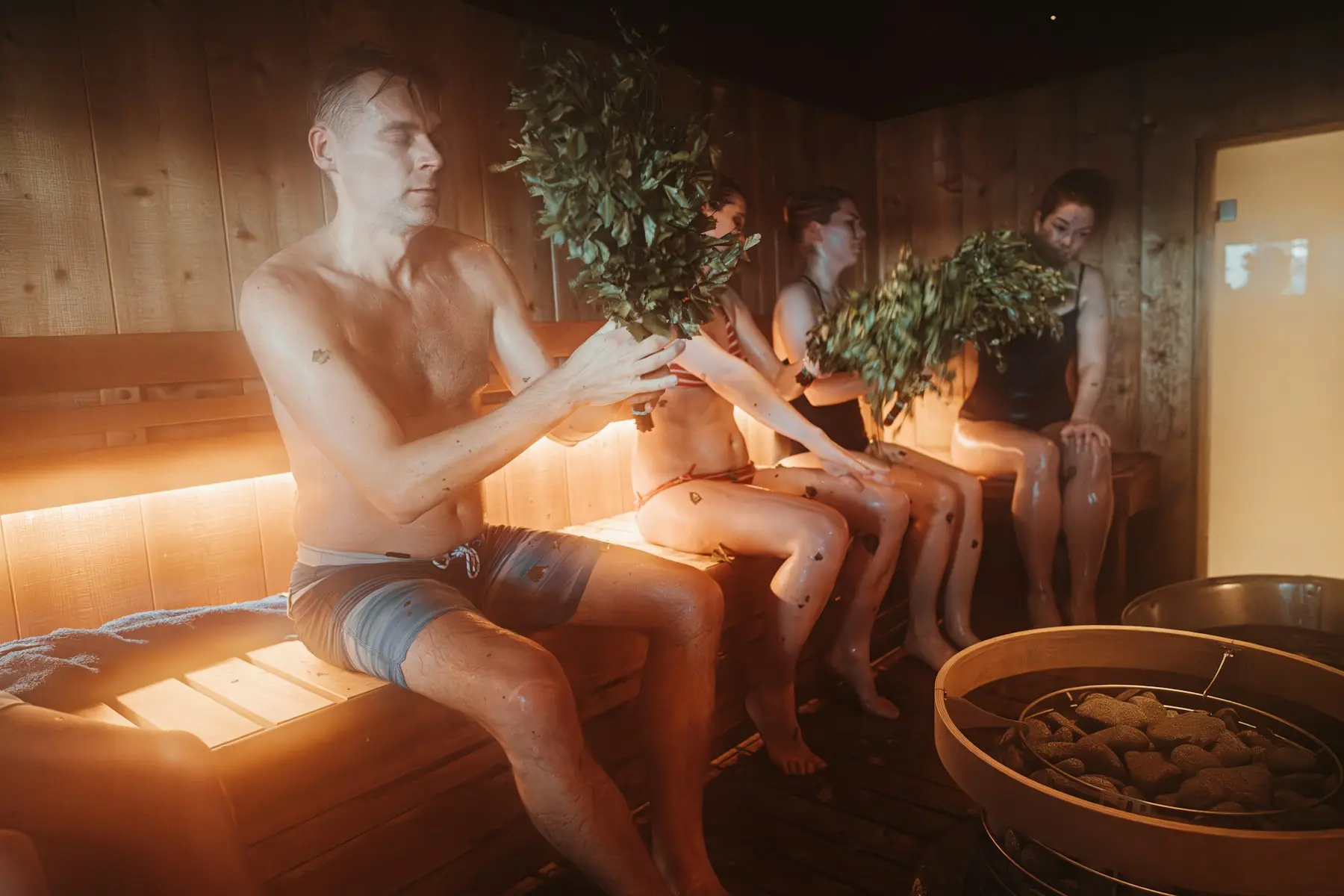
The curriculum runs across four days, each with a distinct focus. Day one is an arrival and introduction to prepared plant materials (herbal teas, aromatic waters, cooling infusions, natural body-care preparations) followed by a light evening pirtis session. Day two moves outdoors for plant recognition, ethical gathering, and whisk binding from birch, oak, maple, willow, hazel, juniper, and whatever else the Lithuanian August forest provides. The afternoon shifts to preparing the off-grid bathing area: sorting stones, stacking firewood, planning the temporary space.
Day three is the centerpiece. Participants build a temporary stone krūsnis (the traditional Lithuanian stone heater) and learn the basic physics of field bathing: how stones are selected and stacked, how fire is managed, how heat is stored, and how the hot stone core becomes the source of steam. The group also builds a wild shower and organizes the cooling area. In the evening, the group bathes in what it built.
Day four is dedicated to care and restoration: dismantling temporary structures, cleaning the site, and learning basic pirtis maintenance (drying, ventilation, wood and stone care). The Academy describes this as part of the practice, not afterthought.
Key Facts
- Event The Off-Grid Sauna and Plants Camp
- Organizer Lithuanian Bath Academy (International Bath Academy)
- Dates August 10–13, 2026 (4 days)
- Location Pirčių sodas, Melkys village, near Vilnius, Lithuania
- Price €360 early (until June 15), €460 regular; €160 deposit required
- Accommodation Shared house about half a mile from venue, €20–30/night (not included)
- Capacity ~8 participants (7 spots open as of June 2026)
- Prerequisites None; open to all skill levels
- Academy track record ~5,000 students trained, Lithuanian intangible heritage registry
Who runs this
The Lithuanian Bath Academy (formally the International Bath Academy, registration code 302636594) was founded by Rimas Kavaliauskas and Birutė Masiliauskienė in Vilnius. Kavaliauskas is a whisking master with over 22 years in the field, a sauna stove designer, and the pioneer behind Lithuania’s whisking championships. Masiliauskienė directs the Academy’s educational programs as a certified professional bath attendant and instructor.
The Academy operates a two-level certification system: Level I (Family Bath Master) and Level II (Professional Bath Master), plus specialized tracks in bath phytotherapy, sauna aromatherapy, and microclimate construction. Courses run in Lithuania, Norway, Ireland, and other European countries. Its work appears on Lithuania’s national intangible cultural heritage registry.
Roughly 5,000 students have passed through the Academy’s programs to date, producing several dozen certified professional bath masters. Students come from across Europe, Japan, and the United States.
Why off-grid matters
Most sauna education, even the good kind, happens inside permanent facilities with commercial heaters, municipal water, and controlled ventilation. The Bath Academy’s off-grid curriculum strips that infrastructure away and asks a different question: can you build a real bathing experience from what the forest gives you?
That question matters for two reasons. First, it is how pirtis was practiced for centuries before it became an amenity. Lithuania’s bathing tradition nearly vanished after independence in 1990, a pattern echoed by sento operators in Japan, when Soviet-era public baths closed and the cultural transmission chain broke. The Academy was founded specifically to restore that chain. Second, the skills taught here (stone selection, fire management, temporary shelter construction, plant identification, water sourcing) are the foundation that every permanent installation simplifies and automates. Understanding the physics of a stone krūsnis heated by open fire makes a bath master better at operating a commercial electric heater.
For operators and bath masters watching the Aufguss circuit professionalize and the commercial bathhouse market scale, the techniques taught in a Lithuanian forest in August are the same ones that inform a top-tier Aufgussmeister’s understanding of steam, plant aromatics, and guest care.
Accommodation is extra and dormitory-style
Accommodation is in a shared house about half a mile from the course site, set in a quiet forested area. The Academy describes it plainly: dormitory-style, shared facilities, communal kitchen, not hotel-standard. The house has its own small pirtis available for evening use outside the main program. The accommodation cost (€20–30/night depending on group size) is separate from the course fee.
Registration requires a €160 deposit, with the balance due on arrival. The early-bird rate of €360 runs until June 15; after that, the price rises to €460. No special skills or prior sauna experience are required.