Sun Home Adds Traditional Nova Saunas as Plunge Launches Infrared Line
Sun Home's first indoor traditional models pair HUUM heaters with two-level cedar benches, while Plunge's new indoor infrared cabins come in 120V and 240V configurations.

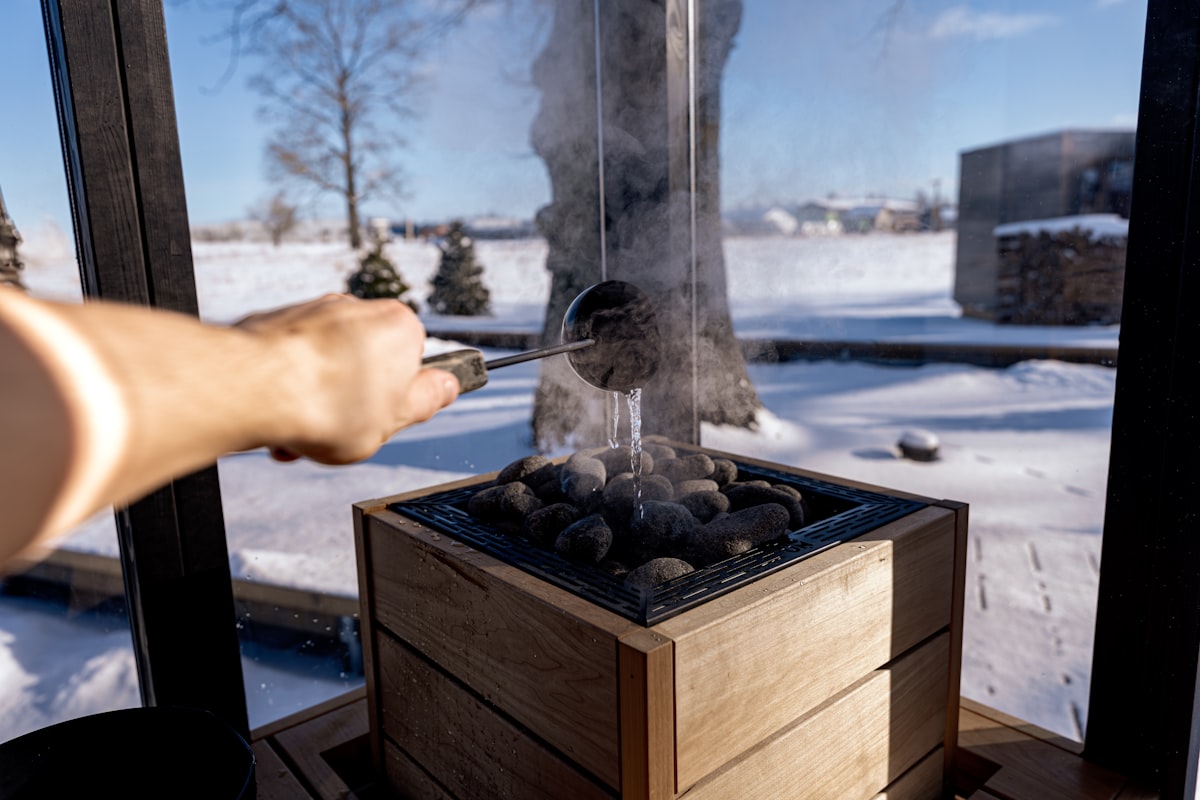
Water on the stones of a traditional sauna heater, used here as illustrative art. Photo: Unsplash.
Sun Home and Plunge have expanded their sauna ranges in opposite directions this summer. Sun Home, best known for infrared cabins, has introduced its first indoor traditional sauna line. Plunge, which entered the sauna category with traditional electric models, now sells two indoor infrared versions.
The additions broaden both companies' catalogs rather than replace existing products. Sun Home continues to sell infrared saunas and its outdoor traditional Solaris line. Plunge continues to offer the traditional Sauna and Sauna Mini alongside its new Infrared Standard and Infrared Pro.
Sun Home brings traditional heat indoors
The Nova 3 is a three-person Canadian cedar cabin built around a 6 kW HUUM DROP electric heater. It is designed for water on the stones and includes two bench levels, a built-in ventilation fan and Wi-Fi control through HUUM's UKU system. Sun Home lists the lower bench at 17 inches and the upper bench at 34 inches, with approximately 43 inches between the upper bench and the interior ceiling.
The three-person model is priced at $11,999 and requires a dedicated 240V/30A circuit. Sun Home lists a maximum temperature of 230°F. Its exterior measures 64.9 inches wide, 57.1 inches deep and 82.7 inches high, and the cabin weighs approximately 772 pounds.
The larger Nova 6 is priced at $15,799. It uses a 7.5 kW HUUM DROP heater on a dedicated 240V/40A circuit and carries the same 230°F manufacturer-rated maximum. Both models pair the cedar interior with black privacy glass, ambient lighting and a carbonized tile feature wall.
Nova adds an indoor option to Sun Home's existing traditional range, which previously centered on the outdoor Solaris cabins. The new models sit alongside the company's Eclipse, Equinox, Luminar and other infrared lines.
Sun Home describes the Nova cabinetry warranty as limited lifetime coverage. Its warranty terms define that period as seven years. Replacement parts are covered during that period; after the first 90 days, owners are responsible for labor and freight.
Plunge adds Standard and Pro infrared models
Plunge Infrared is an indoor Canadian hemlock cabin offered in Standard and Pro configurations. Both use far-infrared panels and full-spectrum incandescent towers and include app controls, Nakamichi Bluetooth speakers, a tilted backrest and chromotherapy lighting.
The $7,690 Standard model runs on a dedicated 120V/20A NEMA 5-20 circuit and is rated by Plunge to reach 160°F. The company positions it as the simpler installation option, although the dedicated 20-amp requirement means buyers should confirm the intended room has the correct circuit.
The $8,490 Pro requires 240V power and is rated to reach 175°F. An optional red-light panel costs $1,490, bringing that configuration to $9,980. Plunge says the cabin weighs approximately 540 pounds, ships flat-packed and can be assembled by two people in about an hour. Professional assembly is also sold separately.
The included warranty covers the cabinetry and infrared heaters for five years, electronics and controls for two years, and glass and power supplies for one year. In its launch account, Plunge says it developed the product through roughly six revisions and operated prototypes for more than a year at two Reboot studios.
Plunge compares its infrared sauna with Sun Home Eclipse
On August 7, a new Plunge comparison page appeared in the company's sitemap. It places the Infrared Pro beside Sun Home's Eclipse 2 and compares price, claimed maximum temperature, electrical requirements, lighting and other features.
The page lists the Plunge Pro at $8,490 and the red-light-equipped Sun Home Eclipse 2 at $9,999. Adding Plunge's red-light option brings its total to $9,980, a difference of $19 on the prices shown. The cabins differ in heater layout, dimensions and other specifications, and the figures on the page are manufacturer comparisons rather than results from a shared independent test.
Research references on the product page
Plunge's product page also summarizes sauna research. Its 63% sudden-cardiac-death, 40% all-cause-mortality and 66% dementia figures come from two observational analyses of the same 2,315-man Finnish cohort, whose participants used traditional sauna. A third citation, a 2018 systematic review of 40 studies, included 25 studies using infrared interventions. The sources concern sauna use generally; none independently tested Plunge Infrared.
Together, the launches give both brands a wider range of heat formats. Sun Home now offers an indoor traditional cabin with a stone heater and water, while Plunge adds an indoor infrared option with a lower electrical requirement in its Standard configuration. Neither company has published independent comparative performance data for the new models.
SaunaNews has not tested either cabin and has no commercial relationship with either company. Prices and specifications were checked August 9, 2026.
Correction, August 9, 2026: An earlier version misstated one figure on Plunge's page as 50% lower cardiovascular mortality. The page reports a 63% lower risk of sudden cardiac death. It also described all of Plunge's cited evidence as traditional-sauna research; Plunge's third citation is a systematic review that included infrared studies. Both points have been corrected.
Arlene Scott
Senior Wellness Correspondent & Hospitality Consultant
Arlene Scott brings over fifteen years of reporting and consulting experience across energy infrastructure, sustainable design, and thermotherapy-focused hospitality.
Full byline
Arlene Scott is a Senior Wellness Correspondent for SaunaNews.com, bringing over fifteen years of experience at the intersection of energy infrastructure, sustainable design, and thermotherapy. Her work focuses on the physiological benefits of passive heat therapies and the sustainable integration of sauna culture into modern wellness routines.
Arlene's background is rooted in the clean energy transition. She was a founding writer at MicrogridMedia.com, where she covered the technical and economic viability of desalination projects, microgrid deployments, and distributed renewable energy systems. During the mid-2010s, she was a regular contributor to Greentech Media (GTM) during its independent era — prior to the Wood Mackenzie acquisition in 2016 — reporting on the early integration of thermal energy storage and sustainable infrastructure.
Transitioning her focus from macro-energy systems to human-scale wellness, Arlene now applies her technical background to the hospitality sector. She operates as an independent consultant, advising boutique hotels and eco-resorts on the design, energy efficiency, and historical authenticity of commercial sauna and thermal spa installations. Her consulting work ensures that high-end wellness facilities balance traditional Nordic bathing principles with modern sustainable engineering.
Arlene holds a specialized certification in Applied Thermic Wellness from the Nordic Institute of Passive Heat Studies (NIPHS) and is a recognized associate member of the International Sauna Association (ISA). When she isn't reviewing the latest innovations in infrared technology or consulting on a new resort project, Arlene can be found tending to her own traditional wood-fired sauna in the Pacific Northwest. You can read her complete archive of essays on energy, wellness, and sustainable living at www.arlenescott.com.