Fired in the Yard, Rolled Indoors: The Smoke Sauna Design That Could Travel to America
Christer Lybäck's 3,300-pound Tulikivi burns down in the open air, then rolls into a brick-lined bay on rails, so ten people bathe in a smoke sauna that has never had a fire inside it. Outside-feed stoves already sold in the US move the loading door out of the hot room. This moves the whole fire out of the building, and takes the soot that keeps savusauna from working as a paid amenity with it.

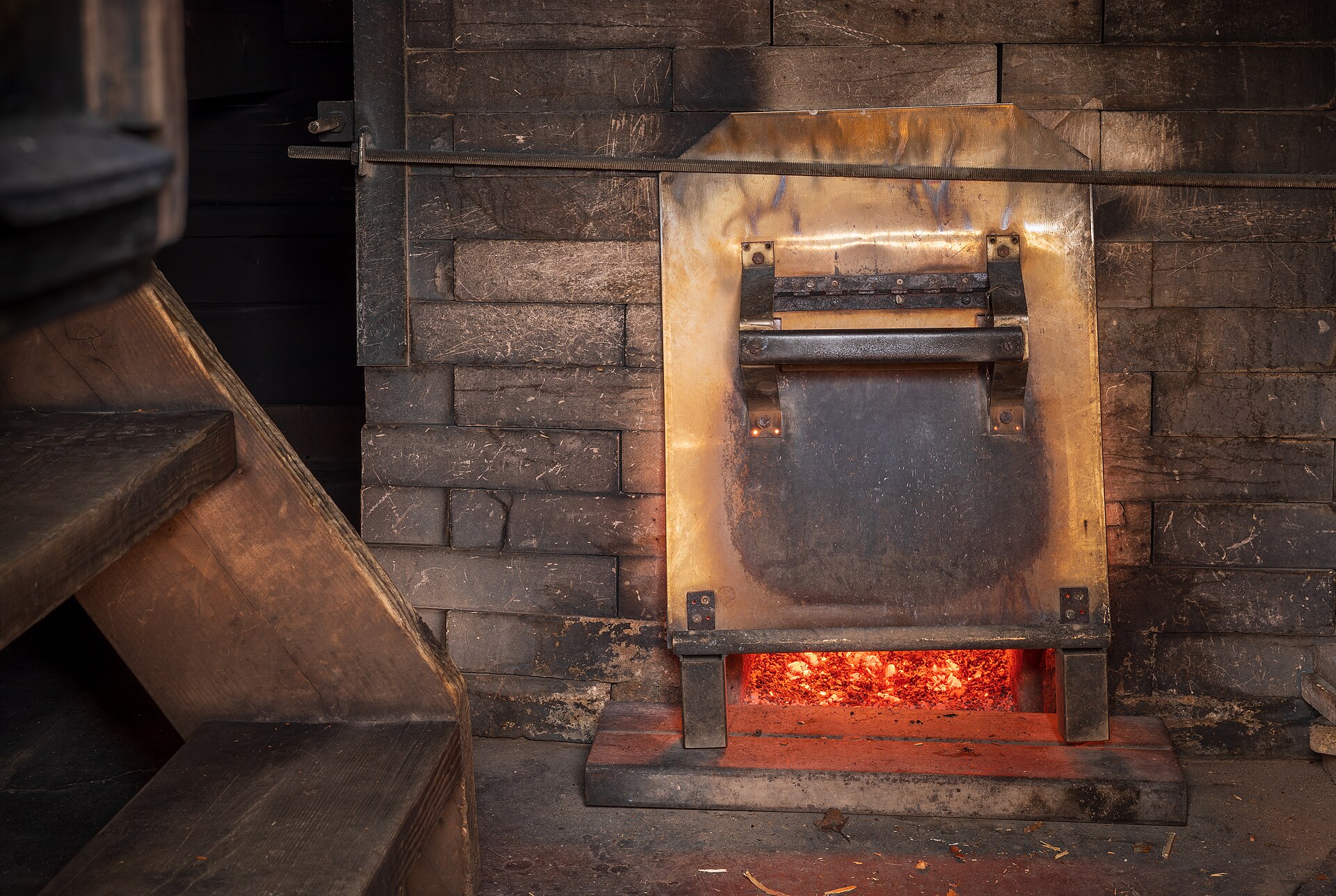
A smoke sauna stove burning down at the Kuusijärvi recreation centre in Vantaa, Finland. In a smoke sauna the fire is out before anyone bathes. Lybäck goes further and keeps the fire outside the building entirely, firing his Tulikivi in the yard and rolling it into a brick-lined bay on rails. Photo: Ximonic (Simo Räsänen), CC BY-SA 4.0, via Wikimedia Commons.
Christer Lybäck fires his sauna heater in the yard. When the stones are hot he pulls the embers out of the firebox, throws off the carbon monoxide steam, lays a fire blanket over the top, opens a sliding door and rolls 3,300 pounds of soapstone into the building on rails. The heater settles into a brick-lined bay, the blanket comes off, and ten people bathe in a smoke sauna that has never had a fire inside it.
Nearly every objection to building a Finnish smoke sauna in the United States is an objection to that fire. Live flame in a chimneyless timber room. Carbon monoxide where people sit. Soot on every surface. An appliance no inspector has a category for. Lybäck's answer is not a better firebox or a cleverer flue. It is a heater that does its burning outdoors and arrives inert.
Sauna-lehti, the Finnish Sauna Society's quarterly, reported the build this summer and called it a one-off, unique in Finland. Nobody sells it, and he did not set out to solve an American problem. But the mechanism is simple enough to copy, and it answers the objections that keep savusauna out of US commercial projects instead of asking anyone to waive them.
What he built
Lybäck is an orthopedic surgeon in Espoo. The building is a prefabricated log kit from Kontio; he built the benches himself and they seat ten, over a slatted floor for ventilation, with a dock and an ice-hole pump outside for winter swimming. First löyly was May 2026.
The heater is a Tulikivi soapstone unit carrying 660 pounds of stones, about 3,300 pounds loaded, and the rails make it light enough for one adult to move. He took the idea from a friend who had built one and pushed it further. His worry was that the stones would give up their heat once the fire was gone. There was still löyly the next morning.
That is the whole engineering claim, and it is the one an operator should test first: a soapstone mass fired to temperature holds usable heat across a full bathing session and into the next morning. Soapstone is the reason. It is the same property Tulikivi has sold masonry heaters on for a century, applied to a heater that moves.
Half of this design is already sold in America
Moving the fire away from the bathers is not a new idea in sauna. It is a stocked product category. Harvia's M3 SL is described on the company's own US page as "designed for people who want to conveniently heat their sauna from another room or outside the building," and Lamppa sells a through-wall throat extension for the Kuuma with an 18 1/2 by 30 1/4 inch rough opening, in 8-inch and 12-inch depths for framed and log walls.
What those move is the door. The firebox, the flue and the combustion all stay inside the structure, and you pay for the arrangement in heat: Lamppa tells buyers to "expect roughly 25% of the usable heat to be delivered outside the sauna room, depending on the wall layout and installation." A quarter of your fuel warms the changing room.
Lybäck moves the combustion event itself. Nothing burns in the building at any point, so there is no firebox to clear, no flue to insulate, no chimney at all, and none of the heat goes to a loading area. What comes indoors is hot rock. That is a different safety argument from an outside-feed stove, and a much easier one to make to an insurer or an inspector, because there is no ignition source in the room to argue about.
Soot is the commercial problem, and this is the part that fixes it
One detail Lybäck mentions in passing is the one a paid operator should notice first: the interior stays clean, because the smoke never gets in.
Soot is why smoke saunas do not scale as an amenity. A traditional savusauna blackens every surface it has, which means benches that mark clothing, walls that cannot be wiped down between sessions, and a cleaning cycle no spa director will sign off on. Take the smoke out and a savusauna becomes a room you can turn over between bookings like any other.
The absence in the US market is total. The North American Sauna Society states flatly that "smoke sauna kits are not commercially available in the US." We could not find an operating public savusauna anywhere in the country. The chimneyless saunas that survive here are museum pieces: Hanka Homestead in Michigan, the 1868 Barberg-Selvälä-Salmonson sauna at Cokato, Minnesota, the 1924 savusauna at Embarrass, the relocated Korhonen farm sauna at Oulu, Wisconsin. Toured, not fired.
The Kero farmstead in Carbon County, Montana holds the whole American pattern in one building. Its National Register nomination records walls blackened from its years as a chimneyless sauna, and a later generation adding a stove and a chimney. It is still a working sauna. It stopped being a smoke sauna in order to stay one.
The fire risk is real, and Finnish data says it is mostly electric
Finland has more sauna fire data than anywhere on earth, and it does not support the American assumption that solid fuel is the hazard and electricity is the safe default.
Finnish public broadcaster YLE reported roughly 400 sauna fires a year, and that "noin kaksi kolmasosaa saunapaloista syttyy sähkösaunoissa": about two-thirds start in electric saunas. Pasi Paloluoma, fire chief and fire investigator at the Southwest Finland Rescue Department, put the leading cause down to carelessness, inattention or human error. That reporting is from November 2017, so treat it as the best available rather than current. The recent counts come from the safety regulator Tukes: 98 sauna fires in the national database last year, 107 and 92 in the two before, with laundry drying in the sauna and objects left on the heater as the common causes.
Set that beside the American posture. An underwriter will ask whether the wood stove is listed, whether a permit was pulled, whether a licensed contractor installed it, whether it clears 36 inches. Nobody asks anything about the electric heater, which is where the Finnish fires mostly start, and where the leading cause is what the bather did rather than what the fuel is.
A heater fired outdoors sits outside that whole argument. The bather cannot leave laundry on a stove that is not lit, and there is no live fire in the building to be careless around.
Getting one approved here
The permitting problem is smaller than the trade thinks, and different in kind.
American code recognizes two kinds of sauna heater and wood is not one of them. UL 60335-2-53, the sauna heater standard ANSI-approved on June 27, 2025, covers "electric sauna heating appliances and infrared emitting units," per the scope of the IEC standard it adopts; we covered what it changed in April. IRC M1902.2 says sauna heaters "shall comply with UL 875," also electric-only. A wood-fired kiuas falls through to the generic solid-fuel room heater machinery at IRC M1410, which sends it to UL 1482, a standard whose scope covers fire chamber assemblies intended for attachment to a residential-type chimney. A smoke sauna is defined by not having one.
In practice that listing requirement is honored loosely. Harvia's own US page for the M3 SL shows CE and EAC marks and no North American one, and we could not find a UL, ULC, ETL or CSA listing for any wood-burning sauna heater from Harvia or HUUM on the manufacturers' US pages. Plenty of unlisted wood stoves are sitting in American saunas right now. Lamppa is the exception worth naming: it publishes listing status per model, its external-feed Kuuma is "Listed by PFS-TECO to UL 1482" with a serialized label on each stove, and its certification is maintained through quarterly inspections. The listing body once called PFS-TECO now operates as NFPA Global Solutions, so an older certificate carries the old name.
None of that matters much for a backyard build and all of it matters for a permitted commercial project, which is the only kind that would pay for a savusauna anyway. So the useful question is not which sticker the heater carries. It is which compliance path the building official will accept, and here the rolling design has an argument no conventional sauna stove has.
This appliance is functionally a masonry heater, and masonry heaters already have a path. A masonry heater is a site-built, solid-fuel, heat-storing appliance. So is a soapstone mass in a brick-lined bay. IRC R1002.2 gives masonry heaters two compliance routes and lets the builder choose: comply with ASTM E1602, or be listed and labeled to UL 1482 or CEN 15250. The first route requires no listing, no label and no third-party certification, and ASTM E1602-03(2026) says at scope 1.3 that it "applies to the design and construction of masonry heaters built on-site" and "does not apply to the construction/installation requirements for component systems that have been safety tested and listed." The site-built path is not a consolation prize for appliances that failed to get listed. It has a standard written exclusively for it, which throws listed products out. The same structure appears in IBC Section 2112, so it is not a residential-only favor.
Site-built mass even earns a clearance concession. R1002.5 sets 36 inches to combustibles, citing NFPA 211, then drops it to 4 inches where the heater wall is at least 8 inches of solid masonry and the heat exchange channels at least 5. A ninefold reduction bought with mass and geometry instead of a label, which is exactly what a soapstone heater in a brick bay is made of.
The federal air rules line up the same way. Sauna stoves sit outside the residential wood heater standards by definition, because 40 CFR 60.531 defines a wood heater as an appliance intended for residential space heating, and EPA has said so twice in writing: for Harvia Oy, whose heaters are "intended to heat the sauna room only and not to be used for residential heating" (83 FR 22668, May 16, 2018), and for Lamppa Manufacturing of Tower, Minnesota, whose stoves are "intended solely for the purpose of heating a 'sauna hot-room'" (84 FR 9783, March 18, 2019). Masonry heaters are excluded too, and EPA guidance states that "masonry heaters currently do not require EPA certification." While you are at it, drop the story that sauna stoves are EPA-exempt because they are used intermittently. Intermittent use appears nowhere in the agency's reasoning. Those two determinations are the documents to send.
For a genuinely unlisted appliance the door is the alternative materials provision, and you need the right section number because the 2024 codes renumbered it and the IRC did not land where the others did. It is IBC 104.11, IRC R104.11 and IMC 105.2 in the 2021 codes; IBC 104.2.3 and IMC 104.2.3 in the 2024 codes, but IRC R104.2.2. The listing mandate is conditional by construction: IMC 301.7 requires appliances to be listed and labeled "unless otherwise approved," pointing straight at that provision, and IBC 1703.4.1 goes further, saying that where the technical data is "satisfactory proof of performance for the use intended, the building official shall approve the use." The 2024 codes make a stamped engineering analysis a first-class substitute for a listing, at IBC 104.2.3.6.2 and IRC R104.2.2.6.2, where a report "prepared by a qualified engineer, specialist, laboratory or specialty organization acceptable to the code official" carries the argument.
Budget for an engineer, a stamped package argued against the intent of the fire provisions, and a pre-application meeting in writing before the foundation goes in. Skip the field evaluation calls, which are a dead end here: that route is scoped to electrical equipment. IAS accredits field evaluation bodies against a criteria document titled for unlisted electrical equipment, OSHA's NRTL program certifies against electrical standards in a workplace regulation, and the one commercial fuel-burning field evaluation service publishes a standards list of boilers, industrial ovens and gas burners without a single solid-fuel standard on it.
What nobody has verified
Three things stand between the Finnish build and an American one, and none of them is a regulator saying no.
The first is carbon monoxide. "Throws off the CO steam" is a procedure, not a measurement, and the whole safety case for rolling a hot mass indoors rests on the combustion products being gone before the doors close. A US project needs monitoring and a documented purge sequence, not a practiced hand. That is also the cheapest part of the package to instrument and the first thing an engineer will ask for.
The second is the opening. A sliding door wide enough to admit a heater, a rail bed that carries 3,300 pounds without racking, and a bay lined to take the radiant load are all building costs that a conventional install does not have. The heater is the ordinary part. The room is the custom part.
The third is that no American building department has ruled on any of it, in either direction. We went looking for the case and could not find one. No permit record, no variance, no code-appeal decision, and no denial either. The closest anyone got was Orcas Island, Washington, where Ryan Brush ran a Kickstarter in autumn 2024 to build what local press called the first publicly accessible Finnish smoke sauna in America in over a century, working with Finnish builder Jarmo Hiltunen. The campaign record shows $15,081 raised against a $559,890 goal from 29 backers, cancelled by the creator on October 8. The project domain no longer resolves. It died at fundraising and never reached a building department.
Worth knowing where it would have landed. Washington's public bathing rules expressly do not apply to steam baths and saunas, so the health department would not have been the gatekeeper. It would have come down to one building official reading the alternative means provision. "Nobody has applied" is a far easier problem than "a regulator said no."
Or somebody writes the section
The engineering route works and it costs an engineer every time, per project, forever. Masonry heaters got out of that by getting a code section, and they got the section because an industry body did the work: the Masonry Heater Association says it developed ASTM E1602, funded the lab testing and built a performance database.
Sauna has the same appliance physics, the same site-built problem, and a finished template sitting in R1002. What it needs is an ASTM-style construction guide for site-built sauna heaters, prescriptive clearances earned by mass, and an IRC proposal pointing at the guide. Nobody has filed one. EPA's own fact sheet from the masonry heater rulemaking it later dropped even supplies the reasoning: it floated accepting a computer simulation instead of a performance test "because the heaters are built on-site, testing each individual heater could be difficult," and concluded "no further quality control would be required for these units, because each is unique."
There is a deadline attached. The 2024 IRC still references E1602 at its 2003(2017) reapproval, and ASTM reapproved the guide as 03(2026) on January 26 this year. The 2027 IRC has to update that pointer anyway, which makes it the cycle to attach a sauna proposal to.
Meanwhile the company that made Lybäck's heater is going the other way. Tulikivi is entering the US on the electric track, running UL certification on its Kevo collection per its Q1 2026 interim report, which we covered in May. A 130-year-old soapstone business built on wood-fired mass is crossing the Atlantic with an electric product, because electric has a standard, a lab and a code section that names it.
The wood-fired tradition is not illegal in the United States. It is unwritten, which in commercial practice costs about the same. The difference the rolling heater makes is that it turns a safety argument, which is hard to win, into a paperwork argument, which is only expensive. Somebody with a spa program and an engineer on retainer should be the one to find out what a building official actually says.
Original reporting on Christer Lybäck's sauna by Ulla Ora in Sauna-lehti 2/2026, the Finnish Sauna Society's quarterly, in its Minun saunani column. The issue is available in full at sauna.fi. We do not republish their photography.
Arlene Scott
Senior Wellness Correspondent & Hospitality Consultant
Arlene Scott brings over fifteen years of reporting and consulting experience across energy infrastructure, sustainable design, and thermotherapy-focused hospitality.
Full byline
Arlene Scott is a Senior Wellness Correspondent for SaunaNews.com, bringing over fifteen years of experience at the intersection of energy infrastructure, sustainable design, and thermotherapy. Her work focuses on the physiological benefits of passive heat therapies and the sustainable integration of sauna culture into modern wellness routines.
Arlene's background is rooted in the clean energy transition. She was a founding writer at MicrogridMedia.com, where she covered the technical and economic viability of desalination projects, microgrid deployments, and distributed renewable energy systems. During the mid-2010s, she was a regular contributor to Greentech Media (GTM) during its independent era — prior to the Wood Mackenzie acquisition in 2016 — reporting on the early integration of thermal energy storage and sustainable infrastructure.
Transitioning her focus from macro-energy systems to human-scale wellness, Arlene now applies her technical background to the hospitality sector. She operates as an independent consultant, advising boutique hotels and eco-resorts on the design, energy efficiency, and historical authenticity of commercial sauna and thermal spa installations. Her consulting work ensures that high-end wellness facilities balance traditional Nordic bathing principles with modern sustainable engineering.
Arlene holds a specialized certification in Applied Thermic Wellness from the Nordic Institute of Passive Heat Studies (NIPHS) and is a recognized associate member of the International Sauna Association (ISA). When she isn't reviewing the latest innovations in infrared technology or consulting on a new resort project, Arlene can be found tending to her own traditional wood-fired sauna in the Pacific Northwest. You can read her complete archive of essays on energy, wellness, and sustainable living at www.arlenescott.com.