Does Steam Make the Sauna Harder on Your Heart? A Finnish Study of 50 Bathers Says Yes

Research, standards and the sauna industry
- Published
- Reading time
- 6 min
SaunaNews is published by SaunaShare, Inc., which also runs SaunaShare.com and SaunaMarketplace.com, where we sell many of the products we write about. That experience may change what we write about and what we don't. Who owns SaunaNews
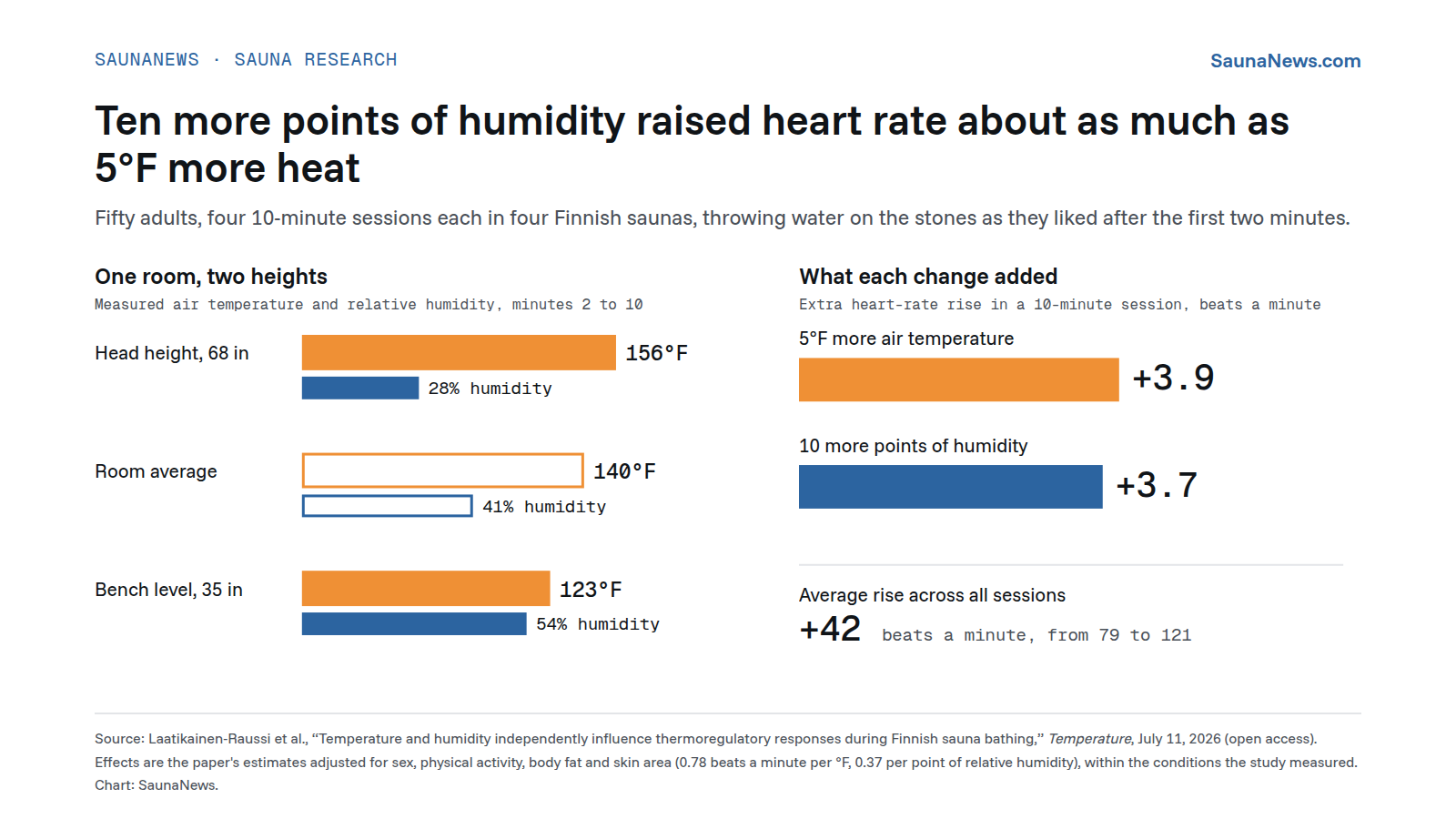
Heart rate rose 42 beats a minute in 10-minute rounds at the University of Jyväskylä, and each 10 points of humidity added about 4 more, roughly what 5°F of extra heat did. The bench ran 33°F cooler than head height.
In this story4 sections
Every ladle of water on the stones raises more than the humidity. In a University of Jyväskylä study of 50 adults, heart rate climbed by an average of 42 beats a minute during a 10-minute sauna, from 79 to 121. The more humid the air, the bigger the climb at the same temperature. Each 10 points of relative humidity added about 4 beats a minute to the rise, roughly what 5°F more heat added. Core body temperature followed the same pattern on a smaller scale.
The paper ran on July 11 in the open-access journal Temperature, under a university release headlined “Steam increases physiological strain during sauna bathing.” Researchers from the university and the Finnish Institute of High Performance Sport (KIHU) sent volunteers through four 10-minute rounds, each in a different sauna heated by electricity, gas, hydrogen or wood, with 30 minutes of rest in between. Nobody threw water for the first two minutes. After that, each group of two or three bathers threw as much as it liked. Six sensors per room logged temperature and humidity at seat level and head height. Volunteers swallowed a temperature-logging capsule and wore chest-strap heart-rate monitors, and 50 of the 69 who took part produced complete data. Harvia provided the saunas, the room measurements and the publication costs, and Toyota partly funded the measurements as part of a wider research project on hydrogen saunas.
The bench sat 33°F cooler than head height
Across the eight minutes when water was allowed, the four rooms averaged 140°F at 41% relative humidity. That average hid a wide spread. At 35 inches off the floor, the height the paper calls sitting level, the air ran 123°F at 54% humidity. At 68 inches, typical head height, it was 156°F at 28%. In its own write-up of the study, Harvia says the heaters were set to about 167°F.
The authors say a gap between the setting and the room is common in sauna research. They cite a 2025 University of Oregon study that measured 151°F at the top of a sauna set to 176°F, and a 2018 study in Finland that logged 163°F in a room set to 183°F. Most studies report one thermostat figure and describe the room as dry, they write, so earlier work “may underestimate the physiological strain associated with real-world sauna use.” The March study of white blood cells after one sauna, in the same journal, logged its room at 163°F and 10% to 20% humidity.
Ten points of humidity, about 4 beats a minute
In the paper’s statistical model, each extra degree Fahrenheit of air temperature added 0.78 beats a minute to the heart-rate rise. Each percentage point of relative humidity added 0.37. Both held after the team accounted for sex, self-reported activity level, body fat and skin surface area, and nothing else predicted the rise. Core temperature, read by the swallowed capsule, went from 99.3°F to 100.0°F at its peak during the session or the half hour after. Ten points of humidity added about 0.14°F to that rise. More active volunteers, and those with less body fat, warmed up less.
The heart’s response didn’t build across the four rounds. The fourth session raised heart rate about as much as the first. Volunteers felt more comfortable as the rounds went on, and how hot the room felt to them tracked air temperature far more than humidity. Humidity’s small effect on how hot it felt disappeared in the fully adjusted model. The steam that made their hearts work harder was the part they felt least. “Regular exposure to heat may increase tolerance, allowing conditions to be perceived as hot but comfortable,” the authors write.

The authors’ explanation is evaporation. Humid air slows the evaporation of sweat, the body’s main way to shed heat, so the heart pumps more blood to the skin. They also tested a popular sauna theory, that steam condenses on cooler skin and dumps extra heat into it. A condensation measure built from dew point and skin temperature showed only a weak link to heart rate, which vanished once individual differences were accounted for, and no link to core temperature. “The overall moisture content of the sauna air may be more influential than condensation itself,” they write. Harvia says it’s studying condensation further with its own measurements.
Humidity wasn’t controlled, and nobody had heart disease
Each group threw as much water as it wanted, and heater type also shaped the humidity in each room. That makes the result an association measured inside an experiment, not a controlled test of steam against no steam. On its own, humidity’s simple correlation with the heart-rate rise wasn’t statistically significant. Its effect showed up once temperature was in the model.
The volunteers were healthy, recreationally active and mostly regular bathers, average age 35, and 90% used a sauna at least once a month. People with unstable angina, a recent heart attack or severe aortic stenosis were excluded, and nobody’s blood pressure was measured. Caffeine and medicines weren’t controlled, the study wasn’t registered in advance, and 19 of the 69 volunteers were dropped for missing or faulty sensor data. The rooms averaged 140°F, well below many commercial saunas and far below an Aufguss room in Germany, so the per-point figures may not hold at higher heat. The authors call for more controlled studies.
An older, smaller study points the same way. In a 2014 study in Poland, 10 young men who had never used a sauna took three 15-minute rounds in a dry sauna at about 196°F, and a month later in a steam sauna at 138°F and 60% humidity. Heart rate peaked at 138 beats a minute in the steam room and 126 in the dry one, and rectal temperature rose 2.9°F against 2.1°F. The men also tolerated the cooler, wetter room worse.

Measure humidity where people sit
Bathhouses, gyms and spas: Steam is a dose your staff control. A guided Aufguss, an automatic infusion system or a guest with a ladle can raise the load on every heart in the room without the thermostat moving. Mount a hygrometer beside the thermometer at seated head height on the top bench, and log both at peak hours. Write your water rules (how much, how often, who throws) into staff training, and post them alongside the health warnings your sauna sign may already need.
Home sauna owners: The number on the control panel isn’t what you’re sitting in. A thermometer and hygrometer hung at head height over the bench will tell you more. For an easier round, throwing less water lowers the load the way turning down the heat does. Anyone with a heart condition should ask their doctor about steam as well as temperature, because this study included nobody with heart disease.
Heater and control makers: Most controllers regulate temperature only, and this study puts humidity on the list of what bathers’ bodies respond to. Harvia’s write-up points readers to its own smart sauna sensor for tracking humidity at home, and says the sensor won’t match the lab’s precision.
Anyone writing about sauna and health: Many studies behind sauna health claims list a set temperature and call the room dry. Before you cite one, check what humidity it measured, and where in the room.
The study at a glance
- Who Fifty healthy adults analyzed (32 men, 18 women, average age 35) of 69 who took part, at the University of Jyväskylä and KIHU in Finland
- Sessions Four 10-minute rounds, each in a different sauna (electric, gas, hydrogen, wood-burning), with 30 minutes of rest between them; water on the stones allowed after the first two minutes
- Rooms 140°F and 41% relative humidity on average; 123°F and 54% at 35 inches, 156°F and 28% at 68 inches
- Results Heart rate up 42 beats a minute on average, core temperature up 0.7°F; each degree Fahrenheit added 0.78 beats a minute to the rise and each point of humidity 0.37
- Not studied blood pressure, people with heart disease, and the hotter rooms many commercial saunas run
- Funding Harvia provided the saunas, room measurements and publication costs; Toyota partly funded the measurements
- Paper Laatikainen-Raussi, Mikkola, Ihalainen and Ahokas, “Temperature and humidity independently influence thermoregulatory responses during Finnish sauna bathing,” Temperature, July 11, 2026, open access, DOI 10.1080/23328940.2026.2698162