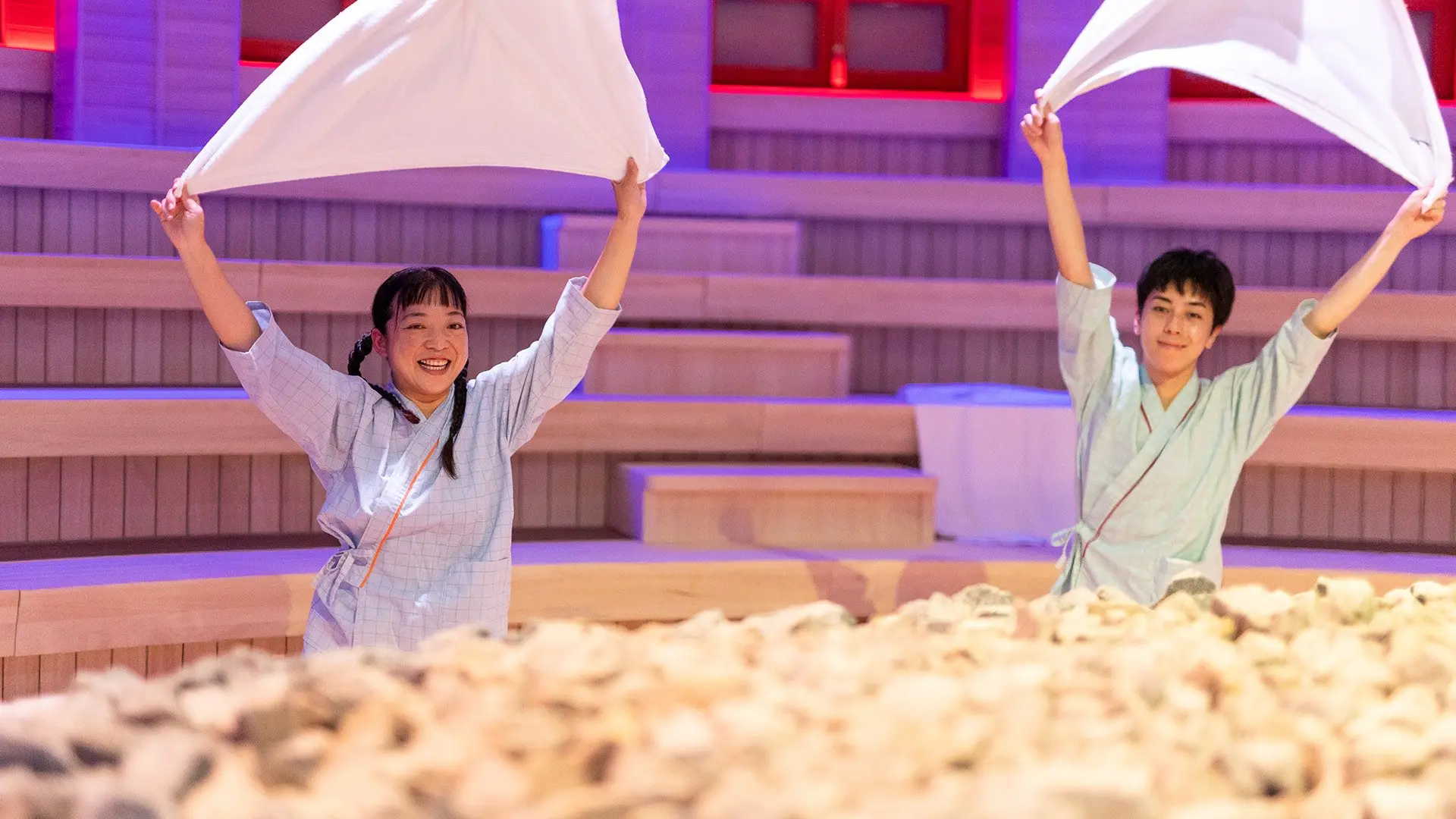
What Is Aufguss? How a Sauna Master’s Session Works, and What Its History Shows

Research, standards and the sauna industry
- Published
- Updated
- Reading time
- 19 min
SaunaNews is published by SaunaShare, Inc., which also runs SaunaShare.com and SaunaMarketplace.com, where we sell many of the products we write about. That experience may change what we write about and what we don't. Who owns SaunaNews
The word means a pouring-over. A sauna master pours water, scents or ice on the stones and moves the heat with a towel, usually for 6 to 10 minutes. German rules set the limits, judges score the show, the towel was in a bather’s hands by 1985 and a sauna master’s by 2001, and a US aufguss teacher explains how to sit through a first one.

In this story18 sections
- 01The word is old, and the sauna meaning is newer
- 02Water on the stones, then the towel
- 03How a session runs, step by step
- 04The towel techniques have names
- 05Five kinds of aufguss, by the German book
- 06Scents are flammable, so dose them by the label
- 07Löyly is the steam; aufguss adds a sauna master
- 08Other languages have their own words
- 09A bather waved the towel in 1985, a sauna master by 2001
- 10The judged show took off after 2005
- 11In German saunas, aufguss runs on the hour
- 12What judges score
- 13House rules: sit down, keep quiet, leave if you need to
- 14Where Americans can try one
- 15Before a first aufguss: a warm shower and the middle bench
- 16A classic aufguss is quiet
- 17What an operator needs before adding aufguss
- 18Check the local health code before scheduling one
Aufguss is German for a pouring-over. In a sauna, it’s a session in which a sauna master pours water onto the hot stones, often scented and sometimes as ice, and then waves a towel to push the hot, humid air across the benches. Germany’s aufguss guideline says one should last 6 to 10 minutes and never more than 12. Competition shows run 12 to 15.
The word comes from the verb aufgießen, to pour on. Duden, the standard German dictionary, gives it two meanings: a liquid made by pouring water over something, as with tea, and “pouring water over the hot stones in a sauna, to raise the humidity,” according to Duden’s entry for Aufguss.
Key facts
- The word Aufguss, from aufgießen, to pour on; the plural is Aufgüsse, and in everyday German it also means a tea infusion
- Who leads it a trained sauna master; in German public saunas, only staff pour
- Length Germany’s guideline sets 6 to 10 minutes, 12 at most; competition shows run 12 to 15
- The routine usually three pours, with towel waving in between
- The room German guidance assumes about 194°F to 212°F, measured about 3 feet above the top bench
- The Finnish counterpart löyly, the steam bathers raise by throwing water on the stones themselves
- History a bather waving a towel in 1985, a sauna master in 2001, the first competition in 2007
- Research no peer-reviewed study we could find has measured bathers during a towel-waved aufguss
The word is old, and the sauna meaning is newer
The Grimm brothers’ German dictionary defined aufgusz in 1854 as both the act of pouring on and what is poured, with tea and linden blossom as its examples, and no sauna in sight. The root verb, gießen, goes back to the Old High German gioʒan of the 8th century. A standard German dictionary from 1967, quoted by DWDS, still gave no sauna sense.
The Digital Dictionary of the German Language (DWDS) quotes the sauna sense from Hanna Fresenius’s 1974 book Sauna as something bathers did themselves: it advises anyone making aufguss to do it only toward the end of a sauna round. DWDS’s own definition still leaves the sauna sense out.
Sauna masters use the word for both the pour and the whole session, as in “the 3 o’clock aufguss,” said Thorsten “Thor” Moeller, founder and CEO of Aufguss Roots USA, which teaches the curriculum of the German and Swiss school Aufguss Roots in North America.
Auf means onto, and Guss comes from gießen, to pour or to cast, the same root as Gusseisen, cast iron, Moeller said. The word is a noun, the pour itself: a sauna master makes an aufguss, and the plural is Aufgüsse. That is why he calls “aufguss ritual” and “aufguss ceremony” a misuse.
The towel work has its own word, Wedeln, which is also the name of an old ski technique from Austria, Switzerland and Germany, in which skiers twisted rapidly left and right, leaving a wave pattern in the snow, Moeller said. In Bavaria and Austria, the waving is also called wacheln, a regional word for fanning; Duden’s example for wacheln is “an aufguss with and without wacheln.”
“For me, the aufguss is the moment just before the water touches the stones: the preparation, the intention; the ladle hovering over the rocks. Everything after that is service to the guests. It’s stewardship, not showmanship.” Thorsten “Thor” Moeller, Aufguss Roots USA
Water on the stones, then the towel
When water hits the stones, “an invisible cloud of steam shoots to the ceiling and flows through the room,” and as the moist air reaches a bather’s skin, vapor condenses on it and heats it further, the Deutscher Sauna-Bund, Germany’s sauna association, explained in a 1999 guest FAQ (translated from German).
The condensation is real and measurable. In a 2015 study that tagged the thrown water with stable isotopes, between about a third and a half of the water dripping off test subjects was condensed steam from the stove rather than sweat, according to the paper in Isotopes in Environmental and Health Studies.
The towel moves that moist air down to the benches. When Germany’s statutory accident insurers measured four sauna rounds for a 2018 report on heat stress for sauna staff, the aufguss made no measurable change to the air temperature, and humidity and condensation on the skin were the main effect. About a quart of water makes about 60 cubic feet of steam, about 5 percent of their 1,165-cubic-foot test sauna. Humidity at the middle bench rose from 10 to 15 percent before a three-pour round to 20 to 25 percent after it, and bare skin warmed from about 97°F to 100°F. The test used two people, a professional sauna master and a regular guest, and it wasn’t peer-reviewed.
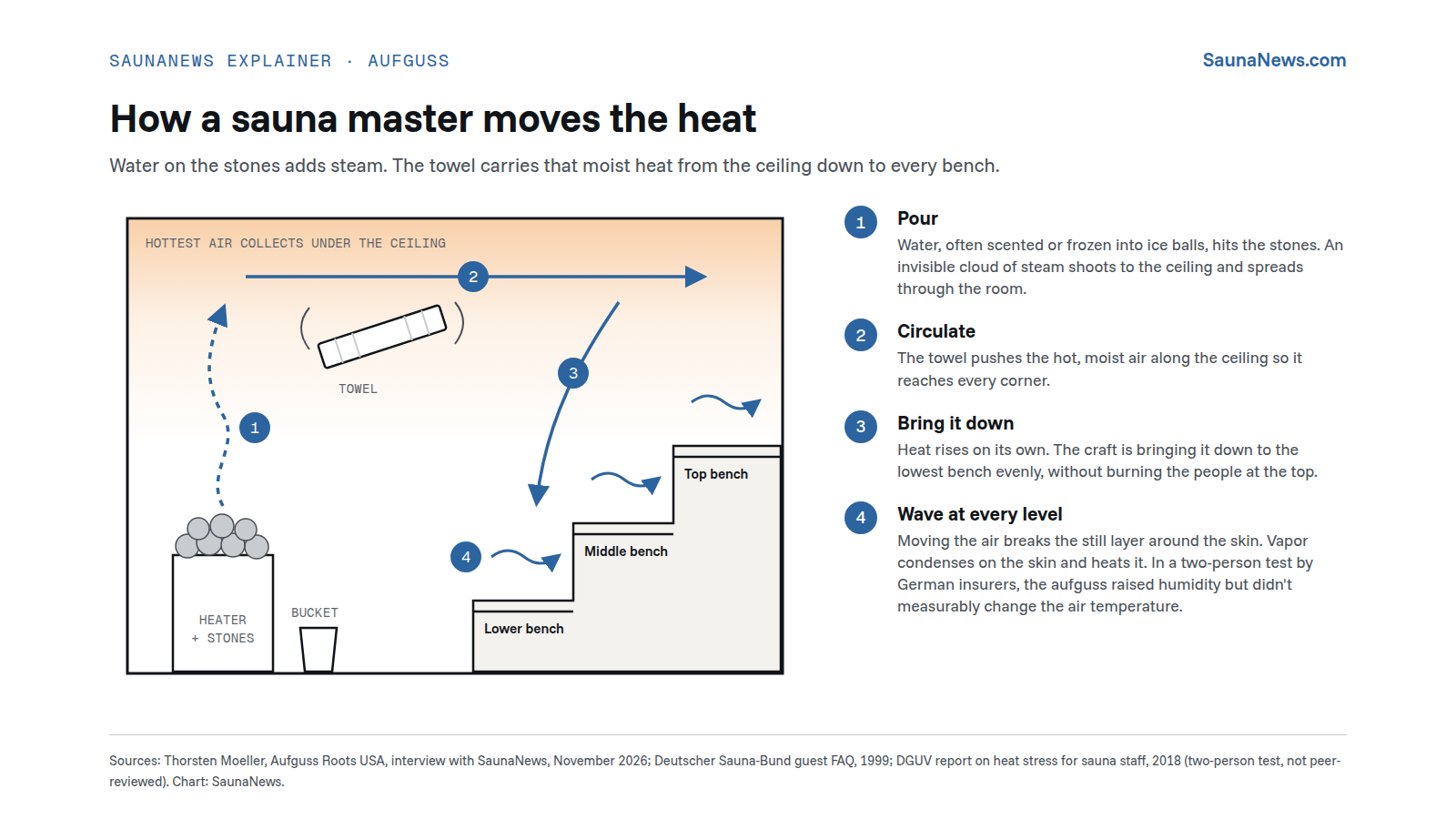
German guidance sets the limits. The insurers’ rules for aufguss staff allow about 2.9 fluid ounces of water per 100 cubic feet of room per session, 10 to 12 minutes at most, and one aufguss per staff member per hour. The Sauna-Bund’s sample aufguss schedule from 2017 counts a session as intensive if it runs past 12 minutes, uses more water than that or is held above 194°F. A guideline published in December 2025 allows up to twice the water after a test in each room.
How a session runs, step by step
Germany’s aufguss guideline, DGfdB R 26.30.04, sets out the order. Before the first pour, staff must announce how long the aufguss will last, warn of a very strong heat, name the scent and tell guests they may leave at any time, even mid-session. They should also introduce themselves, give the intensity and, where it fits, ask for quiet, according to the public draft of the guideline from June 2025 (in German). The final text, published in December 2025, is sold, not posted free.
Staff may first wave in fresh air, which takes the edge off the heat; in one of the insurers’ field tests, the sauna master did it with the door open for a minute or two. The water goes on carefully and spread across the stones, never onto the heating elements, with the hand kept out of the rising steam. German practice is three pours per session, with waving in between, according to the insurers’ 2018 report. EOS, the German heater maker, says the same in its sauna guide for guests.
Ice balls go on a spot of stones wetted first, and staff pour more water around them and break them up with the ladle. A brew of herbs or tea goes on stones cooled with ice beforehand, so fine plant bits don’t burn and smell. Afterward, staff should tell guests to get fresh air, cool down and rest, and look over anyone still on the benches for signs of trouble.
The guideline counts the time from when staff walk in to when they walk out: 6 to 10 minutes is the target, and 12 is the limit, “for health reasons and per occupational-medicine advice.” Real schedules follow it. The municipal sauna in Lintorf, near Düsseldorf, runs a house aufguss of 6 to 8 minutes, a crushed-ice aufguss of 8 to 10 and a big-water special of 10 to 12 in a room at 194°F. It closes the room 15 minutes before each one and reopens it 5 minutes before, according to its aufguss plan for 2026.
The towel techniques have names
The guideline gives the towel two jobs: spread the steam through the room, and thin the layer of still air that clings to the skin, about a sixth to a third of an inch thick at rest. Waving and beating with the towel thins that layer, so the heat reaches the body more intensely. The sauna master has to move calmly and reach every guest.
The Sauna-Bund’s training academy teaches the simple strike, the rolled technique and the half and full figure eight as its standard moves, according to a Sauna-Bund text on the German championship’s website in 2015.
Rules for the Modern Classic Cup, a contest run by the Aufguss WM, name three classic techniques, flag, helicopter and parachute, the moves whose main purpose is moving heat and air. Aufguss.it, an Italian site run by aufguss fans, many of them trained at CRON4’s school, describes four basics in its online tutorials:
- Helicopter: a doubled towel rotated evenly over the head, usually right after the pour, to spread the steam through the room.
- Parachute, also called the shovel: pushes the hot air down toward the guests, with a strong draft.
- Side flag: the towel held between both hands and swung left and right, one of the most efficient ways to move air to the benches.
- Comb: a quick sweep from low to high that brings cooler air from the bottom of the room to the guests, like briefly opening the door. It’s not for the start of an aufguss.
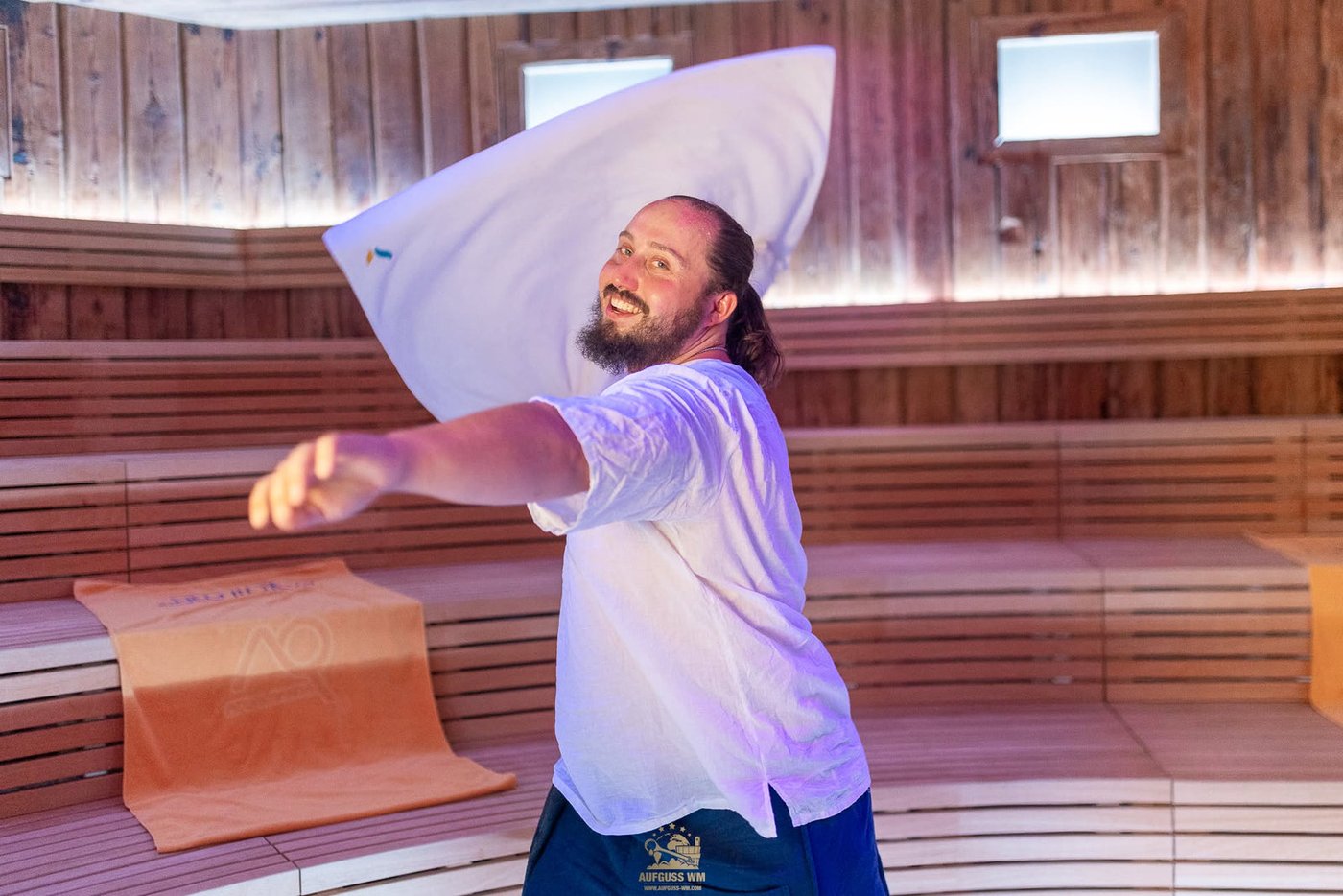
Sauna masters don’t all use a move the same way. Moeller told the Swiss homeowners’ magazine Der Hauseigentümer in 2025 that he beats the warm air down like a parachute to lower the temperature before the next round, and that a flag moved sideways sends only a gentle draft past the face and arms.
Show waving is a separate skill set. Aufguss Roots teaches show moves such as the pizza, the figure eight, the angel, the Hungarian eight and Around the Sun, plus two throws, in its advanced courses, according to its course catalog (in German). Its basic courses teach four waving techniques, and Aufguss Roots USA calls those four classics “what every guest needs” and show waving “extra, not a necessity,” according to its aufguss FAQ.
Five kinds of aufguss, by the German book
The guideline lists five types: classic with water, classic with ice balls, classic with both, the show aufguss and the wenik aufguss. A show aufguss is a themed session with light effects, music and special waving techniques and tools. A wenik aufguss, from the Baltic and Russian tradition, uses a bundle of leafy birch branches dipped in water to waft the air or tap the guests. Championships fall outside the guideline.
Venues add their own. In EOS’s guest guide, a honey aufguss starts as a normal one, and after the first warm-up the guests are handed honey to rub on their skin in the sauna. A salt aufguss works the same way with mineral salt, kept away from eyes, genitals and wounds. The guideline, though, says salt, honey, drinks and fruit must be handed out outside the sauna room, for hygiene, so some venues move the scrub to the steam room.
One thing never goes on the stones: sea water. Harvia lists it as “forbidden to use” because of rapid corrosion, in its Spirit heater manual, and EOS’s manuals forbid chlorinated or salty water and salty scents. Check the heater maker’s manual before adding any themed aufguss to a schedule.
Scents are flammable, so dose them by the label
In a study of aufguss fumes from 2016, the German insurers found that most commercial aufguss concentrates are essential oils dissolved in ethanol or isopropyl alcohol and diluted in the bucket. On four makers’ safety data sheets, the flash points run from about 55°F to 86°F, and three warn of allergic skin reactions.
EOS’s heater manuals warn that wrongly dosed concentrates, essential oils or herbs can catch fire, and they rule out more product than the label says, undiluted concentrate, alcohol, and herbs in the water or on the stones. The insurers’ staff rules go further: skip concentrates altogether, or use only products shown not to give off hazardous substances when heated above 392°F. Aufguss Roots USA puts essential oils only on ice balls, never in the bucket or straight on the stones, and suggests an herbal brew or tea as an alternative.
The Sauna-Bund’s sample schedule lists a mint aufguss made with peppermint tea and shaved ice, and says venues may describe a scent’s effect only as stimulating, calming, balancing or strengthening. Guests with fragrance allergies can ask what’s in the bucket; the Lintorf sauna tells its guests to ask staff for the ingredients.
Löyly is the steam; aufguss adds a sauna master
The Finnish word for the steam is löyly. Finland’s etymological dictionary defines it as the heat or hot steam that rises when water is thrown on the stove in a sauna, and traces it to the 16th-century writing of Mikael Agricola, as “leuly.” Its relatives include the Estonian leil and the Hungarian lélek, “soul,” according to the dictionary of the Institute for the Languages of Finland.
In Finland, bathers make their own löyly. At its Vaskiniemi saunas in Helsinki, the Finnish Sauna Society tells guests to “throw as much water onto the stones as the bathers want,” and bans “competitions to see who can tolerate the most heat,” according to its house rules.
Finland’s own heat-endurance contest in Heinola, held from 1999, ended after a competitor died in 2010, as the Associated Press reported at the time. Aufguss contests judge the sauna master, not the bathers’ endurance.
In a news item from 2016, the Society called aufguss “löylyn löyhyttely,” wafting the löyly, and noted that it is less known in the Nordic countries. The difference comes down to who holds the ladle: in a Finnish sauna, the bathers do; in an aufguss, a sauna master pours and fans, and the guests sit.
Löyly and aufguss, side by side
| Löyly in a Finnish sauna | Aufguss in a German public sauna | |
|---|---|---|
| Who pours | The bathers, as much as they want | Staff only |
| When | Whenever the bathers like | At set times on a posted schedule |
| The heat | Rises from the stones | Moved to every bench with a towel |
| Length | Up to the bathers | Germany’s guideline: 6 to 10 minutes, 12 at most |
| Contests | Heat-endurance contests banned at the Finnish Sauna Society’s saunas | Judged championships since 2007 |
Other languages have their own words
Aufguss isn’t in the English dictionaries we could check, and English speakers mostly borrow it, along with “sauna master” and “aufguss master.” Other languages borrowed it or made their own words, according to their associations, venues and dictionaries:
What the session and the person are called
| Language | The session | The person |
|---|---|---|
| German | Aufguss (Saunaaufguss) | Saunameister, Aufgießer |
| Dutch | opgieting | saunameester, opgieter |
| Italian | gettata di vapore, a “throw of steam” | Aufgussmeister, maestro di Aufguss |
| Polish | seans saunowy, a sauna session | saunamistrz |
| Czech | saunový ceremoniál, a sauna ceremony | saunér |
| Danish | saunagus | gusmester |
| Japanese | アウフグース (aufugūsu) | 熱波師 (neppashi), a “heat-wave master” |
A bather waved the towel in 1985, a sauna master by 2001
No dictionary, association or published study dates the first towel-waving aufguss. Claims that it began in Germany in the 1970s appear on retail and blog sites without a source. The Sauna-Bund’s 1999 definition doesn’t mention a towel or staff at all.
The towel itself shows up in 1985, in a bather’s hands. Writing in Deutsches Ärzteblatt, the German medical journal, Fresenius described the head of a family who, after a stressful day, “has himself given löyly, the burst of steam, the aufguss with sauna scent,” and uses the terry towel “to spread the steam cloud with swinging waves,” according to her February 1985 article (translated from German).
A sauna master appears by 2001. Previewing a new sauna in December 2001, the Süddeutsche Zeitung wrote that “the sauna master will swirl the moisture of the aufguss through the room with the towel,” as quoted in the DWDS corpus of German texts. That October, the Mediterana sauna near Cologne was already advertising aufguss with herbal oils every hour on the hour, according to an archived copy of its website.
Moeller said he knows of no source that dates the first one either. Moving the steam is older than the towel, he said: in the Latvian pirts, the bath master doesn’t only use whisks on the skin but also fans the steam down toward the bathers, and the oldest grip for towel waving came from the grip used for whisking.
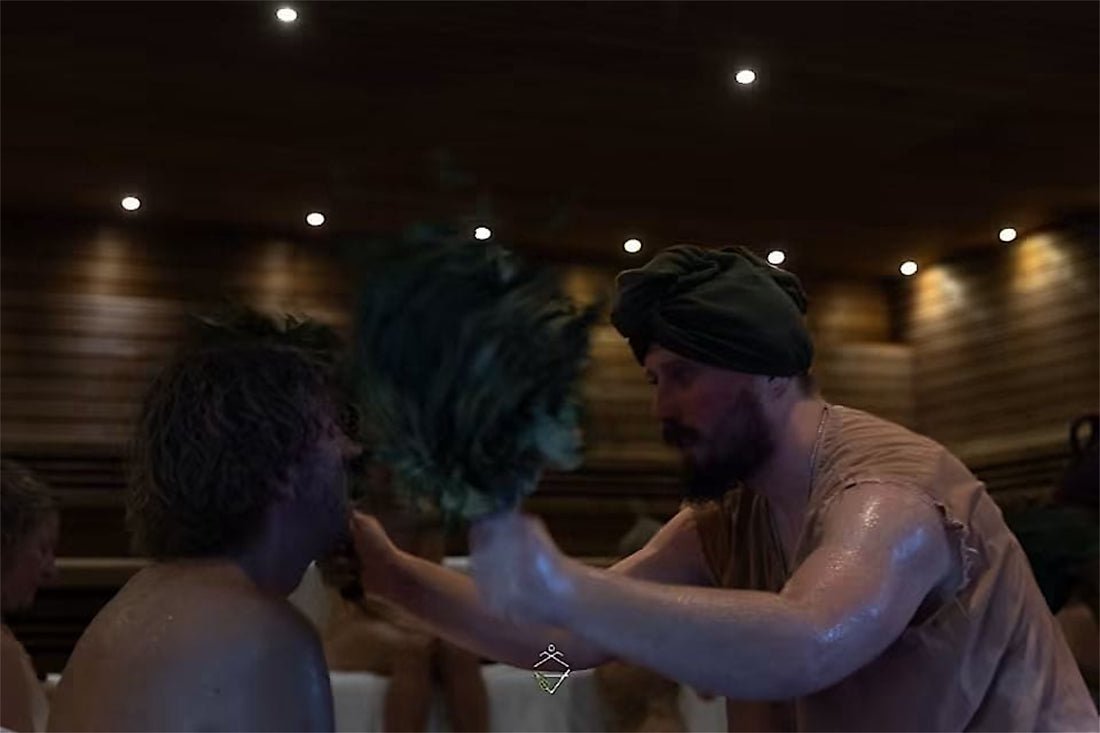
Germany’s first aufguss guideline, published in May 2011, looked back on the change. “Until 20 years ago,” it said, aufguss played only a minor role in German sauna bathing, usually lasted a few minutes “and was also performed by sauna guests.” By 2011 it was one of the main reasons people visited, and in public saunas staff did it, according to the German insurers’ report from 2016, which quotes the guideline’s foreword (translated from German).
The judged show took off after 2005
The Sauna-Bund’s own history puts the boom in the 2000s. A survey of more than 23,000 guests at nearly 200 public saunas first showed aufguss as the trend that “by the end of the decade would drastically change” what saunas offered, and German saunas moved from health-focused bathing toward entertainment, it wrote in a 2024 history of the association (translated from German).
In the 2010s, “the trend that had begun in 2005” became the basis of how saunas run, the association wrote. It answered with the aufguss guideline, staff training and a German aufguss championship, first held in July 2015 at the Bora Sauna in Radolfzell, on Lake Constance, and run by its subsidiary Sauna-Matti, according to the championship’s website.
Italy’s sauna association, AISA, gives one venue’s account: it dates aufguss “as we know it today” to December 22, 2005, when two staff members put one on to entertain guests at CRON4, a sauna center in Reischach near Bruneck, South Tyrol, according to AISA’s competitions page.
The same center held the first Italian aufguss championship on March 24, 2007, with 14 contestants, and in 2011 a contest it billed as the first world championship, with 22 contestants from seven nations, according to CRON4’s championship history.
It wasn’t the first to use the title. Austria’s Sauna-WM crowned a “world champion of the experienced aufguss” at a thermal spa in Fohnsdorf in September 2009, with competitors from Austria, Germany and Belgium, the organizers announced at the time. After a debate with organizers of comparable events, CRON4 renamed its 2012 contest the International Aufguss Trophy.
The Aufguss WM in its current form dates from 2013, when the SATAMA resort in Brandenburg built a 160-seat sauna theater for a championship with more than 50 competitors from 18 nations. Six national groups founded the organization in South Tyrol in January 2014, and it became a registered association in 2017. For 2026, it listed national competitions in 18 countries, the US among them. It puts “a lot of value” on aufguss as a health ritual, with entertainment “an addition and support,” according to the association’s About page.
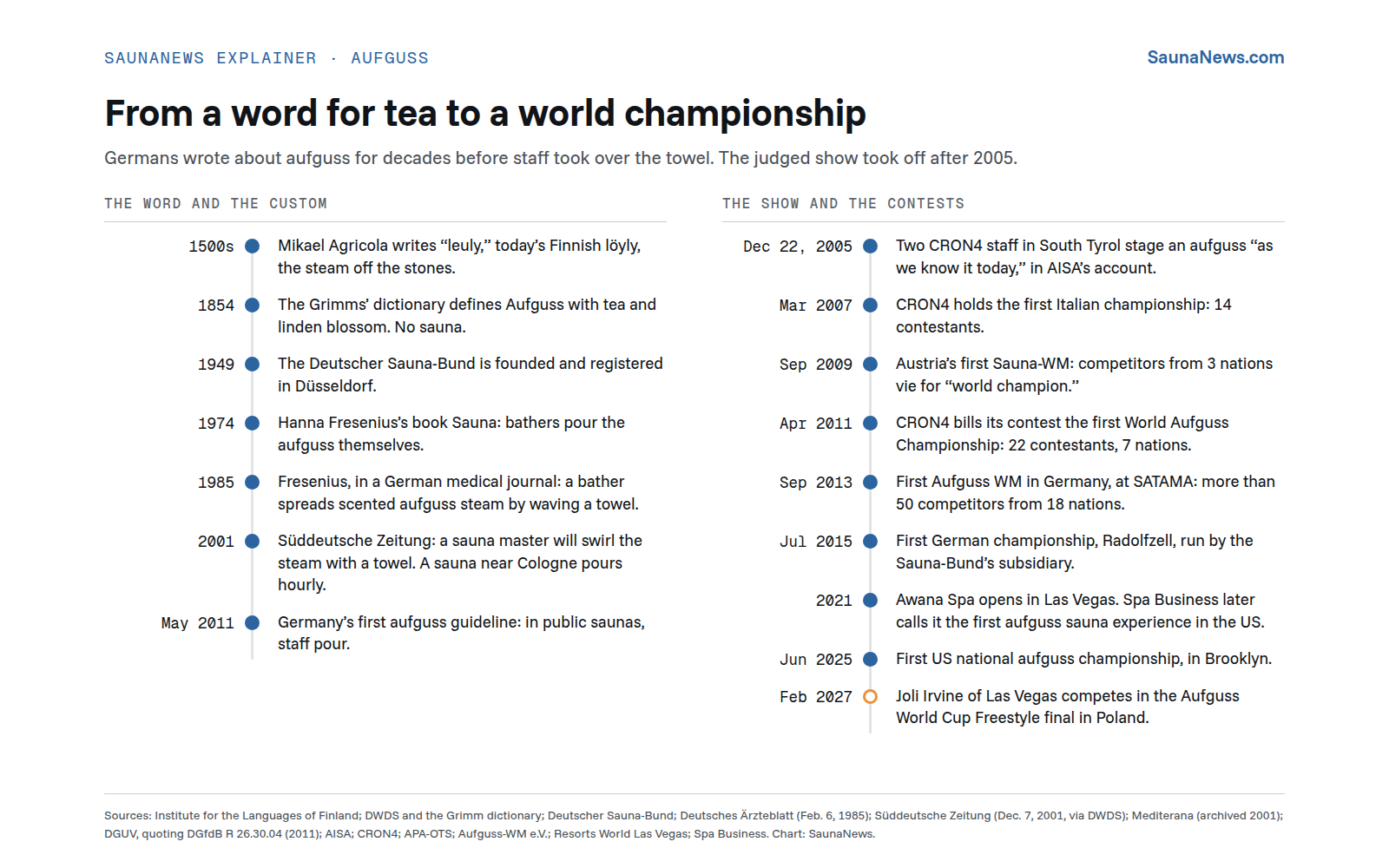
Today there are four separate world championships.
In German saunas, aufguss runs on the hour
Just under 31 million Germans called themselves sauna-goers before the pandemic, and 16 million of them used public saunas, the Sauna-Bund told the news agency dpa, as reported by t-online in 2022. In a 2018 Sauna-Bund survey of sauna staff, 65 percent said their saunas held an aufguss every hour and 18 percent every half hour, according to the association’s conference slides, which don’t give a sample size.
The biggest spas run them all day. Therme Erding, near Munich, counted about 140 aufguss and health sessions a day across its 34 saunas and steam rooms in 2018, for 1.8 million guests a year, according to its facts and figures.
What judges score
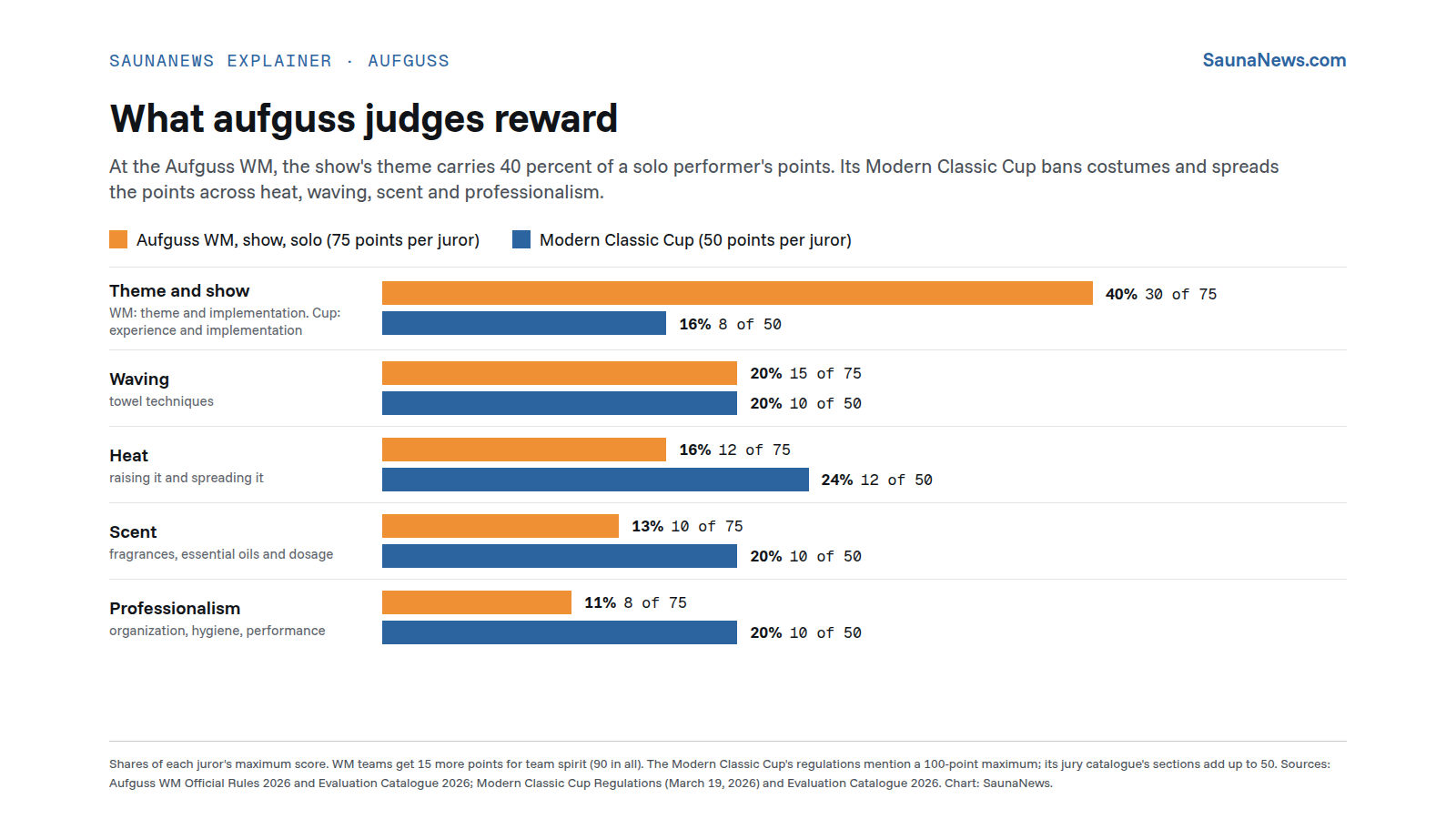
At the Aufguss WM, a show runs 12 to 15 minutes including the welcome and farewell, with 14 the ideal, and a spoken welcome may take 90 seconds at most, according to the championship’s 2026 rules.
Six jurors sit in the sauna, and if guests leave because of the heat, that costs points. The jurors look for heat that builds through the rounds to a “heat shower” at the end, at least three natural aromas they can smell and a theme they can follow, and they take off half a point for each dropped towel, according to the championship’s evaluation catalog for 2026.
The same organizer’s Modern Classic Cup allows only ice with essential oils, bans costumes and allows a fan for two minutes at most. The Aufguss World Cup Freestyle, a head-to-head format, bans raising the heat between rounds and says ice, water and towels must never touch the guests, according to the competition’s rules.
House rules: sit down, keep quiet, leave if you need to
The Sauna-Bund’s guide for its annual Sauna Day spells out the etiquette. Only staff should pour, “because the use of infusion products has to be learned.” It’s polite to sit and watch, out of respect for the person pouring. Loud talking is out, and so are scraping off sweat, brushing, and photographing or filming other guests. A towel goes under the whole body. The guide suggests 8 to 12 minutes in the sauna, 15 at most, according to the guide’s 2018 edition.
Nothing in the Sauna-Bund’s guidance obliges a guest to stay to the end. Its sample schedule tells bathers to move to a lower bench or leave if they stop feeling well, and its FAQ says sensitive people can skip aufguss altogether, since “a sauna bath without aufguss is fully effective.” EOS’s guest guide warns that a 12- or 15-minute special aufguss may be too strenuous on a first visit, and tells guests to leave at once if they can’t take it, even if others grumble about the open door.
Heart patients should skip it. Germany’s heart foundation, the Deutsche Herzstiftung, says aufgüsse are “generally taboo” for all heart and circulation patients, and that people with heart failure should keep to 140°F to 158°F through a long adjustment period, according to a press release from 2020.
A 2001 review in The American Journal of Medicine lists unstable angina, a recent heart attack and severe aortic stenosis as reasons not to bathe, and says drinking alcohol in the sauna raises the risk of low blood pressure, arrhythmia and sudden death, according to the review by Hannuksela and Ellahham.
No peer-reviewed study we could find has measured how bathers’ bodies respond during a towel-waved aufguss. The Sauna-Bund ran trials with volunteers, including medical measurements, at the Donaubad in Neu-Ulm in July 2024 to set its new water limits, but it hasn’t published the results, according to the association’s announcement.
The closest published work is a 2026 Finnish study of 50 adults who threw their own water, published in the journal Temperature: their heart rate rose by an average of 41.6 beats a minute in the sauna, and higher humidity was linked to a faster heart rate independently of temperature. Its saunas averaged about 140°F, far cooler than a German aufguss room, and Harvia, the Finnish heater maker, provided the saunas and measurements and paid the publication costs; Toyota partly funded the measurements.
Where Americans can try one
Spa Business called the event sauna at Awana Spa, Resorts World Las Vegas, the first aufguss sauna experience in the US. The spa opened in 2021, and its launch release from Resorts World promised that aufguss “will make its U.S. debut” there.
Design for Leisure, the firm that built the sauna, later founded Aufguss USA, now the official US member of the Aufguss WM and the organizer of two national competitions, according to its About page.
The first US national championship was held in Brooklyn in June 2025, according to the Aufguss WM’s national results.
WorldSprings in The Colony, Texas, runs more than 30 sessions a week for about 50 people each, included with a soak reservation, and more than 25,000 guests have now sat through one.
Las Vegas sauna master Joli Irvine of Lapis Spa & Wellness at Fontainebleau Las Vegas will compete in the Aufguss World Cup Freestyle final in Poland in February. Grotto Baths in Miami lists guided aufguss in a ceremonial sauna that runs up to 185°F, according to its bathing menu.
The people waving the towels train privately. The US has no government credential for the job, and private US courses start at two and a half days.
Before a first aufguss: a warm shower and the middle bench
Moeller, who teaches aufguss courses in the US and describes himself as a four-time national aufguss champion, gave SaunaNews his advice for a first session:
- Arrive a few minutes early and shower first. Make it a warm shower, not a cold one, especially after a chlorinated pool. A cold shower or plunge beforehand makes it harder for the body to start sweating.
- Sit low to middle. The middle bench is the safe choice, with good scent and warm air. The bottom bench is the hardest for a sauna master to look after.
- Leave whenever you need to. Any reason is fine, but don’t come in late or go back in mid-round: guests outside can’t tell whether you heard the safety briefing, and they may follow you in.
- Pause before the cold. He teaches the cycle as heat, pause, cold, rest: rinse off and let your breathing and heart rate settle first.
“Taking a cold shower before an aufguss is like putting your frying pan in the freezer before you sear a steak. It only takes longer to heat up, and you never get the result you came for.” Thorsten “Thor” Moeller
“Heat rises on its own. Anyone can make the top bench hot. Bringing that heat down to the lowest bench, evenly, without burning the people at the top: that’s the real craft, and it’s where you see who is an aufguss master.” Thorsten “Thor” Moeller
A classic aufguss is quiet
A good aufguss is measured by the guests, not the heat, Moeller said. The sauna master pours for a heat that suits the room and the scent, circulates the air along the ceiling so it reaches every corner, brings it down so every guest gets heat, then moves it at every level to break the still layer of air around the skin.
A classic, as he describes it, uses one bucket of water, a bowl of three ice balls with one essential oil in each, one towel and the four classic towel techniques. There is no fan, music, smoke, whisks or tea. Nobody speaks after the introduction, the sauna master included, and nobody claps at the end.
“A true classic has nothing to hide behind: one bucket, one towel, three ice balls and silence. No music to carry you and no applause at the end. If it was done well, the quiet as people leave says everything.” Thorsten “Thor” Moeller
What an operator needs before adding aufguss
German guidance puts most of its rules on the staff. A sauna master must be at least 18, keep first aid and CPR training current every two years, perform clothed and refuse guest requests that break the limits, according to the guideline draft. One person should lead no more than one aufguss per working hour, though extra sessions under 6 minutes can be allowed after a risk assessment. The person in charge needs a Sauna-Bund Saunameister certificate or at least 50 hours of comparable classroom training.
The work is hard on the body. In the insurers’ 2018 test, the sauna master’s heart rate peaked at 131 to 150 beats a minute over four rounds, up from the 80s before each one. Their staff rules call for at least 10 air changes an hour in the sauna room, up to 20 when needed, and heaters built so the water can’t hit the heating elements.
The room matters too. The guideline wants open floor between the heater and the benches, nothing built in that gets in the way of waving, and bench tiers at least 31 inches deep, counting the seat and the room for the feet, or 24 inches for the top bench. A heater in the middle of the room works best. Aufguss Roots USA’s checklist adds a heater made for water pours, a floor drain, and enough height for towel work.
Check the local health code before scheduling one
Local rules can get in the way, so ask the health department before adding sessions. New York City’s health code bars “pouring water on heater or heating elements” during operating hours at bathing establishments and caps sauna rooms at 194°F; it doesn’t mention aufguss, according to Article 165 of the city health code.