From One Day in Denmark to 1,320 Hours in Lithuania: How the World Trains Its Sauna Masters

Research, standards and the sauna industry
- Published
- Reading time
- 15 min
SaunaNews is published by SaunaShare, Inc., which also runs SaunaShare.com and SaunaMarketplace.com, where we sell many of the products we write about. That experience may change what we write about and what we don't. Who owns SaunaNews
Hungary requires a certified sauna master for sauna programs in public baths, Latvia and Lithuania award state qualifications, and Japan has certified 50,201 people by mail. Most US courses take three or four days. A country-by-country guide to aufguss and sauna-ritual training.

In this story11 sections
- 01Courses run from eight hours to 1,320
- 02Hungary made the certificate a legal requirement
- 03Latvia and Lithuania teach bath masters as a trade
- 04Finland has no state sauna qualification
- 05In Germany, an association issues the certificates and the title isn’t protected
- 06Italy and Poland examine candidates in front of real guests
- 07Denmark trains gusmestre in a day
- 08Japan certified 50,201 people by mail
- 09Champions fly in to train new teams
- 10In the US, the rules cover the room, not the sauna master
- 11Before you hire or train a sauna master
Hungary is the one country in this guide where the law requires a certified sauna master. Since March 2024, its public baths may run sauna programs only under the coordination of staff who hold the state-recognized szaunamester qualification, which takes a four-day course and an exam that ends with the candidate leading a 30-minute session.
In most other countries, how much training stands behind the person waving the towel is the operator’s call. A Danish sports federation, DGI, teaches gusmestre in a single eight-hour day. Lithuania’s state program for new bath masters runs 1,320 hours. Japan’s national sauna association has issued 50,201 certificates through a mail-order course. In Germany, the Deutscher Sauna-Bund finishes its five-day course for sauna operations managers in Bielefeld today. Its certificates are one way into the German aufguss championship, but German law requires none of them.
In the US, no federal rule or model health code addresses who may lead a sauna session. The US certification courses with published prices take three or four days and cost $1,495 to $1,895, and two of them are built on a German academy’s curriculum.
Courses run from eight hours to 1,320
Sauna-master training in 15 countries
| Country | Main credential and who issues it | Training | Cost |
|---|---|---|---|
| Hungary | Szaunamester, a state qualification, required for sauna programs in public baths | 4 days (40 lessons), then a written and live exam | About $500 to $550, plus about $180 to $215 for the exam |
| Latvia | Pirtnieks and pirts meistars, state qualifications awarded by one accredited school | At least 480 to 960 hours | Private pirts courses: about $890 to $2,230 |
| Lithuania | Pirtininkas, a state qualification since 2020 | 1,320 hours for a first qualification; 900 hours for career changers | About $5,440 for the 1,320-hour program; the employment service has paid it for job-seekers |
| Czechia | Sauna attendant, a state qualification since 2013, with one authorized examiner | A 4-to-5-hour exam; private ceremony courses from 2 days | Two-day ceremony course: about $305 |
| Germany | Saunameister, a Deutscher Sauna-Bund certificate | 78 hours over about two weeks | About $1,170 to $1,335, exam included |
| Austria | Saunawart, defined by the national standard ÖNORM S 1150 | 24 units of about 50 minutes, including one on aufguss | About $645 to $800 |
| Switzerland | Dipl. Saunameister, a Schweizer Sauna Bund diploma | 10 days, at least 80 hours including self-study | About $2,000 to $2,350 |
| Italy | Aufgussmeister, an AISA diploma | 40 hours, then 12 supervised sessions with real guests and exams | About $835 to $1,075 |
| Poland | Saunamistrz, a Polskie Towarzystwo Saunowe certificate | A weekend to a month of workshops, then an exam in front of guests | About $240 to $420, plus $18 to $38 for the exam |
| Netherlands | No national credential; trade-association and private courses | 1 to 6 days | About $67 to $995 |
| Denmark | Gusmester course from DGI, one of two national sports umbrella groups | 8 hours | About $280 to $365 |
| Finland | No state qualification; a trademarked course for traditional sauna hosts | 187 hours | About $2,390 |
| Japan | Sauna Spa Health Advisor and Aufguss Master, Japan Sauna-Spa Association | Mail-order course; about six months for Aufguss Master | About $32; about $870 |
| United Kingdom | No national credential; private courses, including one accredited by the Beauty Guild | 2 to 3 days | About $565 to $925 |
| United States | No government credential; private certificates | 3 to 4 days | $1,495 to $1,895 |
Dollar figures use the European Central Bank’s reference rates for October 29, 2026.
Hungary made the certificate a legal requirement
Hungary’s government decree 510/2023 on public baths covers every public bath, sauna and steam bath. Section 12 says sauna and steam-bath programs may be organized “only under the coordination of staff holding a sauna-master qualification” (our translation). The same section caps saunas at 212°F and steam rooms at 122°F. Qualifications earned before the rule took effect still count.
The course is a national vocational program run by licensed adult-education providers. At WSZFI in Budapest, it takes four days, 40 lessons, at Aquaworld Budapest and costs 180,000 forints (about $547), plus about 70,000 forints (about $213) paid to an independent exam center. The exam has two parts: a 40-question written test with an 80% pass mark, then a 30-minute session the candidate designs and leads, scored equally on professionalism, heat, scent and fanning. Endangering a guest is an automatic fail. The curriculum includes a list of English phrases for sauna masters.
“My goal in the basic course is to pass on the SzaunaSzeánsz philosophy and the ability to create a successful sauna experience, not just to show towel acrobatics, because that’s not the hard part,” trainer Gitta Ruszkabányai writes on the course page (our translation).
Latvia and Lithuania teach bath masters as a trade
Latvia lists two state qualifications for work in the pirts, the Latvian sauna: pirtnieks, or bath attendant, at level 3 of the European Qualifications Framework, and pirts meistars, or bath master, at level 4. They require at least 480 to 960 hours of full-time study, depending on the qualification and entry route, and the national register names one awarding school, Pirts skola in Riga. A pirts meistars, the register says, assesses a client’s physical and emotional condition and plans individual sauna procedures.
About 3,000 people have completed Latvia’s large amateur pirts schools, most of them to steam their own families, Aija Stepanova of the Latvju Pirts un spa asociācija told Santa.lv in September. Private courses cost about €800 to €2,000 or more (about $890 to $2,230), one pirts school says. The Latvian Bath Union runs an ethics code, and a certified member who breaks it must be certified again. Its chairman, Uldis Rudzītis, told Latvian Radio in 2024 that the law requires no certificate and that sitting through some course is enough.
Lithuania made pirtininkas, bath master, a level IV national qualification in 2020. The state vocational program for a first qualification runs 33 weeks and 1,320 hours, and a Kaunas training center prices it at €4,888.70 (about $5,440). The center’s fall 2026 schedule lists a 900-hour version for people changing careers, at €4,021.31 (about $4,475). Lithuania’s employment service has paid the full fee for eligible job-seekers.
The Lithuanian Bath Academy, which calls itself the country’s first bath school, began in 2003 with a course taught by a Latvian healer and reworked its program in 2020, when the state standard was adopted, so graduates could sit the state exam. Its own final exam has candidates run a group procedure of up to 20 minutes and an individual client procedure of up to 30 minutes in front of at least three examiners, who score the sauna’s atmosphere, group work, individual work, whisking and body work.
Americans already take the Baltic route. The academy taught a 12-hour bath-master course in English at Cedar Grove Sauna in Montville, Maine, in May 2023. Two of the eight trainees on a five-day English-language course in Latvia, run by the Belgian company Pirts Spirit in February 2025, were American, according to a British participant’s account published by the British Sauna Society. The course cost about €1,700 (about $1,890).
Finland has no state sauna qualification
Finland has 3.3 million saunas for 5.5 million people, by UNESCO’s count, and no vocational qualification with “sauna” in its name in the national register. The title saunamestari is honorary. The Saunamestari Kilta guild confers it, and nobody can apply. There were 23 living holders in 2020, the Finnish Sauna Society reported.
When Finland held what Yle called its first whisking course, in 2015, it was taught by a Lithuanian whisking professional. The Finnish Sauna Society ran it with the Lithuanian academy over three weekends. In June 2026, Finland added perinnesaunottaminen, traditional sauna hosting with folk-healing roots, to its national list of living heritage. The 187-hour Perinnesaunottaja program, which trains these hosts, is in its seventh year and costs €2,150 including VAT (about $2,390). Graduates may use the trademarked title.
In Germany, an association issues the certificates and the title isn’t protected
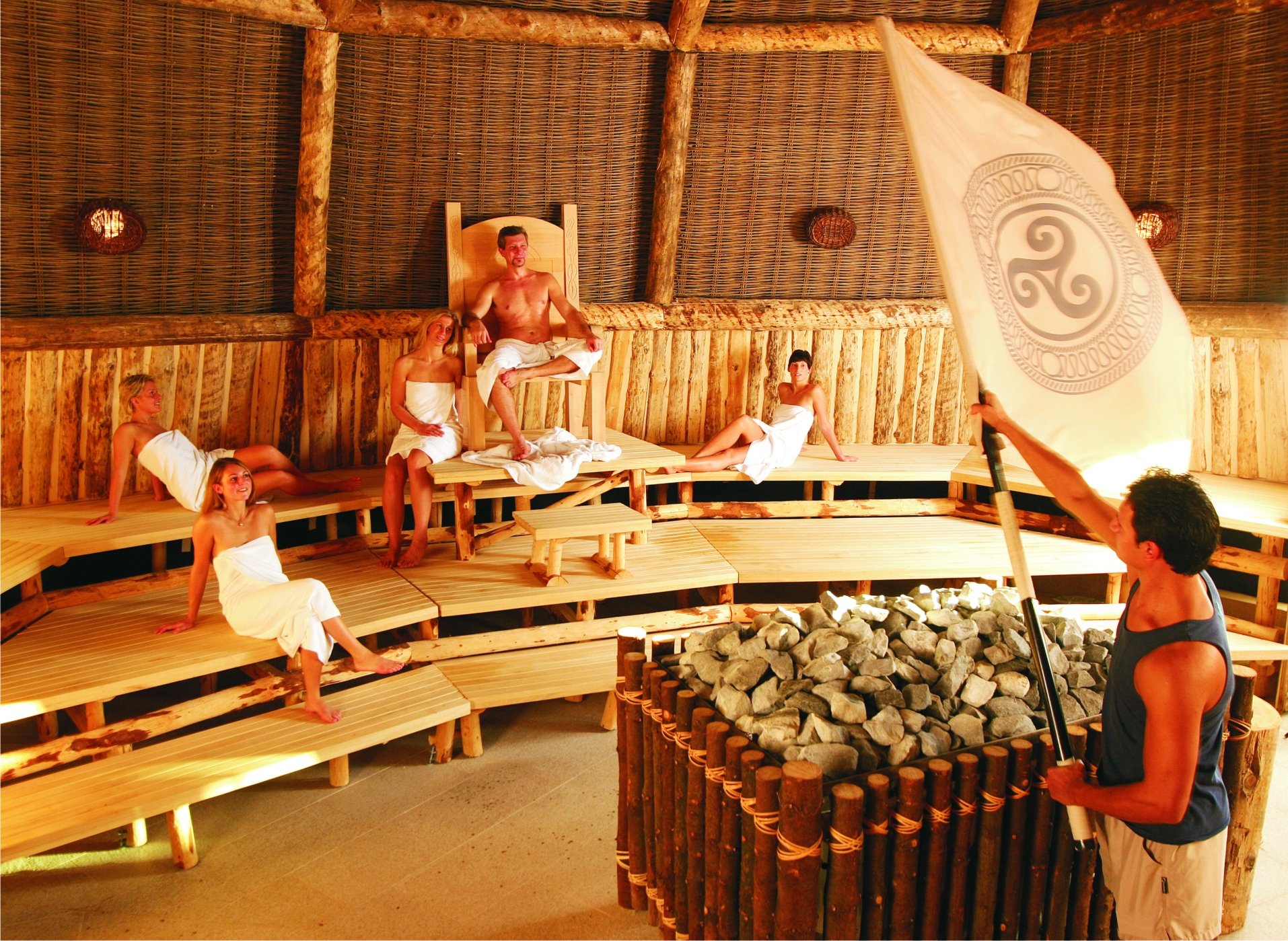
Germany’s state-recognized pool apprenticeship, Fachangestellte für Bäderbetriebe, takes three years. Neither its training regulation nor the master’s exam that follows mentions saunas. “Saunameister” is currently not a state-recognized training occupation in Germany, the aufguss academy Aufguss Roots tells prospective students (our translation).
The Deutscher Sauna-Bund, founded in Bielefeld in 1949, fills the gap with association certificates. Its Saunameister course runs 78 hours over about two weeks and costs members €1,050 to €1,199 (about $1,170 to $1,335), including a €100 exam fee. There are no entry requirements. About 60 people took the course in Kempten last November and nearly 50 completed it in Bielefeld in February, according to Sauna-Bund posts relayed by the German trade news site Sauna Wellness Update. The operations-manager course that ends today, 40 lesson hours at €1,080 for members, assumes participants have finished the Saunameister course.
The certificates matter inside the industry. The Sauna-Bund’s entry-level seal for public saunas requires supervision “by a Saunameister or other qualified staff” (our translation). A Sauna-Bund subsidiary, Sauna-Matti GmbH, owns the German Aufguss Championship, and entrants prove their skill with an employer’s letter or a Sauna-Bund certificate. Aufguss WM e.V., the world championship’s governing body, is registered at the Sauna-Bund’s street address in Bielefeld. In December 2025, the joint sauna committee of the Sauna-Bund and DGfdB, the German bath association, reissued its aufguss guideline, which covers staffing and the qualifications aufguss staff need.
Private academies teach the show side. Aufguss Roots says it has trained more than 3,500 aufguss staff across Europe since 2013 in three-day modules of at most 10 students, at about €595 to €625 (about $660 to $695). Its trainers include Hendrik Bißlich, a German who won this year’s team world title competing for Czechia. The 2026 German singles champion, Lennart Kloß, came up through the state pool apprenticeship at Thermen & Badewelt Sinsheim, which he started at 16, and has built his show-aufguss skills since qualifying in 2024, his employer said.
Austria comes closest to a legal floor. Its bath-hygiene law requires a sauna operator to have someone reachable during opening hours who is responsible for guests’ health and has “the corresponding knowledge” (our translation). A voluntary national standard, ÖNORM S 1150, sets out the usual course for a Saunawart. The customer-facing version runs 24 units of about 50 minutes, and one of them covers aufguss techniques, show aufguss included. The economic chamber’s WIFI institutes teach it for €580 to €720 (about $645 to $800), in some states with the exam fee on top. WIFI Tirol adds a four-level aufguss course, and its first level is taught by Mark Zipperle, who won Austria’s show-aufguss singles title in 2025.
Switzerland has “no regulated training,” its official careers portal says (our translation). The Schweizer Sauna Bund, founded in 2022, built a five-level system. Its Saunameister diploma takes 10 days and at least 80 hours, counting self-study, ends with a practical exam leading a structured aufguss, and costs CHF 1,655 for members or CHF 1,946 for others (about $2,000 to $2,350). The association says more than 300 people have trained with it. It is preparing an English-language version, Certified Saunamaster; registration hasn’t opened.
Italy and Poland examine candidates in front of real guests
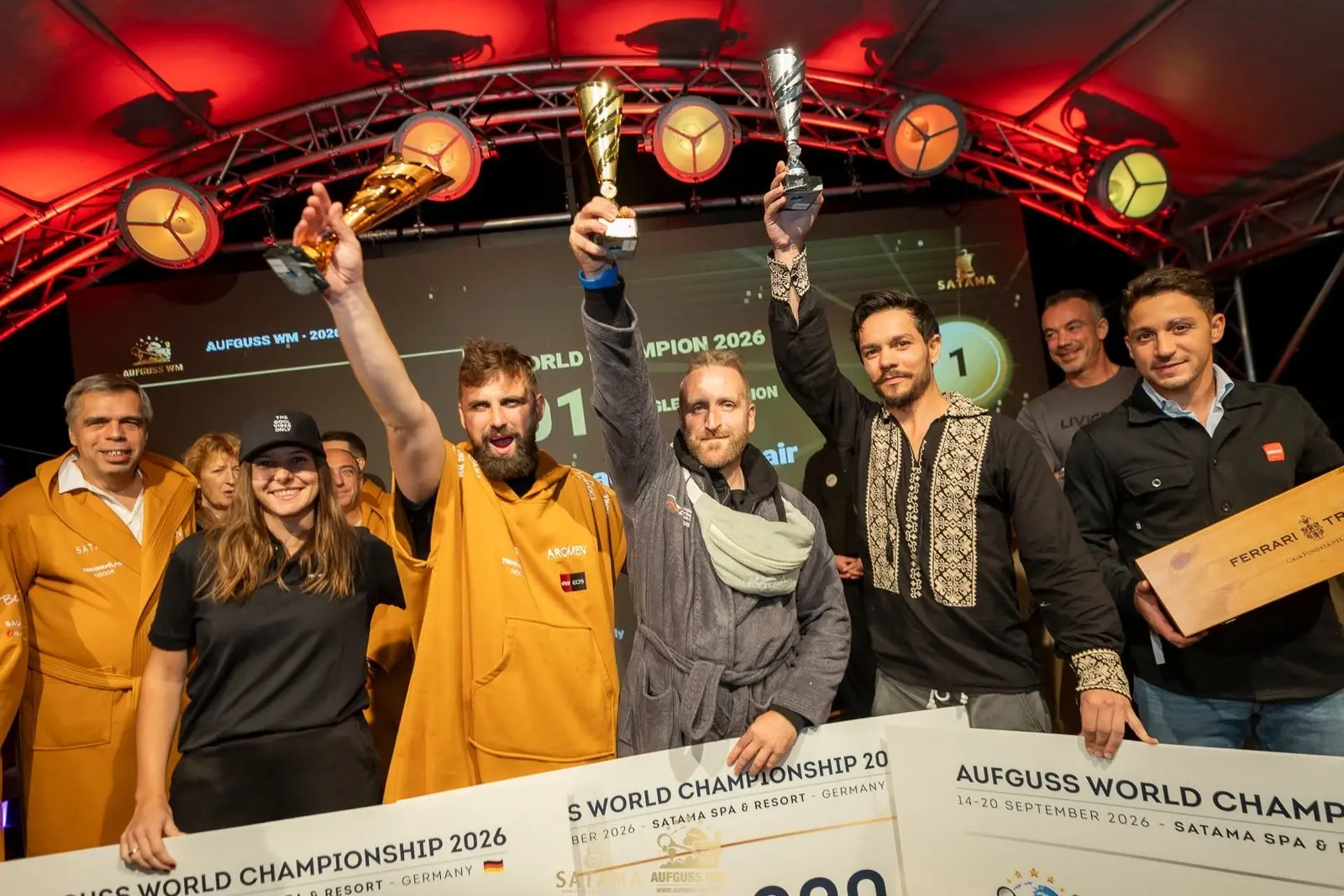
Competitors representing the Netherlands, Poland, Czechia and Italy have won 22 of the 24 Aufguss WM world titles awarded since 2014, by our count of the organizer’s results. None of those countries has a state credential that tests towel work. Associations and employers do the testing, and the scoring criteria of aufguss’s world championships turn up in their course outlines.
Italy’s AISA, the Associazione Italiana Saune e Aufguss, works like a licensing body. Its diploma requires a 40-hour course, 25 hours of theory and 15 of practice. Trainees then run 12 supervised sessions for a venue’s real guests, 10 aufguss and 2 steam-room scrubs, at three or more venues, with at least half of the aufguss done solo. A 50-question test and a practical exam follow within 12 months. Courses cost €750 to €965 (about $835 to $1,075), and a November exam notice says the test is in Italian only. Annual dues include liability insurance for working members.
The rules reach the towel. It must be white, unsewn and about 55 by 35 inches to 59 by 39 inches, and trainees carry a spare in case one hits the floor. AISA’s public directory lists 715 aufgussmeister. Japan’s new aufguss school adopted its curriculum.
Poland’s Polskie Towarzystwo Saunowe certifies only graduates of its licensed trainers. A three-person commission has the candidate draw five questions and answer four correctly, then watches the candidate prepare and lead a classic ceremony alone in front of the facility’s guests. The exam costs 70 złoty for members and 150 for others (about $18 to $38). Courses that feed the exam run from a weekend intensive to a month of workshops and cost about 950 to 1,650 złoty (about $240 to $420).
Czechia has a state qualification, sauna attendant, registered since 2013, and the national register lists one authorized examiner for the whole country. The four-to-five-hour exam has candidates give first aid to a fainting stand-in, fill in the operations log and sell admission on a cash system. Ceremonies are examined orally, and no towel work is tested. Czech chains train their own staff. Infinit puts each new hire through a 40-to-60-hour course that ends in an exam and a trial shift, Deník reported in 2022.
In Belgium, VIVES University of Applied Sciences in Kortrijk builds a sauna-master certificate into its bachelor’s degree in wellness and spa management. The practical sauna-and-hammam exam is 80% of the course grade, and students must bring a paying client to it or lose two points. In the Netherlands, the trade association VNSWB opened an academy this year with one-day classes at €75, and every 2026 class is full. Sigrid van Rijswijk, the Dutch 2025 world singles champion, teaches two-day courses through her company, Aufguss Creations, at a sauna just over the German border, from €425 (about $475), in English unless the whole class speaks Dutch.
Denmark trains gusmestre in a day
Danish winter-bathing clubs roughly tripled their membership in ten years, to about 75,000 across 188 clubs, DR reported in 2024. Clubs such as Odder Vinterbadeklub send their gusmestre, who lead saunagus, the Danish aufguss, on a course from DGI, one of Denmark’s two national sports umbrella groups. The eight-hour course, sold as “become a gusmester in one day,” costs DKK 1,895 for members and DKK 2,460 for others (about $280 to $365). Private courses at Copenhagen-area saunas such as Sauna85 and Iluma cost about DKK 2,000 (about $300).
“Gusmester is not a protected title,” the course page at Gusmester.dk tells students (our translation). Denmark has held a national saunagus championship since 2004. Some Copenhagen operators write their own curricula; Plugin Heat Club trains facilitators through its own seven-module course, which ends with an assessment on real guests.
Japan certified 50,201 people by mail
Japan’s biggest sauna credential costs ¥5,000 (about $32) and never requires a classroom. The Japan Sauna-Spa Association’s Sauna Spa Health Advisor course is done entirely by correspondence, and 50,201 people had passed it by March 31, according to the association’s annual report. New sign-ups have fallen every year, from 11,600 in fiscal 2022 to 4,470 in fiscal 2025. The next tier, Sauna Spa Professional, covers facility management, including Legionella prevention, for ¥15,000 (about $95); 4,823 people hold it.
The association is blunt about its older certificates. A slide from a talk by its managing director, Yukitaka Yoneda, printed in the association’s newspaper in July, lists their problems as “centered on theory, technical knowledge only,” no link to international standards and “weak brand power” (our translation). Its answer is the Sauna Master Academy. The first Aufguss Master course opened in November 2025: about six months, ¥137,000 including tax (about $870), and a curriculum taken from Italy’s AISA, with instructors who have all competed at the Aufguss WM. The final exam is 15 minutes alone in a sauna room with paying guests, scored by three judges on professionalism, steam control, aroma and towel work. Of the 78 students who enrolled, the first seven were certified on July 16 and 17.
Japan’s homegrown alternative is the neppashi, or heat-wave master, a word coined in 2009 at a Yokohama bathhouse for Katsumasa Inoue, a professional wrestler who left the ring later that year. The Japan Sauna Neppa Aufguss Association charges ¥26,400 (about $167) for its entry exam. It says about 3,000 people have taken its exams since 2019, about 80% with no experience, and since April its top certificate expires after two years. Its exam page sums up the job in one line: “Before the wind, look at the guest” (our translation). Japan’s national aufguss championship asks for no certificate at all. Entrants need 100 hours of work at a Japanese sauna.
South Korea has no state credential for its bath attendants, the scrubbers of its public baths, estimated at 30,000 in 2016. The government’s register of private qualifications lists five bathing certificates for people and six for pets. None mentions saunas or aufguss.
Champions fly in to train new teams
Outside Europe, many teams learned from European champions brought in to train them. At Awana Spa at Resorts World Las Vegas, which Spa Business described as the first US aufguss program, three-time world champion Rob Keijzer and Lasse Eriksen, now the Aufguss WM’s president, spent a week training the team in 2021 with Don Genders, whose design firm later founded Aufguss USA. The new sauna masters “had watched aufguss YouTube videos” before the trainers arrived, Spa Business reported.
Canada’s Groupe Nordik brought German champion Felix Reschke to train its staff in 2024, and Aufguss Creations has posted a plan for November training visits to its Whitby, Chelsea and Winnipeg spas. Italian and British trainers taught Aufguss Australia’s April training. Lithuanian instructors ran a train-the-trainer whisking course for the Japan Sauna-Spa Association in 2022.
English speakers also go to Europe. Nate Daubert, billed as the first American to earn full certification from Germany’s Deutsche Sauna-Akademie, translated its curriculum for the US course that became Ritual Heat. Alycia Wong, Grace Edmunds and Sarah Spoto, all now working US sauna masters, took Anada’s three-day course in the UK. Another competitor told Slate he met Joli and Alexi Irvine, the two-time US team champions from Las Vegas, “training in the Netherlands.” Joli Irvine is now in the freestyle world final in Poland in February.
In the US, the rules cover the room, not the sauna master
No federal agency sets training rules for the people who lead sauna sessions. The CDC’s Model Aquatic Health Code covers pools, hot tubs and splash pads, and the Council for the Model Aquatic Health Code’s July guidance on commercial cold plunges has no sauna counterpart. The Pool & Hot Tub Alliance’s Certified Pool & Spa Operator course, approved by California’s Department of Public Health among others, has trained more than 700,000 people since 1973 in 16 hours. Its course page doesn’t mention saunas.
Where local codes mention saunas, they regulate the room and the water, not the session. New York City’s health code caps saunas at 194°F and requires a one-hour heater timer or an attendant who checks the room every 15 minutes. Its rules for sauna and steam rooms, in section 165.27, also say, “Pouring water on heater or heating elements is prohibited during operating hours.” The code doesn’t mention aufguss. Washington, D.C., requires anyone who maintains a public sauna’s cleanliness and water quality to hold a pool and spa operator card, with training built around pool and hot-tub chemistry.
Training is private. Ritual Heat, founded by three US sauna masters, sells a sauna master certification that grew out of a 2025 English pilot of the Deutsche Sauna-Akademie curriculum. It runs three days plus online prework and costs $1,695 to $1,795, and its November course in Minneapolis is sold out. SaunaMeister.com listed four-day versions in Madison, Wisconsin, and Burlington, Vermont, this spring for $1,895, ending in a written exam and a practical aufguss assessment. Revivery’s three-day REV-1 course in Tampa, $1,495, pairs aufguss with breathwork and facilitation and carries 30 CrossFit continuing-education credits. None names a regulator or outside accreditor.
“There are very few formally trained sauna masters in the US, and even in the UK where sauna culture is a little bit further along, sauna master is still an emerging role,” Spoto wrote in Badii Talk.
The competition circuit doesn’t require a certificate either. Aufguss USA, founded in 2025 by the hydrothermal design firm Design for Leisure, asks entrants for US citizenship or a year’s work as a sauna master in the US, plus a towel-waving video of up to two minutes that needn’t be filmed in a sauna. Applications for its Modern Classic category open November 1. This year, the Aufguss WM gave the US two places in each of its singles and team finals, plus a playoff place in each, more than Austria or Switzerland received.
Among English-speaking countries, the UK is furthest along on standards. The British Sauna Society has published a three-tier framework, Sauna Host, Sauna Guide and Sauna Master, with first-aid training listed at each level, and says it is working with HABIA, the UK standards body for hair, beauty and wellness, toward national occupational standards. In November 2025 it said it “isn’t directly organising training programmes.” Courses there take two to three days and cost £425 to £695 (about $565 to $925); Anada’s is accredited by the Beauty Guild and endorsed by HABIA. Insurers do some of the pushing. Members of the society’s forum report that Balens and Blythin & Brown ask for proof of training before covering a sauna master.
In Canada, Groupe Nordik trains its “ritual artisans” in-house. “I’ve been doing Aufguss for around 8 months,” Jad Maalouf said in a Nordik blog post a month before he became the country’s first national solo champion, in 2025. The new Australian Sauna Association’s charter asks operators to ensure practitioners are “trained in heat control, towel technique, and guest safety,” and its accreditation scheme is still in development.
Before you hire or train a sauna master
- Ask what the exam was. Certificates range from attendance at a one-day course to Italy’s 12 supervised sessions with real guests and Poland’s solo ceremony in front of a facility’s bathers. A course that never put the candidate in front of guests is a starting point, not proof of skill.
- Require current first aid. Hungary’s exam fails a candidate who endangers a guest, Czechia’s tests first aid for a fainting bather, and the British Sauna Society’s framework lists first-aid training at every level.
- Put the water question to your health department in writing. If your local code bans pouring water on the heater during opening hours, as New York City’s does, get the department’s reading before you schedule aufguss.
- Ask your insurer what training it accepts. Two UK insurers named on the British Sauna Society’s forum ask for proof before covering a sauna master.
- Budget for travel or a visiting trainer. Courses taught in English include Aufguss Creations in Germany, the Lithuanian Bath Academy’s courses in Norway and the UK, Anada in the UK and, once dates are set, the Schweizer Sauna Bund’s Certified Saunamaster. US courses cost $1,495 to $1,895.