
Leisurecraft Launches CT Element Indoor Sauna with Thermo Grandis Wood

By Arlene Scott
Senior Wellness Correspondent & Hospitality Consultant
- Published
- Reading time
- 8 min
SaunaNews is published by SaunaShare, Inc., which also runs SaunaShare.com and SaunaMarketplace.com, where we sell many of the products we write about. Assume that experience shapes what we cover and what we don't. Who owns SaunaNews · The ownership announcement
The Canadian manufacturer’s glass-fronted indoor sauna line starts around $7,900 USD and targets the gap between budget kits and European imports. The Thermo Grandis wood creates real trade-offs against Auroom’s thermo-aspen and Kohler’s KLAFS-engineered builds.
In this story4 sections
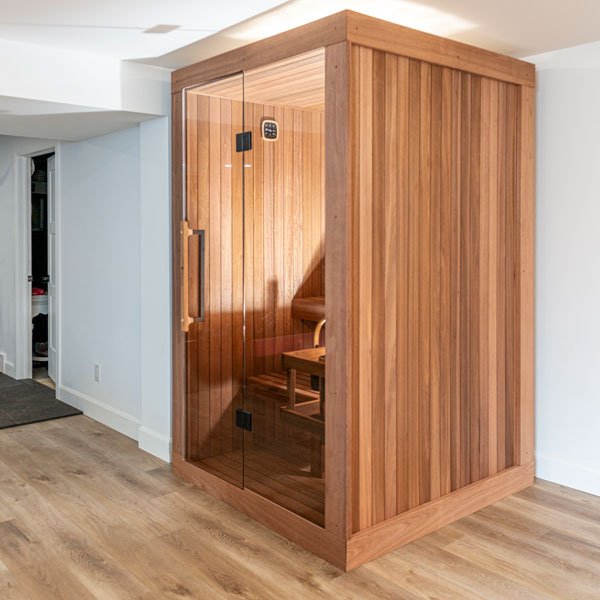
Leisurecraft, the Ontario-based manufacturer known for its barrel and cabin saunas, is launching the CT Element: a glass-fronted indoor sauna kit in three sizes, aimed squarely at homeowners who want a real sauna that looks like it belongs in a finished basement or dedicated wellness room. The line sits under Leisurecraft’s Canadian Timber Collection and represents the company’s first push into the indoor market.
The CT Element lands in the middle of an increasingly crowded field. Below it sit the familiar budget options from Almost Heaven and Costco. Above it sit the European imports from Auroom and Kohler. Where CT Element gets interesting is the wood: it is built from Thermo Grandis, a thermally modified eucalyptus that none of its competitors use, and that choice creates trade-offs worth understanding before ordering.
Key Facts
- Manufacturer Leisurecraft (Melancthon, Ontario, Canada)
- Product line CT Element indoor sauna (Canadian Timber Collection)
- Sizes Nook (54 x 54 in.), Loft (54 x 74 in.), Studio (64 x 84 in.)
- Wood Thermo Grandis (thermally modified Eucalyptus grandis)
- Glass 3/8-inch tempered, full front panel
- Walls Triple-layer construction
- Benches 20 in. upper / 15 in. lower, wide format
- Floor Complete framed base included
- Heater Electric compatible (sold separately)
- MSRP From approximately $10,800 CAD / ~$7,900 USD (Nook)
- Ships from Ontario, Canada
- Assembly Kit format, pre-framed panels
Three sizes for home use
The CT Element comes in Nook (roughly 4.5 x 4.5 feet, a two-person compact), Loft (4.5 x 6.2 feet, the mid-size), and Studio (5.3 x 7 feet, the largest of the three). All share the same material stack: Thermo Grandis throughout, 3/8-inch tempered glass on the front wall, triple-layer wall construction, a complete framed floor, and wide two-tier benching at 20 inches (upper) and 15 inches (lower).
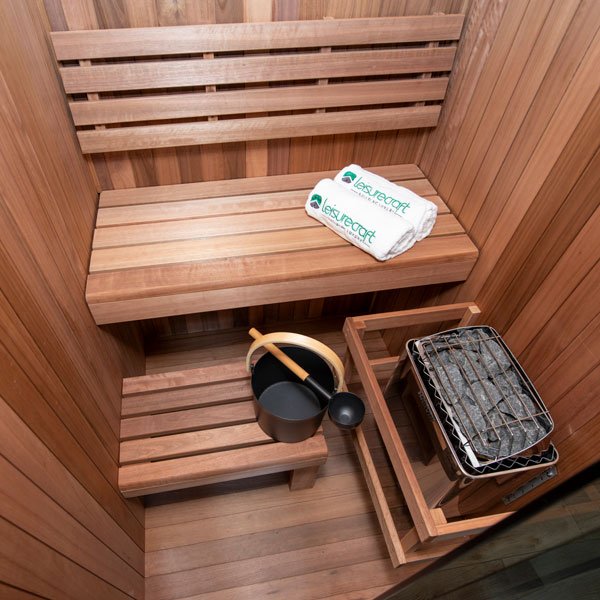
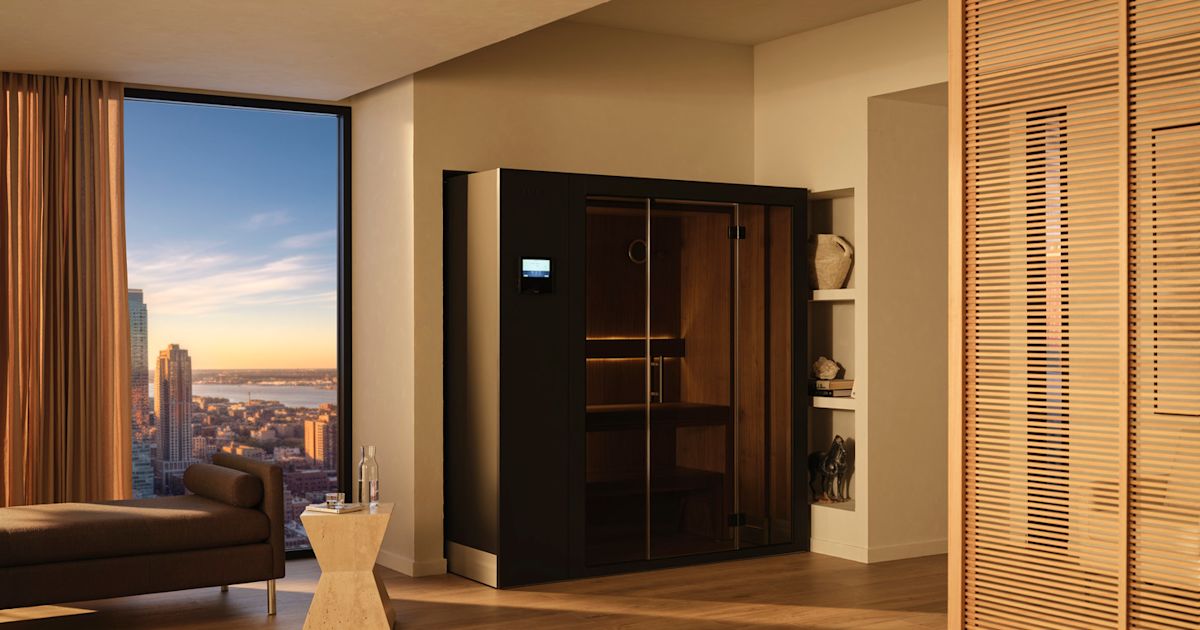
Like its competitors, CT Element is a kit sauna designed for homeowner or contractor assembly with pre-framed panels. The heater is sold separately, giving buyers flexibility to choose their preferred brand and output. The company describes the finish as “closer to furniture than equipment,” and the clean geometry and full glass front support that framing. For homeowners coming from the barrel and cabin saunas that dominate the under-$6,000 market, the CT Element looks and feels like a different category of product.
The wood: what Thermo Grandis actually is
This is where the CT Element gets interesting, and where buyers should pay attention.
“Thermo Grandis” is thermally modified Eucalyptus grandis, a plantation hardwood grown primarily in South America and southern Africa. The thermal modification process (heating to 375–450°F in a low-oxygen steam environment for 24 to 96 hours) fundamentally changes the wood’s properties. Equilibrium moisture content drops from roughly 12–15% to 4–6%. Volumetric swelling decreases by about 35%. Decay resistance improves by a wide margin.
Research at Brazil’s Universidade Federal do Espírito Santo found that fungal weight loss dropped from 34.3% for untreated eucalyptus to 6.05% after thermal modification at 430°F, an 82% improvement. The resulting wood is dimensionally stable, moisture-resistant, and carries a deep reddish-brown color that penetrates the entire board rather than sitting on the surface.
In those respects, Thermo Grandis is genuinely well suited to a sauna enclosure. It will not warp, cup, or decay the way untreated softwoods can. For a home sauna that needs to hold up over a decade or more of regular use, that matters.
But eucalyptus is a dense hardwood, and that creates a specific trade-off. Denser woods generally conduct heat faster than lighter ones, so a Thermo Grandis bench may feel warmer against bare skin than one made from a lighter species; Leisurecraft does not publish a conductivity figure for it. The thermal conductivity of a dense modified hardwood runs roughly 0.11–0.14 W/m·K, compared to about 0.09–0.10 W/m·K for thermo-aspen (the wood used in Auroom sauna interiors) and roughly 0.09 W/m·K for obeche (the bench wood in Kohler’s C1 line). For shorter sessions at moderate temperatures, the difference is subtle. For longer sits at higher heat, it becomes noticeable.
Where CT Element fits: five price tiers for indoor home saunas
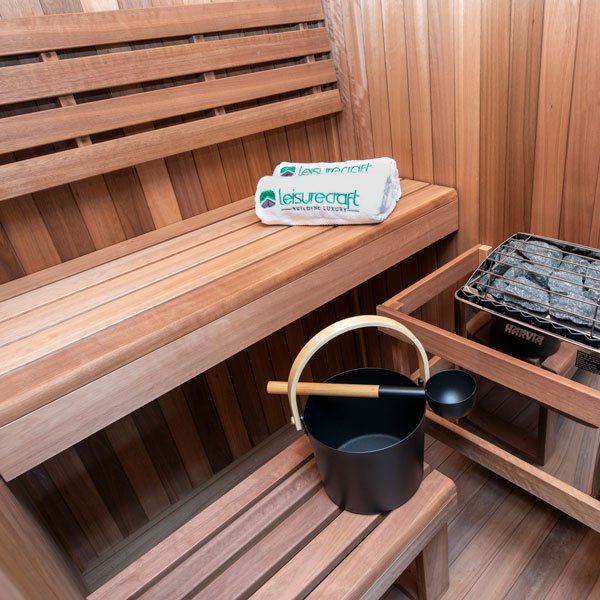
The indoor home sauna market has organized itself into five fairly distinct price tiers over the past few years. Where a buyer enters depends on budget, how much they care about materials, and how long they plan to keep using the sauna.
Tier 1: Budget kits ($2,400–$4,000). The Costco channel sells Almost Heaven models starting around $2,400 for a two-person unit. Costco lists the Almost Heaven Sutton 2-person indoor sauna in Heartwood Spruce with a 6.0 kW stainless steel heater, shipped by common carrier. For a buyer testing whether they will actually use a sauna regularly, these are a reasonable starting point.
Tier 2: Mid-market traditional ($5,500–$7,500). Almost Heaven’s direct line (now Harvia-owned) runs from roughly $5,600 for a two-person Sutton to $7,000–$8,000 for a four-person Rainelle. These use Western Red Cedar with 1-3/8-inch tongue-and-groove construction and ship with Harvia heaters. Cedar is the classic North American sauna wood: aromatic, naturally rot-resistant when new, and comfortable to sit on at high temperatures. The trade-off is that cedar’s protective oils evaporate over years of heat cycling, and its rot resistance gradually fades. These are well-made saunas from a proven lineage with a five-year warranty. They are built in West Virginia and ship from the US, which means straightforward domestic logistics.
Tier 3: CT Element ($7,900–$10,000 USD). The CT Element Nook starts around $10,800 CAD (approximately $7,900 USD), with the Studio topping out near $13,700 CAD (~$10,000 USD). The step up from the tier below buys thermally modified wood (permanent rot resistance baked into the cellular chemistry, not dependent on fading oils), triple-layer wall construction, 3/8-inch tempered glass, and a more refined aesthetic. The price gap from a $7,000 Almost Heaven Rainelle to a $7,900 CT Element Nook is narrow enough that the material upgrade is hard to argue against on durability alone. But CT Element ships from Ontario, Canada, which means cross-border logistics, potential customs processing, and potentially longer lead times than US-stocked alternatives.
Tier 4: European premium ($8,500–$13,000). Auroom’s Cala Glass is the most direct competitor to CT Element at comparable sizes. A two-person Cala Glass in thermo-aspen starts around $8,500 at US dealers; a four-person runs $12,000–$13,000 (heater not included). That puts Auroom at roughly 10–25% more than the CT Element at each size. The premium buys a lighter bench wood (thermo-aspen has lower thermal conductivity, meaning it stays more comfortable at high temperatures), mineral wool insulation with a foil radiant barrier, and the backing of Thermory, one of the world’s leading producers of thermally modified wood. Auroom saunas are made in Estonia and stocked at US distribution points, so they ship domestically despite European origins.
Tier 5: Top of market ($17,900+). Kohler’s C1 indoor sauna starts at $17,900 and runs to $25,000 or more depending on size. The C1 uses Scandinavian spruce for its enclosure and obeche for its benches, one of the lightest and lowest-conductivity hardwoods available. Kohler adds 2.1 inches of mineral wool insulation and backs the product with over a century of brand history. Kohler saunas are made in Europe through its KLAFS subsidiary (acquired January 2024) and stocked in the US. The distinguishing factor beyond materials: Kohler is the only brand in this comparison with a nationwide US installation and service network. For a buyer who wants the sauna delivered, installed, and supported by a single call, that infrastructure commands a real premium.
Getting it home: logistics and assembly
All five tiers sell kit saunas designed for assembly in a few hours with two people, basic tools, and no specialized training. The differences are in where the kits ship from and what support is available after the boxes arrive.
Almost Heaven ships from West Virginia. Domestic ground freight, straightforward returns, and a US-based customer service team. Lead times run three to six weeks depending on model.
CT Element ships from Leisurecraft’s facility in Melancthon, Ontario. That means cross-border freight, customs paperwork, and potentially longer transit times to US addresses. Leisurecraft has been shipping barrel and cabin saunas to the US for years, so the logistics path is established, but buyers should factor in the extra lead time and the possibility of border-related delays that domestic shipments avoid.
Auroom ships from European factories to US distribution centers, then domestically to the buyer. Despite Estonian origins, the last-mile experience is a US shipment. Flat-rate LTL shipping runs around $1,000 from some dealers, and some offer free delivery from their US warehouse.
Kohler ships from US stock and is the only manufacturer in this comparison that offers professional installation through its nationwide dealer and installer network. For buyers who want turnkey delivery and setup rather than a DIY assembly project, that network is a genuine differentiator, though the sauna itself is still a kit that a handy homeowner could assemble independently.
Under current trade conditions, the Canadian origin of CT Element and the European origins of Auroom and Kohler all carry potential tariff exposure. Almost Heaven’s US manufacturing avoids cross-border trade considerations entirely, though its parent company Harvia is Finnish.
Why It Matters
The home indoor sauna market has grown enough to support five distinct price tiers, and CT Element fills the gap between traditional cedar kits and European imports. For a homeowner who has outgrown the Costco-and-Almost-Heaven tier but finds Kohler’s $18,000 entry point too steep, the real decision is between Leisurecraft’s Thermo Grandis at ~$7,900 and Auroom’s thermo-aspen at ~$8,500. The price gap between the two is smaller than the gap between either and the tier below, and both deliver thermally modified wood with permanent rot resistance. The differentiators at that point are bench comfort at high heat (thermo-aspen is lighter and cooler to the touch), insulation quality (Auroom publishes mineral wool specs), and shipping logistics (US-stocked vs. cross-border).
The Bottom Line
CT Element gives homeowners a durable, modern-looking indoor sauna at a price point that sits meaningfully above the budget tier and close to the European imports. Whether the roughly $600 gap between CT Element and a comparable Auroom Cala Glass justifies the lighter bench wood and US-stocked shipping is a question buyers should answer by sitting in both. Kohler remains the choice for buyers who want a fully supported installation experience and are willing to pay nearly double for it.