FinSteam Skips the Chimney on Its 8.1 kW Propane Sauna Heaters

Research, standards and the sauna industry
- Published
- Updated
- Reading time
- 6 min
SaunaNews is published by SaunaShare, Inc., which also runs SaunaShare.com and SaunaMarketplace.com, where we sell many of the products we write about. That experience may change what we write about and what we don't. Who owns SaunaNews
The Finnish maker’s BOTNIA 81 and AURORA 81 release their exhaust into the sauna and run without electricity, so the safety work moves to the vents.
In this story5 sections
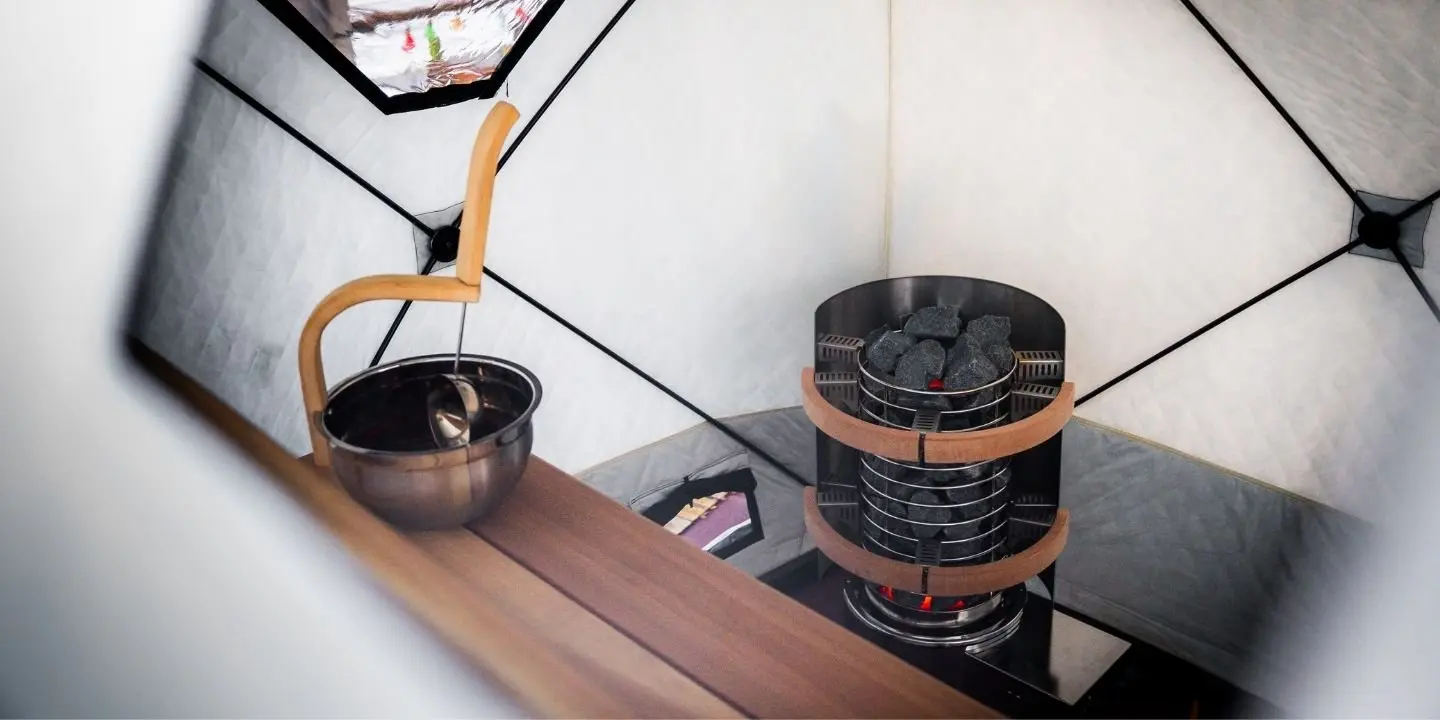
FinSteam, a Finnish company based in Pietarsaari on the west coast, makes sauna heaters that burn bottled gas and need neither electricity nor a chimney. Its two 8.1 kW models, the BOTNIA 81 and the AURORA 81, release their combustion gases (carbon dioxide and water vapor) straight into the sauna room, according to FinSteam’s technology page.
That puts a stone-heated sauna where electric and wood heaters struggle: sauna tents, barrel and garden saunas with no power line, and mobile or floating saunas. It is a different way off the grid from ThermaSol’s solar-powered Solaris sauna, and it moves the safety work to the vents. On its installation page, FinSteam says that of all its requirements, “ventilation is the most critical.”
FinSteam Ab Oy entered the Finnish Trade Register in October 2022, under the line “manufacture of non-electric domestic appliances.” Its October 2026 product catalog says the heaters are developed in Finland and Sweden and assembled in Finland from burners and structural parts made in Europe, and that its burner patent runs until 2043. Markus Käld signs the company’s EU declaration of conformity as chair of the board. FinSteam also sells pop-up sauna tents and portable benches, and it is a member of Sauna from Finland, the Finnish sauna industry association.
The design is older than the company. In 2008 the father of two of FinSteam’s founding shareholders developed the gas sauna heater its current models are based on, Toni Hannukainen, head of FinSteam’s international distributor network, told SaunaNews. Those heaters sold for almost ten years, until new EU gas appliance rules effectively halted sales of gas sauna heaters in Europe. In the early 2020s a Swede asked the Finnish team to develop a version that would meet the EU requirements, and FinSteam was founded in 2022 to do it.
Two heaters share one 8.1 kW burner
FinSteam’s datasheets rate both heaters at 8.1 kW, about 27,600 BTU an hour, burning about 1.3 pounds (0.58 to 0.60 kg) of gas an hour at full power. At that rate a standard 20-pound propane cylinder lasts about 15 hours of full-power heating, by our arithmetic.
- BOTNIA 81: the original, in five versions with different stone cages and guards, weighing 22.5 to 33.3 pounds (10.2 to 15.1 kg) without stones.
- AURORA 81: the same burner in a restyled body meant for permanent saunas, 32.2 to 39.9 pounds (14.6 to 18.1 kg). It adds an optional timer that sounds an alarm and shuts the heater off after 60 minutes.
- Stones: the largest cage holds 55 to 66 pounds (25 to 30 kg).
- Room size: 141 to 494 cubic feet (4 to 14 cubic meters), never smaller, and up to 353 cubic feet (10 cubic meters) in sauna tents and uninsulated saunas.
- Heat-up: 15 to 40 minutes, FinSteam says, depending on the room and the weather.
The heaters are certified for propane, butane and mixtures of the two. They can’t run on natural gas, Hannukainen said, though FinSteam aims to bring certified natural gas models to market. A pan or pot can sit on top of the heater’s flue for cooking, he said, and the company is developing a cooking accessory.
Lighting is manual, with a push-button piezo igniter and a control knob. The heading on FinSteam’s technology page reads “No Wi-Fi. No Bluetooth. No Software.” Its installation guide gives an outdoor operating range of −31°F to 95°F on propane, and 41°F to 95°F on butane.

The exhaust stays in the sauna, so the vents carry the load
The heaters’ EU certificate classes them as “Type A,” the European class for gas appliances that don’t connect to a flue. FinSteam says the water vapor from burning LPG raises the room’s base humidity before any water goes on the stones, and it markets that as “Humidity Balance.”
Every heater has an oxygen depletion system: a pilot flame and a thermocouple that shut the gas valve if the oxygen in the room drops too low, with no electricity involved. FinSteam’s technology page adds that it “does not replace the requirement for correctly designed combustion air and sauna ventilation.” The November 2026 installation guide sets these minimums:
- A fresh-air inlet with at least 54 square inches (350 cm²) of free area after the grille and hatch, close to the heater, its lower edge 2 to 6 inches above the floor, drawing straight from outdoors.
- An exhaust of at least 39 square inches (250 cm²), high on the opposite wall or in the ceiling, discharging straight outdoors.
- At least 59 inches (1,500 mm) between the centers of the two openings, and six to eight air changes an hour.
- Natural ventilation only. FinSteam says the heaters aren’t suitable for mechanically ventilated saunas.
- 6 inches (150 mm) of clearance to combustible materials on all sides, or 2 inches (50 mm) from a wall protected by a non-combustible cover, and 39 inches (1,000 mm) above.
- The gas cylinder outside the sauna, upright, with one cylinder per heater and a low-pressure regulator matched to the heater’s gas category.
The guide says a qualified professional must install the heater, authorized where local rules require it. It limits the heater to sauna rooms, sauna tents and other sauna structures that meet those rules, and rules out heating homes, cabins, accommodation tents, garages and workshops. It warns that a wrong installation can cause carbon monoxide poisoning and lists the symptoms.
FinSteam shared results from its certification tests, which Hannukainen said look at extreme conditions rather than a normal session in a properly vented sauna. In a closed room of about 320 cubic feet with every air inlet and exhaust shut, a heater ran at full output until its oxygen depletion system shut it off, and the readings were tracked until they stopped rising. Carbon monoxide peaked at 10 parts per million on propane and 13 on butane, and carbon dioxide at 1.5% and 1.1%. In a second test, with carbon dioxide in the room air deliberately raised to 2.1%, the heater produced 2 parts per million of carbon monoxide on propane and 5 on butane.
The certification is European
The heaters are CE-marked under the EU’s Gas Appliances Regulation. The Spanish notified body AENOR issued the EU type-examination certificate, No. A01/002220, on March 14, 2024, for a portable 8.1 kW LPG sauna heater. It is valid until 2034. FinSteam’s 2026 declaration of conformity says AENOR assessed it against a sauna-heater specification written with reference to EN 449, the European standard for domestic flueless LPG space heaters.
Tent rentals use them, and a 17.5 kW model is in development
FinSteam’s heaters are common in sauna-tent rental businesses and are also used in rental mobile saunas, outdoor saunas and barrel saunas, Hannukainen said. Most public saunas are too big for an 8.1 kW heater, he said, though a smaller one could use it.
The company’s biggest development project is a larger, 17.5 kW gas heater. FinSteam won’t promise a launch date, but it hopes the model will be ready and certified in 2027, Hannukainen said.
Sold through distributors, from about $2,000 in Europe
FinSteam doesn’t sell to consumers. The FinSteam distributor list runs from Norway to Cyprus and adds Australia and South Africa. In Sweden the list includes Marinbastun, the floating sauna builder that says it made Stockholm’s new city sauna, which is also a Sauna from Finland member.
FinSteam publishes no prices. FinSteam Benelux, its distributor for the Netherlands, Belgium and Luxembourg, lists the BOTNIA 81 R14 at about $1,980 (€1,795), the AURORA 81 R14 at about $2,200 (€1,999) and the AURORA 81 R14S at about $2,770 (€2,515), at the November 16 exchange rate. The manufacturer’s warranty runs 12 months from purchase.
Update, November 18, 2026: Added FinSteam’s history, natural gas plans, cooking use, certification test results, rental use and the 17.5 kW heater it is developing, from Toni Hannukainen’s answers to SaunaNews. The photo credits now name the photographer, Jere Harjula.
Disclosure: SaunaNews is published by SaunaShare, Inc., which also operates Sauna Marketplace, a retailer that sells sauna heaters, including propane models.