The Pellet Sauna Company Puts a Thermostat on a Wood Fire

Research, standards and the sauna industry
- Published
- Reading time
- 9 min
SaunaNews is published by SaunaShare, Inc., which also runs SaunaShare.com and SaunaMarketplace.com, where we sell many of the products we write about. That experience may change what we write about and what we don't. Who owns SaunaNews
The P1, due in June 2027, burns wood pellets from a hopper outside the sauna wall, starts from a phone and plugs into 110 volts. How it works, what a session costs, how it compares, and what to ask before paying the balance.
In this story8 sections
- 01The wall splits the stove in two
- 02Two heat exchangers to cool the exhaust
- 03A fire with its own air changes the room’s vents
- 04A session burns about a quarter of a bag
- 05It needs a plug, or a power station
- 06How it compares
- 07The listing it’s after is for room heaters
- 08Get the manual before you cut the wall
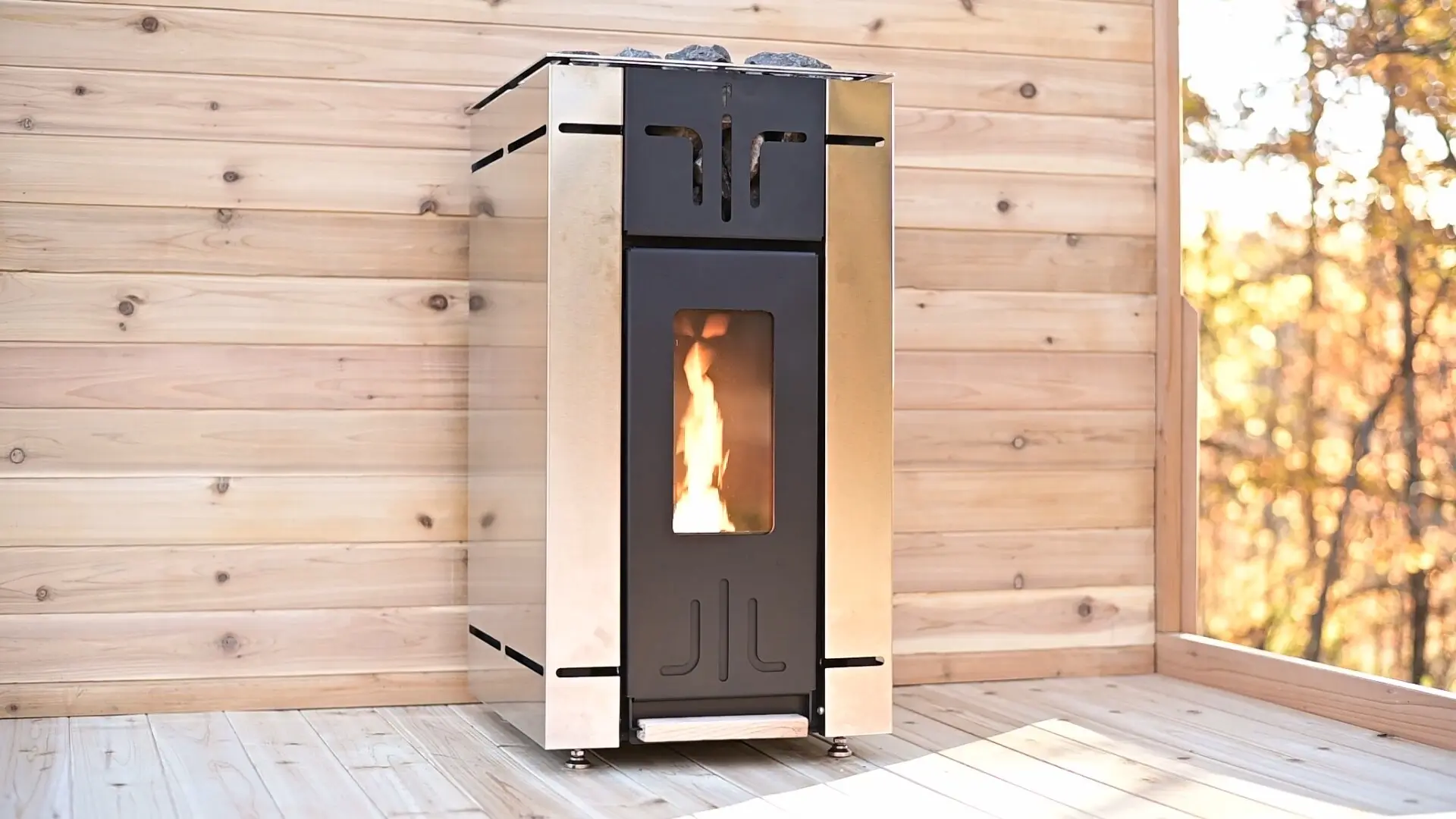
The Pellet Sauna Company, started by two friends who went to high school together in Minnesota, is taking reservations for a wood-burning sauna stove you start from a phone. The P1 burns wood pellets, meters them to hold the temperature you set and plugs into a standard 110-volt outlet. It costs $3,495 for the first 100 stoves and $3,995 after that. Production is due to begin in Fergus Falls, Minnesota, in June 2027, and certification is in progress.
“I loved the convenience of electric, but I was in love with the experience of a wood stove,” co-founder Chris Bigelow told SaunaNews in written answers on November 24. He was a renter, and wiring an electric heater meant hiring an electrician. Pellet grills gave him the idea: “remote start and precise temperature control.”
He wasn’t the only one to think of it. “It would be like a Traeger grill but for a sauna,” one poster wrote on Reddit’s r/Sauna in January 2022, after shopping around and finding nothing built for one.
Key facts
- Stove P1, installed through the sauna wall; listed at 16.6 by 14.2 by 26.8 inches; holds 110 lb of stones
- Room 210 to 500 cubic feet, up to 220°F
- Heat-up about 40 minutes from 63°F to 176°F in a 300-cubic-foot sauna, the company says
- Fuel 60 lb hopper, 12 to 15 hours a fill, about 10 lb a session
- Electricity 110-volt outlet, or a portable power station with a solar panel
- Price $3,495 for the first 100, then $3,995; $100 refundable deposit; shipping $99 in the contiguous US
- Warranty 20 years on the steel body, one year on electrical parts
- Certification in progress, to ASTM E1509 with OMNI-Test Laboratories
- Sold in the US and Canada, with production due in June 2027
Bigelow spent six years as a software engineer at Google and builds the P1’s app and controls. Jared Kugler, his co-founder, came from Polaris, the Minnesota maker of snowmobiles and off-road vehicles, and leads the mechanical design. Kugler’s sauna habit took hold over three years in Germany, at evening Aufguss ceremonies in thermal baths. With the P1 “there’s no need to add wood, which makes the experience more relaxing,” he said.

The wall splits the stove in two
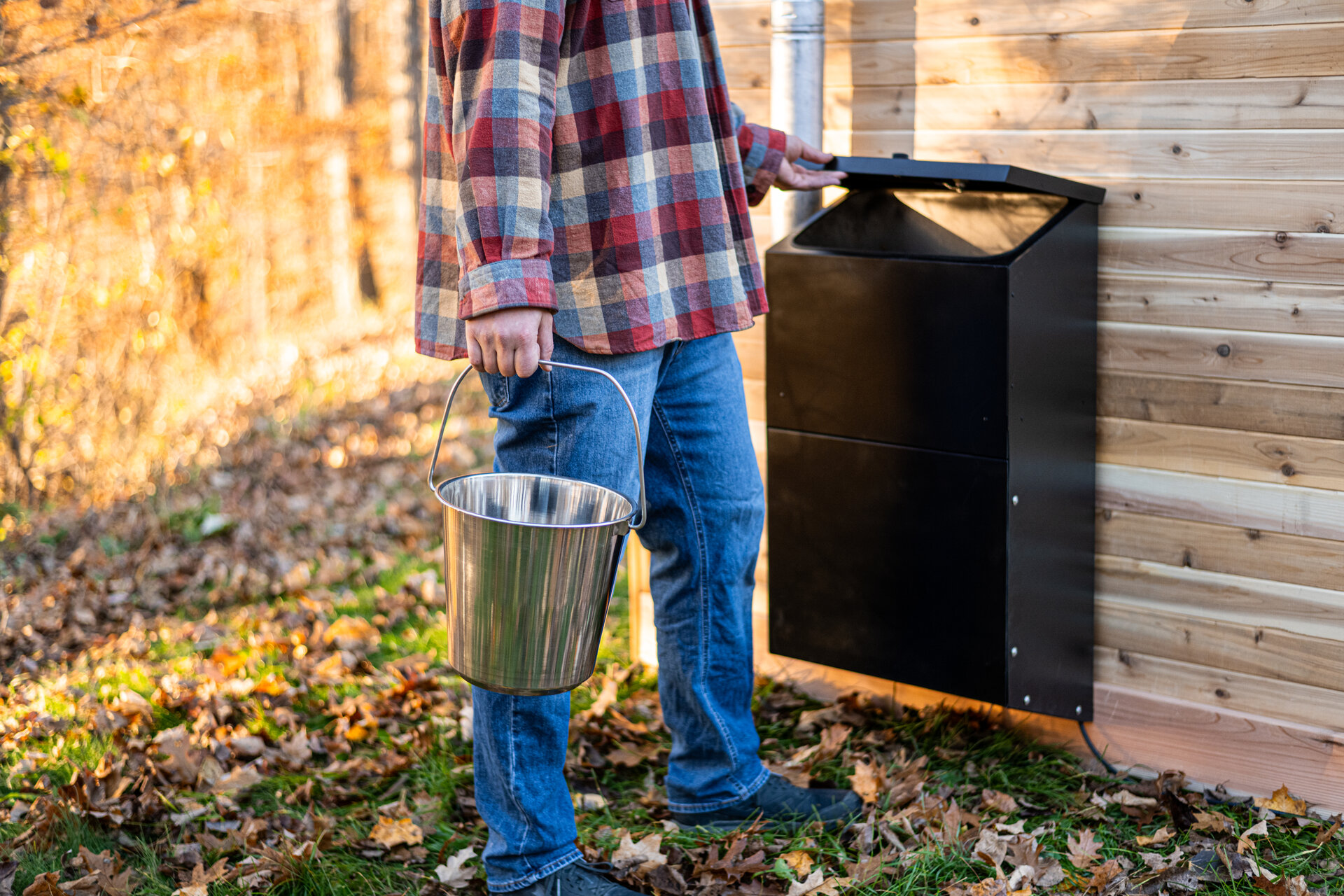
The firebox and stones sit in the hot room. The hopper and the electronics hang on the outside of the same wall, so pellets go in from outdoors and the dust stays there. The P1 product page gives a wall thickness of 1.5 to 6.5 inches.
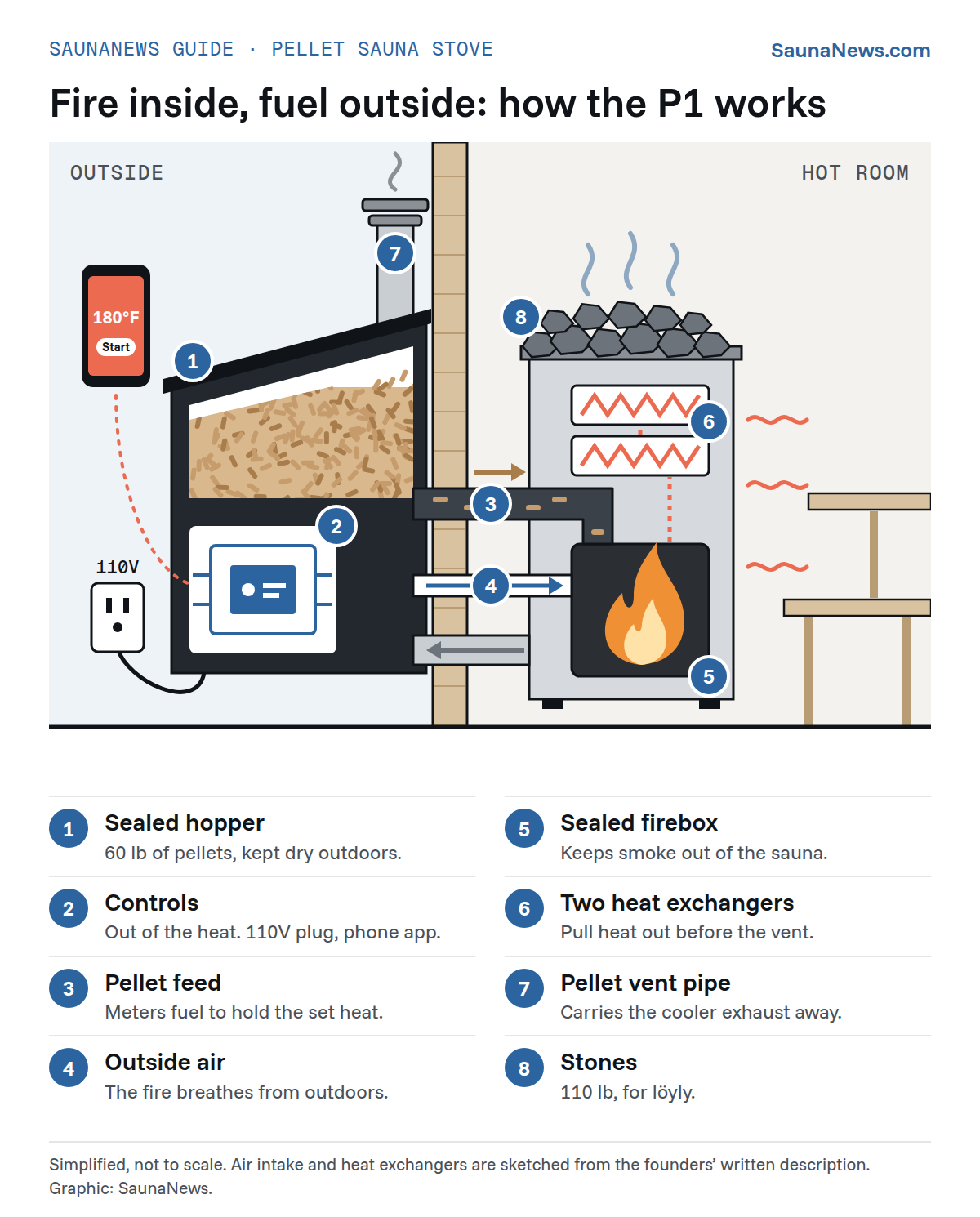
Heat is the reason for the split. The biggest difference from a home pellet stove, Kugler said, is that “a sauna stove lives in a room that gets above 200°F, which most electronics don’t handle well.” Moving the electronics outside “was the best solution for longevity, and it also moved the mess of the pellets outside.”
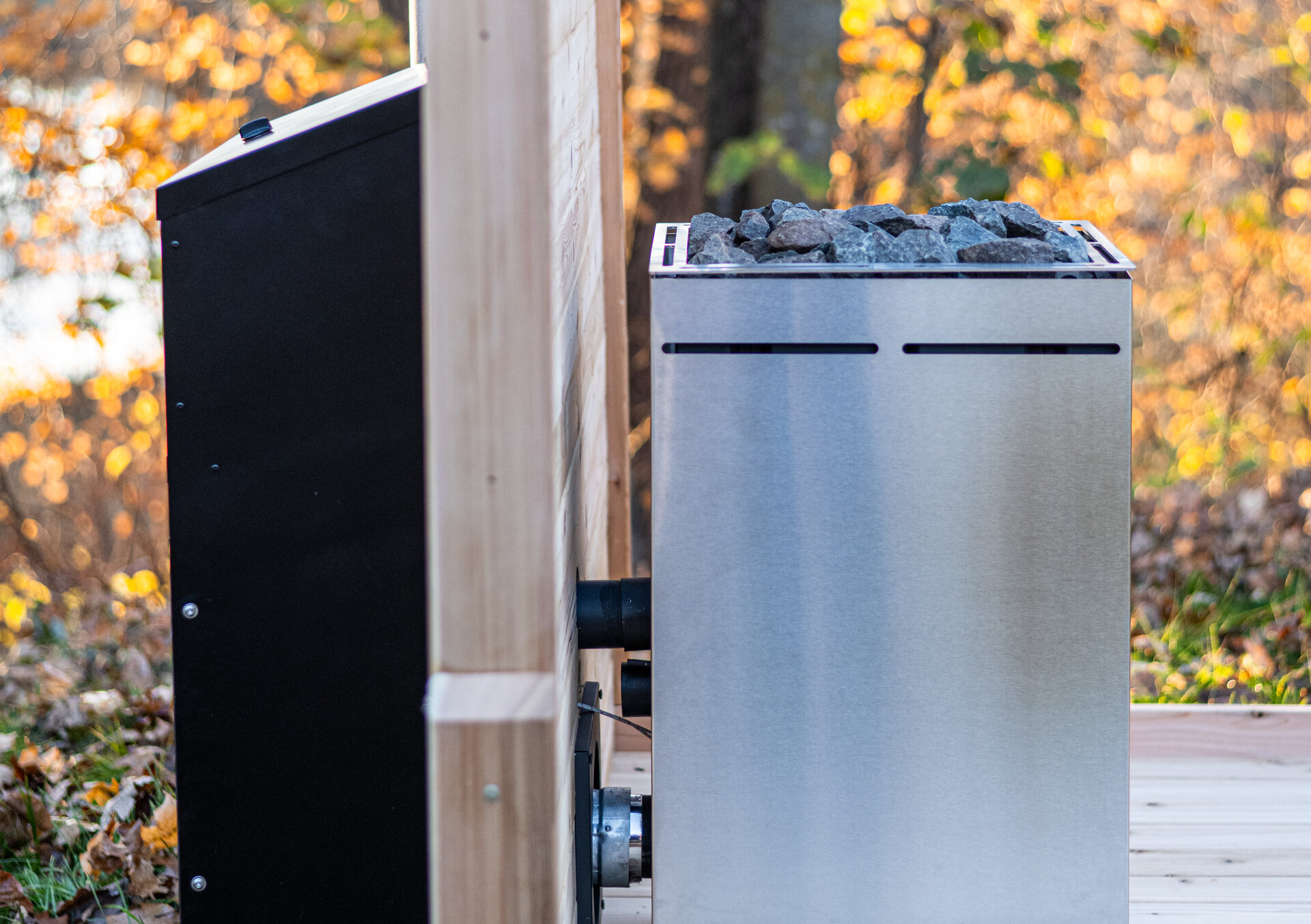
Outdoors, the enemy is rain. To get pellets through a Minnesota winter, Kugler said, they had to seal the hopper completely, with silicone at every steel-to-steel joint and an automotive seal in the lid.
Two heat exchangers to cool the exhaust
Pellet stoves need low exhaust temperatures to pass certification, Kugler said, and in a body this small that took two heat exchangers. “That design keeps the heat in the sauna instead of sending it up the flue, which is why the P1 heats up so quickly,” he said.
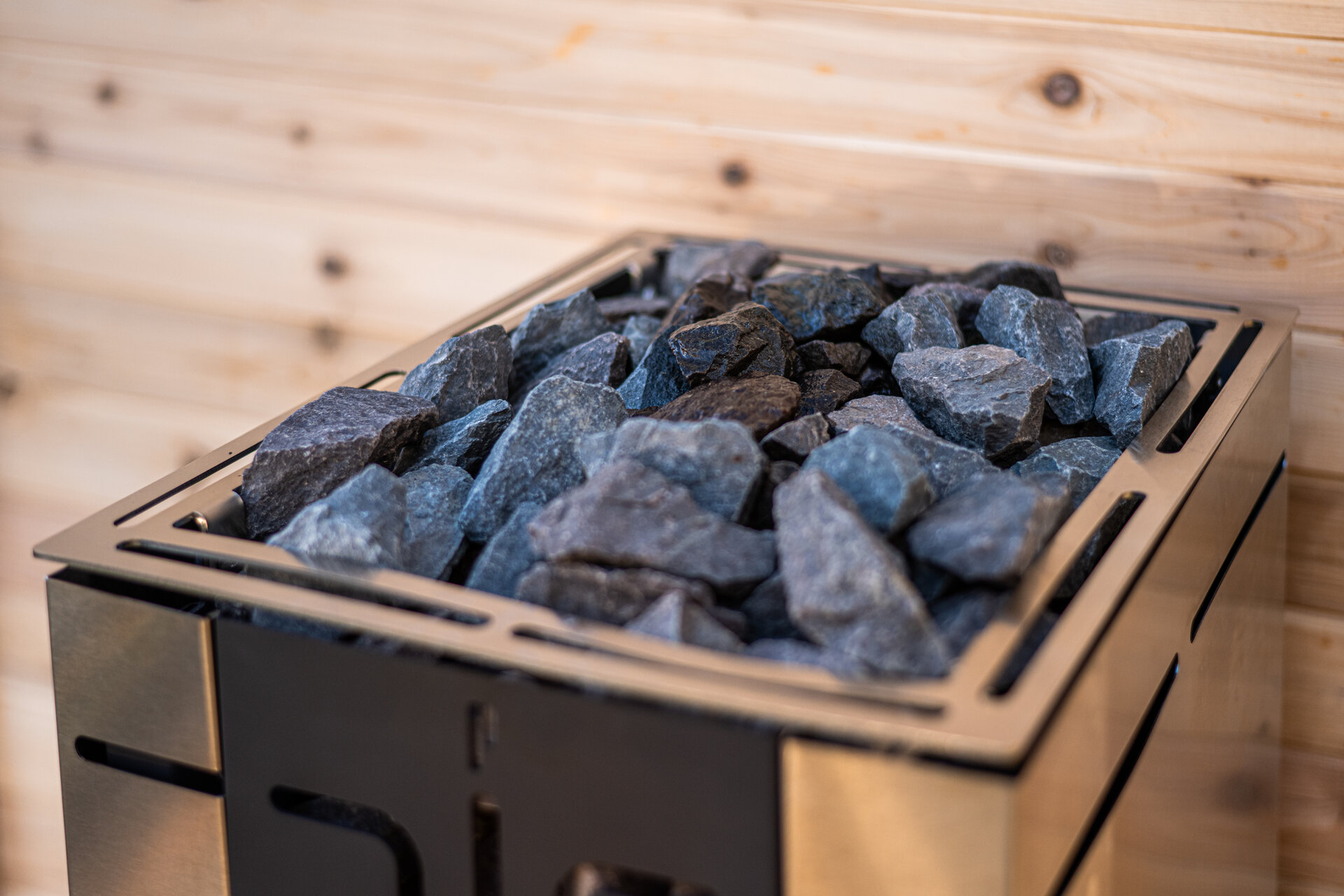
The stones, 110 pounds of them, sit on top. Kugler calls a session “very similar to a log-fired session,” with rocks hot enough for “smooth löyly,” the steam off the stones.
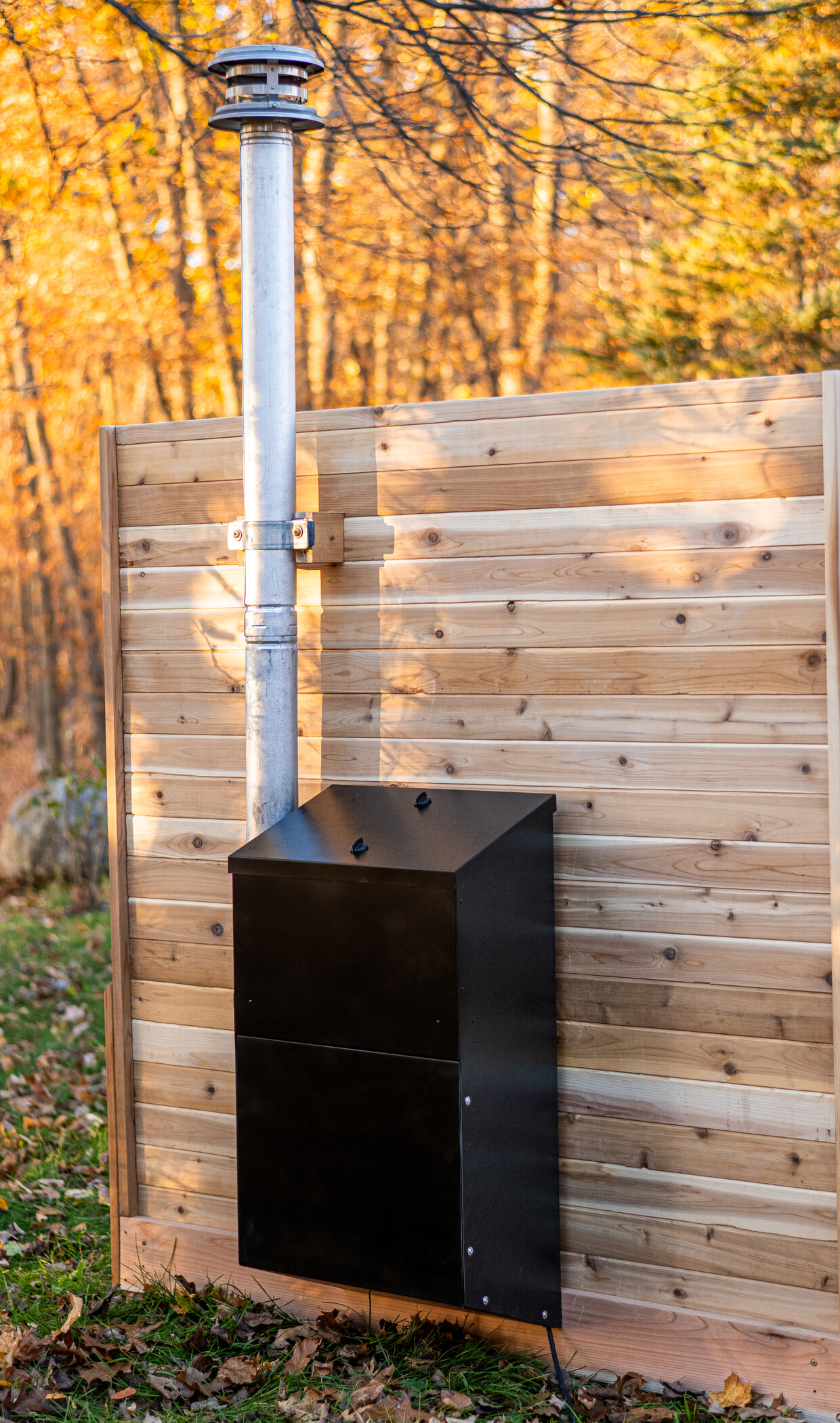
The cooler exhaust also changes the chimney. The P1 uses standard pellet vent pipe. One common brand, Duravent’s PelletVent Pro, is rated for flue gas up to 570°F and needs an inch of clearance to combustibles. In the company’s photos the pipe leaves through the wall and runs up the outside.
A fire with its own air changes the room’s vents
Kugler said the stove body is completely sealed and draws combustion air from outside, “so smoke never enters the sauna.” Vacuum and temperature sensors monitor it constantly, Bigelow said.
That matters to whoever builds the room. A log stove fed from inside the sauna pulls air out of it: “the stove itself acts as an exhaust,” as HUUM’s ventilation guide puts it. A stove sealed the way Kugler describes wouldn’t, so by HUUM’s logic a P1 room needs its own exhaust vent, like an electric sauna’s. For natural ventilation, HUUM puts that vent on the wall across from the stove, within about 24 inches of the floor. The P1’s own guide says the room “needs its own ventilation plan.”
Rooms with a fan are the interesting case. HUUM warns that mechanical ventilation and a wood heater can, if badly installed, lower the air pressure and produce dangerous carbon monoxide. A stove that doesn’t share the room’s air would change that sum. Ask whether the P1’s listing allows a fan before designing around one.
A session burns about a quarter of a bag
A typical session uses about 10 pounds of pellets, Kugler said, though sauna size, insulation and outdoor temperature move it a lot. At that rate a full hopper is six sessions. A ton, or 50 forty-pound bags, is 200.
The company estimates about $1.50 a session, which is a $6 bag. Every dollar on the bag moves a session by 25 cents. Pellet makers’ own US sales averaged $246.98 a ton in August, or about $4.94 for 40 pounds, the Energy Information Administration says. Stores charge more: a dealer in Bristol, Connecticut, lists most brands at $440 to $505 a ton, about $9 to $10 a bag.
Electricity comes out about even. SaunaNews put an 8-kilowatt-hour electric session at about $1.46 at this year’s average US rate. With a $6 bag, and a nickel of power for the stove itself, pellets are cheaper in 14 states and Washington, DC, from Pennsylvania, by 13 cents, to Hawaii, by $2.09. Power is cheaper in the rest, Minnesota included. At $8 a bag the 14 states become nine. The company’s own comparison has electric at $1.90 and a log fire at $3.20 for an hour and 45 minutes.
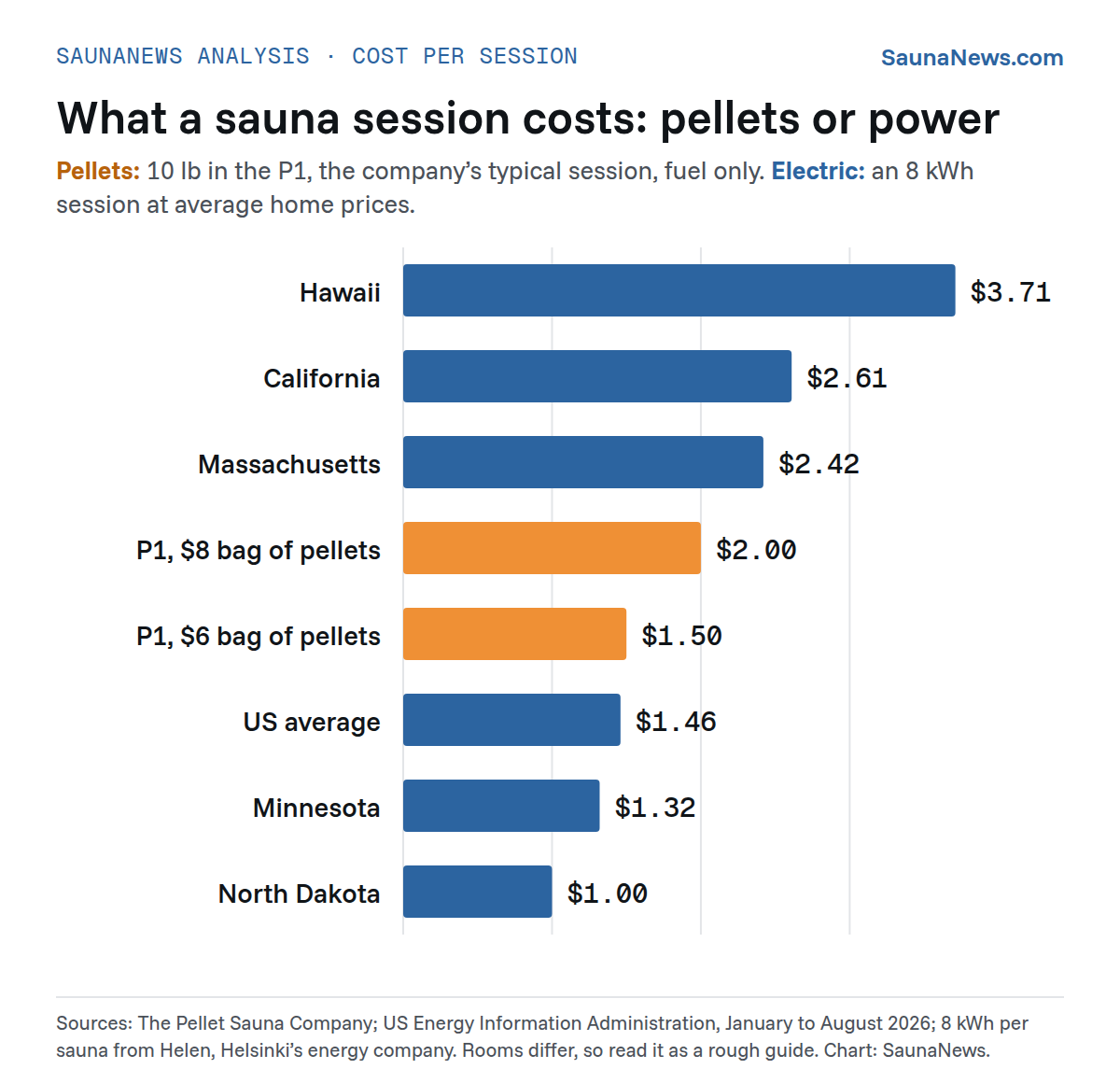
Pellets are the cheaper heat. The stove uses more of it. American heating pellets averaged 8,171 to 8,462 Btu a pound in August, depending on the region, by EIA’s count, so 10 pounds holds the heat in about 24 kilowatt-hours. At $6 a bag that costs about 6 cents a kilowatt-hour, a third of the average electric rate. The two sessions don’t come from the same room, so treat this as a rough guide.
There isn’t much to sweep up. The same pellets averaged 0.3% to 0.7% ash, so 10 pounds carries about half an ounce to an ounce.
Heat output isn’t published yet. The company’s 12 to 15 hours a hopper works out to 4 to 5 pounds an hour. EPA-certified home pellet stoves usually run at 70% to 83% efficiency. If the P1 matched that in a hot room, it would average about 7 to 10 kilowatts by our arithmetic, in the range of a home electric heater.
It needs a plug, or a power station
Pellets make the heat, but the P1 won’t run without electricity. If the power cuts out, the stove shuts off. “For safety, it won’t restart on its own when power returns; you resume the session from the app,” Bigelow said.
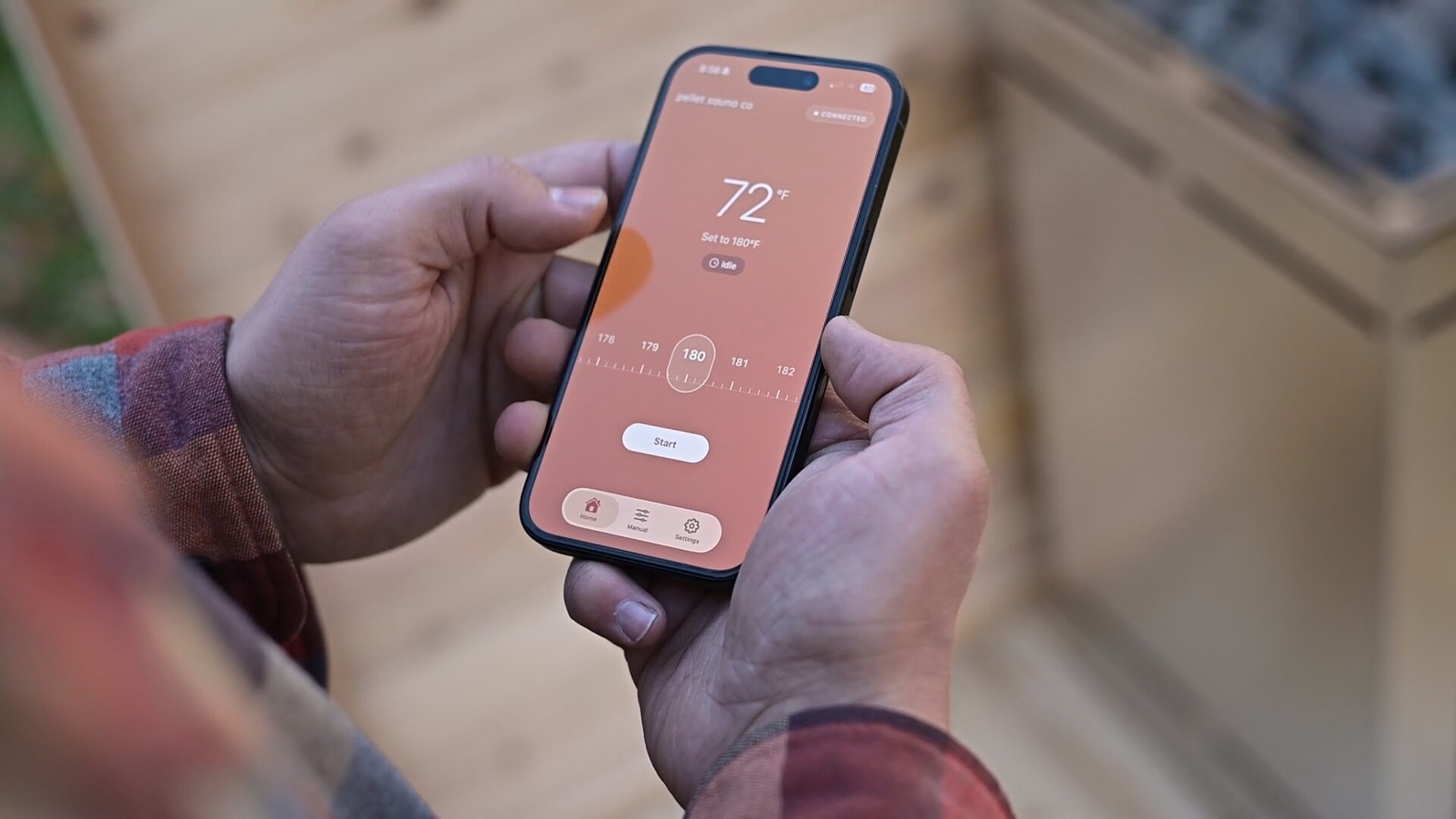
A 110-volt outlet or a battery reaches places a 240-volt heater circuit doesn’t: a dock, a rented yard, a cabin on a small electrical service. The outlet still has to be up to it. “A plug that fits is not enough to establish that the supply is suitable,” the company’s installation guide says.
The P1’s wattage isn’t out yet. The closest published figure comes from Japan, where sauna brand SAUNEA rates its own pellet sauna stove, ALKU, at 450 watts while it lights and 80 watts while it runs. If lighting takes 10 minutes and the stove then runs two and a half hours, that’s about 275 watt-hours. A one-kilowatt-hour power station would cover three sessions, before losses, and the electricity costs about a nickel. SAUNEA ran ALKU on a floating sauna on Lake Suwa in the summer of 2024.
How it compares
Japan’s ALKU works much the same way. SAUNEA developed it with Shimotani, a pellet stove maker in Gifu. It lights at the press of a button, feeds itself from a tank that holds about 44 pounds of pellets and keeps the temperature you set, for 14 to 20 hours on a full tank. SAUNEA sells it in Japan by quote, from 1.2 million yen before tax, about $7,500, with the chimney, controller and tank. ALKU starts from a button; the P1, from a phone.
Simpler pellet stoves leave out the electronics. Overland Sauna’s Basecamp, a $1,259 stove for sauna tents built in Oregon, and Estonia’s PELLUM P47, 1,390 euros (about $1,520), feed pellets by gravity and need no power. PELLUM’s manual has you light the pellets with fire-starter cubes or gel and set the heat with an air damper. A full hopper lasts about 1.5 hours in the Basecamp and up to 4.5 in the PELLUM, which Canada’s Leisurecraft lists with the price on request.
Japan’s public saunas show what the powered kind is for. YUBUNE SAUNA PARK Hanyu no Yu, beside a mall in Hanyu, north of Tokyo, wanted a log stove but not the daily refueling and fire watch, its manager told the trade site Spaworks. It put in ALKU. A few hundred yen of pellets (about $2 to $5), loaded once at the start, burns for seven hours, the manager said, and staff set the heat with one button. A room at JIN6 SAUNA in Karatsu, built with bricks from pottery kilns, runs on one too, SAUNEA says. JIN6 placed third in SAUNACHELIN 2026, Japan’s sauna ranking.
The listing it’s after is for room heaters
The P1 is being certified to ASTM E1509 with OMNI-Test Laboratories, “so it can be sold in the US and Canada,” Kugler said. E1509 covers automatic-feed pellet room heaters. Its tests include rain, an impact on the glass and a water shock to the glass, which any bather with a ladle can appreciate.
The listing gives an inspector a page to turn to. The residential code, as Colorado’s 2021 edition prints it, says vented room heaters must be tested to ASTM E1509 for pellet burning, in the same section that sends log stoves to UL 1482. It also wants a noncombustible floor or a listed floor protector underneath, unless the stove’s listing allows a combustible floor.
The code’s sauna heater section reads differently. It cites UL 875, the electric heater standard, and a thermostat that stops the room at 194°F. The P1 is advertised to 220°F. Ask which section your inspector will use, since wood-fired saunas already sit in a gap in the US codes.
Europe has a gap of its own. Its new sauna stove standard covers stoves that burn logs, and PELLUM’s manual says there are “no CE requirements for pellet-fueled sauna stoves.”
On smoke, EPA’s residential wood heater rule covers stoves “intended for residential space heating,” and the agency has found wood-burning sauna stoves outside it, in a 2018 answer to Harvia and a 2019 answer to Lamppa. Its pellet stove definition uses the same words, and SaunaNews found no ruling on one built for a sauna. Local burn bans can still apply: around Seattle, a Stage 2 ban stops pellet stoves too.
The team has “put thousands of hours into prototyping,” Kugler said, and testing has focused on rapid heat-ups, “which are the hardest thing on a stove.” He said the P1 has proven very durable.
Get the manual before you cut the wall
The seller is Praxion Engineering LLC, a Colorado company doing business as The Pellet Sauna Company. Its terms of sale make the $100 deposit refundable until the $3,395 balance is charged, with at least 14 days’ notice by email and the full written warranty in hand. June 2027 is “our current estimate, not a guarantee.” A buyer can cancel for a full refund any time before the stove ships, or return it within 30 days of delivery and pay the freight back. Permits and inspections are the buyer’s job.
Certification should settle most of what isn’t published yet. Until then, ask for these in writing:
- The lab numbers: heat output at high and low fire, efficiency and emissions.
- Clearances: to walls, benches and ceiling, plus the floor protection and the hopper’s size.
- The vent: pipe diameter, and how far it has to rise.
- The plug: watts while lighting and running, whether there’s a fan, and how loud it is.
- The phone: what works without Wi-Fi, and what besides the owner checks that the heater area is clear before a remote start. The door-switch and cover rules for electric heaters don’t reach a pellet stove.
- The use: whether the warranty covers rentals, mobile saunas and other businesses. The site describes the P1 as a stove for residential saunas.
- In Canada: which ULC standard the listing covers.
The company’s installation guide gives the same advice: confirm the final instructions before making structural changes or ordering vent parts.