Which Sauna Brands Are Most Exposed to US Tariff Increases?

By Arlene Scott
Correspondent, Research and Industry
- Published
- Reading time
- 6 min
SaunaNews is published by SaunaShare, Inc., which also runs SaunaShare.com and SaunaMarketplace.com, where we sell many of the products we write about. That experience may change what we write about and what we don't. Who owns SaunaNews
Chinese-made sauna kits carry higher US tariffs than European imports, so where a brand manufactures sets its exposure.

In this story4 sections
The current US trade environment puts sauna brands in two tariff tiers: Chinese imports, where sauna rooms and heaters carry a 25% Section 301 duty on top of a 10% Section 122 surcharge, and European goods, which pay the 10% surcharge alone. Where a brand actually manufactures its products, not where it’s headquartered, determines its exposure.
Highest exposure: Chinese manufacturing
Sauna360 / TyloHelo (Sweden/Finland): The parent company of Tylö, Helo, Finnleo and Amerec has the most China exposure of the brands listed here. US customs import records show Sauna360 Inc. receives the vast majority of its prefabricated sauna kit shipments from two Chinese manufacturers, Wuxi Sfactor Co. and Changzhou Sfactor Co., both based in Jiangsu province. Custom-built units are produced at the company’s Cokato, Minnesota plant, and its heaters come from Finland and Sweden. Masco agreed to acquire Sauna360 in July 2023 and completed the deal in the third quarter of 2023.
High exposure: Finnish and Estonian manufacturers (10% tariff)
Harvia (Finland): The world’s largest sauna equipment company manufactures across Finland, Estonia, and Germany. Its heaters, sold through a wide US dealer network, face the full 10% Section 122 surcharge. However, Harvia’s 2024 acquisition of ThermaSol (Texas-based) and its Almost Heaven factory in Lewisburg, West Virginia give it a domestic manufacturing foothold for steam and barrel-sauna products. CEO Matias Järnefelt told analysts on the Q3 2025 earnings call that the tariff regime is lifting costs, but that Harvia is being measured on pass-through: “Tariffs also apply higher cost of goods sold due to tariffs and currency exchange rates. It’s also a little bit of a balancing act, what’s the right strategy and right pace?” He also disclosed on the Q3 call that Harvia is “assessing what potentially could be the right time for us to have a sauna cabin factory” in North America, a move that would further insulate the Group from European-origin tariffs.
HUUM (Estonia): All HIVE and DROP heaters are manufactured in Estonia. HUUM has no US production. Tariff exposure is total on the heater side.
Thermory (Estonia): The world’s largest thermowood producer ships from Estonian and Finnish factories. Thermally modified wood is a key material for outdoor sauna construction. Thermory does maintain US warehouse operations, but the product still enters the country as an import.
Moderate exposure: European brands with US distribution
KLAFS (Germany, owned by Kohler): German manufacturing, facing the 10% Section 122 surcharge. Kohler’s US distribution network and supply chain scale give KLAFS more flexibility than standalone European brands to absorb or route around tariff costs.
Lower exposure: North American manufacturers
Homecraft (Canada): Manufactured in Surrey, BC since 1988. Canadian products face their own tariff considerations (Section 232 on certain materials), but are not subject to the China-origin duties described above.
Dundalk Leisurecraft (Canada): Cedar saunas manufactured in Ontario. Similar Canadian tariff dynamics apply.
For buyers, where a sauna is made sets the duty
If you’re buying a sauna or heater in the US right now, manufacturing origin matters more than brand origin. The Supreme Court struck down IEEPA tariffs in February 2026, but a 10% replacement surcharge remains through at least July 2026. A sauna kit made in China carries higher US duties than the same kit made in Finland: a 25% Section 301 duty on top of the 10% surcharge both pay, per USTR and CBP. The price difference on a $5,000 sauna is significant and will either be absorbed by the distributor, passed to the consumer, or both. Canadian-made alternatives from Homecraft and Dundalk Leisurecraft, and custom-built Sauna360 units from Cokato, MN, avoid both tariff tiers entirely.
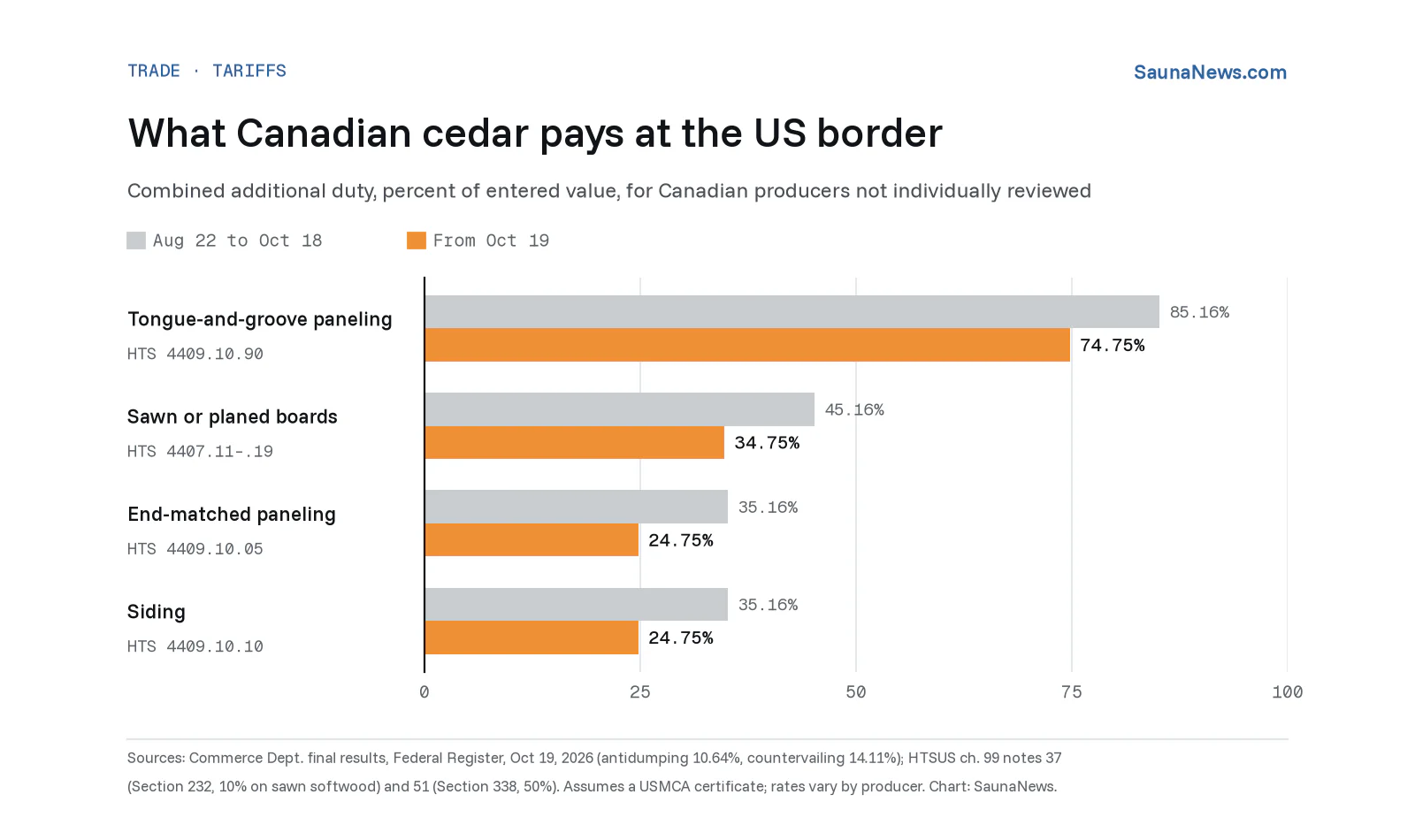
Update, August 23, 2026: the Canadian position described above changed. New Section 338 duties effective August 22 put an additional 50% on a list of Canadian goods that includes shaped cedar, plywood, MDF, wooden doors and wooden seat parts, though not on 9406.10, the classification for a complete prefabricated wooden sauna. See our line-by-line read of what the 50% list does and does not cover for Canadian saunas.
Harvia events
1 event